
On this page
Start here
Quick answer
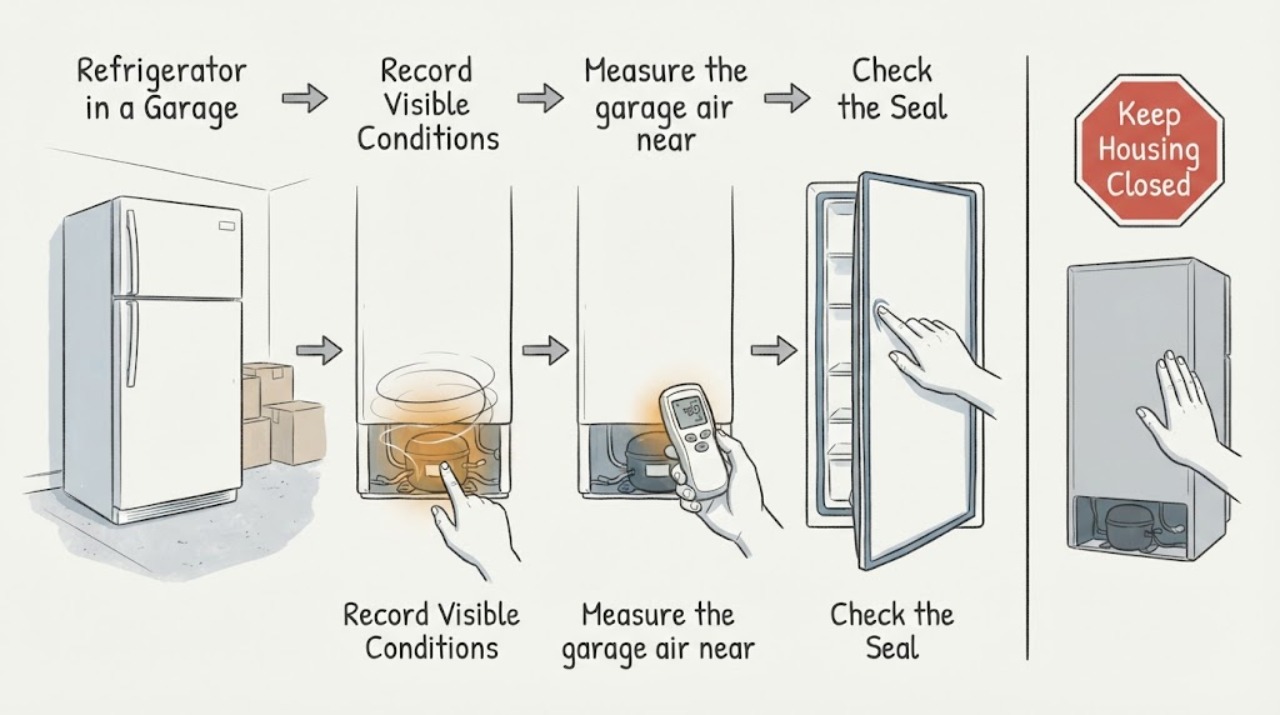
Do not treat a GE GTS21FGKBWWW refrigerator's warm food, long run time, or a warm cabinet as proof that the compressor has failed, and do not open the sealed system or handle refrigerant. First photograph the rating plate because the extra W in GTS21FGKBWWW does not match the opened GE Owner Center page for the closely named GTS21FGKWW; the exact suffix, country, and manual must be confirmed. From a safe position, record separate refrigerator and freezer food or thermometer temperatures, the garage temperature, door and gasket closure, blocked vents, frost pattern, and the sound and timing of the unit. GE says compressors are designed to run much of the time, while its garage-ready guidance treats ambient temperature, controls, frost, and door sealing as checks before service. If food is warming, the garage is outside the model's permitted range, the compressor only clicks or hums without cooling, protection trips, there is a burning odor, or the cabinet is abnormally hot, keep people clear and arrange qualified refrigerator service. A repair-versus-replace decision needs a model-matched diagnosis; this evidence does not justify a cost, life, or purchase recommendation.
Before you begin
Safety first
- User checks stop at rating-plate identification, temperature and environment recording, visible door/airflow/frost observations, and listening from outside. Do not open the cabinet, touch the compressor, capacitor, wiring, fan, refrigerant tubing, or sealed system; do not add or recover refrigerant; do not bypass controls or perform a live electrical test.
Work through in order
Diagnostic checks
Use only checks that match the exact appliance or system and its official guide.
-
Check 1
From outside the refrigerator, record separate freezer and fresh-food temperatures with a thermometer if available, the temperature of representative food, the garage air temperature, and how long the symptom has been present. Keep the doors closed as much as practical. If food is warming, move temperature-sensitive food to a known-safe appliance or follow applicable food-safety guidance rather than relying on the display or a hand on the cabinet.
Expected result: Both compartments are within their normal operating range; the freezer is cold but the fresh-food section is warm; both sections are warm; or temperatures continue to rise.
Next step: Preserve the temperature record and continue only with safe external checks. For rising food temperatures, protect the food and arrange qualified service if the basic setting, door, frost, and environment checks do not explain it.
Stop if: Do not remove panels, touch refrigerant tubing, or open the sealed system to confirm a diagnosis.
Why this matters
Why: Normal food temperatures make a compressor failure less likely even if runtime is long. A cold freezer with a warm fresh-food section points toward airflow, door, or temperature-distribution checks. Warming in both sections is a real no-cool symptom, but it still does not identify the compressor or sealed system.
-
Check 2
Measure the garage air near the refrigerator and compare it with the exact model's installation guidance. Do not assume that a garage installation is approved for the extra-W suffix. Check from a safe position that the refrigerator is not pressed against stored items and that the required side, top, and rear clearance is available; do not move the appliance while it is connected.
Expected result: The garage is unusually cold or hot, the unit lacks the model's required clearance, the model is confirmed garage-ready within its stated range, or garage suitability remains unknown.
Next step: Bring the environment within the exact manual's permitted range or arrange a suitable location only if that can be done safely. If temperatures or clearance are outside the verified requirements, correct the environment before judging the compressor; if the model remains unresolved, use GE support or qualified service.
Stop if: Do not operate the refrigerator in an extreme garage temperature or block its air path while trying to force a cooling test.
Why this matters
Why: GE's opened garage-ready guidance says ambient temperature affects cooling, with no cooling capability below 32°F and compressor or sealed-system damage possible above 110°F; its general guidance also says installation-area limits and clearances vary by style and model. These limits cannot be assigned to an unverified suffix.
-
Check 3
With the refrigerator operating normally and viewed from outside, check that both doors close fully, no package holds a door open, the gaskets contact the cabinet, and food or containers do not block the freezer or fresh-food air vents. Look through the freezer for an abnormal wall of frost; do not remove interior panels or scrape frost with a tool.
Expected result: A door does not seal, a gasket is loose or damaged, an air vent is blocked, or frost covers a substantial area; or doors, airflow, and visible frost appear normal.
Next step: Correct only an obvious external loading or door-closure issue using the exact manual. If frost is substantial, follow the exact model's defrost instructions or arrange service; do not infer a failed compressor from frost alone.
Stop if: Do not chip, heat, puncture, or dismantle the evaporator area, and do not handle refrigerant tubing.
Why this matters
Why: GE identifies door closure, gaskets, blocked air paths, and frost as causes of poor cooling or long runtime. A frost or airflow problem can mimic a sealed-system failure, while normal external observations only mean that further diagnosis is needed.
-
Check 4
From a safe position, note the sound pattern and timing without touching the compressor, fan, wiring, or tubing: a steady operating hum, ordinary cycling, repeated clicks followed by silence, an unusual buzz, or no operating sound while the compartments warm. Record whether cooling changes after a door opening, a recent food load, or a garage-temperature change.
Expected result: The unit runs steadily and temperatures recover; it cycles normally but is warm; it repeatedly clicks or hums without cooling; or there is no sound and no cooling.
Next step: Keep a short symptom record for service. Stop use for smoke, burning odor, a hot or damaged cord, sparking, repeated protection trips, or an abnormally hot cabinet; otherwise do not extend the test or open the cabinet, and arrange qualified service when cooling remains inadequate.
Stop if: Do not touch the compressor, capacitor, electrical terminals, refrigerant lines, or any component behind a cover.
Why this matters
Why: A steady hum can be normal and does not establish compressor failure. Repeated start attempts, silence with warming, or a new abnormal sound make a qualified electrical/refrigeration diagnosis more important, but an observation alone cannot distinguish compressor, start device, control, fan, airflow, or sealed-system causes.
-
Check 5
Photograph the complete rating plate, including every suffix, serial number, and country or market information, and gather the temperature log, garage temperature, door/frost/airflow observations, sound pattern, and installation history. Use the exact GE support page or manual for that identity before discussing repair or replacement.
Expected result: GE confirms the exact model and garage suitability; the page resolves to a different suffix such as GTS21FGKWW or GTS21FGKBB; or no matching support document is found.
Next step: Request qualified GE or refrigeration service with the full identity and observations. Ask for a diagnosis that separates environment, settings, airflow, frost, fan, electrical start/control, and sealed-system conditions before deciding whether repair or replacement is appropriate. Do not use a generic compressor part or sealed-system procedure.
Stop if: Do not open the sealed system, recover or add refrigerant, bypass controls, or choose repair versus replacement from the model name and symptom alone.
Why this matters
Why: The extra-W mismatch changes which controls, clearances, parts, and garage instructions are applicable. A correct model match allows a technician to diagnose cooling and sealed-system conditions; it does not make a compressor failure certain.
Use your observations
Decision map
Find the observation that best matches what you see, then follow the next safe action.
-
PATH 01Next step
What you see
Both compartments are at or near normal temperature and the main change is long runtime, especially after a warm food load or during hot garage weather.
Do this next
Continue monitoring actual food temperatures and check door sealing, airflow, frost, and the verified garage range. Do not label the compressor failed from runtime alone.
Why this path and its safety boundary
Why it matters: Long runtime can be normal operation or an environmental/load response; GE states that compressors may run 80% to 90% of the time.
-
PATH 02Next step
What you see
The garage is outside the exact model's permitted range, clearance is obstructed, a door or gasket does not seal, vents are blocked, or frost is substantial.
Do this next
Correct only safe external loading, clearance, or door issues using the exact manual; address abnormal frost through the exact model guidance or service. Reassess actual temperatures without opening the cabinet.
Why this path and its safety boundary
Why it matters: Environment, door-air leakage, airflow, or frost can explain poor cooling or long runtime before a compressor diagnosis is justified.
-
PATH 03Next step
What you see
The freezer and fresh-food compartments are both warming after settings, door, airflow, frost, and verified environmental checks are normal, or the unit repeatedly clicks/hums without recovering.
Do this next
Protect the food and arrange qualified GE or refrigeration service. Keep the appliance accessible and provide the temperature and sound log; do not touch refrigerant or compressor components.
Why this path and its safety boundary
Why it matters: A cooling-system, fan, electrical start/control, or sealed-system fault is possible, but the symptom does not select the compressor.
-
PATH 04Next step
What you see
There is smoke, a burning odor, sparking, a hot or damaged cord, repeated electrical protection trips, an abnormally hot cabinet, or water or oil-like residue near a sealed-system component.
Do this next
Stop using the refrigerator and isolate power only from a safe dry location if needed. Keep clear and obtain qualified electrical or refrigeration help; do not touch the compressor, refrigerant lines, or residue.
Why this path and its safety boundary
Why it matters: This is an electrical, fire, heat, or refrigeration safety boundary rather than a repair-versus-replace experiment.
-
PATH 05Next step
What you see
The rating plate confirms a suffix or market different from GTS21FGKBWWW, or GE support cannot match the extra-W identity.
Do this next
Hold the appliance diagnosis at symptom level and obtain the exact GE manual or qualified service identification. Do not order a compressor, start device, control, or sealed-system part from the near-match model.
Why this path and its safety boundary
Why it matters: The model-specific evidence is incomplete; a related GTS21F page cannot establish garage readiness, controls, clearances, or parts for the assigned identity.
Helpful context
Understand the symptom
A compressor label is not a diagnosis
A refrigerator may run for long periods after warm food is loaded, in hot weather, with frequent door opening, with a damaged gasket, or with blocked airflow. GE says many compressors are designed to run 80% to 90% of the time. Conversely, food temperatures that keep rising, repeated clicking without a cooling response, a protection trip, or a strong electrical/burning odor need service. The first decision is therefore whether the unit is actually failing to hold temperature and whether the garage environment is allowed, not whether a compressor can be heard.
The extra-W model suffix must be verified
The live GE Owner Center pages opened for this research show closely named GTS21FGKWW and GTS21FGKBB top-freezer models. They do not establish that the assigned GTS21FGKBWWW suffix is a valid complete model, garage-ready, or covered by the same manual. Photograph the rating plate and use GE's model-specific support before applying a temperature control position, clearance requirement, parts list, or service procedure. Do not infer a compressor or sealed-system fault from a suffix mismatch.
When checks do not resolve it
Need a professional?
Use qualified GE or refrigeration service for confirmed no-cooling, repeated start attempts, hidden frost or airflow faults, a model-specific garage mismatch, or any diagnosis involving the compressor, start device, control, fan circuit, refrigerant, or sealed system. Use electrical help for smoke, sparking, a hot/damaged cord, or repeated protection trips.
Safety scope: User checks stop at rating-plate identification, temperature and environment recording, visible door/airflow/frost observations, and listening from outside. Do not open the cabinet, touch the compressor, capacitor, wiring, fan, refrigerant tubing, or sealed system; do not add or recover refrigerant; do not bypass controls or perform a live electrical test.
Have this ready
- Provide the full rating-plate model and serial, country/market, temperature readings for both compartments and food, garage temperature, time since installation or move, door/gasket/airflow/frost observations, sound pattern and timing, control settings, and any odor, heat, trip, or visible residue.
Common questions
FAQ
Does a GE refrigerator running almost constantly mean the compressor is failing?
No. GE says compressors may be designed to run 80% to 90% of the time, and long runtime can follow hot weather, warm food, door openings, damaged gaskets, blocked airflow, or frost. Check actual food temperatures and the verified garage conditions before calling it a compressor failure.
Can I assume GTS21FGKBWWW is garage-ready because it resembles GTS21FGKWW?
No. The opened GE page is for GTS21FGKWW and does not establish the extra-W suffix. Photograph the rating plate and obtain the exact manual or GE support confirmation before applying garage-temperature, control, clearance, or parts information.
What does a cold freezer but warm refrigerator section suggest?
It makes airflow or temperature distribution, a blocked vent, door sealing, or frost worth checking before assuming a compressor fault. The pattern is not a part diagnosis; record temperatures and arrange service if the fresh-food section stays warm.
Should I replace the refrigerator instead of repairing the compressor?
The supplied symptom and the near-match model evidence cannot answer that safely. First obtain the complete model identity and a diagnosis separating environment, airflow, electrical start/control, fan, and sealed-system causes. Do not use a fixed age, cost, or lifespan rule or order a compressor based on sound or temperature alone.
Read the exact guide
Official sources
- Refrigerator or Freezer - Normal Run TimeGE Appliances · Opened GE support guidance for normal refrigerator runtime. It supports the distinction between long runtime and proven compressor failure, without identifying the assigned model's component condition.
- Troubleshooting for GTS21FGKBBGE Appliances · The opened GE page identifies GTS21FGKBB as a related 20.8 cu. ft. top-freezer model and links model-specific troubleshooting. It is not evidence for the assigned GTS21FGKBWWW suffix, parts, controls, or garage rating.
- User Manual & Care for GTS21FGKWWGE Appliances · The opened GE page identifies GTS21FGKWW as a 20.8 cu. ft. top-freezer refrigerator manufactured March 2017 to January 2020. It does not display the assigned extra-W GTS21FGKBWWW identity, so no exact model or garage-ready claim is transferred.
- Top-Freezer Refrigerator - Garage-Ready Models Not CoolingGE Appliances · Opened GE guidance explicitly scoped to garage-ready top-freezer models. It is used conditionally because the assigned GTS21FGKBWWW suffix was not confirmed as garage-ready.
- Refrigerator - Not Cooling EnoughGE Appliances · Opened GE support guidance for refrigerator no-cooling symptoms. It supports external temperature, door, airflow, frost, environment, and service-boundary checks, not a GTS21FGKBWWW compressor diagnosis.
Community feedback
Share a repair observation
Share a plain-text repair observation. Accepted observations are published automatically; this page may take a moment to update.