
On this page
Start here
Quick answer
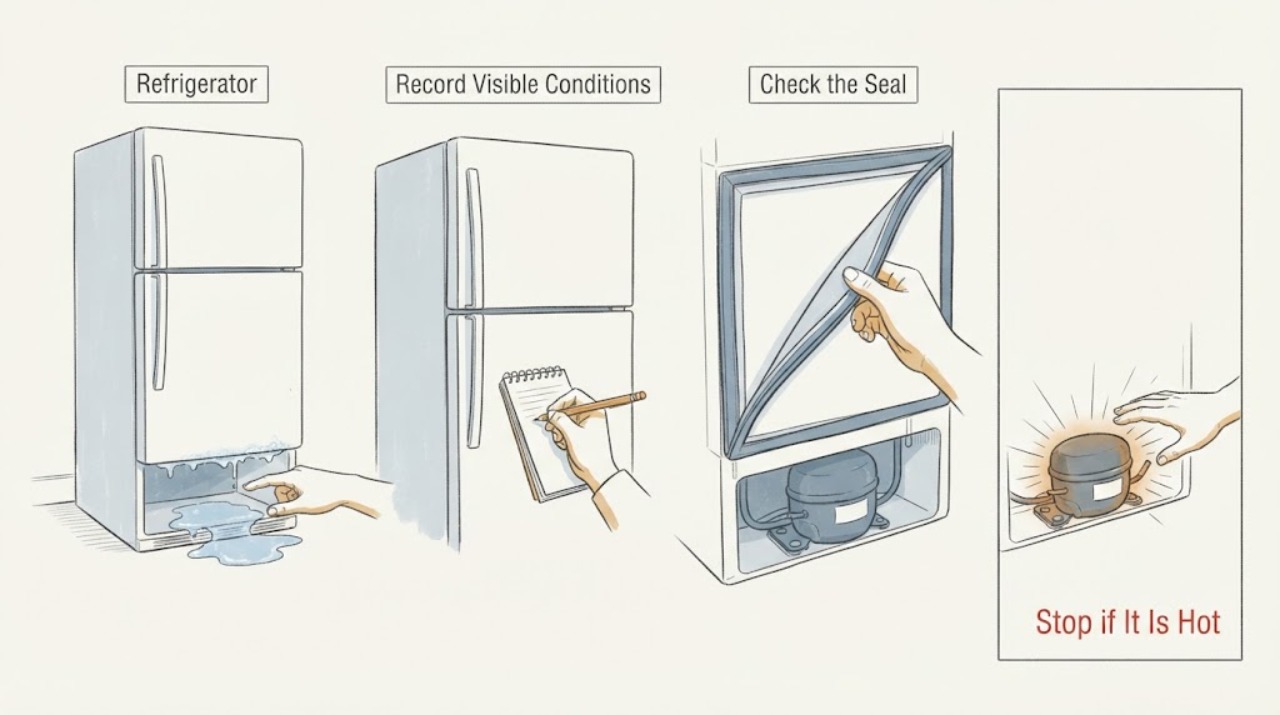
Several past compressor repairs do not, by themselves, prove that the LG refrigerator currently has another compressor failure. First establish whether cooling is actually failing: record refrigerator and freezer temperatures, protect food if temperatures are unsafe, and check only the external setting, door seal, and accessible airflow. Confirm the complete model suffix and purchase market before relying on a manual or warranty summary. LG's U.S. support page for LFXS28566S.ASTCNA0 currently shows separate general and compressor/sealed-system coverage, while an LG Canada product sheet shows different terms; the written terms for the appliance's market, purchase date, proof of purchase, exclusions, and the authorized diagnosis control. A code, clicking, warm cabinet, or repair history is not a safe basis for naming the compressor. Do not open the sealed system, handle refrigerant, replace a compressor, or make live electrical tests; recurring no-cooling or a documented sealed-system diagnosis needs qualified LG appliance service.
Work through in order
Diagnostic checks
Use only checks that match the exact appliance or system and its official guide.
-
Check 1
Verify the current cooling result from outside the refrigerator: with the doors closed as normally used, record the refrigerator and freezer temperatures with an appliance thermometer if available, note any high-temperature display, and identify whether food is softening or warming.
Expected result: Both compartments are at their normal ranges, or one or both are clearly warmer than usual and the food is thawing or unsafe.
Next step: Protect or discard food according to safe food-handling guidance when temperatures are unsafe, keep the doors closed, and arrange service when cooling is not recovering; do not diagnose the compressor from the temperature result alone.
Why this matters
Why: Normal measured temperatures provide no current evidence of compressor failure. A real temperature rise establishes a cooling problem but still does not distinguish compressor, airflow, defrost, control, door-seal, or sealed-system causes.
-
Check 2
Check only accessible causes of uneven cooling: confirm the temperature setting was not changed, move packages away from the model's visible supply and return vents, and verify that each door closes fully with the visible gasket making continuous contact.
Expected result: A setting is too warm, a package blocks an airflow path, a shelf or bin prevents closure, or the gasket has dirt, a gap, a tear, or a section out of position; alternatively, the accessible paths are clear and the doors seal.
Next step: Correct only the setting, loading, or visible gasket-surface issue allowed by the exact manual, then monitor the same temperatures. Arrange qualified service if the seal cannot close, the vents are iced, or cooling remains poor; do not pull the gasket, adjust hinges, or remove covers.
Why this matters
Why: A setting, obstruction, or air leak can explain a warm compartment without a compressor fault. Clear accessible obstructions and a clean continuous seal make an internal cooling or sealed-system issue more relevant if temperatures remain abnormal.
-
Check 3
Observe operation without touching the rear compartment or any wiring: from a normal standing position note whether the refrigerator has ordinary fan or compressor run periods, repeated start-and-stop attempts, unusual clicking, no cold-air movement, abnormal cabinet heat, smoke, or a burning smell.
Expected result: The sound and run pattern are ordinary while temperatures are stable, or repeated attempts coincide with rising temperatures, abnormal heat, smoke, burning odor, sparking, or a tripped breaker.
Next step: For a stable appliance, continue only temperature monitoring. For repeated failed starts or loss of cooling, stop repeated cycles and arrange qualified service. For smoke, sparking, burning odor, damaged wiring, or water near electrical parts, stop using the refrigerator and seek prompt appliance or electrical help; do not perform a live test.
Why this matters
Why: Sound and cycling can prioritize the urgency of a service call but cannot identify a compressor, start device, fan, control, power, or sealed-system part. Smoke, burning odor, sparking, damaged wiring, or unusual heat is an immediate safety condition.
-
Check 4
Photograph any displayed code or diagnostic message exactly as shown and record when it appears, without forcing a service mode or applying a generic button sequence from another LG model.
Expected result: There is no code, or the code is present and can be matched to the complete model's manual or an LG support page; the code may refer to a fan, defrost, cooling, refrigerant, or compressor-related condition.
Next step: Give the exact code, full model suffix, temperatures, and photos to qualified service. If a compatible guide calls for service for a cooling, refrigerant, or compressor indication, do not open panels or repeat resets while the refrigerator warms.
Why this matters
Why: LG states that refrigerator codes vary by type and model. A matching code can direct a technician toward a system area, but it is not proof that one compressor part has failed and an unmatched code should not be interpreted by letters alone.
-
Check 5
Build a repair-history packet: list each failure date, the exact model and serial recorded on the invoice, the measured symptom, the written diagnosis, the parts replaced, whether sealed-system work was performed, and the result after each repair.
Expected result: The records document a current measured cooling failure and repeated sealed-system or compressor work, or they contain only a past label such as compressor failure without measurements, parts detail, or a current diagnosis.
Next step: Ask the service provider to document current compartment temperatures, the tested fault area, the root cause, and the proposed repair scope. Request the provider to state in writing whether the applicable warranty includes the work and labor; do not authorize refrigerant or compressor work based only on history.
Why this matters
Why: A documented recurrence is valuable evidence for root-cause and warranty review, but an old label or an unverified repair story cannot establish what has failed now. Missing paperwork is a reason to obtain a diagnosis, not to guess a replacement part.
-
Check 6
Verify warranty identity before accepting a labor answer: photograph the complete model and serial label, confirm the country or market of purchase, delivery or purchase date, proof of purchase, installation location, and the written LG warranty that applies to that appliance.
Expected result: The label, market, date, and proof are complete, or the appliance is missing a suffix, was bought in another market, or the available page is only a summary.
Next step: Have LG or an authorized provider review the written terms against the current documented diagnosis before approving work. Treat any coverage decision as case-specific; do not promise reimbursement, labor coverage, or a repair price in advance.
Why this matters
Why: LG publishes different market summaries for this base model, and its U.S. page says the detailed terms supplied with the product control. A statement that labor is never covered, or that it is automatically covered, cannot be confirmed without these identity and contract facts.
Use your observations
Decision map
Find the observation that best matches what you see, then follow the next safe action.
-
PATH 01Next step
What you see
Temperatures are normal, food is safe, there is no compatible code, and operation sounds ordinary.
Do this next
Keep a temperature log and service records, and arrange service only if cooling changes or a qualified diagnosis identifies a fault.
Why this path and its safety boundary
Why it matters: There is no established current compressor failure; the old repair history should not trigger another parts order.
-
PATH 02Next step
What you see
One compartment is warm while a visible setting, blocked vent, door obstruction, or gasket gap is found and there is no immediate electrical hazard.
Do this next
Correct only the accessible condition permitted by the exact manual, then monitor temperatures; call service if the seal cannot close or the temperature does not recover.
Why this path and its safety boundary
Why it matters: A user-accessible temperature or air-leak condition is more likely than a primary compressor conclusion.
-
PATH 03Next step
What you see
Both compartments warm, temperatures continue rising, or repeated start attempts and a compatible cooling/fan/refrigerant/compressor indication occur after accessible checks are clear.
Do this next
Protect food and arrange qualified LG appliance service with the temperature log, code photo, full suffix, and repair packet. Do not open the sealed system, handle refrigerant, or perform live electrical measurements.
Why this path and its safety boundary
Why it matters: The refrigerator has a significant cooling-system symptom, but the code and sound still do not isolate the compressor from the start circuit, control, fan, defrost, or sealed system.
-
PATH 04Next step
What you see
A technician's records show repeated compressor or sealed-system work followed by another measured loss of cooling.
Do this next
Ask the provider to document the current fault, why the earlier repair did not resolve it, what work is proposed, and whether parts and labor fall within the written market-specific terms before authorizing work.
Why this path and its safety boundary
Why it matters: This is a documented recurrence that merits a written root-cause and warranty-scope review, not a symptom-only compressor replacement decision.
-
PATH 05Next step
What you see
There is smoke, sparking, a burning odor, damaged wiring, water around electrical parts, a hot or damaged cord, repeated breaker trips, or food has reached an unsafe temperature.
Do this next
Stop using the refrigerator, disconnect power only if it can be done without contact with damage or water, protect or discard food, and obtain prompt qualified appliance or electrical help.
Why this path and its safety boundary
Why it matters: The immediate issue is a safety or food-protection problem, not a consumer compressor diagnosis.
Helpful context
Understand the symptom
A compressor label in an old invoice is a repair-history fact, not a diagnosis of today's symptom. LFXS28566S is a model family whose support material can carry a full suffix such as LFXS28566S.ASTCNA0. Record that complete label and the market before applying any model-specific instructions. The first decision is whether both compartments are actually losing temperature, whether a simple airflow or door condition is present, and whether a qualified technician has documented a sealed-system fault.
LG's general not-cold guidance points to temperature setting, air circulation, doors that are not fully closed, and blocked vents before service. Its error-code guidance also warns that codes vary by refrigerator type and model and that several cooling, fan, refrigerant, or compressor-related indications require service rather than a consumer component test.
Repeated failures change the service conversation: ask for a written current diagnosis and root-cause explanation, preserve every invoice and replaced-part record, and have the provider state which work and labor are covered under the applicable written warranty. Do not authorize a compressor or sealed-system job solely because the refrigerator has failed before.
When checks do not resolve it
Need a professional?
Use qualified LG appliance service for recurrent no-cooling, repeated failed starts, a compatible sealed-system or compressor indication, or any repair-history recurrence. Use prompt electrical or emergency help for smoke, sparking, burning odor, exposed damage, or water at electrical parts.
Common questions
FAQ
Does a previous LG compressor replacement prove the compressor has failed again?
No. It makes the repair history important, but current temperatures, cooling behavior, exact code, and a written diagnosis are still needed. The same warm-refrigerator symptom can come from airflow, defrost, fan, control, start, power, or sealed-system causes.
Does the LG LFXS28566S warranty always exclude labor?
Do not assume that. The current U.S. support summary for the exact support record displays separate coverage periods, including compressor labor, while an LG Canada sheet shows different market terms. The complete suffix, market, dates, proof, exclusions, and written warranty control a case-specific decision.
Can I recharge refrigerant or replace the compressor to test the diagnosis?
No. Refrigerant handling, opening the sealed system, compressor replacement, and live electrical tests are professional work. Stop using the refrigerator when cooling is unsafe or an electrical hazard is present and provide the service technician with the temperature and repair-history record.
Read the exact guide
Official sources
- LG Refrigerator Error Code ListLG Electronics USA · LG USA generic refrigerator error-code guide; the page explicitly says codes vary by refrigerator type and model, so it is not an exact LFXS28566S code table.
- If Your LG Refrigerator Is Not Cold EnoughLG Electronics USA · LG USA user-level guidance for refrigerator cooling symptoms; settings vary by model and it does not diagnose a compressor.
- LFXS28566S.ASTCNA0 Support: Manuals, Warranty & More | LG USALG Electronics USA · Exact U.S. LG support record for the LFXS28566S base model with the displayed ASTCNA0 suffix; warranty summary and exact support routing, not proof of a particular claim.
- LFXS28566S EnLG Electronics Canada · Official Canadian product sheet for the LFXS28566S base model; product identity, cooling architecture, and Canadian warranty summary only. It does not establish coverage in another market.
Community feedback
Share a repair observation
Share a plain-text repair observation. Accepted observations are published automatically; this page may take a moment to update.