
On this page
Start here
Quick answer
Treat “compressor failure” on an LG LFXC24726S as a reported diagnosis, not a confirmed cause, until the actual refrigerator and freezer temperatures, the cooling-loss timeline, and a written professional diagnosis agree. Protect food first, then check only the visible temperature settings, clear air vents, full door closure and gasket contact. LG's exact support page identifies the LFXC24726S and lists model-family sealed-system and compressor warranty terms, while its specification identifies a Linear Compressor, Smart Cooling Plus and Multi-Air Flow; none of those facts tells a homeowner to replace a compressor or choose a dual-compressor refrigerator. If the measured temperatures are unsafe, cooling drops again, or the noise returns, stop relying on the appliance for perishables and obtain qualified sealed-system service.
Work through in order
Diagnostic checks
Use only checks that match the exact appliance or system and its official guide.
-
Check 1
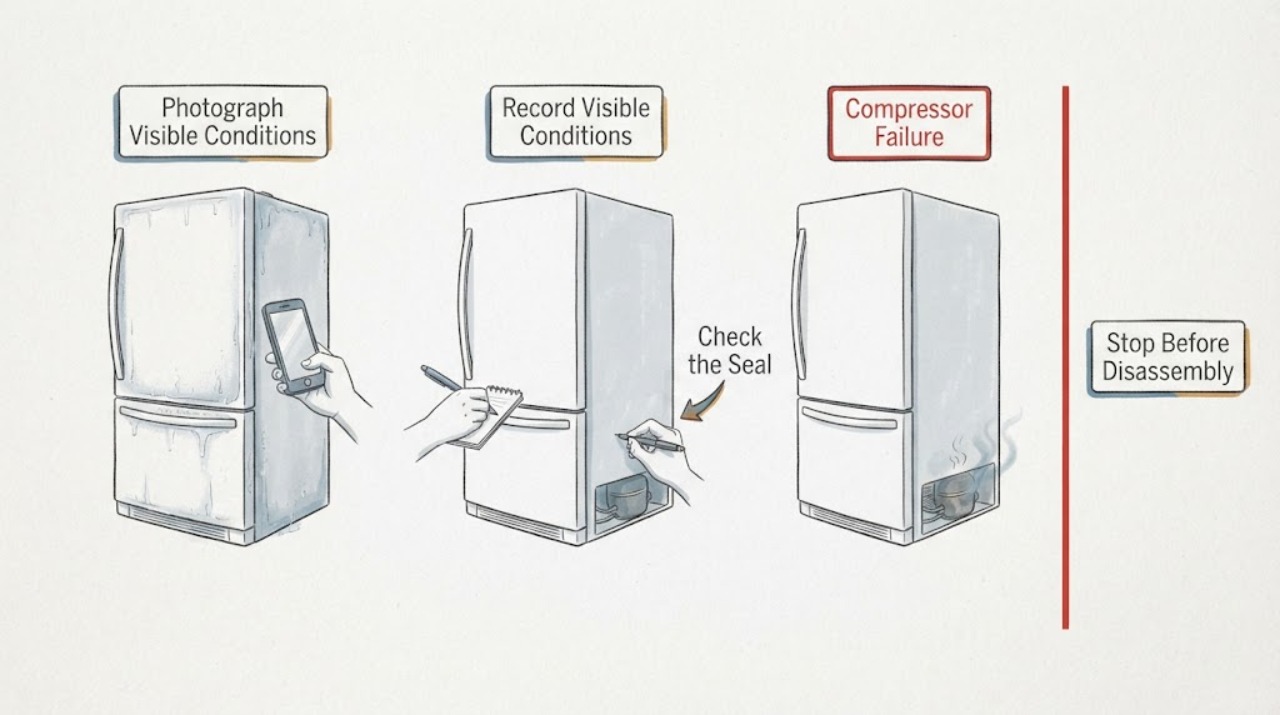
Confirm the exact label as LG LFXC24726S, record the serial number and market, and gather any service invoice or written diagnosis that says “compressor failure.” Photograph any display message and note when the cooling loss, unusual noise, food loss and apparent recovery occurred; do not remove a cover to look for a compressor label.
Expected result: The label matches LFXC24726S and a technician supplied measurements or a written diagnosis, or the compressor conclusion is only a user assumption, an online suggestion or an unexplained invoice description.
Next step: If the diagnosis is not written and supported by measured results, ask for model-specific service documentation or a qualified second opinion before authorizing a compressor or sealed-system repair. Keep the exact model and serial available for warranty review.
Why this matters
Why: LG's official support route is model-specific and lists the LFXC24726S documentation and warranty terms. A component name without test results does not distinguish a compressor from airflow, fan, control, door-seal, power or another cooling-path issue.
-
Check 2
Place an appliance thermometer in the refrigerator compartment and another in the freezer, record the actual temperatures with the doors closed as much as practical, and note whether one or both compartments are warming. If food has already been warm, write down the known temperature history instead of judging safety by smell or taste.
Expected result: The refrigerator is at or below 40°F (4°C) and the freezer at or below 0°F (-18°C), or either compartment is warmer or the readings are rising; the duration of unsafe temperature may be known or uncertain.
Next step: Move perishables to a known-safe cold appliance when temperatures are unsafe. Discard food when its exposure time is uncertain rather than relying on appearance, odor or a later recovery; preserve the readings for service.
Why this matters
Why: FDA recommends an appliance thermometer and these temperature targets. A safe reading now proves only the current condition; it neither confirms nor rules out an intermittent compressor fault. If the time above the safe range is unknown, the food decision is separate from the repair diagnosis.
-
Check 3
With the controls unlocked if necessary, compare the refrigerator and freezer settings with the LFXC24726S owner documentation, then inspect only the visible interior: keep packages away from cold-air outlets, ensure shelves and bins do not hold the French doors open, and check that the gaskets contact evenly around the cabinet.
Expected result: A setting is warmer than intended, a package blocks an air outlet, a shelf or container prevents full closure, or a gasket has dirt or a visible gap; alternatively, these visible conditions are normal while temperatures remain high.
Next step: Correct only the visible setting, loading or door obstruction and continue measuring. If temperatures remain unsafe or fall again after the visible correction, stop changing settings and request qualified service.
Why this matters
Why: LG's cooling guidance links high settings, blocked vents and warm air entering through an incompletely closed door to weak cooling. Finding one of these conditions can explain a warm observation, but correcting it does not verify a previously claimed compressor failure or explain a recurring loud event by itself.
-
Check 4
From a stable position outside the cabinet, record the noise pattern during ordinary operation: start, steady running, stopping, door opening, or no audible operation. Note whether the sound is a hum, buzz, click, scrape or vibration and whether it occurs at the same time as a temperature rise. Do not hold a door switch, remove the rear cover or touch the compressor or fan.
Expected result: The refrigerator is quiet and maintains measured temperatures, the noise returns while temperatures rise, repeated clicking or vibration occurs, or the appliance becomes quiet while cooling is lost.
Next step: Save a short recording if it can be made safely and add the time and temperature to the log. If the noise/cooling combination recurs, stop relying on the refrigerator for perishables and give the record to qualified service; do not repeatedly power-cycle it to reproduce the symptom.
Why this matters
Why: LG lists LoDecibel operation and a Linear Compressor for the LFXC24726S specification, but those labels do not define an acceptable noise level or identify a failed part. A repeatable combination of abnormal noise and measured cooling loss is stronger service evidence than either symptom alone, while a quiet cabinet with safe temperatures is not proof of repair.
-
Check 5
Before authorizing work, compare the exact model and purchase details with the warranty information on LG's official support page and the warranty document supplied with the appliance. Ask the technician to state what was measured, which cooling subsystem was ruled in or out, whether the sealed system was opened, and what coverage applies; do not infer coverage from the compressor name alone.
Expected result: The model and purchase history fit an applicable warranty route and the diagnosis is documented, or coverage is unclear, expired, market-dependent or the technician has not provided a written finding.
Next step: Provide the model, serial, purchase record, temperature log and written diagnosis to LG or a qualified appliance service provider. Do not buy a dual-compressor refrigerator or a replacement compressor as a substitute for a documented repair-or-replace decision.
Why this matters
Why: LG's LFXC24726S support page lists one-year parts and labor plus model-family sealed-system and compressor terms, while directing owners to the detailed warranty document. Coverage and repair authorization depend on the actual terms, market and purchase history, not merely the presence of a compressor.
Use your observations
Decision map
Find the observation that best matches what you see, then follow the next safe action.
-
PATH 01Next step
What you see
The label matches LFXC24726S, both compartments measure within the food-safety targets, visible settings/airflow/doors are normal, and the loud event has not returned.
Do this next
Continue a temperature and noise log during normal use, keep service records, and avoid buying a part or replacement appliance solely because the refrigerator is temporarily cold and quiet.
Why this path and its safety boundary
Why it matters: The refrigerator is currently maintaining temperature, but the result does not confirm that a previously reported compressor failure has been repaired or that no intermittent fault exists.
-
PATH 02Next step
What you see
One or both compartments remain above the safe measured range, food has warmed, or the time above that range is uncertain.
Do this next
Move or discard food using the documented temperature history and request prompt qualified service. Keep the refrigerator from being used as the sole storage appliance until stable temperatures are verified.
Why this path and its safety boundary
Why it matters: This is first a food-safety and cooling-failure condition. A later cold reading cannot make previously unsafe food safe and cannot validate a component label.
-
PATH 03Next step
What you see
The loud noise returns together with a renewed temperature rise, repeated clicking/vibration or loss of cooling after an apparently quiet period.
Do this next
Stop storing perishables, preserve the sound and temperature record, and request model-specific diagnosis. Do not open the refrigeration circuit, test live terminals, touch the compressor or add refrigerant.
Why this path and its safety boundary
Why it matters: The history is now a repeatable intermittent cooling symptom. It still does not distinguish a compressor, fan, start device, control, airflow or sealed-system cause from user-visible observations.
-
PATH 04Next step
What you see
A visible setting, blocked outlet or door/gasket obstruction is found and measured temperatures improve after the safe correction.
Do this next
Keep the vents and doors clear, continue measuring and request service if the noise or cooling loss returns.
Why this path and its safety boundary
Why it matters: The visible condition plausibly contributed to the immediate warm reading, consistent with LG's general cooling guidance, but it does not prove the earlier compressor claim was correct or incorrect.
-
PATH 05Next step
What you see
A qualified technician provides a written, model-specific diagnosis with measured evidence that identifies a compressor or sealed-system fault, and the warranty/repair terms are confirmed.
Do this next
Review the written scope, coverage, labor and post-repair temperature expectations before authorizing work. Do not perform the sealed-system repair yourself.
Why this path and its safety boundary
Why it matters: The component claim has moved from an unverified label to a documented service decision; the user can compare authorized repair terms with replacement based on their own budget and appliance needs.
-
PATH 06Next step
What you see
There is smoke, burning odor, sparking, damaged wiring or cord, water near electrical parts, abnormal cabinet heat or a repeated breaker trip.
Do this next
Stop using the refrigerator and isolate power only if it can be done without contact with water or damaged wiring; keep people clear and obtain appropriate qualified or emergency help.
Why this path and its safety boundary
Why it matters: This is an electrical, water or fire-safety stop condition rather than a compressor-identification exercise.
Helpful context
Understand the symptom
This page addresses an LFXC24726S refrigerator that someone has called a compressor failure. That wording may be a technician's conclusion, a warranty label, or a guess made after a cooling problem; the article does not accept it as proof. Confirm the full model on the appliance label and keep the serial number and any prior service paperwork with the case.
The LG product page describes this model as a 24 cu. ft. French Door Counter-Depth Refrigerator. LG's specification lists a Linear Compressor, Smart Cooling Plus, Multi-Air Flow and SmartDiagnosis, and the support page provides model documentation and warranty information. These are model facts, not a remote diagnosis of a compressor, fan, control or sealed-system fault.
Because the proposed repair or a replacement purchase can be expensive, separate three decisions: whether food is safe now, whether the cabinet is actually maintaining temperature, and whether a qualified technician has documented the failed subsystem. Do not add refrigerant, open tubing, access the compressor, or choose a new appliance based only on a noise or a temporary return of cooling.
When checks do not resolve it
Need a professional?
Request qualified LG or appliance service when the LFXC24726S has unsafe or unstable measured temperatures, cooling returns and then fails again, the unusual noise recurs with cooling loss, or a compressor/sealed-system diagnosis needs confirmation. Before authorizing work, obtain a written diagnosis with measurements and check the exact model, serial, market and purchase details against the applicable LG warranty document. Stop immediately for smoke, arcing, burning odor, damaged wiring or cord, water near electrical parts, abnormal heat or repeated breaker trips. Do not open the refrigeration circuit, add refrigerant, access the compressor or perform live electrical tests.
Common questions
FAQ
Does a label saying compressor failure prove that the compressor is bad?
No. Treat it as a reported diagnosis until the exact model, measured temperatures, symptom history and written service findings support it. A warm refrigerator can also involve settings, airflow, doors, fans, controls or other cooling-path conditions.
Can I keep using the refrigerator because it started cooling again?
Only after verifying actual temperatures, and even then a temporary recovery is not proof that an intermittent fault is gone. Keep a temperature log and move perishables if the refrigerator rises above 40°F or the freezer above 0°F.
Should I buy a dual-compressor refrigerator instead of repairing this LG?
That shopping decision is outside the diagnosis. First obtain measured temperatures and a written, model-specific repair finding, then compare the documented repair scope and warranty with replacement options according to your own circumstances. Do not use the unverified compressor label as the sole reason to buy another appliance.
Read the exact guide
Official sources
- LG LFXC24726S: Ultra Capacity 3-Door French Door RefrigeratorLG USA · Opened LG's official product page; it identifies LFXC24726S as a 24 cu. ft. French Door Counter-Depth Refrigerator and describes its Smart Cooling Plus and SpacePlus ice features. It does not diagnose a compressor failure.
- Refrigerator Thermometers — Cold Facts about Food SafetyU.S. Food and Drug Administration · Opened the FDA consumer guidance; it recommends an appliance thermometer, a refrigerator at or below 40°F and a freezer at 0°F, and discarding food when time above the safe range is uncertain.
- LFXC24726 Super-Capacity 3 Door French Door Refrigerator — SpecificationLG Electronics USA · Opened LG's official specification PDF for the LFXC24726 family. It lists the LFXC24726S stainless model, Linear Compressor, Smart Cooling Plus, Multi-Air Flow, temperature sensors, LoDecibel operation and published warranty categories; it does not identify a fault from noise or warm food.
- LG LFXC24726S — Support, Manuals, Warranty & MoreLG USA · Opened LG's official product-support page displayed as LFXC24726S.ASTCNA0. It provides the model's online manual, owner's manual and specification links and lists the model-family warranty terms; verify the appliance label and market before relying on coverage.
- If Your LG Refrigerator Is Not Cold EnoughLG USA · Opened LG's official help article; it links weak cooling to high settings, blocked vents and doors that do not close fully, gives a standard temperature range and directs service if those steps do not resolve the issue. It notes that menus vary by model.
Community feedback
Share a repair observation
Share a plain-text repair observation. Accepted observations are published automatically; this page may take a moment to update.