
On this page
Start here
Quick answer
A Maytag refrigerator that seems to have a compressor failure should not be diagnosed from one sound or from the compressor being quiet for a short period. Maytag lists power, settings, blocked vents, dirty coils, door seals, clearance, the condenser fan, the compressor, and the control board as separate possible causes of poor cooling. Check the power, controls, airflow, seals, and visible operating pattern from a safe position. Frequent clicking and short cycling, nonstop running with poor cooling, repeated breaker trips, or unusually loud compressor noise need professional diagnosis; these symptoms do not prove the compressor itself has failed.
Work through in order
Diagnostic checks
Use only checks that match the exact appliance or system and its official guide.
-
Check 1
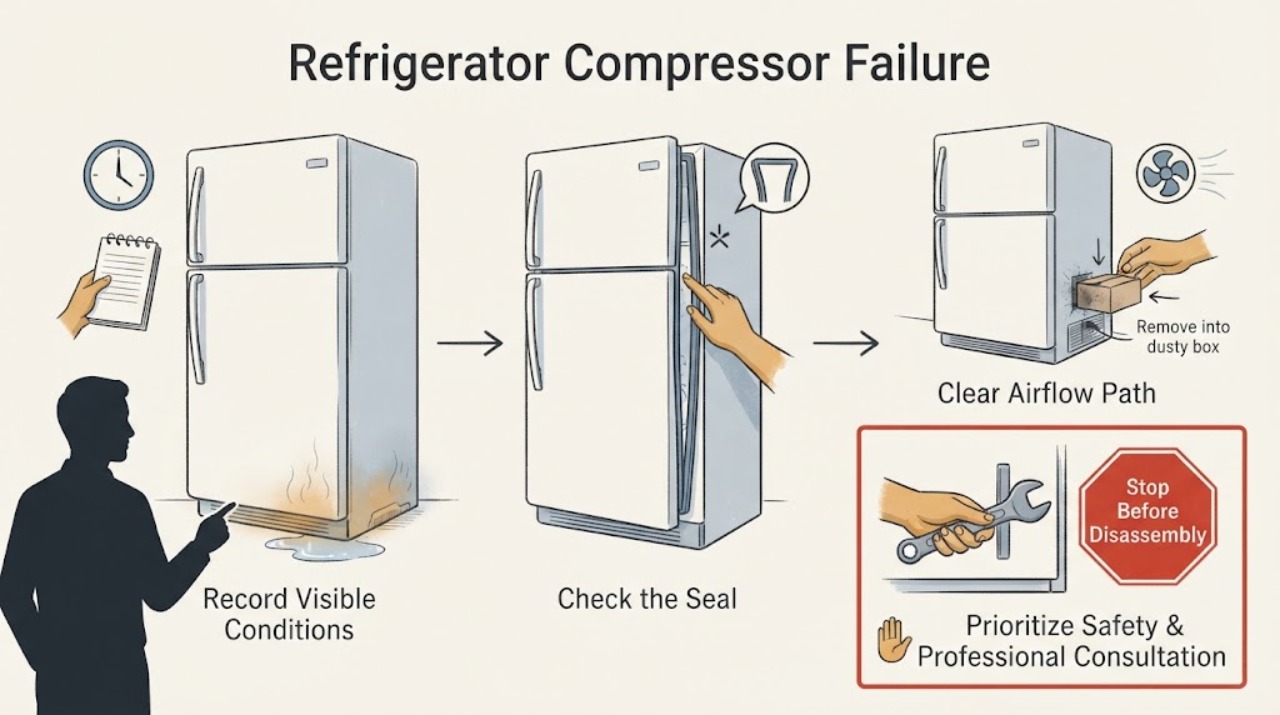
Record the Maytag model and serial number, whether the interior light and display work, the refrigerator and freezer temperatures or symptoms, and the compressor sound pattern from outside the cabinet.
Expected result: The unit may be fully dark, powered with weak cooling, cooling in the freezer but not the refrigerator, quiet for a short interval, running continuously, clicking repeatedly, or unusually loud.
Next step: Protect perishable food if temperatures are rising. Do not touch components or remove panels; continue only with safe external checks when there is no smoke, burning odor, damaged cord, or repeated breaker trip.
Why this matters
Why: These patterns separate a general power or airflow problem from a possible short-cycling, cooling-system, fan, or control problem. A quiet compressor alone does not prove failure because some models have normal pauses such as defrost.
-
Check 2
Confirm from the control panel that cooling is enabled and the temperature settings have not been changed; visually check that interior vents are not blocked by food and that the doors close against the gaskets.
Expected result: Cooling may be off or set incorrectly, vents may be blocked, or the controls, vents, and door seals may appear normal.
Next step: Restore only an obviously changed setting and move food away from an accessible vent. If the gasket is torn or the door does not seal, arrange service; do not disassemble the door or control panel.
Why this matters
Why: Maytag lists settings, blocked vents, and door gaskets among causes of poor cooling. If these checks are normal, the symptom remains unresolved and should not be labeled a compressor failure yet.
-
Check 3
From a safe external position, check the cabinet clearance and visible lower or rear airflow area against the exact model instructions; if the manual permits coil cleaning, disconnect power as directed before cleaning only the accessible exterior area.
Expected result: Clearance or visible airflow may be restricted by the installation, or the accessible area may look normal.
Next step: Correct only an obvious clearance or external dust condition allowed by the manual. Do not pull the refrigerator, remove a grille that the manual does not identify, or reach toward the fan or compressor.
Why this matters
Why: Maytag says insufficient clearance and dirty condenser coils can make cooling harder and cause the compressor to work harder. A clear exterior does not rule out a fan, sealed-system, compressor, or control fault.
-
Check 4
Observe one normal cooling period without deliberately forcing a restart, and note whether the compressor runs for long periods, clicks off and on frequently, or trips the breaker.
Expected result: The unit may run longer but maintain temperature, run nonstop while remaining warm, click repeatedly as it restarts, make unusually loud noise, or trip the breaker.
Next step: Stop using the appliance and arrange qualified service for repeated clicking/short cycling, poor cooling with nonstop running, unusual compressor noise, or a breaker that trips again. Do not keep cycling the breaker.
Why this matters
Why: Maytag describes extended operation as possible for high-efficiency compressors, but identifies nonstop running, repeated breaker trips, unusually loud noise, and short cycling as reasons for professional attention. None of these patterns alone identifies the failed component.
-
Check 5
Prepare the model, serial number, cooling temperatures or food symptoms, sound and run pattern, recent power event, and all external-check results for Maytag service.
Expected result: The cooling problem persists after the accessible checks, or the appliance remains warm, intermittently starts, or stops unexpectedly.
Next step: Keep the refrigerator out of service if it cannot cool or shows an electrical or overheating symptom, protect food, and request qualified Maytag appliance service.
Why this matters
Why: Maytag’s troubleshooting material treats compressor, fan, sealed-system, and circuit-board issues as professional diagnosis areas; a symptom report is not a component confirmation.
Use your observations
Decision map
Find the observation that best matches what you see, then follow the next safe action.
-
PATH 01Next step
What you see
The refrigerator is powered, temperatures recover, and the compressor runs for long periods without repeated clicking, breaker trips, unusual noise, or unsafe cooling.
Do this next
Keep vents clear, doors sealed, and the installation within the exact manual’s clearance guidance. Arrange service if temperatures stop recovering or the operating pattern changes.
Why this path and its safety boundary
Why it matters: Maytag says high-efficiency refrigerators can run for extended periods; longer operation alone is not proof of compressor failure.
-
PATH 02Next step
What you see
The compressor clicks on and off frequently, the refrigerator stays warm while it runs nonstop, the sound is unusually loud, or the breaker trips again.
Do this next
Stop using the refrigerator, protect perishable food, and arrange qualified Maytag service. Do not repeatedly reset the breaker or order a compressor from the symptom alone.
Why this path and its safety boundary
Why it matters: Maytag identifies short cycling, nonstop operation with poor cooling, unusual compressor noise, and repeated breaker trips as problem patterns, but they do not distinguish the compressor from a fan, control, electrical, or sealed-system fault.
-
PATH 03Next step
What you see
The freezer cools but the refrigerator compartment is warm, while the compressor does not show the warning patterns above.
Do this next
Check only accessible vents and settings. If the compartment remains warm, request service for model-specific airflow and control diagnosis.
Why this path and its safety boundary
Why it matters: Maytag lists an evaporator fan, damper, thermistor, or temperature circuit board as possible causes of this split-temperature pattern; the compressor is not established as the cause.
-
PATH 04Next step
What you see
The control panel and lights are off, the outlet or breaker is interrupted, or the unit recently lost power.
Do this next
Check the accessible plug and labeled breaker once from a dry, safe position. If power is normal but the refrigerator remains off, arrange service and do not open electrical covers.
Why this path and its safety boundary
Why it matters: A supply or control state can explain apparent compressor silence before a compressor fault is considered.
-
PATH 05Next step
What you see
There is smoke, a burning smell, a hot or damaged cord, exposed wiring, refrigerant or oil residue, or water near electrical parts.
Do this next
Stop immediately, keep clear, isolate power only if safe, protect food, and arrange qualified service. Do not touch residue, tubing, wiring, or the compressor.
Why this path and its safety boundary
Why it matters: This is an electrical, fire, sealed-system, or water hazard beyond user diagnosis.
Helpful context
Understand the symptom
A compressor suspicion is a symptom pattern, not a confirmed diagnosis
The compressor starts the refrigeration cycle, but a refrigerator that is warm can also have a power, setting, airflow, seal, fan, or control problem. Maytag lists these alternatives before its compressor and circuit-board possibilities. A quiet compressor for a short time can occur during a normal defrost period on some models, while repeated clicking, nonstop operation with poor cooling, or a breaker that trips repeatedly deserves service.
Record cooling and operating behavior
From outside the cabinet, note whether the interior light and display work, whether the freezer is cooling, whether the refrigerator compartment is warm, and whether the compressor sounds quiet, runs continuously, clicks on and off, or makes an unusually loud noise. Do not pull the refrigerator out, remove a cover, or touch the compressor, fan, tubing, or electrical connections.
Check the accessible causes Maytag lists
Confirm the controls are set to a cooling mode and that food is not blocking the interior vents. Look around the cabinet for the model instructions on clearance, and visually check whether the door gasket is dirty, torn, or failing to seal. If the manual permits external coil cleaning, disconnect power as directed and clean only the accessible area; do not open the sealed system or reach through a grille.
Separate normal sounds from warning patterns
Maytag says whirring, hissing, dripping, pulsating, and longer run times can be normal on some efficient refrigerators. A compressor that cycles off and on unusually often, runs nonstop while temperatures remain unsafe, makes unusually loud noises, or repeatedly trips the breaker is a different pattern. The pattern narrows the service diagnosis but still does not prove the compressor is the failed part.
Protect food and arrange service when the pattern persists
If the refrigerator cannot maintain safe cooling after the accessible checks, move perishable food to a safe cold location and arrange qualified Maytag appliance service. Give the technician the model and serial number, temperatures or cooling pattern, sound pattern, breaker behavior, and the results of the external checks. Do not order a compressor, relay, fan, or control board from symptoms alone.
When checks do not resolve it
Need a professional?
Arrange qualified Maytag appliance service when short cycling, nonstop running with poor cooling, unusual compressor noise, repeated breaker trips, persistent warm temperatures, or a split-temperature problem remains after safe external checks. Stop immediately for smoke, burning odor, damaged or hot wiring, exposed electrical parts, refrigerant or oil residue, or water near electrical components.
Common questions
FAQ
How can I tell if my Maytag refrigerator compressor has failed?
You cannot confirm compressor failure from a sound alone. Maytag lists power, settings, vents, coils, gaskets, clearance, fan, compressor, and control-board causes for poor cooling. Frequent clicking, nonstop running with poor cooling, unusually loud noise, or repeated breaker trips need professional diagnosis.
Is it normal for a Maytag refrigerator compressor to run a long time?
Maytag says high-efficiency compressors may run for extended periods. Long run time becomes a service concern when the refrigerator stays warm, the compressor runs nonstop, cycles unusually, makes unusually loud noise, or the breaker trips.
Why is my Maytag freezer cold but the refrigerator warm?
Maytag lists airflow and control possibilities such as an evaporator fan, damper, thermistor, or temperature circuit board for this pattern. Check accessible vents and settings, then arrange service if the refrigerator compartment remains warm.
Read the exact guide
Official sources
- Refrigerator TroubleshootingMaytag · Official Maytag troubleshooting article used for the meaning of short cycling, frequent clicking, and the recommendation for professional service.
- 10 Reasons Your Refrigerator is Not CoolingMaytag · Official Maytag guidance used for the differential causes of poor cooling, normal versus concerning compressor patterns, airflow, clearance, and professional service boundary.
- Service Manual 16025629Maytag · Maytag service manual used to distinguish a temporary defrost-mode pause from a confirmed compressor failure and to set the service boundary for a refrigerator that still will not operate.
Community feedback
Share a repair observation
Share a plain-text repair observation. Accepted observations are published automatically; this page may take a moment to update.