
On this page
Start here
Quick answer
First establish whether the complaint is no new ice, slow production, or ice that exists but will not dispense. Haier's official troubleshooting guidance starts with the ice-maker setting and the water valve connected to the refrigerator; it also notes that a refrigerator that has just been powered on or has not cooled the freezer sufficiently will not make ice yet. Check only the external control and the clearly identified water valve, and use the exact model instructions because Haier's ice-maker controls differ across model families. If the freezer is warm, frost is blocking a drawer or ice-maker area, water is leaking, the valve will not supply water, a persistent code is displayed, or no ice is made after the model-appropriate waiting period, stop guessing and arrange Haier service. Do not open the rear panel, access the inlet valve or wiring, force an ice mold, or perform live electrical checks.
Before you begin
Safety first
- This article covers model identification, user-control observation, external water-valve observation, accessible ice-box inspection, and model-approved plastic-tool or defrost checks. Do not open panels, access internal valves or wiring, force mechanisms, apply direct heat, or perform live testing.
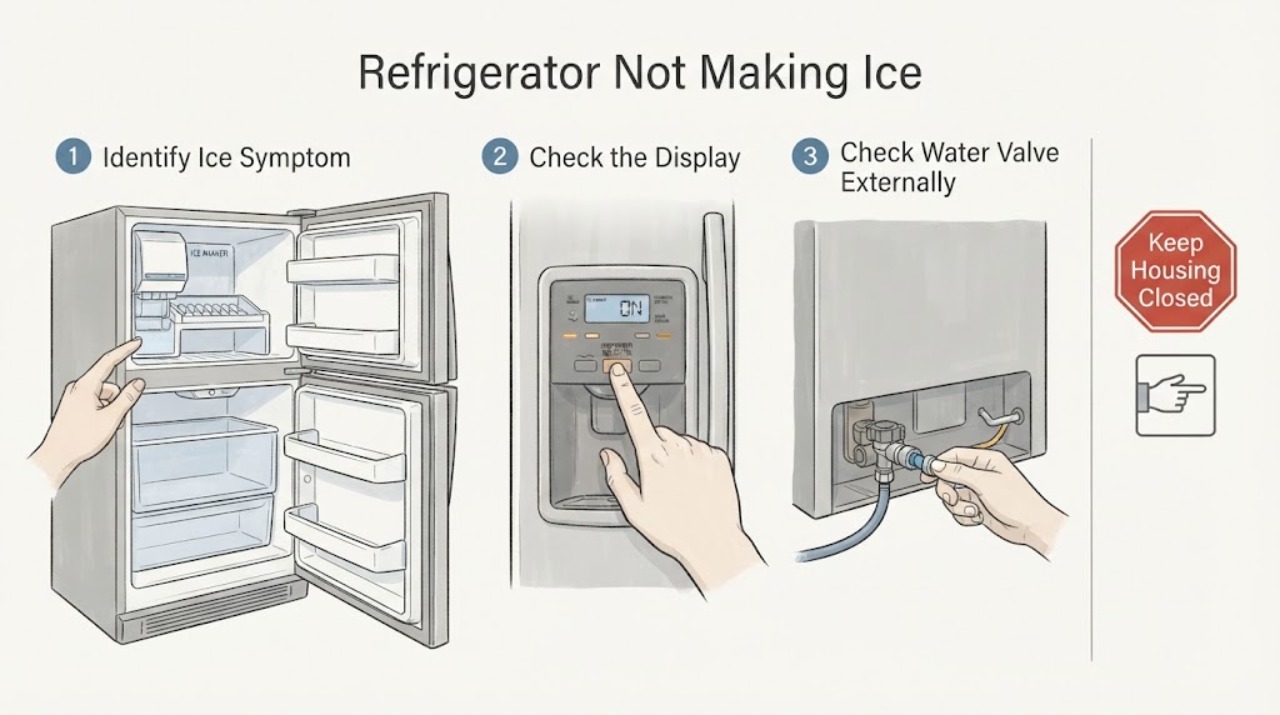
Work through in order
Diagnostic checks
Use only checks that match the exact appliance or system and its official guide.
-
Check 1
Inspect the accessible ice storage area and record whether there are no cubes, only slow production, cubes frozen together, cubes that will not dispense, or frost around the ice-maker or freezer drawer. Record the full Haier model and any display message.
Expected result: No cubes are present, cubes exist but clump, the dispenser alone fails, the freezer is warm, or frost physically interferes with the ice area.
Next step: Use the setting, water, recovery, frost, or service branch below. Stop for a leak, damaged wiring, smoke, or water near electrical equipment.
Stop if: Do not force the ice maker or continue operation with a leak or electrical hazard.
Why this matters
Why: No production, poor production, clumping, and dispensing are different symptoms with different next checks; a model code or warm freezer changes the priority.
-
Check 2
Check the display or control panel for the ice-maker-on state and compare it with the exact Haier model manual. Use only a clearly identified user control; do not enter diagnostics or copy a button sequence from another model family.
Expected result: The ice maker is visibly off, its control state is unclear, it is on, or the panel shows a model-specific warning.
Next step: Turn the ice maker on only with the exact model-approved control and reassess after the normal production period. Arrange service for a persistent warning or a control that will not respond.
Stop if: Do not hold unverified button combinations, bypass a control, or open the control panel.
Why this matters
Why: Haier documents different on/off controls and first-power-up defaults across named model families, so an absent ice icon may be a setting rather than a component failure.
-
Check 3
From a dry, safe position, verify that the external water valve connected to the refrigerator is open and that another household tap has water. Look only for a visible leak or kink in an accessible section.
Expected result: The valve is closed, household water is unavailable, a visible supply section is kinked or leaking, or the external supply appears available.
Next step: Open only a clearly identified valve when the area is dry and safe. Arrange qualified service for a leak, hidden hose, internal valve, or no ice after normal water supply is restored.
Stop if: Do not loosen a pressurized hose, remove an inlet valve, or operate with water near electrical equipment.
Why this matters
Why: Haier lists a closed refrigerator water valve as a no-ice cause. A leak or a supply path that needs disconnection is not an owner repair, and normal external supply does not prove that an internal valve is working.
-
Check 4
Record whether the refrigerator was recently installed, reconnected, or frequently opened, and whether the freezer is visibly holding its normal frozen-food condition. Leave the setting at the exact manual's normal range and allow the model-appropriate recovery period before judging a new ice cycle.
Expected result: The appliance is newly powered, the freezer is warmer than expected, doors have been opened frequently, or the freezer is stable but ice production remains absent.
Next step: Allow recovery without repeatedly changing controls. If the freezer remains warm or ice does not begin after the model-appropriate period, arrange refrigerator service rather than accessing the sealed or electrical system.
Stop if: Do not set unknown extreme temperatures, block freezer airflow, or open refrigeration panels.
Why this matters
Why: Haier says recent power-up and insufficient freezer cooling can delay ice production, and frequent door opening or warmer freezer conditions can reduce capacity. A stable freezer with no production makes a control or water path more likely.
-
Check 5
Inspect the accessible ice box, drawer, and surrounding surfaces for cubes frozen together, oversized cubes, or frost that prevents movement. If the exact manual permits a user-level ice or drawer check, use only the supplied or plastic tool and keep hands clear of mechanisms.
Expected result: Cubes are clumped, the ice box is overfilled, frost blocks movement, the ice area is clear, or the ice maker appears to need internal access.
Next step: Follow only the exact manual for clearing an accessible ice box and reassess. Stop for hidden ice, a jammed mechanism, leaks, or a condition requiring an internal panel or motor access.
Stop if: Do not chip ice, apply direct heat, force the ice mold or auger, or open the rear or electrical panel.
Why this matters
Why: Haier associates clumping with oversized water fill, long door opening, or infrequent use and warns against sharp tools for freezer ice. A clear ice area with no new cubes points back to water, temperature, control, or service diagnosis.
-
Check 6
Provide Haier service with the model, ice-maker control state, freezer recovery history, water-valve observation, ice-box condition, last successful ice production, and any code or leak. Leave the ice maker unused when the safe external checks do not restore production.
Expected result: The ice maker is on, water is available, the freezer is stable, the ice area is clear, but no cubes appear; or there is a leak, fault message, warm freezer, damaged wiring, or repeated failure.
Next step: Arrange authorized Haier or qualified appliance service. Isolate water or power only from a safe external control when necessary and feasible, and protect food if the freezer is not maintaining temperature.
Stop if: Do not open panels, access the inlet valve or wiring, bypass the ice-maker control, perform live testing, or replace parts by guesswork.
Why this matters
Why: An internal fill valve, water path, motor, sensor, heater, control, wiring, or freezer-temperature issue may be involved and cannot be selected safely from a generic model-free procedure.
Use your observations
Decision map
Find the observation that best matches what you see, then follow the next safe action.
-
PATH 01Safety boundary
What you see
The ice-maker icon or exact model control shows off, or the refrigerator uses a model family that defaults to off after first power-up.
Do this next
Use only the exact manual-approved control, then allow the normal production period and reassess.
Why this path and its safety boundary
Why it matters: No ice is expected until the ice maker is enabled; Haier's control sequence differs by model family.
Safety stop: Do not copy a button sequence from another Haier model or enter service diagnostics.
-
PATH 02Safety boundary
What you see
The external refrigerator water valve is closed, household water is unavailable, or a visible supply problem is present.
Do this next
Restore only a clearly identified external valve when dry and safe; arrange service for leaks, hidden hoses, or no ice after supply is restored.
Why this path and its safety boundary
Why it matters: Haier identifies a closed water valve as a direct no-ice possibility, but normal external supply does not verify the internal valve or fill path.
Safety stop: Do not loosen pressurized connections or work near water and electricity.
-
PATH 03Safety boundary
What you see
The refrigerator was recently powered, the freezer is not yet stable, or frequent door opening or a warmer freezer condition coincides with slow production.
Do this next
Allow model-appropriate recovery and avoid frequent door opening. Arrange service if the freezer remains warm or production never begins.
Why this path and its safety boundary
Why it matters: Haier says freezer temperature and recovery time affect ice production; this pattern does not by itself prove an ice-maker failure.
Safety stop: Do not use extreme unknown settings or block airflow.
-
PATH 04Safety boundary
What you see
Cubes are frozen together, oversized, or physically blocked by frost in the accessible ice box or drawer, while the freezer otherwise holds temperature.
Do this next
Follow only the exact manual for an accessible ice-box check or plastic-tool defrost step. Call service for a jammed mechanism, hidden frost, leak, or recurrence.
Why this path and its safety boundary
Why it matters: Haier associates clumping with fill, door-opening, or infrequent-use conditions and warns against sharp tools on freezer ice.
Safety stop: Do not chip ice, apply direct heat, or force the ice maker or auger.
-
PATH 05Safety boundary
What you see
The ice maker is enabled, water is externally available, freezer recovery is adequate, and the accessible ice area is clear, but no cubes are made or a code, leak, or warm freezer persists.
Do this next
Leave the unit off or the ice maker unused as appropriate and arrange Haier or qualified appliance service with the recorded observations.
Why this path and its safety boundary
Why it matters: An internal valve, fill path, ice-maker motor or sensor, control, wiring, or freezer-temperature issue is more likely and requires the exact model.
Safety stop: Do not open panels, bypass controls, perform live electrical work, or replace an internal part by guesswork.
Helpful context
Understand the symptom
Separate no ice from no dispensing
Look in the ice storage area before changing anything. If there are no new cubes, investigate the ice-maker setting, freezer cooling, and water supply. If cubes are present but the dispenser gives nothing, the dispenser selector or a clumped ice supply is a different path. Haier's no-ice guidance also discusses cubes frozen together and a dispenser selector arm, so do not treat a dispensing fault as proof that the ice maker is not producing.
Confirm the ice maker is enabled on this model
Check the display or control panel for an ice-maker-off indication. Haier documents several different control sequences: some named models use paired buttons, some use a dedicated Ice ON/OFF control, and some have different behavior after power is reconnected. These sequences are not interchangeable. Record the full model and follow only its manual; do not hold random buttons or enter a service mode.
Check the external water supply
From a dry, safe position, verify that the water valve connected to the refrigerator is open and that the household water supply is available. Haier identifies a closed valve as a direct no-ice possibility. Do not loosen the supply hose or remove a filter housing to investigate flow without the exact model instructions; a leak or water near electrical equipment is a stop condition.
Allow for freezer recovery and normal production time
A refrigerator that was just installed, recently powered on, or has had frequent door opening may not have reached the freezer condition needed for ice production. Haier also describes a cycle taking time and identifies frequent door opening or a warmer freezer setting as factors that reduce capacity. Keep the door closed as normally required and assess production only after the model-appropriate recovery period; do not keep changing settings in a way that risks freezing stored food.
Look for frost or clumped ice without forcing it
Visually check the accessible ice storage box and drawer surfaces for cubes frozen together or frost that prevents normal movement. Haier identifies clumped cubes, oversized cubes, long door opening, and infrequent ice use as different possibilities. Its freezer guidance says not to use sharp tools on ice; use only the model-approved plastic scraper or defrost approach, and do not apply direct heat near the liner, wiring, or refrigeration components.
Escalate water, temperature, and control faults
If the ice maker is enabled, the external water valve is open, the freezer has had enough recovery time, and the accessible ice area is clear but no cubes appear, the remaining cause may involve an inlet valve, fill path, ice-maker motor or sensor, control, wiring, or freezer temperature system. Haier provides model-specific manuals and service appointment routes. Give the technician the model, control state, freezer symptoms, water observations, and the date of the last successful ice cycle.
Safety boundary
Stop conditions
- Stop for water near electrical equipment, a supply leak, smoke, burning odor, damaged wiring, an unstable appliance, or a persistently warm freezer containing food.
- Do not open rear, electrical, control, or refrigeration panels or access an inlet valve, heater, motor, sensor, or wiring.
- Do not chip ice with sharp tools, apply direct heat, force an ice mold or auger, or bypass the ice-maker control.
- Use only the exact model's control, ice-box, and defrost guidance; Haier button sequences and ice-maker architectures vary by model family.
- Arrange service when safe external checks do not restore ice production or a code, leak, warm freezer, or repeated failure remains.
When checks do not resolve it
Need a professional?
Arrange model-specific Haier refrigerator service when the ice maker is enabled, the external water valve is open, the freezer has had the model-appropriate recovery period, and the accessible ice area is clear but no cubes appear; also call for a persistent code, leak, warm freezer, damaged wiring, jammed mechanism, or any internal valve, heater, motor, sensor, or control diagnosis. Protect food if freezer temperature is not stable and stop immediately for water near electricity, smoke, burning odor, or exposed wiring.
Safety scope: This article covers model identification, user-control observation, external water-valve observation, accessible ice-box inspection, and model-approved plastic-tool or defrost checks. Do not open panels, access internal valves or wiring, force mechanisms, apply direct heat, or perform live testing.
Read the exact guide
Official sources
- Low ice-making capacityHaier · Haier India refrigerator ice-maker support guidance; the stated cycle and sensor behavior are model-specific and are not universal timing or temperature requirements.
- Icing in the freezer compartmentHaier · Haier India refrigerator freezer troubleshooting guidance; frost locations and defrost methods vary by model.
- Haier Service SupportHaier · Official Haier India support hub; available service channels and contacts vary by market and model.
- No ice cubesHaier · Haier India refrigerator support article; controls, water paths, ice-box layout, and dispenser architecture vary by model and region.
- How can I turn the ice maker on and offHaier · Haier India support article for named refrigerator model families; button sequences and first-power-up behavior must not be generalized.
- Haier Manual DownloadHaier · Official Haier support page for selecting a refrigerator model and its manual; model and regional availability determine instructions.
Community feedback
Share a repair observation
Share a plain-text repair observation. Accepted observations are published automatically; this page may take a moment to update.