
On this page
Start here
Quick answer
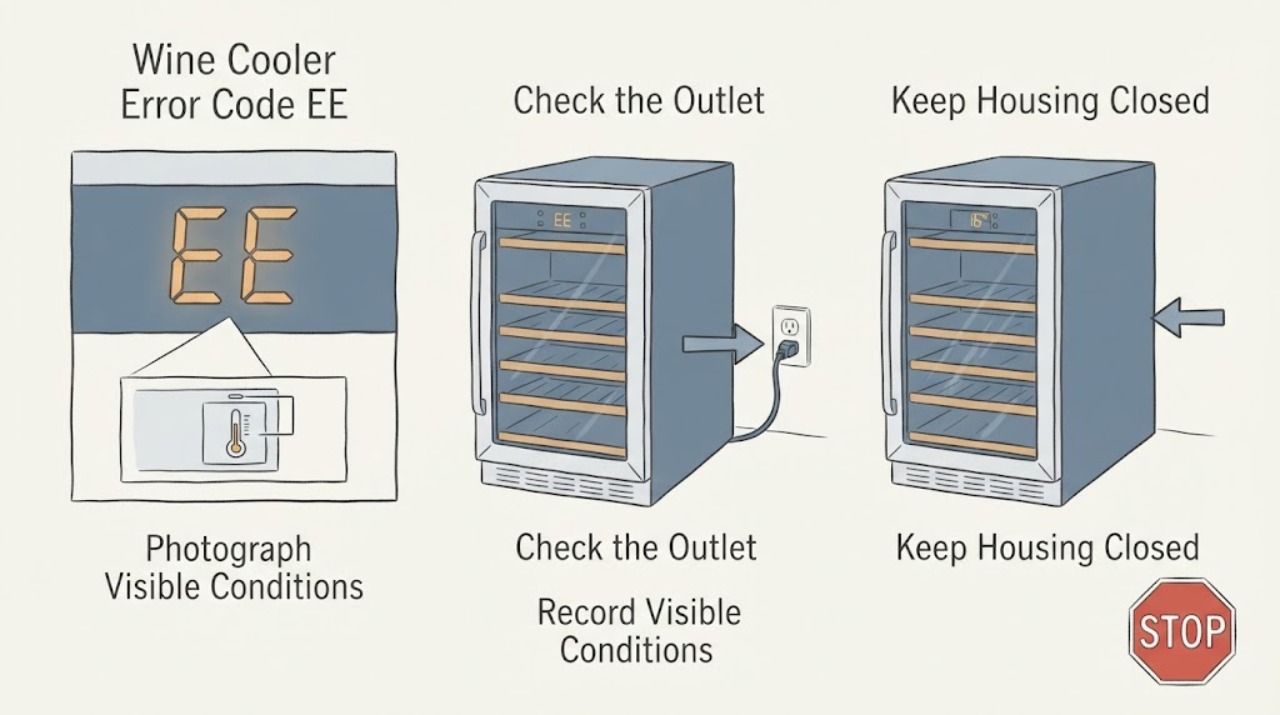
Haier's opened regional support tables list EE among wine-cellar error codes and group it with sensor or sensor-temperature errors, but Haier also warns that different series display different codes. Confirm the cooler's exact model, market, and complete display before applying the meaning. If EE disappears after one normal power-off/power-on but returns later, treat that as a recurring fault rather than a repair; Haier's guidance directs owners to service and says not to repair these codes themselves. Keep the unit away from water and do not open panels, bypass the sensor, or guess a replacement part. If the cooler is leaking, warm, or near electrical parts, handle that safety symptom first and keep the unit off until it can be inspected.
Work through in order
Diagnostic checks
Use only checks that match the exact appliance or system and its official guide.
-
Check 1
Photograph the complete display and confirm that the characters are exactly EE, not E1, E2, HH, LL, F1-F5, or a normal operating indicator. Record the full Haier model, serial or product number if visible, country or market, and whether the appliance is a wine cooler/wine cellar rather than a refrigerator or beverage cooler.
Expected result: The code and wine-cooler identity are clear, or the display is partial, ambiguous, or from another Haier product category.
Next step: Use the exact model manual or Haier service route when the identity is unclear. If the code is confirmed as EE on a wine cooler, continue to the external safety and service checks rather than copying a refrigerator code table.
Stop if: Do not guess from a similar code, enter an undocumented service mode, or use another brand's EE definition.
Why this matters
Why: Haier says different series display different error codes; the opened EE guidance is scoped to wine-cellar products and cannot establish the meaning for another appliance.
-
Check 2
From a dry, external position, check whether water is pooling under the cooler, reaching the plug, outlet, cord, controls, or rear electrical area, and note any smoke, burning odor, arcing, cracked glass, or abnormal heat. Do not move a loaded or wet cooler and do not remove a cover.
Expected result: The electrical area and floor are dry with no hazard, or water/damage is touching or approaching electrical parts.
Next step: If water is near electrics or there is smoke, arcing, burning odor, or visible damage, isolate power only from a dry and safely reachable disconnect, keep clear, and arrange qualified appliance/electrical service. Use local emergency procedures for active fire or immediate danger.
Stop if: Do not touch a wet plug or outlet, unplug through water, restore power to test, open rear covers, or continue operation with an active leak.
Why this matters
Why: EE has a sensor or sensor-temperature interpretation in Haier's wine-cellar table, but a water or electrical hazard changes the priority to safe isolation and service rather than code observation.
-
Check 3
Without opening the cabinet, record whether the cooler is still controlling temperature, whether the interior is becoming unusually warm, whether the compressor or fan runs unusually long, and whether EE remains continuously lit or blinks. Do not try to bypass the sensor or change a temperature setting as a substitute for diagnosis.
Expected result: EE remains while cooling is normal, EE accompanies a warm interior or abnormal run behavior, or the code is not currently visible.
Next step: Keep the exact code and temperature timeline for service. Protect temperature-sensitive wine or other contents if the cooler is not maintaining the model's normal conditions, and do not rely on a briefly cleared display as proof of recovery.
Stop if: Do not probe the liner, remove a temperature sensor, open the electronics, handle refrigerant, or test energized wiring.
Why this matters
Why: Haier groups EE with wine-cellar sensor or sensor-temperature errors, but the public guidance does not identify the failed part or establish a universal temperature threshold. Cooling symptoms help the technician but do not turn EE into a part-selection signal.
-
Check 4
If the exact manual allows a normal power restart and there is no hazard, switch the cooler off once, restore power once, and record the time and result. Do not repeatedly cycle the appliance or use a power reset to suppress the display while leaving an active leak or electrical concern connected.
Expected result: EE clears and stays away, EE returns immediately, or EE returns after a few hours or a normal cooling period.
Next step: For any return of EE, stop repeated resets and request Haier service with the code photo, model, market, and timing. If the cooler is warm or leaking, keep it off and arrange service sooner.
Stop if: Do not bypass a sensor, alter wiring, change a protective device, or continue cycling the unit until the code is hidden.
Why this matters
Why: Haier's regional guidance specifically warns that a code may disappear after power-off/power-on and reappear after several hours. A returning code is evidence of an unresolved fault, not evidence that the sensor circuit is repaired.
-
Check 5
Prepare the service handoff with the exact EE display, model and product/serial information, market, onset time, whether a power restart was attempted, whether EE returned after hours, interior temperature or cooling observations, and any leak or electrical-safety evidence.
Expected result: EE is persistent or recurring, the exact series cannot be matched, the cooler is warm, or there is any leak or electrical hazard.
Next step: Request qualified Haier appliance service; use a qualified electrician as well when the supply, outlet, cord, or water near electrics is involved. Keep the cooler off for an active leak, repeated trip, or unsafe heat.
Stop if: Do not order a part from EE alone, open the cabinet, test live wiring, bypass the alarm or sensor, or work on sealed-system components.
Why this matters
Why: Haier's opened wine-cooler guidance directs owners to service, and its regional table says the listed wine-cellar sensor or sensor-temperature codes require service. The code alone does not identify a compatible sensor, controller, or other part.
Use your observations
Decision map
Find the observation that best matches what you see, then follow the next safe action.
-
PATH 01Next step
What you see
The code is exactly EE on a confirmed Haier wine cooler, with no electrical or water hazard, and the cooler otherwise appears to control temperature normally.
Do this next
Record the code and model details and arrange Haier service rather than selecting a part or treating the code as a moisture symptom.
Why this path and its safety boundary
Why it matters: The opened Haier sources still group EE with wine-cellar sensor or sensor-temperature errors and direct the owner to service; normal cooling does not rule out a sensor-circuit fault.
-
PATH 02Next step
What you see
EE clears after one normal power restart but returns later, or the cooler shows EE again after several hours.
Do this next
Stop repeating resets and request service with the code recurrence time and cooling observations. Keep the cooler off if it is warm, leaking, or near electrical parts.
Why this path and its safety boundary
Why it matters: This matches Haier's warning that a displayed code can temporarily disappear after power cycling and reappear later; the underlying error remains unresolved.
-
PATH 03Next step
What you see
EE is accompanied by a warm interior, abnormal running, a leak, or water below the cabinet.
Do this next
Protect temperature-sensitive contents, stop use for an active leak or unsafe temperature, and arrange qualified Haier service. Do not open or tilt the cooler to trace the water.
Why this path and its safety boundary
Why it matters: The code remains a sensor/sensor-temperature service signal, while the cooling or leak symptom may affect the contents and safety. The public Haier sources do not establish which internal component caused the combination.
-
PATH 04Next step
What you see
Water reaches the outlet, plug, cord, controls, or rear electrical area, or there is smoke, burning odor, arcing, cracked glass, or repeated protection trips.
Do this next
If safe, isolate power from a dry position, keep clear, and obtain qualified appliance or electrical service. Use local emergency procedures for active fire or immediate danger.
Why this path and its safety boundary
Why it matters: This is an immediate safety stop and cannot be handled as a routine EE reset or sensor check.
Helpful context
Understand the symptom
What EE means on a Haier wine cooler
The opened Haier regional table places EE in the wine-cellar group and labels that group as a sensor or sensor-temperature error. The Philippines wine-cooler article independently lists EE among the wine-cellar codes and says to call service. This supports a code-specific service decision, not a universal diagnosis of one sensor, board, probe, or temperature value. Haier says different series display different codes, so do not transfer this meaning to a refrigerator, beverage center, or another model family.
Why a brief reset is not a fix
Haier's opened regional guidance says a code may disappear after power is turned off and back on, then reappear after a few hours. That behavior is useful evidence for a service handoff, not proof that the sensor circuit has recovered. Do not keep cycling the cooler or dismantle it to chase the code; preserve the exact display, timing, temperature behavior, and model information for service.
When checks do not resolve it
Need a professional?
Request qualified Haier service when EE persists or returns, even if a power restart temporarily clears it, because Haier's wine-cooler guidance treats the code as a service condition. Arrange urgent appliance/electrical help for an active leak, water near electrics, smoke, arcing, burning odor, cracked glass, abnormal heat, or repeated protection trips.
Have this ready
- Exact EE display photo, Haier model and product/serial information, market, onset and restart history, recurrence timing, cooling observations, leak location, and any electrical-safety signs.
Common questions
FAQ
What does EE mean on a Haier wine cooler?
Haier's opened regional wine-cellar table groups EE with sensor or sensor-temperature errors, and Haier's wine-cooler support page lists EE among the codes for which the owner should call service. Different Haier series can use different codes, so confirm the exact model and market.
Why did Haier EE disappear after I turned the wine cooler off and on?
Haier warns that a displayed code may disappear after power-off/power-on and return after a few hours. Treat a later return as an unresolved fault, not a successful repair, and avoid repeated resets while arranging service.
Can I replace the sensor myself for Haier EE?
No safe universal part fit or owner replacement procedure is established by the opened Haier sources. The code identifies a sensor or sensor-temperature error group, not one guaranteed component; use qualified Haier service and provide the exact model and code history.
What if the Haier wine cooler shows EE and is leaking?
Treat the leak and any water near the outlet, plug, cord, controls, or rear electrical area as the priority. If safe, isolate power from a dry position, keep the cooler off, do not tilt or open it, and arrange qualified appliance or electrical service.
Read the exact guide
Official sources
- The error code for the wine coolerHaier Philippines · Opened Haier Philippines support page specifically for wine coolers; it lists EE among wine-cellar codes and directs owners to service, while noting that different series display different codes.
- The error code for the refrigerator and freezerHaier Bangladesh · Opened Haier Bangladesh support table; wine-cellar grouping is used with market and model caveats, not as a universal code table for every Haier series.
- The error code for the refrigerator and freezerHaier Pakistan · Opened Haier Pakistan support table; used to corroborate the wine-cellar EE grouping, model variation, temporary disappearance after power cycling, and no-owner-repair boundary.
Community feedback
Share a repair observation
Share a plain-text repair observation. Accepted observations are published automatically; this page may take a moment to update.