
On this page
Start here
Quick answer
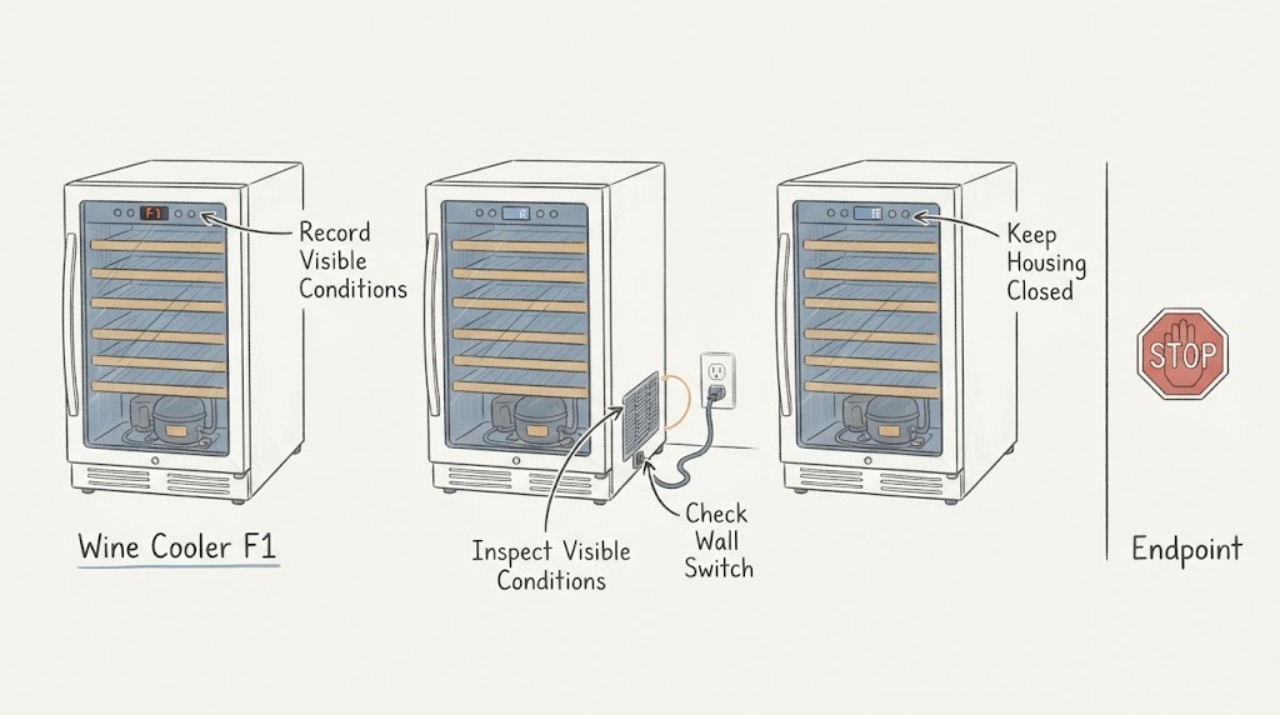
On Haier wine cellars, the official F1/F4 error-code page says F1 means the compressor has been running continuously for more than three hours and directs the owner to service. Pressing the set or light button can silence the alarm, but it does not clear the code or fix the condition. Record the exact model and what the cooler is doing, check only the safe external power and control conditions, and arrange Haier or qualified refrigeration service if F1 remains. Do not open the cabinet or keep restarting a cooler that is warming, leaking, or making abnormal electrical noises.
Work through in order
Diagnostic checks
Use only checks that match the exact appliance or system and its official guide.
-
Check 1
Write down F1 exactly as displayed, note whether the compressor appears to run continuously, and record the wine cooler's exact model and serial information from the rating label without moving an unstable unit.
Expected result: F1 is stable, intermittent, or accompanied by another code; the compressor runs continuously or cycles normally; and the model can or cannot be identified.
Next step: Use the exact model manual and keep the code history for service. If the model cannot be confirmed, treat the display as unresolved and arrange Haier support rather than guessing at a sensor or compressor diagnosis.
Stop if: Do not remove panels, probe wiring, or keep operating solely to force the code to return.
Why this matters
Why: Haier defines F1 as a compressor running continuously for more than three hours, but the product support path and code table can depend on the exact wine-cellar model.
-
Check 2
If the alarm is sounding, press the set or light ON/OFF button once as Haier describes, then observe whether the buzzer stops while F1 remains on the display.
Expected result: The buzzer stops but F1 remains; the buzzer or display does not respond; or another alarm appears.
Next step: Continue with documentation and service preparation. Do not repeatedly press controls or treat the alarm silence as permission to ignore a warming cooler.
Stop if: Do not bypass the display, disconnect sensors, or repeatedly power-cycle the unit to hide F1.
Why this matters
Why: Silencing the alarm acknowledges the alert only. Haier states that F1 stays displayed until the underlying failure is resolved, so a quiet display is not a repair result.
-
Check 3
From a dry, safe position, confirm the cooler is connected to a working outlet, switched on, and set to a cooling temperature. Inspect only the visible cord, plug, door closure, and surrounding clearance; do not remove the rear cover.
Expected result: The outlet is dead, the unit is off, the control is not set to cooling, the cord or plug is damaged, the door cannot close, or the visible setup is normal but F1 remains.
Next step: Correct only a safe outlet or control-setting issue and follow the exact model guide. If F1 remains, the unit runs continuously, or any cord, door, or enclosure problem is present, leave it off and arrange service.
Stop if: Do not use an unsafe outlet, extension workaround, blocked ventilation path, or cabinet access as a test.
Why this matters
Why: A basic power or control setting can explain a non-running cooler, but a normal visible setup with F1 still indicates the official long-running-compressor service condition rather than a user-adjustable setting.
-
Check 4
Before contacting service, record whether wine is warming, whether the compressor ever cycles off, the displayed temperature, any unusual sound or odor, visible moisture or leakage, and when F1 first appeared.
Expected result: F1 remains with continuous running, the cabinet is warming, or there is a leak, burning odor, unusual electrical noise, repeated breaker trip, or visible damage.
Next step: Keep the cooler unplugged when it is safe to do so and arrange Haier or qualified refrigeration service. Provide the exact model, F1 history, temperature behavior, and observations.
Stop if: Do not open the sealed system, replace a sensor or compressor, or continue running a hot, leaking, smoky, or electrically abnormal unit.
Why this matters
Why: These observations increase the urgency and help a technician distinguish a long-running cooling condition from an electrical, airflow, sensor, or refrigeration fault; they do not identify a replacement part by themselves.
Use your observations
Decision map
Find the observation that best matches what you see, then follow the next safe action.
-
PATH 01Next step
What you see
F1 appears and the compressor has been running continuously for more than three hours, with the wine cellar otherwise intact.
Do this next
Silence the alarm if needed, record the model and temperature behavior, and arrange Haier or qualified refrigeration service.
Why this path and its safety boundary
Why it matters: This matches Haier's official F1 description; the manufacturer lists service as the resolution rather than a user reset or part replacement.
-
PATH 02Next step
What you see
The alarm stops after pressing set or light ON/OFF, but F1 remains on the display.
Do this next
Do not resume normal use on the basis of silence. Use the exact model support route and arrange service if the code remains or the cooler is warming.
Why this path and its safety boundary
Why it matters: Only the buzzer was acknowledged; Haier says the F1 code remains until the failure is resolved.
-
PATH 03Next step
What you see
The visible outlet, power switch, cooling setting, door closure, and clearance are normal, but F1 remains or the compressor never cycles off.
Do this next
Leave the cooler off if it is warming or operating abnormally and arrange qualified service. Do not guess at a sensor, fan, or compressor replacement.
Why this path and its safety boundary
Why it matters: A simple power or setting issue is less likely; the code has reached the manufacturer service boundary and may involve temperature control, airflow, sensing, or refrigeration components.
-
PATH 04Next step
What you see
F1 is accompanied by warming wine, a burning or electrical odor, smoke, a damaged cord, repeated breaker trips, uncontrolled leakage, or cabinet damage.
Do this next
Stop using the wine cooler, isolate power only from a dry and safe position, protect nearby contents from leakage, and arrange qualified service.
Why this path and its safety boundary
Why it matters: The condition is more urgent than a display-only service flag and may involve an electrical, fire, water, or refrigeration hazard.
Helpful context
Understand the symptom
F1 is a service flag, not a normal reset message
Haier's official wine-cellar chart treats F1 as a long-running-compressor condition and lists service as the solution. Silencing the buzzer is only an alarm acknowledgement; it does not establish that the compressor, sensors, airflow, or temperature control are healthy. Use the exact model support material before interpreting any other display or temperature behavior.
Keep the external checks limited
Haier provides model and product-line support for wine and beverage centers, including manuals and service. A safe first pass can confirm that the unit is plugged into a working outlet, turned on, and set to a cooling temperature, but an F1 that remains after those visible conditions are normal should be handled as a service issue rather than a cabinet repair.
Only after diagnosis
Potential parts
- temperature sensor or control component
Only consider a sensor or control component after the exact model documentation and qualified diagnosis identify it as the cause of the F1 condition.
F1 alone does not establish sensor fit or failure; confirm the exact model and manufacturer part information before ordering. - compressor or refrigeration service
Only consider compressor or sealed-system work after Haier or qualified refrigeration service confirms that continuous operation is caused by that subsystem.
Do not open the sealed system or select a compressor based on the F1 code alone.
When checks do not resolve it
Need a professional?
Arrange Haier or qualified refrigeration service when F1 remains after the safe visible power and control check, the compressor continues running, the cooler is warming, the code recurs, or any sensor, fan, compressor, sealed-system, wiring, or cabinet work would be required. Provide the exact model, serial information, F1 history, displayed temperature, compressor cycling behavior, and any odor, noise, leak, or breaker observations.
Common questions
FAQ
What does F1 mean on a Haier wine cooler?
Haier's official wine-cellar error chart says F1 means the compressor has been running continuously for more than three hours and lists service as required. Confirm the exact model because support procedures can be model-specific.
Does pressing the light or set button fix Haier F1?
No. Haier says the set or light ON/OFF button can silence the alarm, but F1 remains displayed until the underlying failure is resolved.
Can I replace the compressor or sensor myself when F1 appears?
Do not choose or replace those parts from F1 alone. Check only the safe external conditions, record the exact model and symptoms, and arrange Haier or qualified refrigeration service for diagnosis.
Read the exact guide
Official sources
- Haier - Wine Cellar Error CodesHaier Appliances · Opened official Haier wine-cellar error-code guidance; it defines F1/F4 and directs service, while exact model procedures remain model-specific.
- Haier Wine Cellar - Not Coming On / Not RunningHaier Appliances · Opened official Haier wine-cellar support for the limited external outlet, power, thermostat, and service checks used here.
- Support by Product Line | Haier AppliancesHaier Appliances · Opened official Haier product-line support for Wine & Beverage Centers, model-number manuals, parts, and service scheduling.
Community feedback
Share a repair observation
Share a plain-text repair observation. Accepted observations are published automatically; this page may take a moment to update.