
On this page
Start here
Quick answer
In Haier Appliances' official Wine Cellar Error Codes chart, F3 with the red indicator and buzzing alarm means both sensors have failed, and the stated solution is service. That is a model- and market-scoped service diagnosis, not permission to replace sensors or open the cabinet. Haier's official regional wine-cooler support also says different series can display different codes, so record the exact model, market, complete display, and serial information before applying the chart. Keep the cooler closed and stable, protect wine or other contents if temperatures are abnormal, and arrange qualified Haier service for F3 rather than repeatedly resetting or ordering parts from the code alone.
Before you begin
Safety first
- Do not open the wine cooler cabinet, bridge or test sensor wiring, perform live electrical tests, handle refrigerant, bypass controls, or order a sensor or board from F3 alone. Stop immediately for water near electrics, smoke, burning odor, sparks, a hot or damaged cord, repeated trips, severe overheating, or an unstable unit.
Work through in order
Diagnostic checks
Use only checks that match the exact appliance or system and its official guide.
-
Check 1
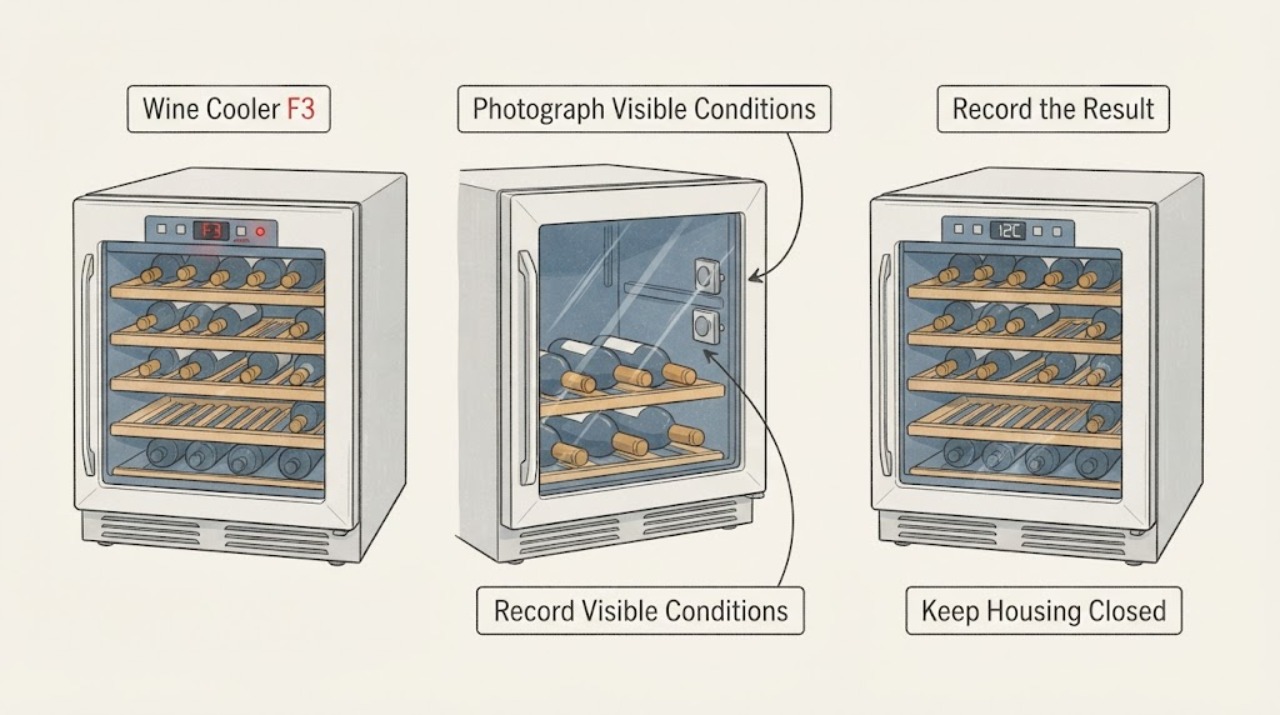
From a dry, safe position, photograph the full display and rating label. Record the exact characters, whether a red indicator or buzzer is active, the complete Haier model and serial number, market, and whether the unit is a wine cellar, wine center, or another beverage appliance. Do not remove panels or touch the sensor wiring.
Expected result: The appliance and market match the Haier wine-cellar chart and the display is exactly F3, or the product family, market, or code format is uncertain or different.
Next step: Use the exact model documentation or regional Haier support path and provide the identity record to service. If the code is not confirmed as F3, stop using this article's code meaning.
Stop if: Do not treat F1, F2, F4, F5, EE, ER, HH, LL, or a similar alarm symbol as F3, and do not open the electrical or cooling enclosure.
Why this matters
Why: A confirmed match supports the chart's both-sensors-failed service branch. An uncertain identity means the F3 meaning and any service procedure cannot safely be transferred from another Haier series.
-
Check 2
Without dismantling the cooler, record whether the red indicator is lit, whether the buzzer sounds, whether the display remains F3 after the alarm is acknowledged by the model's normal controls, and whether each zone is warming, stable, or visibly outside its normal setting. Keep the door closed except for necessary checks and do not repeatedly cycle power.
Expected result: F3 remains with a red indicator or buzzer, the alarm clears but F3 remains, one zone is abnormal, both zones are abnormal, or temperatures appear normal despite F3.
Next step: Record the pattern and arrange qualified Haier service for F3. Protect wine or other contents from unsafe temperature changes while waiting; do not select one sensor or a control board from the code alone.
Stop if: Do not bridge sensors, probe connectors, force the alarm controls, or continue operating around smoke, burning odor, water near electrics, a hot cord, or repeated electrical trips.
Why this matters
Why: The U.S. Haier chart pairs F3 with both sensor failure and a red indicator/buzzing condition. Normal current temperature does not disprove a sensor or control reporting fault, and a single warm zone does not prove only one sensor has failed.
-
Check 3
Check only visible conditions that can affect temperature or access: the door closes fully, the gasket is clean and intact, bottles are not blocking the visible air path, the unit has the clearance required by its manual, and the cooler is stable. If a user-accessible control shows a zone setting, record it without entering a diagnostic or service mode.
Expected result: A door, gasket, loading, airflow, installation, or setting issue is visible, or the external arrangement is normal while F3 remains.
Next step: Correct only a plainly visible condition allowed by the exact manual, then monitor without repeatedly resetting. Arrange service if F3 remains, returns, or either zone becomes unsafe.
Stop if: Do not remove the gasket, fan cover, rear panel, evaporator cover, or control panel, and do not move a loaded cooler through water or around a wet electrical connection.
Why this matters
Why: A visible condition may affect wine temperature but does not explain away Haier's F3 sensor-failure report. Normal external conditions with persistent F3 leave sensor, wiring, control, or related diagnosis for service.
-
Check 4
Do not attempt an owner sensor test or replacement. The opened Haier wine-cellar chart gives F3 a service-required outcome; prepare the exact model and symptom record instead. If the F3 display is from a different regional series, use that series' support documentation rather than a generic Haier reset.
Expected result: F3 persists, returns after a normal control interaction, the product series is different from the chart, or the cooler develops abnormal temperature, noise, water, odor, or electrical symptoms.
Next step: Leave the cooler in a safe state and arrange qualified Haier service. Provide the code photo, model, serial number, market, zone temperatures, alarm behavior, and any visible conditions.
Stop if: Do not run a diagnostic mode, bypass sensor inputs, perform live electrical tests, handle refrigerant, or order sensors or boards from F3 alone.
Why this matters
Why: F3 is a technician-facing sensor-failure report in the applicable chart, and a regional mismatch adds uncertainty. The code cannot distinguish sensor element, harness, controller input, or another condition without model-specific service diagnosis.
-
Check 5
If there is water near the plug or controls, a damaged or hot cord, smoke, burning odor, sparks, severe overheating, or an unstable cabinet, stop handling the unit. Disconnect power only through a dry, safely reachable normal control and only if doing so does not require touching the hazard. Otherwise leave it alone and obtain qualified help.
Expected result: The cooler is dry and stable with only F3, or a separate electrical, water, fire, or mechanical hazard is present.
Next step: For a safe unit, arrange Haier service with the full record. For a hazardous unit, keep clear, protect nearby contents and property, and obtain appliance or electrical service before restoring power.
Stop if: Do not unplug a wet connection, move the cooler through water, restore power to test, or open covers to find the sensors.
Why this matters
Why: The F3 service branch is secondary to immediate electrical and property safety. A hazard can make continued temperature observation or alarm handling unsafe.
Use your observations
Decision map
Find the observation that best matches what you see, then follow the next safe action.
-
PATH 01Next step
What you see
The product and market match the Haier Wine Cellar Error Codes chart, the display is exactly F3, and the red indicator or buzzer is present or F3 persists.
Do this next
Stop troubleshooting at the owner level and arrange qualified Haier service with the exact model, serial number, code photo, alarm state, and zone temperatures.
Why this path and its safety boundary
Why it matters: This matches Haier's documented F3 condition: both sensors have failed and service is required. It does not identify which sensor or control component should be replaced.
-
PATH 02Next step
What you see
F3 appears on a different Haier regional series, the display format is different, or the appliance is a beverage center rather than the platform described by the opened chart.
Do this next
Use the exact model and regional support documentation, and do not carry over a sensor-failure or reset decision until the matching code table is confirmed.
Why this path and its safety boundary
Why it matters: Haier states that different wine-cooler series can display different codes, so the U.S. F3 meaning is not established for the unmatched identity.
-
PATH 03Next step
What you see
F3 is shown but the cooler is dry, stable, and appears to hold normal zone temperatures without smoke, odor, sparks, water, or damaged wiring.
Do this next
Keep the code and temperature record, avoid repeated resets or part substitution, and book service for F3.
Why this path and its safety boundary
Why it matters: Normal current temperature does not clear a both-sensors-failed report; a sensor or control can report a fault before the compartment visibly warms.
-
PATH 04Next step
What you see
F3 is accompanied by a warm or rapidly changing zone, water near electrics, smoke, burning odor, sparks, a hot or damaged cord, repeated electrical trips, or an unstable cabinet.
Do this next
Stop operation, isolate power only from a dry safe position if possible, keep clear of the hazard, and obtain qualified appliance or electrical service.
Why this path and its safety boundary
Why it matters: The immediate safety condition overrides routine code interpretation and may cause food or wine loss, property damage, fire, or shock risk.
Helpful context
Understand the symptom
What F3 means on the documented Haier wine-cellar platform
Haier Appliances' opened Wine Cellar Error Codes article applies to a wine cellar and lists F3 as a red indicator with buzzing where both sensors have failed. Its solution is service. The chart identifies the reported subsystem at the control level; it does not establish which physical sensor, connector, wiring path, controller, or replacement part is defective.
Why model and market still matter
A separate official Haier regional support page says different wine-cooler series display different error codes and lists F3 among the possible wine-cellar codes without assigning one universal meaning. Treat the U.S. F3 definition as applicable only when the product family and market match the opened chart. Record the model, serial number, region, exact display, and whether the cooler has one or two temperature zones before service.
When checks do not resolve it
Need a professional?
Arrange qualified Haier service when F3 is confirmed on the matching wine-cellar platform, persists or returns, the model or market cannot be matched to the chart, or any temperature, water, electrical, fire, or mechanical hazard appears. Haier's opened chart explicitly marks F3 as service required.
Safety scope: Do not open the wine cooler cabinet, bridge or test sensor wiring, perform live electrical tests, handle refrigerant, bypass controls, or order a sensor or board from F3 alone. Stop immediately for water near electrics, smoke, burning odor, sparks, a hot or damaged cord, repeated trips, severe overheating, or an unstable unit.
Have this ready
- Provide the exact F3 display photo, red-indicator and buzzer state, model, serial number, market, wine-cooler type, zone temperatures, door and gasket condition, visible airflow or clearance observations, and the time pattern.
Common questions
FAQ
What does F3 mean on a Haier wine cooler?
On Haier Appliances' opened U.S. Wine Cellar Error Codes chart, F3 with a red indicator and buzzing means both sensors have failed and service is required. Confirm the exact model and market first because Haier says different wine-cooler series can display different codes.
Can I reset Haier wine cooler F3?
The opened Haier F3 chart does not provide an owner reset; it directs service. Record the code and model, keep the cooler safe and stable, and do not repeatedly cycle power or enter a diagnostic mode from another series.
Does F3 tell me which sensor to replace?
No. The chart says both sensors have failed at the system-report level. It does not identify a particular physical sensor, connector, wiring path, controller, or compatible part. Qualified service and the exact model are needed before replacement.
Read the exact guide
Official sources
- Haier - Wine Cellar Error CodesHaier Appliances · Directly applicable to the Haier wine-cellar platform covered by the article: F3 is listed with a red indicator and buzzing as both sensors failed, with service required.
- Haier Refrigeration - Wine CentersHaier Appliances · Directly applicable to product-category identity: Haier describes a dual-zone wine center with separate temperature controls and a door alarm; it does not define F3.
- The error code for the wine coolerHaier Philippines · Directly applicable to model/market scope: Haier says different series display different error codes, lists wine-cellar codes including F3, and directs owners to service.
Community feedback
Share a repair observation
Share a plain-text repair observation. Accepted observations are published automatically; this page may take a moment to update.