
On this page
Start here
Quick answer
If a Hisense washing machine does not complete its cycle, first note where it stopped and any message on the display. Check that the door is fully closed, the machine is not paused or locked, and the load is not badly unbalanced. Then make safe external observations of the water supply and drain path; excess foam can also pause a program while the washer defoams, and the displayed time can change while the washer senses, fills, or heats. If water is trapped, the door stays locked, a fault returns, or you see a leak, scorching, overheating, a spark, or a breaker trip, stop and arrange qualified service.
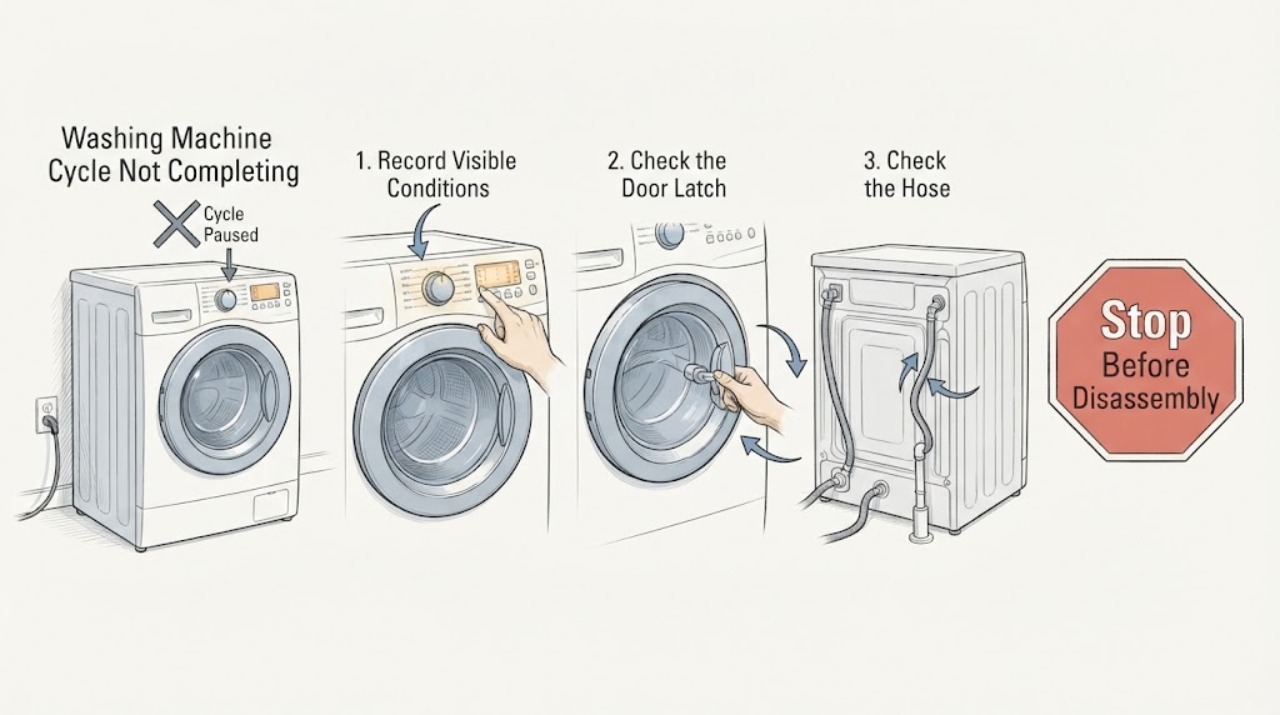
Work through in order
Diagnostic checks
Use only checks that match the exact appliance or system and its official guide.
-
Check 1
Leave the controls as they are and record the exact stage, remaining-time display, indicator, and any fault message. Note whether the drum is empty, partly full, full of water, full of suds, or holding a wet load.
Expected result: A changing time with occasional tumbling suggests the washer is still sensing, heating, balancing, or defoaming. A frozen display, repeated alarm, or no movement with water remaining is a different branch.
Next step: Follow the door and pause check for a stopped or paused program, the foam check for visible suds, and the drain check if water remains; record any code exactly rather than guessing its meaning.
Why this matters
Why: Hisense describes adaptive time changes and fault interruptions separately; the display and water level help distinguish a normal correction from a blocked cycle.
-
Check 2
With the drum stopped, press Start/Pause once if the display shows a pause state, and check that the door closes fully with its latch engaged. If a child-lock indicator is lit, use only the model's documented unlock control; never pull the door open.
Expected result: If the washer resumes after the door closes and Start/Pause is pressed, the cycle was paused or the door was not sensed as closed. If the door remains locked, an alarm returns, or the washer will not respond, note that result.
Next step: Do not force a locked door. If the drum contains water or the lock fault returns, leave the machine off and arrange service after the safe water and electrical checks below.
Why this matters
Why: Hisense instructions state that an unclosed or unengaged door prevents starting and that a paused program resumes only after the door is closed and Start/Pause is used.
-
Check 3
With the washer stopped and dry on the outside, inspect the water tap, inlet hose, and visible hose connections. Confirm the tap is open, the hose is not sharply kinked or crushed, and there is no active leak; do not loosen a hose or reach behind a wet appliance.
Expected result: A closed tap, visibly kinked hose, damaged hose, or no water entering during a fill stage points to a supply-side interruption. A normal visible supply with no fill still leaves an inlet filter, valve, sensor, or control fault possible.
Next step: Correct only an obvious tap or hose-position issue without dismantling anything, then make one resume attempt. If the machine does not fill or the hose leaks, stop and arrange qualified service.
Why this matters
Why: Hisense manuals identify water supply and inlet conditions as factors that can interrupt or extend a program, while a damaged or leaking hose is a safety concern rather than a reason to keep testing.
-
Check 4
If water remains in the drum or the washer stopped before draining, do not open the door. From a dry standing position, inspect the external drain hose for a kink, crushing, or an obviously blocked end. If your model manual provides an emergency-drain or pump-filter procedure, use it only with the washer disconnected from power, the water contained safely, and the machine cool.
Expected result: Water that cannot leave, a drain hose that is pinched, or a pump-filter warning points to a drain-path branch. A clear visible hose with standing water suggests an internal pump, filter, sensor, or control problem.
Next step: Keep the door closed and stop if water is near electrical parts, the drain procedure is unclear, or the pump makes a harsh or burning sound. Arrange service for an unresolved drain fault.
Why this matters
Why: A washer cannot safely advance to spin or unlock its door while water level is unsafe; forcing the door can release hot or contaminated water and cause flooding.
-
Check 5
Look through the door for persistent suds and review the detergent amount and type against the model manual and detergent label. Do not add another chemical or run repeated high-speed tests while foam is present.
Expected result: A large amount of foam with a paused or slowly changing program supports the washer's defoaming branch; the machine may resume after the foam is reduced. Little or no foam with a full stop points elsewhere.
Next step: Allow the program to complete its defoaming pause and make one resume attempt. If foam persists, the cycle repeatedly pauses, or liquid leaks, stop using the machine and request service or model-specific guidance.
Why this matters
Why: Hisense troubleshooting guidance identifies excess foam as a reason the appliance may pause and then automatically resume, and it also identifies detergent choice and amount as operating factors.
-
Check 6
If the washer stopped or repeatedly extends the time during rinse or spin, pause it only when the door can unlock safely, then check for a tightly wound, single heavy item or an overloaded drum. Redistribute the load without reaching into a moving drum and close the door before pressing Start/Pause.
Expected result: A washer that resumes after the load is loosened or balanced was likely correcting an unbalanced or unsuitable load. Repeated stopping with a normal load indicates a separate drain, motor, door, or control issue.
Next step: Use the correct load size and one normal cycle attempt. If the drum bangs violently, will not turn, or the machine remains stopped with a balanced load, stop and arrange service.
Why this matters
Why: Hisense identifies imbalance and load sensing as causes of changed program timing and explains that the appliance can perform an automatic balance adjustment.
-
Check 7
If no water is trapped, there is no leak or burning smell, and the manual permits a restart, turn the washer off using its normal control, wait briefly, and start the same program once. Record whether the same message or stopping point returns.
Expected result: One successful restart after a temporary interruption suggests a recoverable control or supply disturbance. The same fault, a new fault code, or another stop at the same stage is a repeatable failure.
Next step: Stop testing after the single restart. Provide the model, code, stage, water level, load condition, and observations to a qualified Hisense service provider.
Why this matters
Why: Hisense troubleshooting instructions allow a controlled switch-off and repeat of the program for some disturbances, but persistent faults require authorized service rather than repeated resets.
Use your observations
Decision map
Find the observation that best matches what you see, then follow the next safe action.
-
PATH 01Next step
What you see
The display time changes but the drum occasionally tumbles and no fault is shown.
Do this next
Allow the washer to continue while observing for foam, balance correction, water intake, or heating delay; do not judge a changing estimate as an immediate failure.
-
PATH 02Next step
What you see
The washer is paused or the door is not sensed as closed.
Do this next
Close the door, press Start/Pause once, and never force the lock; use the model-specific child-lock instructions if a lock indicator is present.
-
PATH 03Next step
What you see
The washer has persistent suds and the program is paused.
Do this next
Allow the defoaming process to work and make one resume attempt; persistent foam or leakage needs service guidance.
-
PATH 04Next step
What you see
The washer stopped while filling or the visible water supply is closed, kinked, or leaking.
Do this next
Correct only an obvious tap or hose-position issue without dismantling, then try once; a failed fill or damaged hose requires service.
-
PATH 05Next step
What you see
Water remains in the drum or the washer cannot drain before spin.
Do this next
Keep the door closed, avoid wet electrical contact, inspect only the visible drain hose, and use an emergency-drain procedure only when the matched manual permits it and power is disconnected.
-
PATH 06Next step
What you see
The stop occurs at rinse or spin with a single heavy or tangled load.
Do this next
Pause only when safe, redistribute the load, close the door, and make one resume attempt; repeated imbalance with a normal load needs service.
-
PATH 07Next step
What you see
A fault message or code returns after one documented restart.
Do this next
Stop using the machine and give the exact code and stage to an authorized Hisense service provider; do not guess a part from the code.
-
PATH 08Next step
What you see
The washer leaks, smells scorched, overheats, sparks, or trips the breaker.
Do this next
Stop the cycle, keep clear of water and electrical parts, disconnect power only from a safe dry position if possible, and arrange qualified service.
Helpful context
Understand the symptom
A cycle that seems stuck is not always a failed timer. Hisense manuals describe automatic adjustments for load, foam, water intake, temperature, and balance, so the remaining time may increase or pause while the machine makes a correction. A true stop is more likely when the display shows a fault, the drum remains full of water, the door will not safely unlock, or the machine will not resume after the stated checks.
Use the control panel and visible hoses only. Do not force the door, reach into a moving drum, remove an electrical cover, or work on a wet machine. The exact buttons and fault meanings vary by model, so use the manual matched to the rating-plate model when a code is shown.
Keep the laundry and water situation in mind. If the washer stopped during wash or rinse, door and foam checks come first; if it stopped before spin or end, drain, balance, and door-lock conditions become especially important.
Safety boundary
Stop conditions
- If water is near the plug, controls, or other electrical parts, do not touch the machine or wet surfaces; keep clear and arrange qualified help.
- If the door remains locked with water in the drum, never force it open; stop and follow the matched manual's safe drain or service path.
- If you see an active leak, a damaged hose, smoke, a burning or melted smell, overheating, a spark, or a breaker trip, stop the washer and arrange qualified service.
- If a fault message returns after the model-specific check or one controlled restart, do not repeatedly reset or run the washer.
- Do not reach into a moving drum, remove electrical covers, work on live wiring, or dismantle the pump, valve, motor, or door lock as a home troubleshooting step.
Only after diagnosis
Potential parts
- door lock or door-sensing component
Consider this category only when the door closes physically but the machine repeatedly reports a door or lock condition after safe alignment and control checks.
Match the exact Hisense model and revision with the manufacturer or authorized servicer before selecting a part. - drain pump or drain filter component
This category is relevant only when water remains after the visible hose is clear and a technician confirms a drain-path failure.
Confirm model-specific fit and use the service procedure; do not open a wet or energized machine. - water inlet valve or inlet filter component
Consider this only when the tap and hose are available and sound but the washer still fails to fill and a technician confirms an inlet fault.
Verify the exact model, water configuration, and manufacturer fit information before ordering anything.
When checks do not resolve it
Need a professional?
Arrange qualified Hisense service when the cycle will not resume after the door, foam, supply, drain, and load observations; when a code repeats; or whenever there is a leak, locked water-filled drum, abnormal noise, overheating, scorching, sparking, or a breaker trip.
Have this ready
- Provide the exact model and serial information, displayed message or code, cycle stage, remaining time, water level, load condition, and whether you saw foam, a leak, unusual sound, heat, smoke, or a power trip.
Common questions
FAQ
Why does my Hisense washing machine keep adding time?
The washer may be recalculating for foam, an unbalanced load, water intake, heating, load sensing, or selected options. Watch for a fault message or a full stop rather than treating every time change as a failed timer.
Why is my Hisense washer paused before the cycle ends?
Check the door, Start/Pause state, visible foam, water supply, and load balance. Excess foam can pause the program for defoaming, and the washer may resume after that process.
Why will the door not open after my Hisense washer stops?
The lock can remain engaged when water level or temperature is unsafe, or when a fault has interrupted the program. Do not force the door; if water remains, follow the matched manual's safe drain path or call service.
Can an unbalanced load stop a Hisense washing machine?
Yes. A large, single, or tangled item can trigger balance correction and extend or interrupt the spin stage. Pause only when the door can unlock safely, redistribute the load, and make one resume attempt.
Should I keep resetting a Hisense washer that stops?
No. Use the model's documented restart once when there is no water or safety warning. If the same fault returns, stop testing and give the code, stage, and observations to an authorized service provider.
Read the exact guide
Official sources
- User Manual HWFS7514S RevisedHisense Australia Pty Ltd · Hisense HWFS7514S-series washing machines
- Hisense USER’S OPERATION MANUALHisense · Hisense washing machine user manual troubleshooting guidance
- Hisense Washing Machine User ManualHisense · Hisense washing machines with program interruption and fault guidance
- Hisense Washing Machine User ManualHisense · Hisense washing machine water-supply installation and hose guidance
Community feedback
Share a repair observation
Share a plain-text repair observation. Accepted observations are published automatically; this page may take a moment to update.