
On this page
Start here
Quick answer
If a Hotpoint washer dryer is not spinning, first check whether water remains in the drum, the load is badly unbalanced, or a selected programme is holding the final rinse. Keep the door closed while the drum is moving, check the drain hose and accessible plumbing for a kink or blockage, and redistribute a mixed load rather than overloading it. Make sure the door closes, the normal spin or Start/Pause control is selected, and the exact model manual is followed. Stop for a leak, smoke, burning smell, repeated electrical trip, or a door that will not unlock safely; do not reach into a moving drum or open the appliance for internal testing.
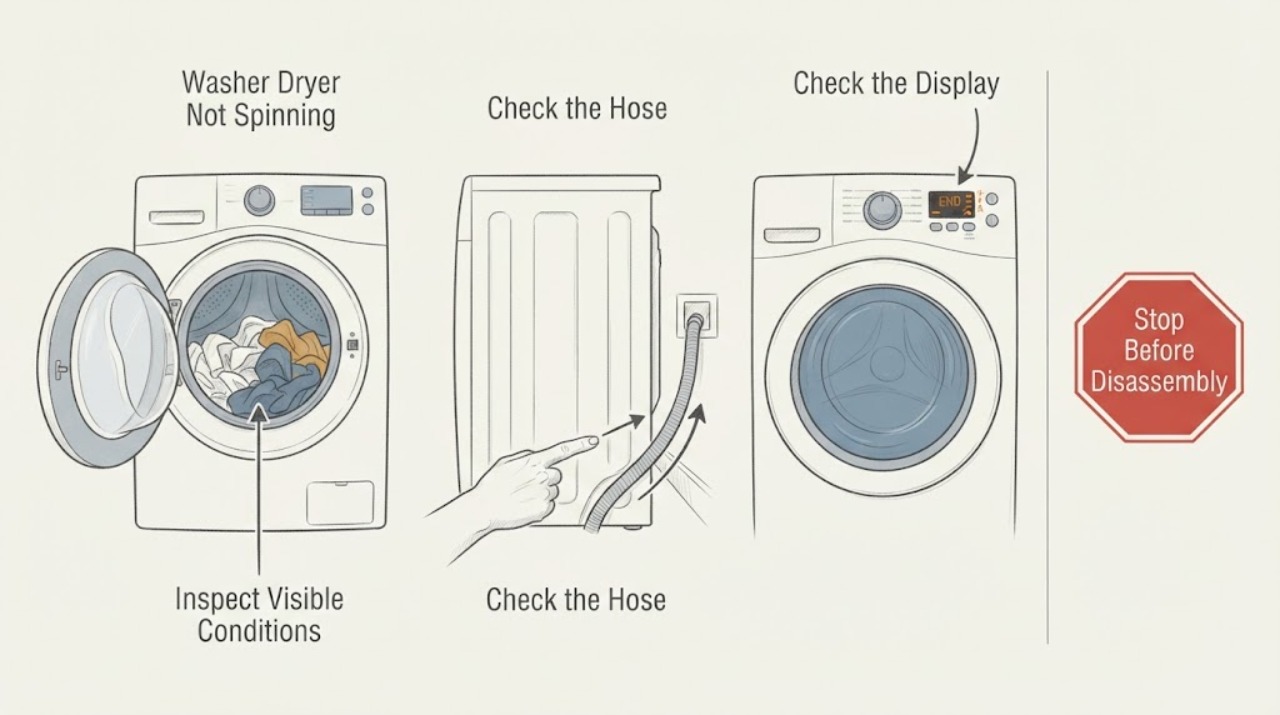
Work through in order
Diagnostic checks
Use only checks that match the exact appliance or system and its official guide.
-
Check 1
Observe the washer dryer at the point where spinning should occur. Note whether the drum is empty of water, partly or fully full, turning slowly, repeatedly redistributing laundry, or completely still. Record any flashing spin, tap, door, or error indicator.
Expected result: Water remains, the drum rocks or redistributes laundry, or the drum is empty but never reaches spin.
Next step: Use the drain check for standing water, the load check for instability, and the programme/control check when neither condition explains the failure.
Why this matters
Why: Water remaining directs the next check to drainage or a hold option. Repeated redistribution points to balance. An empty drum with no spin after normal conditions leaves a control, lock, or drive fault possible.
-
Check 2
If water remains, switch the programme off and inspect the visible drain hose and its accessible connection for a kink, crush point, blockage, or incorrect placement. Do not loosen a hose with water under pressure or open a pump cover unless the exact manual gives a safe, model-specific procedure.
Expected result: The drain route is visibly kinked or blocked, or it appears clear but the drum still will not empty.
Next step: Correct only an obvious external kink and run the model's drain or spin programme once. If water remains, stop and arrange service rather than forcing the door or dismantling the pump.
Why this matters
Why: Hotpoint identifies a kinked or blocked drain hose or waste path as a reason water cannot leave and the spin step cannot proceed. A clear external route with standing water may indicate an internal pump or filter issue.
-
Check 3
Check the selected programme and options. Confirm that a spin step is included or selected and that rinse hold, crease care, delayed start, or a reduced-spin option is not intentionally holding the load. Use the exact model manual for the control names.
Expected result: A hold, delay, or reduced-spin option was selected, or the programme should spin but the machine still stops before spinning.
Next step: Cancel only the normal user option, select the documented spin or drain-and-spin programme, and observe one cycle. Do not override a door or safety message.
Why this matters
Why: A hold option can leave laundry in final-rinse water by design; a reduced-spin setting can leave clothes wetter without a mechanical failure. Persistent no-spin with the correct programme needs a different branch.
-
Check 4
If the drum is empty of water, stop the programme and redistribute the laundry. Remove an obviously overloaded amount, mix large and small items, and ensure nothing bulky is gathered on one side. Close the door securely before selecting spin again.
Expected result: The washer reaches a stable spin after redistribution, or it repeatedly tumbles and refuses/reduces spin.
Next step: If it remains unstable, stop using high-speed spin and arrange service. Do not hold the machine down or continue restarting a violently vibrating cycle.
Why this matters
Why: Hotpoint's balance system can reduce or abort spinning when it cannot distribute the load evenly. Repeated instability after a sensible load change may indicate leveling, suspension, or another mechanical issue.
-
Check 5
Check the door, visible hose connections, floor, and controls from outside. Look for a door symbol, a leak, an error light, a damaged hose, or a breaker that has tripped. Do not force the door while water or motion is present.
Expected result: The door is not securely latched, a leak or error is visible, or all visible conditions look normal but spin still does not occur.
Next step: Follow only the model manual's user-level response to the displayed condition. Stop for a leak or electrical hazard and request qualified service for persistent no-spin.
Why this matters
Why: A door, water, or error condition can stop the programme before spin. No visible cause after safe checks leaves an internal lock, pump, motor, belt, control, or sensor fault possible.
-
Check 6
Record the exact model, programme and options, whether water remained, the load size and balance, the drain-hose condition, and the point where the cycle stopped. If the manual permits a power reset for the displayed fault, use only that documented procedure and do not repeat it if the fault returns.
Expected result: The washer dryer completes a normal spin, or the same no-spin condition returns after the documented user step.
Next step: Give the recorded sequence to a qualified Hotpoint service provider. Do not open the appliance or replace internal parts based only on a no-spin symptom.
Why this matters
Why: A successful cycle after a load, drain, or option correction supports an operating condition. A recurring failure after those corrections needs model-specific service diagnosis.
Use your observations
Decision map
Find the observation that best matches what you see, then follow the next safe action.
-
PATH 01Safety boundary
What you see
There is a leak, smoke, burning smell, damaged electrical part, repeated breaker trip, or the drum is still moving when access is attempted.
Do this next
Stop the programme and use the appliance no further. Isolate power only if safe, keep clear of moving or wet parts, and arrange qualified service; never force the door.
Why this path and its safety boundary
Safety stop: Continue with the drain, programme, load-balance, and door checks.
-
PATH 02Safety boundary
What you see
Water remains in the drum or a drain/tap indication persists.
Do this next
Check only the visible drain hose and accessible waste connection for a kink or blockage, then follow the exact manual. If the drum remains full, request service and do not dismantle the pump.
Why this path and its safety boundary
Safety stop: Continue with hold-option, load-balance, and normal spin selection checks.
-
PATH 03Safety boundary
What you see
The load is redistributed repeatedly, the machine bangs, or the spin is reduced/aborted after a sensible load correction.
Do this next
Stop high-speed spin and arrange service for leveling, suspension, or another mechanical diagnosis; do not restrain the appliance by hand.
Why this path and its safety boundary
Safety stop: Run the documented spin programme once and observe whether the drum reaches normal operation.
-
PATH 04Safety boundary
What you see
The drain path is clear, the load is balanced, the door is latched, and the correct spin programme still will not spin.
Do this next
Stop user troubleshooting and arrange qualified service for the door lock, pump, motor, belt, control, or sensor path.
Why this path and its safety boundary
Safety stop: Monitor the next cycle and avoid overloading or repeatedly selecting a hold option unintentionally.
Helpful context
Understand the symptom
A wet load does not always mean the motor failed
If water remains in the drum, many washer dryers will not proceed to a normal high-speed spin. A rinse-hold or crease-care option can also leave clothes in water by design. If water has drained but the load is still wet, an unbalanced load or a programme with reduced spin may be the more useful lead.
Balance the load without forcing the machine
Hotpoint describes a load-balancing process that may redistribute laundry, reduce the spin speed, or abort spinning when the drum remains unstable. Mix smaller and larger items, remove an obviously excessive load, and do not keep restarting a violently vibrating machine.
Keep user checks separate from repair work
The safe checks below are limited to controls, laundry, visible hoses, and accessible plumbing. Do not remove panels, defeat the door lock, reach into a moving drum, or replace a pump, belt, motor, or control without qualified diagnosis and the exact model instructions.
Only after diagnosis
Potential parts
- drain pump or filter assembly
Consider this category only after a qualified diagnosis finds standing water with an unobstructed external drain path and identifies the pump or filter assembly as the cause.
Confirm the exact Hotpoint model and the manufacturer's fit information before ordering any part. - door lock or drive component
Consider this category only when a qualified technician confirms that the door locks and drainage is normal but the machine still cannot enter or maintain spin.
Lock, belt, motor, and control components are model-specific; verify the exact model documentation before purchase.
When checks do not resolve it
Need a professional?
Arrange qualified service when water remains after the visible drain route is clear, the washer dryer repeatedly aborts spin after load redistribution, the door will not latch or unlock safely, a leak or electrical hazard appears, an error returns, or the correct programme still will not spin. Provide the exact model, programme and options, water level, load condition, drain observations, indicators, and stop sequence.
Common questions
FAQ
Why is my Hotpoint washer dryer not spinning but the drum has water in it?
A drain hose or waste path may be kinked or blocked, or a selected rinse-hold/crease-care option may be holding the final rinse. Check the visible drain route and the exact model instructions; do not force the door or dismantle the pump.
Why does my Hotpoint washer dryer tumble but not spin properly?
The load may be unbalanced or excessive. Redistribute a mixed load and remove an obvious overload. If the machine repeatedly redistributes, bangs, reduces spin, or aborts the cycle, stop and arrange service.
When should I stop troubleshooting a Hotpoint washer dryer?
Stop for a leak, smoke, burning smell, damaged electrical parts, repeated breaker trips, an unsafe door, or standing water that remains after the visible drain check. Arrange qualified service and do not open the appliance.
Read the exact guide
Official sources
- Quick Guide NoneHotpoint · Hotpoint washer-dryer operating, maintenance, load-balancing, and troubleshooting instructions
- Washing Machine Troubleshooting - Quick fixes & TipsHotpoint · Hotpoint washing machine power, door, drain, load-balance, and no-spin troubleshooting
- Washer Dryer Troubleshooting & Repair ServiceHotpoint · Hotpoint washer dryer drainage, options, maintenance, and service guidance
Community feedback
Share a repair observation
Share a plain-text repair observation. Accepted observations are published automatically; this page may take a moment to update.