
On this page
Start here
Quick answer
If your Bosch washer-dryer is not spinning, first check that the program has not been set to no spin or rinse hold and that the load is balanced. With the appliance off, unplugged, and any remaining water safely cool, inspect the drain hose and the model's accessible pump filter; a newly installed unit may still have transport locks. If an empty drum still will not spin, or there is a leak, burning smell, unusual mechanical noise, or electrical symptom, stop and arrange qualified service.
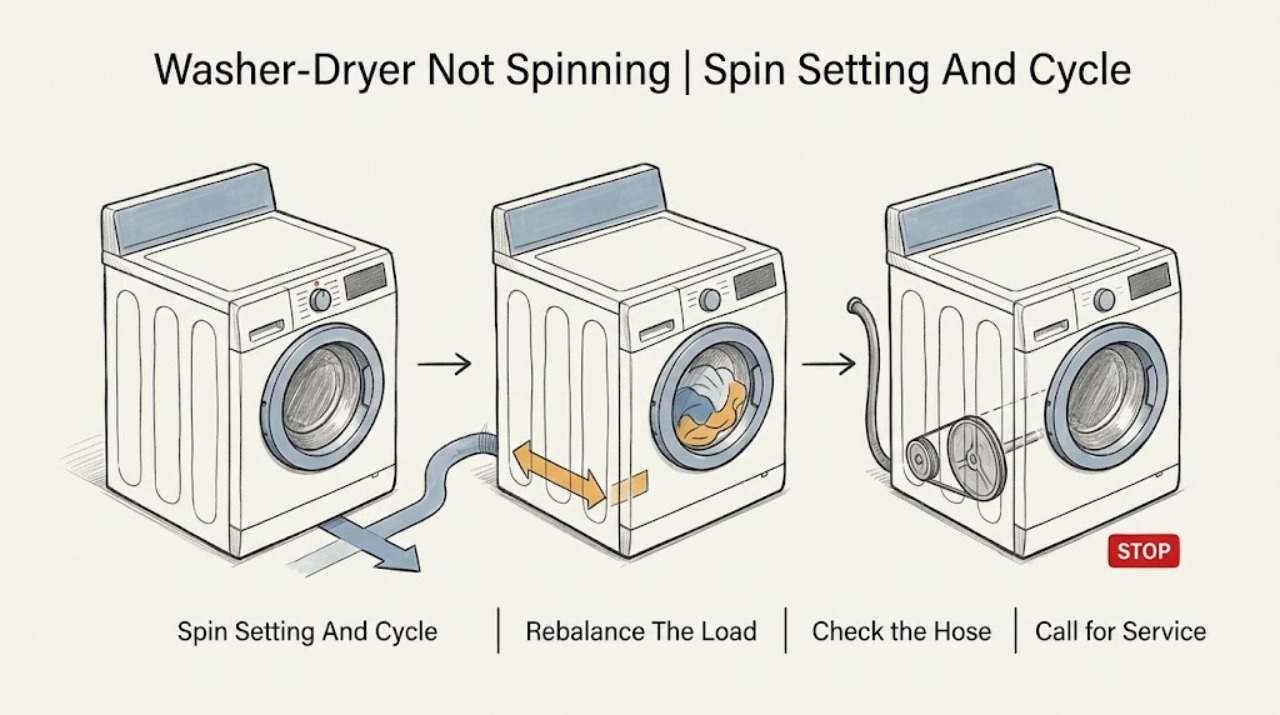
Work through in order
Diagnostic checks
Use only checks that match the exact appliance or system and its official guide.
-
Check 1
Read the selected Bosch washer-dryer program and display for a no-spin, rinse-hold, or zero-spin option, and compare it with the model manual before selecting a spin or drain program.
Expected result: The cycle shows that final spin was disabled or held, or the program allows a spin; alternatively, the controls show a normal spin request but the drum never starts.
Next step: If the setting was intentional, choose the model-approved spin option. If a normal spin is selected, continue with the load and drainage checks rather than repeatedly restarting the cycle.
Stop if: Do not defeat a door lock or change wiring or service settings to make the spin start.
Why this matters
Why: A deliberate no-spin or rinse-hold setting can leave water in the laundry without indicating a failed drive system. A normal spin request with no drum movement moves the diagnosis toward load, drain, installation, or hardware causes.
-
Check 2
With the program stopped, inspect the load for a single heavy item, a tightly wrapped bundle, or an overfilled drum; redistribute the wet laundry and keep within the model's stated load limit.
Expected result: The washer-dryer makes several short attempts, reduces speed, or spins after the load is redistributed; or it behaves the same with a reasonably balanced load.
Next step: Run the model-approved spin cycle once after redistribution. If it still will not spin, check whether water is trapped and inspect the drain path.
Stop if: Stop if the appliance walks, bangs violently, or becomes unstable; do not hold it in place during a spin cycle.
Why this matters
Why: Bosch explains that a large imbalance can prevent or reduce spin speed while the appliance tries to redistribute laundry. Repeating the fault with a balanced load points elsewhere.
-
Check 3
Turn the appliance off and unplug it. If water remains and is safely cool, look behind the unit for a crushed or kinked waste-water hose and check the visible connection for an obstruction without pulling hard on the hose.
Expected result: The hose is kinked or blocked, or the drum is not holding water and the hose looks clear.
Next step: Correct only a simple accessible kink and check for a secure, leak-free connection. If the hose is blocked, inaccessible, or leaking, stop and arrange service rather than dismantling it further.
Stop if: Do not handle hot residual water, move an unstable appliance, or loosen a connection while the machine is powered.
Why this matters
Why: Bosch identifies a kinked or blocked waste-water hose as a cause of poor or absent spinning because the machine cannot complete drainage. A clear hose with the same symptom makes the pump and other branches more likely.
-
Check 4
If the model has an owner-accessible pump filter or service flap, follow its manual with the appliance off, unplugged, and water cooled; drain residual water using the model's intended method and inspect for lint, coins, or other debris.
Expected result: Debris is found and the pump area can be cleaned and reassembled without force, or the filter and pump area are clear and watertight.
Next step: Clean only as far as the model instructions permit, refit the cover securely, and check for leaks before any approved drain or spin check. If the pump is sealed, damaged, or still ineffective, call service.
Stop if: Stop for hot water, a damaged cover or impeller, a leak, sharp debris, or any need to reach live or sealed components.
Why this matters
Why: Bosch says a blocked pump can prevent spinning and that the pump interior and impeller must be able to move. A clear, correctly reassembled pump path does not prove that the motor or control is healthy.
-
Check 5
If the Bosch washer-dryer is new or was recently moved, check the installation paperwork and model manual for transport locks or shipping hardware that should have been removed before operation.
Expected result: The appliance is newly installed and transport hardware may still be fitted, or it has been in service without that installation condition.
Next step: Do not guess at the hardware. Follow the exact model installation instructions or ask the installer to remove it; then reassess the spin cycle.
Stop if: Stop if removing the hardware would require opening the cabinet, lifting the appliance unsafely, or changing anything not identified in the model instructions.
Why this matters
Why: Bosch notes that a new washing machine drum may not turn when its transport lock remains in place. This check is specific to a new or moved appliance and does not explain a failure that began after normal use.
-
Check 6
After the safe checks, record whether the drum never moves, briefly tries and stops, spins empty but not with laundry, or produces grinding, scraping, burning, leaking, or error symptoms.
Expected result: The drum remains still with a balanced load and clear controls and drain path, or the fault appears only under load; alternatively, there is noise, a leak, an odor, or an error.
Next step: Stop using the machine and give a qualified technician the model number, selected program, water status, and symptom pattern. Do not remove the cabinet or test live circuits.
Stop if: Stop immediately for burning smell, smoke, exposed wiring, a water leak near electrical parts, severe mechanical noise, or an unstable appliance.
Why this matters
Why: Failure with an empty drum makes a load-balance explanation less likely and can indicate a motor, belt, drum, control, or other internal fault. A fault only under load still needs model-specific diagnosis if it persists.
Use your observations
Decision map
Find the observation that best matches what you see, then follow the next safe action.
-
PATH 01Next step
What you see
The display or manual shows no spin or rinse hold, and the appliance drains normally.
Do this next
Select the model-approved spin option or drain the load according to the manual; do not treat this setting as a motor failure.
Why this path and its safety boundary
Why it matters: The final spin was disabled or held by the selected option.
-
PATH 02Next step
What you see
The machine attempts to spin, slows down, or stops with one heavy or tightly bundled load.
Do this next
Redistribute the laundry and run the appropriate spin cycle once. If the same thing happens with a balanced load, continue to drainage or service checks.
Why this path and its safety boundary
Why it matters: Load imbalance is the leading explanation.
-
PATH 03Next step
What you see
Water remains in the drum and the waste-water hose is kinked or the pump filter contains debris.
Do this next
Use the model instructions to clear only an accessible obstruction, reassemble it watertight, and stop if the problem persists or water is hot.
Why this path and its safety boundary
Why it matters: The drain path may be preventing the spin stage from completing.
-
PATH 04Next step
What you see
The washer-dryer is new or was moved and transport hardware has not been confirmed removed.
Do this next
Have the exact model installation instructions or installer confirm the transport-lock status before further operation.
Why this path and its safety boundary
Why it matters: Installation hardware may be restricting drum movement.
-
PATH 05Next step
What you see
The controls, load, drain path, and installation are reasonable, but the empty drum still will not spin.
Do this next
Stop using the appliance and arrange qualified Bosch or appliance service with the model number and symptom record.
Why this path and its safety boundary
Why it matters: An internal drive, motor, drum, or control fault is more likely than a simple user setting.
-
PATH 06Next step
What you see
There is smoke, a burning smell, exposed wiring, a significant leak, violent movement, or a severe mechanical noise.
Do this next
Stop the appliance, keep clear of the hazard, and arrange qualified service; do not restart it to collect more observations.
Why this path and its safety boundary
Why it matters: This is an immediate safety boundary.
Helpful context
Understand the symptom
What “not spinning” can mean
A washer-dryer may complete washing but leave the load wet because the final spin was disabled, held, reduced for an imbalanced load, or prevented by a drainage problem. A drum that never turns, including when empty, is a different branch from a cycle that drains but deliberately skips the final spin.
Use the model instructions for controls
Bosch washer-dryer controls and symbols vary by model. Use the complete model number to identify the correct manual before changing a spin option, opening a service flap, or checking transport hardware. The checks below are intended to identify the branch, not to bypass a safety lock or expose live components.
Why service may be the right next step
If the load, selected program, drainage path, and installation are all reasonable but the drum still does not spin, the cause may be a motor, drive belt, control, or other internal fault. Those parts require model-specific diagnosis; repeated restart attempts can turn a small fault into a larger one.
Safety boundary
Stop conditions
- Do not open the cabinet, defeat a door or electrical safety lock, or test live circuits.
- Do not handle hot residual water or continue when a hose, pump cover, drum, or wiring is damaged.
- Do not hold an unstable machine in place or restart it after smoke, burning smell, severe noise, or a significant leak.
Only after diagnosis
Potential parts
- drain pump or pump filter assembly
Consider this only if the model-specific drain path is clearable, water remains or drainage remains abnormal, and a technician confirms pump failure rather than a hose blockage.
Pump and filter designs vary by model; verify the complete appliance model and Bosch fit information before selecting a part. - drive belt or motor assembly
Consider these only after the spin setting, load balance, transport-lock status, and drain path are ruled out and a technician confirms an internal drive fault.
Do not infer fit from appearance or series name; confirm the complete model and the manufacturer's part information.
When checks do not resolve it
Need a professional?
Arrange service if the empty drum still does not spin after the setting, balance, drainage, and installation checks., Call a qualified appliance technician if the pump area is sealed or damaged, the machine leaks, or the drain problem returns after a permitted cleaning., Stop using the washer-dryer and seek urgent qualified help for smoke, burning smell, exposed wiring, severe noise, violent movement, or a significant leak.
Common questions
FAQ
Why is my Bosch washer-dryer not spinning but still washing?
The final spin may be disabled or held, the load may be unbalanced, or drainage may not be complete. Check the selected program first, then the load and drain path.
Can rinse hold make the laundry stay wet?
Yes. Bosch washer-dryer instructions explain that when spin is deactivated, the program can stop after the final rinse with water still present; the model's spin control is needed to drain and spin it.
Can an unbalanced load stop a Bosch washer-dryer from spinning?
Yes. A large imbalance can make the appliance reduce or skip the spin while it tries to redistribute the laundry. Rearrange the load and retry the appropriate cycle once.
What should I check if there is water left in the drum?
With the appliance off, unplugged, and water safely cool, check for a kinked waste-water hose and, only if your model permits it, inspect the accessible pump filter using the manual. Stop for hot water or leaks.
When does a Bosch washer-dryer that will not spin need service?
Arrange service when the empty drum still will not spin after the safe checks, or when there is smoke, a burning smell, a leak near electrical parts, severe mechanical noise, exposed wiring, or violent movement.
Read the exact guide
Official sources
- Why are my clothes soaking wet after washing?Bosch Home Appliances · Bosch wet laundry, spin, drainage, and service guidance
- Why is my washing machine not spinning?Bosch Home Appliances · Bosch washing machine pump, drain hose, and service guidance
- Washing machine drum isn't turningBosch Home Appliances · Bosch new-installation transport-lock and drum-not-turning guidance
- Why Is My Bosch Washing Machine Not Spinning?Bosch Home Appliances · Bosch washing machine spin, load balance, drainage, pump, and service guidance
- Instruction Manual and Installation Instructions: Washer dryerBosch Home Appliances · Bosch washer-dryer operating, spin, rinse-hold, and installation guidance
Community feedback
Share a repair observation
Share a plain-text repair observation. Accepted observations are published automatically; this page may take a moment to update.