
On this page
Start here
Quick answer
A Haier washer-dryer may refuse a full spin when the wet load is uneven, the appliance is not level, water has not drained, the door or lid is not accepted as closed, or a non-spin or delayed programme was selected. First note whether the drum turns slowly, stops before high speed, or never turns, then redistribute the load and check the visible drain path, door or lid, and programme setting. An unbalanced-load display such as UNB or a model-specific no-spin code should be interpreted using the exact manual, not assumed to mean a particular failed part. Stop for a leak, burning smell, repeated power trip, grinding, damaged cord, or a drum that still will not spin after these external checks, and arrange qualified service.
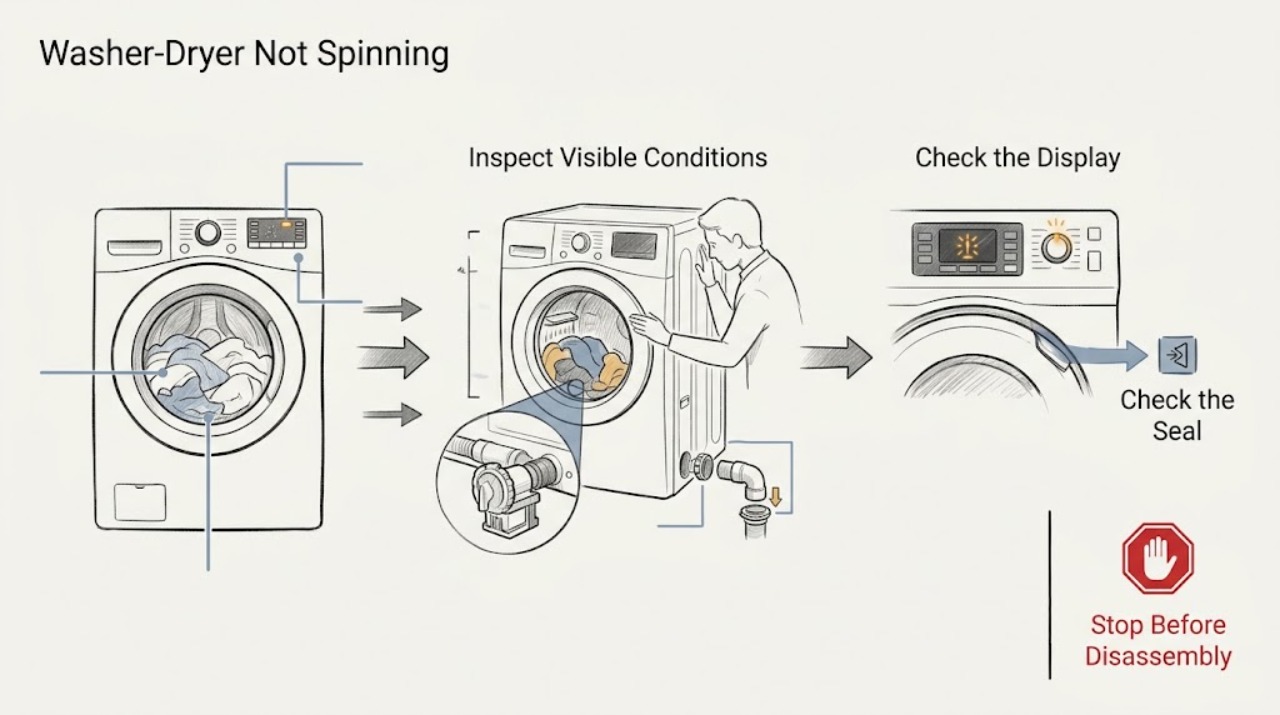
Work through in order
Diagnostic checks
Use only checks that match the exact appliance or system and its official guide.
-
Check 1
Observe one supervised cycle from outside and record whether the drum never moves, turns slowly, attempts to accelerate and stops, or reaches some spin but leaves clothes wet. Note any UNB, E3, or other display and whether the washer-dryer is front-load or top-load.
Expected result: The machine makes repeated balancing attempts, displays an unbalanced-load clue, turns only at low speed, or does not move at all with no related code.
Next step: For low-speed or UNB-like behavior, continue to the load and leveling checks. For no movement with an empty drum or a persistent code, limit testing and prepare the model details for service.
Why this matters
Why: Haier distinguishes failure to reach high speed because of load balance from a drum that cannot spin even without laundry. The symptom and display timing help select the next safe check but do not identify a motor, belt, sensor, pump, or control failure by themselves.
-
Check 2
Pause or stop the programme using the normal control and wait until the drum is stationary. Open the door or lid only when the machine indicates it is safe, then spread laundry evenly around the drum; separate a single blanket or sheet and avoid an obviously overloaded or nearly empty load.
Expected result: The load is bunched on one side, is one large absorbent item, is overloaded, or appears evenly distributed; the machine may spin after redistribution.
Next step: Close the door or lid fully and run one spin programme at a normal or lower setting. If the machine repeatedly stops despite a balanced load, do not keep adding weight or forcing high speed; continue to drainage and professional service checks.
Why this matters
Why: Haier says the machine tests whether laundry can be balanced and can lower or prevent high-speed spinning when it cannot. A spin that returns after redistribution supports an imbalance explanation, while failure with an even load points to drainage, leveling, door or lid, setting, or service checks.
-
Check 3
With the machine stopped, inspect from outside whether it rocks or stands unevenly, and confirm the front door or top lid is fully closed with no visible laundry caught at the seal. Do not move a heavy built-in or stacked unit alone, and do not bypass the door or lid interlock.
Expected result: The appliance rocks, the load is visibly uneven because of the machine position, the door or lid does not close or show its lock indication, or the installation and closure look normal.
Next step: Correct only a visible load or closure issue and use the model's safe leveling instructions if the unit is freestanding and the work is safe. If the door or lid will not be accepted, or the machine is unstable, stop and arrange service or installation help.
Why this matters
Why: Haier links no-spin E3 behavior to laundry placement and a slanting machine, and its front-load guidance says the door must be closed and locked before the programme can proceed. A normal exterior cannot rule out a faulty lock or suspension, but an obvious leveling or closure issue can prevent the spin stage.
-
Check 4
Look for water remaining in the drum and inspect the visible drain hose for a kink, flattening, blockage, or unsafe routing. If the exact model manual permits a user-accessible filter check, unplug the machine, let water cool, prepare towels and a container, and inspect only as directed; do not open a filter or hose connection while water may be hot or pressurized.
Expected result: Water remains, the hose is restricted, the filter area contains visible debris, the machine drains normally, or the spin still fails after the drain path is clear.
Next step: Correct only a visible hose-routing issue or manual-approved filter obstruction, refit everything securely, and run one drain or spin programme if safe. Stop for a leak, hot water, failed drainage, or repeated no-spin behavior.
Why this matters
Why: Haier explains that restricted drainage can leave water in the drum and prevent the spin function from activating, while its support material identifies hose and filter restrictions as common causes. Clearing an accessible obstruction may restore spinning, but persistent water or a failed pump needs service diagnosis.
-
Check 5
Check that the washer-dryer is not set to a no-spin, soak, rinse-hold, delayed-start, or drying-only option and that the selected spin speed is permitted by the exact programme. From outside, confirm the plug is secure and the accessible breaker or supply has not tripped; do not remove electrical covers or test live wiring.
Expected result: A non-spin or delayed option was selected, the spin speed was set low, the panel is dark, the breaker has tripped, or the programme and power appear normal.
Next step: Cancel the incorrect option or unlock the controls using the model manual and make one normal spin selection. If power is absent or trips again, stop using the machine and arrange electrical or appliance service.
Why this matters
Why: Haier's front-load guidance identifies single dehydration or other non-washing programmes, delayed start, and child lock as possible reasons a machine does not begin the expected operation; power and door status are separate prerequisites. A correct setting with normal power but no spin points beyond a simple selection error.
-
Check 6
After the safe load, door or lid, drain, programme, and power checks, make one supervised spin attempt and record the model, display code, load, water level, drum movement, vibration, and any noise or odor. Do not remove panels, reach into the drum while moving, or repeatedly select higher speeds to force a result.
Expected result: The washer-dryer reaches normal spin, remains at low speed, refuses to spin with an empty drum, leaks, makes grinding or banging sounds, trips power, or shows the same code.
Next step: Stop using the appliance for persistent no-spin, grinding, leakage, burning odor, repeated power trips, or a damaged cord and arrange qualified Haier service. Provide the exact code and the checks already completed.
Why this matters
Why: A successful spin after a documented external correction supports a balance, drain, closure, setting, or temporary supply explanation. Persistent no-spin or an unsafe symptom requires internal diagnosis of the drive, suspension, pump, sensor, lock, or control system.
Use your observations
Decision map
Find the observation that best matches what you see, then follow the next safe action.
-
PATH 01Safety boundary
What you see
Does the machine attempt to accelerate, spin slowly, or display UNB or another balance-related clue?
Do this next
Stop safely, redistribute the wet laundry, correct an obvious single bulky load, and retry one spin cycle. Repeated imbalance with a balanced load needs service.
Why this path and its safety boundary
Safety stop: Continue to the door or lid, drainage, programme, and power branches rather than assuming a balance fault.
-
PATH 02Safety boundary
What you see
Is the appliance rocking or is the door or lid not fully closed and accepted?
Do this next
Correct only a safe visible load, closure, or freestanding leveling issue. Never bypass the interlock or move a heavy unit alone.
Why this path and its safety boundary
Safety stop: Continue to drainage and programme checks; a normal door and level exterior do not prove the lock or suspension is healthy.
-
PATH 03Safety boundary
What you see
Is water still in the drum or is the visible drain path kinked or blocked?
Do this next
Use only the exact manual's safe drain or filter procedure after power is disconnected, the water is cool, and a container is ready. Stop for leaks or failed drainage.
Why this path and its safety boundary
Safety stop: Continue to programme and power checks, then arrange service if the machine still refuses to spin.
-
PATH 04Safety boundary
What you see
Is a no-spin, delayed, drying-only, or other non-spin option selected, or is power absent?
Do this next
Correct the selection or perform one safe accessible power check according to the model and household instructions, then retry once.
Why this path and its safety boundary
Safety stop: A normal selection and powered panel with persistent no-spin points toward a fault requiring service.
-
PATH 05Safety boundary
What you see
Does the washer-dryer still refuse to spin with a balanced load, empty drum where the manual allows a test, clear drain, closed door or lid, and correct setting?
Do this next
Stop using it and arrange qualified Haier service. Do not open panels, probe wiring, access the motor or pump, or continue forcing high-speed tests.
Why this path and its safety boundary
Safety stop: If one normal spin completes after the external correction, monitor the next load and retain the exact model manual and display record.
Helpful context
Understand the symptom
Slow movement is not the same as no spin
A washer-dryer can tumble or make balancing attempts without reaching its final spin speed. Haier describes an unbalanced-load protection function that lowers speed or prevents high-speed spinning to limit vibration and noise. Heavy wet laundry, a single bulky item, or items gathered on one side can therefore leave clothes wetter without proving that the motor has failed.
Use the exact model manual for codes and access
Haier uses model and regional variations in displays, door or lid controls, drain access, and programme names. Treat UNB, E3, or any other code as a clue to look up in the matching manual. The checks below stay outside the cabinet and stop before electrical, motor, suspension, pump, or control-board work.
Safety boundary
Stop conditions
- Stop immediately for a leak, hot water, smoke, burning smell, grinding or repeated banging, a damaged plug or cord, repeated power trips, an unstable appliance, or a drum that cannot be safely controlled.
- Do not remove covers, probe live wiring, reach into a moving drum, bypass the door or lid interlock, force a filter or hose connection, or repeatedly select higher spin speeds to force operation.
When checks do not resolve it
Need a professional?
Call a qualified Haier service technician when the machine still will not spin after a balanced load, safe drain check, secure door or lid, correct programme, and accessible power check, or when a recurring code, leak, abnormal noise, odor, damaged cord, or repeated power trip appears.
Common questions
FAQ
Why does my Haier washer-dryer spin slowly or stop before high speed?
Haier may reduce or prevent high-speed spinning when the wet load cannot balance. Stop safely, redistribute a bunched load or single bulky item, close the door or lid, and try one spin cycle. Repeated low-speed behavior with a balanced load needs service.
Can a drain problem stop a Haier washer-dryer from spinning?
Yes. Water left in the drum, a kinked hose, or a blocked filter can interfere with the spin stage. Check only the visible path and the exact manual's user-accessible filter procedure, with power disconnected and water cool; arrange service for failed drainage or leaks.
What does UNB or E3 mean on a Haier washing machine?
Haier support pages associate UNB with an unbalanced load and E3 with load arrangement or a machine that is not level on the referenced models. Codes vary by model, so confirm the complete display in the exact manual before deciding on a repair.
When should I stop troubleshooting a Haier washer-dryer that will not spin?
Stop for a leak, hot water, smoke, burning smell, grinding or repeated banging, damaged cord, repeated power trips, an unstable appliance, or persistent no-spin after the safe load, drain, door or lid, programme, and power checks. Do not open panels or bypass safety devices; arrange qualified service.
Read the exact guide
Official sources
- Not wash of front load washing machineHaier India · Haier front-load washing-machine power, door lock, water, drainage, programme, delay, and child-lock checks
- Displays E3, no spin.Haier United Arab Emirates · Haier washing-machine E3 no-spin load arrangement, leveling, and service guidance
- No spin or washer machine does not spin at a high speed(Display UNB)-Front load washerHaier Saudi Arabia · Haier front-load washing-machine no-spin empty-drum service boundary
- No spin or washer machine does not spin at a high speed(Display UNB)Haier India · Haier washing-machine unbalanced-load protection, low-speed spin, redistribution, and service guidance
- Why Is My Washing Machine Not Draining Water Properly?Haier India · Haier washing-machine drainage, filter, hose, foam, imbalance, spin interaction, and service guidance
Community feedback
Share a repair observation
Share a plain-text repair observation. Accepted observations are published automatically; this page may take a moment to update.