
On this page
Start here
Quick answer
If a Miele washer-dryer finishes with wet clothes or will not start its spin, first check whether a no-spin or rinse-hold option was selected and whether water is still in the drum. A single bulky item, an unbalanced load, an unlevel machine, a restricted drain path, or an incomplete first-use setup can all prevent a normal final spin. Choose an appropriate spin or Drain/Spin program, redistribute the load, check the drain hose route, and keep the machine level. If water remains, a fault repeats after these safe checks, the door stays locked, or there is a leak or electrical smell, stop and arrange qualified service.
Work through in order
Diagnostic checks
Use only checks that match the exact appliance or system and its official guide.
-
Check 1
At the end of the failed cycle, note whether the drum still contains water, whether the clothes are merely damp or dripping wet, whether the display shows rinse hold or no spin, and whether a fault light or code is present.
Expected result: Water in the drum or a drain-related indicator is present; or the drum is empty but the load is wet and no spin option or imbalance behavior is apparent.
Next step: If water remains, keep the door closed and continue with the drain-safety check. If the drum is empty, inspect the selected spin behavior and load before retrying.
Why this matters
Why: Standing water makes a drainage path or drain fault the first branch. An empty drum with wet clothes makes spin selection, load balance, or a protective speed reduction more likely.
-
Check 2
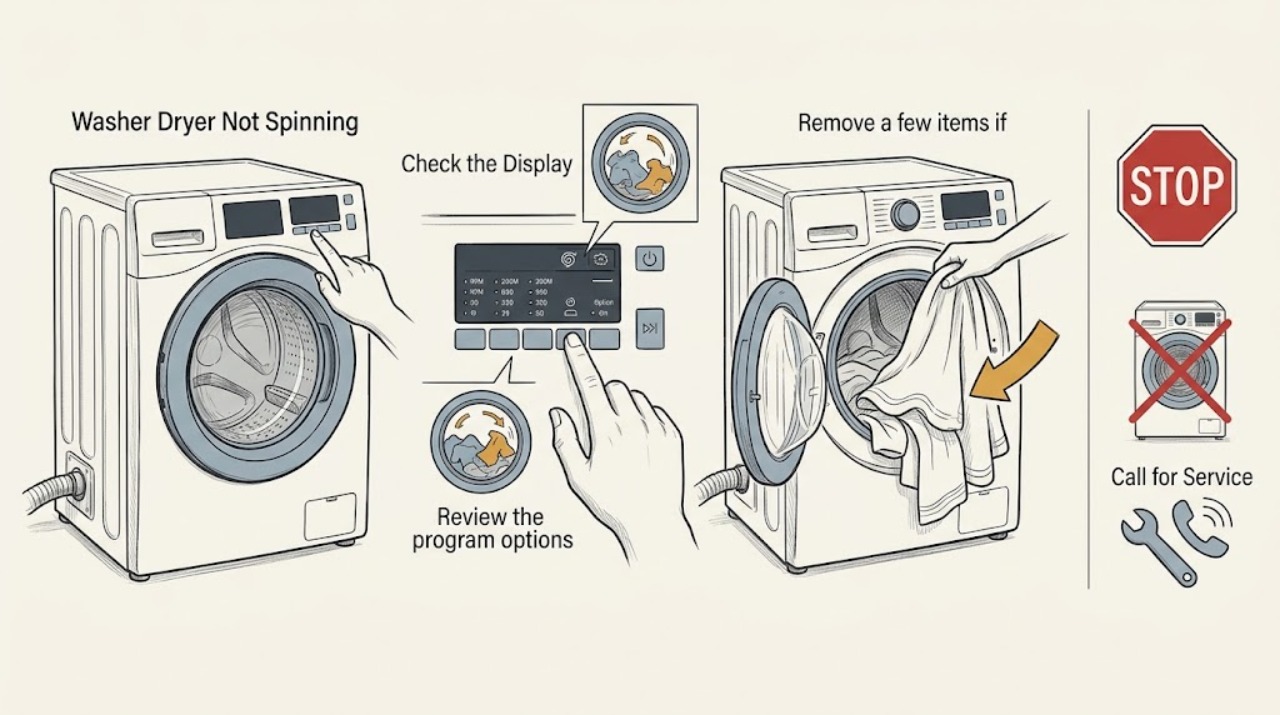
Review the program options and select a permitted spin speed or Drain/Spin program for a small test load; make sure No Spin or Rinse Hold was not intentionally selected.
Expected result: The test program spins after a spin speed is selected, or it drains and spins when Drain/Spin is chosen; alternatively, the machine still refuses to spin with the drum empty.
Next step: Use the appropriate spin setting for the fabric and resume normal use if the test succeeds. If it still will not spin, leave the test result recorded and continue without repeatedly restarting the appliance.
Why this matters
Why: A successful test identifies an option or program-state issue rather than a failed drive. A refusal with an empty drum moves the diagnosis to balance, leveling, drainage, commissioning, or a technical fault.
-
Check 3
Remove a few items if the drum is tightly packed, then redistribute the remaining load so large and small items are mixed; do not test with one dense blanket or one heavy item alone.
Expected result: The redistributed load reaches a normal spin, or the machine again slows down or stops while the load clumps to one side.
Next step: Use mixed, appropriately sized loads and stop if the drum bangs violently. If a balanced load still cannot spin, continue to the installation check and retain any display message for service.
Why this matters
Why: A successful retry supports an imbalance-protection response. A repeated failure with a balanced, ordinary load means the next checks should be the machine installation and drain path, not repeated load rearrangement.
-
Check 4
With the appliance empty and safe to inspect externally, confirm that it stands firmly on all four feet and is level; if it was newly installed, verify that the transport safety device was removed according to the model instructions.
Expected result: The machine rocks, shifts, or shows vibration during spin; or a setup-related fault appears. Otherwise, the cabinet remains stable on a firm base.
Next step: Correct only the external leveling or installation issue described for the exact model, then run one supervised test. Do not open the cabinet or remove internal components; call service if the machine remains unstable or the fault returns.
Why this matters
Why: A rocking or unstable machine can interrupt or reduce spinning and needs leveling before further testing. A new machine with transport hardware still installed has an installation issue; a stable machine points back to load, drainage, or a technical fault.
-
Check 5
If water remains, check the visible drain hose for kinks, crushing, or an overly high delivery route, and compare its installation with the model instructions; Miele lists a maximum delivery head of 1 m (3 ft 3 in) for the cited guidance.
Expected result: The hose is kinked, blocked, or routed above the stated limit; or the external route is clear but the washer still leaves water in the drum.
Next step: Correct only an obvious external hose-routing problem and perform one cool, supervised drain test. If water remains, contain the water using the exact model's user instructions and arrange service rather than opening the pump area or handling hot water.
Why this matters
Why: A restricted or high drain route can prevent the washer from completing drain and spin. If the route is correct but water remains, an internal blockage or pump fault becomes possible and is not a reason to force the door.
-
Check 6
For a newly commissioned appliance, check whether the required empty wash without laundry or detergent has been completed; for an established appliance showing a technical fault, record the message and perform only the single restart permitted by the model instructions.
Expected result: The machine has not completed its first empty program, or a restart clears a one-time message; alternatively, the no-spin condition or fault returns immediately.
Next step: Complete the documented first-use program if applicable. Otherwise stop after the one restart and contact qualified service for a persistent fault, locked door, repeated drain failure, leak, electrical odor, or abnormal mechanical noise.
Why this matters
Why: Miele documents a first-use condition that can keep spin unavailable until the empty program is run. A returning fault is evidence that the appliance needs diagnosis rather than more resets.
Use your observations
Decision map
Find the observation that best matches what you see, then follow the next safe action.
-
PATH 01Next step
What you see
Water remains in the drum or a drain indicator appears
Do this next
Keep the door closed, let hot water cool, check only the external hose route, and arrange service if the drain does not recover after one safe test.
-
PATH 02Next step
What you see
The drum is empty and a selected spin or Drain/Spin test works
Do this next
Use the correct spin option and load size; monitor the next cycle for recurrence.
-
PATH 03Next step
What you see
The machine spins after redistributing the load but not when one bulky item is used
Do this next
Treat it as load imbalance and use mixed, evenly distributed loads; stop if there is violent banging.
-
PATH 04Next step
What you see
The machine is stable, the hose route is correct, and it still will not spin or repeatedly reports a fault
Do this next
Stop troubleshooting and request qualified appliance service; do not bypass the door lock or open electrical or drive components.
Helpful context
Understand the symptom
What a no-spin symptom usually means
Separate a low-speed result from a completely missing spin. A washer-dryer can reduce or skip the final spin when the load cannot settle safely, while standing water points toward drainage or a drain-related fault. A selected rinse hold or no-spin setting can also leave the load wet without a mechanical failure. Record what the display says, whether the drum is empty of water, and whether the problem occurs with every load or only one load before changing anything.
Safety before checking the machine
Do not force the door while water is visible, bypass the door lock, or remove panels. Stop the program and allow hot water to cool before checking any user-accessible drain area. If the appliance leaks, smells of overheated wiring, trips protection repeatedly, or makes a violent mechanical noise, disconnect it only if that can be done safely and arrange qualified service.
Safety boundary
Stop conditions
- Stop immediately for a leak, electrical smell, repeated protection trips, smoke, scorching, or violent drum movement.
- Do not force a locked door or work on the drain area while water may be hot.
- Arrange qualified service when one safe external check and one documented retry do not restore spin, or when a fault returns.
Only after diagnosis
Potential parts
- drain pump or drain filter assembly
Consider this only if water remains after the external hose route is correct and a qualified diagnosis confirms a blocked or failed internal drain path.
Confirm the exact appliance model and manufacturer fit information before any replacement is considered. - door-lock assembly
Consider this only if the door remains locked after the drum is safely empty or a qualified technician confirms a door-lock fault that prevents the cycle from completing.
Do not bypass the lock; verify model-specific fitment and safety requirements with the manufacturer or qualified service. - suspension or drive component
Consider this only after settings, load balance, leveling, and drainage are verified and a qualified diagnosis identifies abnormal movement or a drive-system fault.
A part cannot be selected safely from the symptom alone; confirm the exact model and the diagnosed component.
When checks do not resolve it
Need a professional?
Call qualified Miele appliance service for a persistent no-spin condition after the settings, load, leveling, hose route, and commissioning checks; for standing water that will not drain, a door that remains locked, a recurring fault message, leaking, electrical odor, or abnormal mechanical noise.
Common questions
FAQ
Why is my Miele washer-dryer leaving clothes wet but not showing a fault?
Check for No Spin or Rinse Hold first, then redistribute the load and confirm the machine is level. A washer can reduce or skip a final spin when the load cannot settle safely.
Can I open the door when the Miele washer-dryer will not spin?
Do not force it. If water is visible or the door remains locked, let hot water cool and follow the exact model instructions or arrange qualified service.
When should a Miele washer-dryer that will not spin be serviced?
Arrange service when the drain, settings, load, leveling, hose-route, and first-use checks do not restore spinning, or sooner for a recurring fault, leak, electrical odor, locked door, or abnormal mechanical noise.
Read the exact guide
Official sources
- There are vibrations during spinningMiele USA · Miele USA support guidance for vibration during washer spinning
- Drain/Spin does not startMiele USA · Miele USA washer support guidance for a Drain/Spin program that does not start
- WWB 020 en - US M.-Nr. 10 980 040/01Miele USA · Model-specific Miele USA operating instructions used for general control, drain, door, and safety boundaries; confirm the exact model manual
- Water inlet fault during initial commissioningMiele USA · Miele USA support guidance for initial commissioning behavior
- Fault F37 appears in the washing machine display. The washing machine is not aligned correctly.Miele USA · Miele USA support page for F37 and related installation conditions
Community feedback
Share a repair observation
Share a plain-text repair observation. Accepted observations are published automatically; this page may take a moment to update.