
On this page
Start here
Quick answer
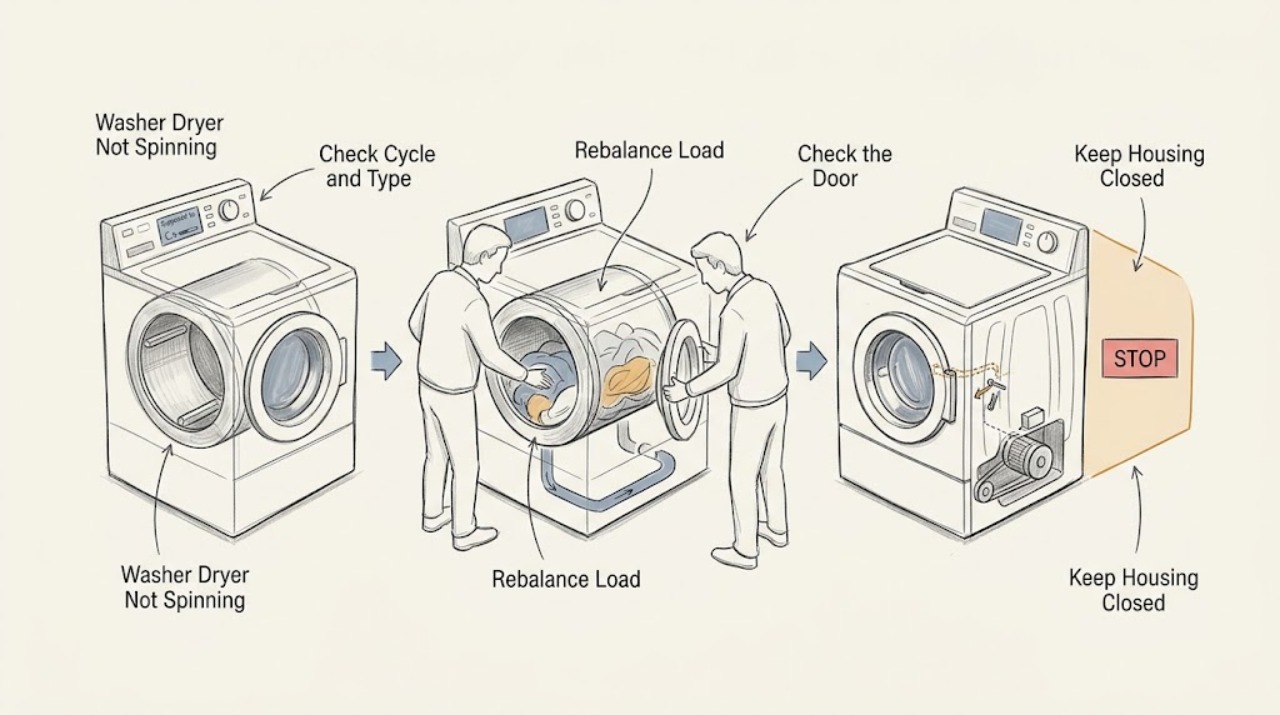
A Frigidaire washer-dryer may refuse to spin because the load is out of balance, the door or lid is not closed and locked, water has not drained, the appliance is not level, a shipping support remains, or a drive component has failed. Start with the exact appliance type and cycle: some pauses before spin are normal. Stop the cycle through the normal control, wait for the lock to release, redistribute the load, confirm the door or lid closes, and check for a kinked drain hose or visible obstruction without opening the cabinet. Do not force the lock, reach into a moving drum, bypass a safety switch, or perform live electrical tests. If the drum still will not spin, water remains, the unit is noisy or leaking, the motor only hums, or the problem returns after one safe retry, leave it out of service and arrange Frigidaire-authorized diagnosis.
Before you begin
Safety first
- This article covers ordinary-access observation, load redistribution, visible closure and hose checks, and model-approved installation checks only. A qualified technician must handle lock, motor, belt, pump, control, wiring, cabinet, and live electrical diagnosis.
Work through in order
Diagnostic checks
Use only checks that match the exact appliance or system and its official guide.
-
Check 1
Use the normal controls to note the selected wash or dry cycle and whether the appliance is in a documented sensing or pause stage; do not open a locked door or reach into a moving drum.
Expected result: Record whether the appliance pauses briefly and then continues, remains paused, shows a warning, contains standing water, or never attempts to rotate.
Next step: If the door or lid unlocks normally and there is no leak or unusual noise, continue to the load-balance check. If it remains locked, the appliance smells electrical, leaks, or behaves erratically, stop and arrange service.
Stop if: Do not force the door or lid, bypass the lock, or reach into the drum while it can move.
Why this matters
Why: A pause between stages or during load sensing can be normal. A persistent pause, standing water, repeated stop, or no spin attempt means the cycle has not reached a normal completed spin and needs the separate load, closure, and drain checks.
-
Check 2
When the machine has stopped and the door or lid has released, inspect the load for a single heavy item, clothes piled to one side, an overloaded tub, or a very small load; redistribute items evenly without reaching under the tub or removing panels.
Expected result: Record a balanced load, an out-of-balance pile, a load that is too large, or a small load that may need similar items for balance according to the model's instructions.
Next step: Redistribute or reduce the load as the manual permits and make one normal supervised retry. If the drum remains still, stops again, or makes abnormal noise, leave the appliance out of service and continue only with the drain and closure observations.
Stop if: Do not overload the tub, force a stuck drum, or repeatedly restart an appliance that will not spin.
Why this matters
Why: Frigidaire says an out-of-balance load can prevent spinning, and adding similar items can help balance a smaller load. If a balanced load still never spins, load balance is not a sufficient explanation.
-
Check 3
Inspect the door or lid and visible frame from ordinary access: remove only an item that is obstructing closure, confirm the latch area is clean and undamaged, and check whether the appliance sits level without attempting to adjust hidden parts.
Expected result: Record a fully closed door or lid and stable level cabinet, or a gap, damaged latch area, object in the seal, rocking appliance, or visible installation issue.
Next step: Correct only a loose visible obstruction and use the manual's leveling procedure if it is clearly intended for the owner. If the latch, hinge, seal, or leveling hardware is damaged or inaccessible, arrange authorized service.
Stop if: Do not defeat the lid or door lock, hold it closed by hand, remove hinges, or dismantle the cabinet to reach the latch.
Why this matters
Why: Frigidaire states that the washer will not operate or spin when the lid is not closed properly; an unlevel appliance can also contribute to operational and balance problems. A damaged lock or installation issue is not a user bypass problem.
-
Check 4
If water remains after the cycle, inspect the visible drain hose for a kink, crush, twist, or obvious blockage and confirm the hose has not been recently moved into an unusual position; do not open the pump housing or put hands into standing water.
Expected result: Record no standing water and a free visible hose, or water in the tub, a kinked or blocked hose, a drain warning, a leak, or a pump area that would require disassembly.
Next step: Correct only a visible hose position issue as the manual allows, then make one supervised normal retry if no hazard exists. If water remains, a leak appears, or access requires opening the pump or cabinet, stop use and arrange service.
Stop if: Do not open a pump filter or housing with hot or contaminated water, reach into the tub or pump, remove panels, or run with a leaking hose.
Why this matters
Why: Frigidaire's drain guidance connects slow or absent draining with a blocked or kinked drain path and notes that the washer will not spin unless the lid is closed. A drain fault can therefore stop the spin sequence, but clearing a visible hose does not prove the pump or wiring is sound.
-
Check 5
For a recently installed or moved washer-dryer, inspect only the visible installation area for remaining shipping material, a unit that is not level, or a hose condition identified by the manual; do not move the appliance alone or remove transport hardware without exact instructions.
Expected result: Record a stable installed unit with shipping material removed, or visible foam, shipping support, instability, or a condition that would require pulling the appliance out.
Next step: Use the exact installation instructions or contact the installer for unresolved setup issues. If the unit is stable and correctly installed but still will not spin, proceed to service rather than disassembling it.
Stop if: Do not pull the washer-dryer by hoses or the power cord, work under it, or remove shipping hardware without model-specific instructions and safe access.
Why this matters
Why: Frigidaire identifies shipping materials and leveling among possible causes when a washer tub will not spin. A recent installation problem belongs with the installer or a qualified technician when it cannot be corrected from safe ordinary access.
-
Check 6
After only the applicable user-level checks, run one normal supervised cycle or spin-only selection using the controls normally; remain nearby and stop if the drum does not rotate, water remains, the unit leaks, or a new noise or electrical symptom appears.
Expected result: Record normal draining and spinning, a repeat no-spin condition, humming without rotation, banging, grinding, a warning, standing water, leakage, burning odor, or a protection trip.
Next step: Leave the washer-dryer out of service for any recurring failure or danger sign and arrange Frigidaire-authorized diagnosis. Provide the cycle, load, drain result, door or lid behavior, noise, warning, and installation history.
Stop if: Do not repeat cycles to reproduce a fault, run with a leak, bypass the lock, or open the cabinet for electrical or drive testing.
Why this matters
Why: A normal result after rebalancing or clearing a visible hose supports that condition as a contributor. A repeat no-spin result, abnormal noise, leak, or electrical symptom points beyond safe user checks toward the lock, motor, belt, control, pump, or other internal system.
Use your observations
Decision map
Find the observation that best matches what you see, then follow the next safe action.
-
PATH 01Safety boundary
What you see
The cycle pauses during sensing or between wash and spin, the door or lid remains secure, and the washer later drains and spins normally.
Do this next
Use the selected cycle normally and monitor for a change; do not interrupt or open a locked appliance.
Why this path and its safety boundary
Why it matters: The pause is likely part of the cycle rather than a failed spin.
Safety stop: Stop if the pause becomes persistent, water remains, the machine repeatedly stops, or the drum never rotates.
-
PATH 02Safety boundary
What you see
The load is piled to one side, contains one heavy item, is overloaded, or is too small to balance, and there is no leak or danger sign.
Do this next
Redistribute, reduce, or balance the load as the exact manual permits and make one supervised retry.
Why this path and its safety boundary
Why it matters: The load can prevent a safe spin without proving that the drive system has failed.
Safety stop: Do not force the drum or keep retrying after the balanced load still will not spin.
-
PATH 03Safety boundary
What you see
The door or lid is not fully closed, the latch area is obstructed, or water remains with a visible kinked or blocked drain hose.
Do this next
Correct only the visible obstruction or hose position according to the manual, then make one supervised retry if the appliance is secure and dry.
Why this path and its safety boundary
Why it matters: A safety closure or drain condition can prevent the normal spin sequence.
Safety stop: Do not bypass the lock, open the pump, reach into standing water, or operate with a leak.
-
PATH 04Safety boundary
What you see
The washer-dryer was recently moved or installed and visible shipping material, instability, or setup error is present.
Do this next
Use the exact installation instructions or contact the installer; obtain qualified help before moving a heavy unit or removing transport hardware.
Why this path and its safety boundary
Why it matters: The spin problem may be installation-related rather than a failed internal drive component.
Safety stop: Do not pull the machine by its hoses or cord, work underneath it, or dismantle installation hardware by guesswork.
-
PATH 05Safety boundary
What you see
The load is balanced, the door or lid closes, the drain path is visibly sound, installation is stable, and the drum still will not spin or the problem returns.
Do this next
Leave the washer-dryer out of service and arrange Frigidaire-authorized diagnosis with the model and symptom sequence.
Why this path and its safety boundary
Why it matters: A lock, motor, belt, pump, control, or other internal fault remains possible and cannot be identified safely from outside.
Safety stop: Do not remove panels, perform live electrical tests, bypass a safety switch, or replace a part based only on a no-spin symptom.
Helpful context
Understand the symptom
A pause is not always a failed spin
Frigidaire notes that a washer can pause between wash and spin, and a load-sensing stage may delay the next action. The useful distinction is whether the cycle eventually drains and spins, or whether it remains full of water, repeatedly stops, or never accelerates. Do not reach into the drum during a pause; use the normal controls and wait for the door or lid lock to release before checking laundry.
Balance, closure, and drainage are separate decisions
An uneven load can keep the tub from spinning, while a lid or door that is not properly closed prevents operation for safety. A kinked or blocked drain path can leave water in the tub and prevent a normal spin sequence. Check each condition separately and record the result; correcting a balanced load does not prove that a drain or lock fault is resolved.
Keep cabinet and drive diagnosis professional
If the washer-dryer is level, the load is balanced, the door or lid closes, and the drain path is visibly sound but the drum still does not spin, the remaining possibilities include a lock, motor, belt, control, or other internal drive fault. Frigidaire's user guidance does not turn those observations into permission to remove panels or test energized parts. Preserve the model and symptom sequence for authorized service.
Safety boundary
Stop conditions
- Stop for a locked door or lid that will not release normally, standing water with a leak, burning odor, smoke, damaged cord, repeated electrical trip, or abnormal grinding, banging, or humming.
- Do not reach into a moving or locked drum, bypass the door or lid lock, force the door, or hold a safety switch closed.
- Do not remove cabinet, pump, motor, belt, control, or electrical covers, perform live tests, or work under a heavy washer-dryer.
- Do not run with a leaking or kinked drain hose, standing water near electrical parts, an unstable installation, or unresolved shipping hardware.
- Do not keep repeating cycles after a balanced load and visible drain or closure checks fail; leave the appliance out of service and arrange qualified diagnosis.
Only after diagnosis
Potential parts
- door or lid lock assembly
Consider this category only after qualified diagnosis confirms that the lock or interlock is not recognizing a secure closure and the door or lid alignment is correct.
Confirm the exact Frigidaire model and manufacturer's fit information; never bypass the lock or use the appliance with an unsecured closure. - drive motor or belt assembly
Consider this category only when a qualified technician confirms a drive fault after the load, closure, drain, and installation checks are complete.
Confirm the exact model and professional diagnosis before selecting a part; internal drive access is not a user troubleshooting step. - drain pump or control assembly
Consider this category only if service diagnosis links standing water or a no-spin sequence to a failed pump or control after visible hose conditions are ruled out.
Confirm the exact model and technician diagnosis; do not open a pump or control housing with water present or power connected.
When checks do not resolve it
Need a professional?
Arrange Frigidaire-authorized service when the washer-dryer still will not spin after a balanced load, secure door or lid, visible drain-path, and installation checks; when water remains or leaks; when the motor hums without rotation; when abnormal noise, a warning, burning odor, smoke, a damaged cord, or repeated electrical trips occur; or whenever diagnosis would require cabinet access, lock, motor, belt, pump, control, or wiring work.
Safety scope: This article covers ordinary-access observation, load redistribution, visible closure and hose checks, and model-approved installation checks only. A qualified technician must handle lock, motor, belt, pump, control, wiring, cabinet, and live electrical diagnosis.
Common questions
FAQ
Can a Frigidaire washer-dryer pause before spinning normally?
Yes. Frigidaire notes that a pause can occur between wash and spin or during load sensing. If the pause persists, water remains, or the drum never rotates, continue with safe balance, closure, and drain checks.
Can an unbalanced load stop a Frigidaire washer-dryer from spinning?
Yes. Stop normally, wait for the lock to release, and redistribute the load. A smaller load may need similar items for balance according to the model manual; make only one supervised retry.
Why is there water left when my Frigidaire washer-dryer will not spin?
A kinked or blocked visible drain path can stop the spin sequence. Check the hose only from ordinary access and follow the exact manual; do not open a pump housing or reach into standing water.
Will a Frigidaire washer spin if the lid or door is open?
No. Frigidaire states that the washer will not spin unless the lid is closed. Do not bypass the lock; arrange service for a damaged latch, hinge, seal, or interlock.
When should a no-spin Frigidaire washer-dryer get professional service?
Use authorized service when balancing, closure, visible drain, and installation checks do not restore spinning, or when the unit leaks, hums without rotation, makes abnormal noise, remains locked, shows a warning, smells electrical, trips protection, or would require cabinet access.
Read the exact guide
Official sources
- What should I do if my Frigidaire Laundry Center is not starting?Frigidaire · Frigidaire Laundry Center support guidance; exact washer-dryer controls and safety interlocks vary by model.
- Laundry top loading washer displaying Error Code E2 water takes too long to drainFrigidaire · Frigidaire top-loading washer drainage guidance used for the same drain-and-spin decision; exact washer-dryer model procedure controls.
- What should I do if my washer does not start?Frigidaire · Frigidaire washer support guidance used for general cycle-state checks; exact washer-dryer model controls.
- What should I do if the washer on my Laundry Center Washer is not spinning?Frigidaire · Frigidaire support guidance for Laundry Center washers; the exact washer-dryer model manual controls cycle and access differences.
- Laundry top loading washer tub not spinningFrigidaire · Frigidaire top-loading washer support guidance used for overlapping no-spin checks; exact washer-dryer model instructions control.
Community feedback
Share a repair observation
Share a plain-text repair observation. Accepted observations are published automatically; this page may take a moment to update.