
On this page
Start here
Quick answer
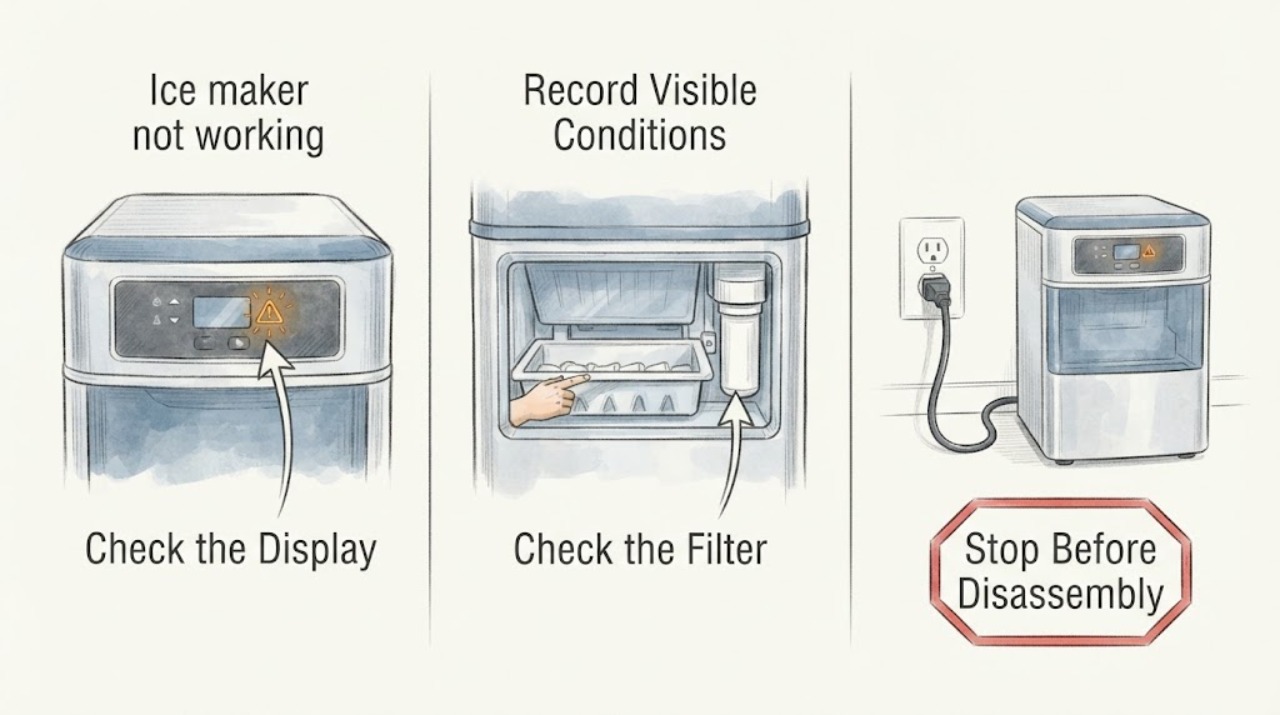
An ice maker that is not working should be checked for an enabled maker, correct bin position, a closed refrigerator door, a cold freezer, and an available water supply. Clear only an accessible ice jam as the model manual allows. If the maker remains inactive after those checks, or the water line leaks, arrange qualified refrigerator service.
Work through in order
Diagnostic checks
Use only checks that match the exact appliance or system and its official guide.
-
Check 1
Confirm the refrigerator has an automatic ice maker, then check its on/off arm or control and bin seating.
Expected result: Feature absent/off, bin missing/mis-seated, or maker enabled and seated.
Next step: Use the exact model manual for the control and bin position.
Why this matters
Why: An absent/disabled feature cannot make ice; a seated enabled maker shifts attention to cold/water.
-
Check 2
Check door closure and freezer coldness from outside; note visible frost or blocked airflow.
Expected result: Door is ajar, freezer is warm, or cold/closure appear normal.
Next step: Correct only an accessible door or airflow condition and avoid altering sealed cooling parts.
Why this matters
Why: Ice production depends on a properly closed cold compartment.
-
Check 3
Inspect accessible water supply/filter/hose routing for closed valve, kink, filter seating, or leak without disconnecting plumbing.
Expected result: Restriction/leak is visible or water path appears normal.
Next step: Correct accessible routing only and keep a leaking water circuit out of use.
Why this matters
Why: Water delivery can mimic maker failure; internal valve diagnosis is model-specific.
-
Check 4
After one correction, allow the model’s normal ice-making interval and check whether a batch forms without forcing the mechanism.
Expected result: Ice resumes, bin remains empty, or maker hums/clicks but does not fill/eject.
Next step: Contact service with model, maker state, freezer condition, and water observations.
Why this matters
Why: A repeat no-fill/no-eject result needs model-specific valve, sensor, motor, or control service.
Use your observations
Decision map
Find the observation that best matches what you see, then follow the next safe action.
-
PATH 01Next step
What you see
Maker is absent, off, or bin is not seated.
Do this next
Use the exact manual to enable/seat it; do not add unrelated parts.
Why this path and its safety boundary
Why it matters: No hardware failure is established.
-
PATH 02Next step
What you see
Maker is enabled but freezer is warm or door/airflow is abnormal.
Do this next
Correct the accessible condition and seek refrigerator service if freezing remains inadequate.
Why this path and its safety boundary
Why it matters: Ice failure is secondary to cooling/sealing.
-
PATH 03Next step
What you see
Freezer is cold, water path normal, and maker still does not fill/eject after the model interval.
Do this next
Arrange qualified service; do not force the ejector or bypass controls.
Why this path and its safety boundary
Why it matters: A model-specific ice-maker/control fault is more likely.
-
PATH 04Next step
What you see
There is a water leak, damaged tube, smoke, burning odor, or electrical trip.
Do this next
Stop water/ice use, isolate only if safe, and obtain service.
Why this path and its safety boundary
Why it matters: Safety boundary.
Helpful context
Understand the symptom
No ice can result from a disabled maker, an empty/mis-seated bin, a jam, warm freezer, or missing water.
The ice-making mechanism varies by refrigerator; do not force ejectors or add water without the manual.
When checks do not resolve it
Need a professional?
Arrange refrigerator or ice-maker service when the enabled maker remains inactive after model checks, no ice forms despite normal freezing/water, or the mechanism/valve/control needs testing.
Common questions
FAQ
Why is my ice maker not making ice?
Check maker state, bin/door position, freezer coldness, and water supply. Persistent no-fill/no-eject needs model-specific service.
Can I force the ice maker to cycle?
Only if the exact manual instructs it. Do not force ejectors or bypass safety controls.
Does a jammed ice bin stop production?
A jam can stop dispensing and may affect the mechanism. Remove/clear it only as the manual permits and keep the bin dry.
Read the exact guide
Official sources
- What should I do if the dispenser on my refrigerator is not dispensing ice?Frigidaire · ice maker/dispenser accessible lock, bin, door, jam and auger checks
- What To Do If Your Side By Side Refrigerator Ice Maker Is Not WorkingFrigidaire · refrigerator ice-maker feature and model support
Community feedback
Share a repair observation
Share a plain-text repair observation. Accepted observations are published automatically; this page may take a moment to update.