
On this page
Start here
Quick answer
A flashing salt indicator on an Indesit DFG15B1 is a water-softener or salt-refill signal, so it does not by itself identify a blocked drain, failed heater, or failed pump. First record the point where the cycle stops and whether water remains. With the appliance switched off, use the exact DFG15B1 regional manual to check the salt reservoir and water-hardness setting; an Indesit dishwasher guide says to use dishwasher salt only, wipe salt from the opening, tighten the cap, and complete the refill before starting a wash. If the indicator remains on after the documented refill and the cycle still stops, treat the salt light and the incomplete cycle as separate symptoms and arrange model-specific service.
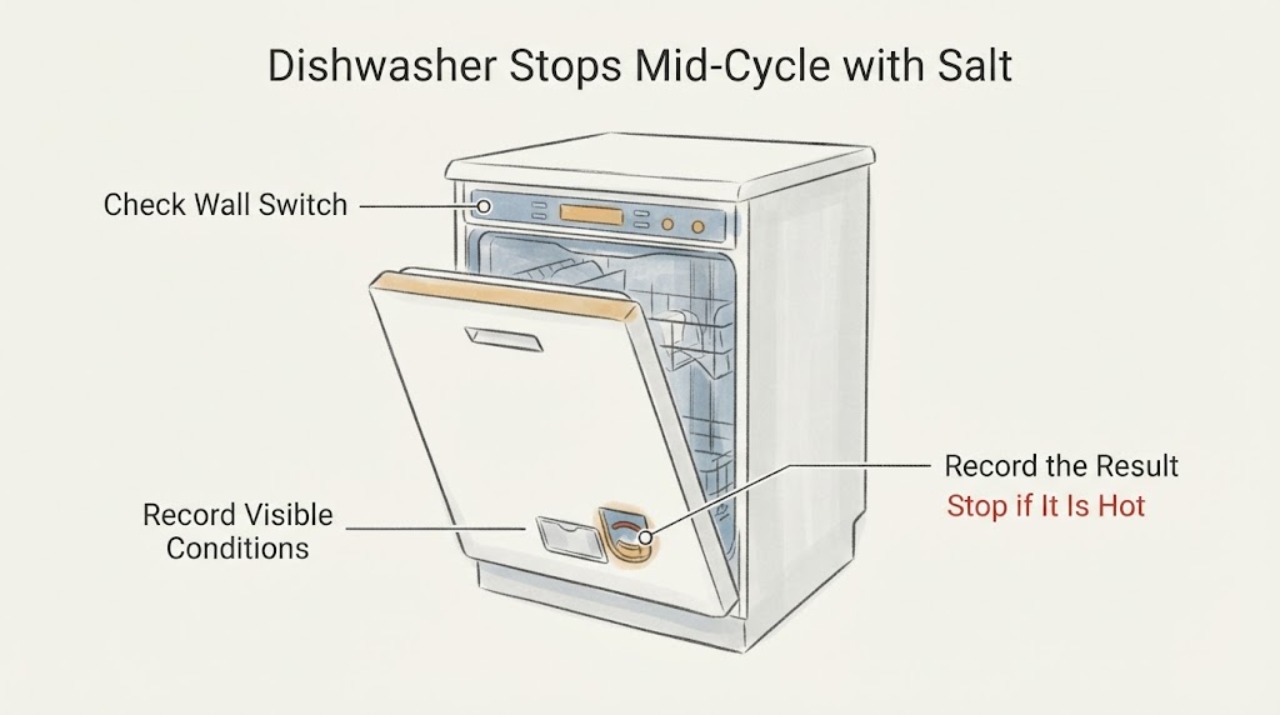
Work through in order
Diagnostic checks
Use only checks that match the exact appliance or system and its official guide.
-
Check 1
With the cycle stopped, record the selected program, elapsed time, exact salt-light pattern, any other lights or display message, and whether the tub is empty, contains water, or is actively pumping.
Expected result: The salt indicator is the only abnormal light and the tub is empty, or the machine stops with standing water, cold water, repeated pumping, or additional indicators.
Next step: Use the matching symptom branch below and keep the exact DFG15B1 regional manual beside the rating-plate details.
Stop if: Stop and isolate power when safe for smoke, burning odor, abnormal heat, a leak near electrics, sparks, damaged wiring, or repeated breaker trips.
Why this matters
Why: A salt-only indication points first to the water-softener or refill state; standing water or a stage-specific stop keeps drain, fill, heat, circulation, or control causes in consideration. The light pattern alone is not enough to choose a part.
-
Check 2
Switch the dishwasher off and, only when the area is dry and safe, inspect the salt-reservoir cap from ordinary access. If the exact manual confirms the procedure, add only dishwasher-specific regenerating salt, wipe visible residue from the opening, and tighten the cap before the next wash.
Expected result: The reservoir is low or empty; the cap is loose; the wrong product or detergent may have entered the reservoir; or the reservoir appears correctly filled and closed.
Next step: Complete the documented refill before starting a wash. If detergent or another substance entered the reservoir, do not improvise a flush or continue cycling; use the exact manual or service route.
Stop if: Do not pour detergent, table salt, cleaners, or other chemicals into the salt reservoir, and do not dismantle the softener or reach into the base.
Why this matters
Why: Low salt or an unsecured cap can explain a refill indication. Indesit warns that detergent entering the salt container can damage the water softener; a full, correctly closed reservoir does not explain a repeated mid-cycle stop by itself.
-
Check 3
Check the water-hardness setting only against the local water supplier's information and the exact DFG15B1 manual; do not change levels by trial and error. Record the current setting before making any permitted adjustment.
Expected result: The setting does not match the documented local hardness, the setting is unknown, or it matches the manual and local supply.
Next step: Apply the manual's model-specific setting procedure once, then complete the manual's required empty or supervised program. If the salt indicator persists or the cycle still stops, stop changing settings and arrange service.
Stop if: Do not guess a hardness value, enter service mode from an unrelated model, or continue operating after a leak, electrical symptom, or chemical contamination.
Why this matters
Why: Indesit says the water-hardness setting is essential for the softener to work correctly, but a setting mismatch is a maintenance or wash-quality issue rather than proof of a drain or heater failure.
-
Check 4
After any permitted salt correction, run one supervised normal program and note whether the salt indicator clears, whether the machine reaches its documented end indication, and whether the same stage stops again.
Expected result: The cycle completes normally; the indicator remains lit but the cycle completes; the cycle stops again with standing water or cold water; or multiple indicators and controls become abnormal.
Next step: For a repeat stop or persistent indicator after the documented procedure, provide the exact model, region, light pattern, stopping stage, and tub water state to Indesit or a qualified dishwasher technician.
Stop if: Do not repeatedly reset or run cycles to test the appliance after a repeat fault or any safety symptom.
Why this matters
Why: A completed cycle after refill makes the salt state the more likely immediate issue. Persistent salt indication or a repeated stage stop means the salt signal may coexist with a sensor, softener, fill, drain, heating, circulation, door, or control fault; the result does not identify which internal part failed.
Use your observations
Decision map
Find the observation that best matches what you see, then follow the next safe action.
-
PATH 01Next step
What you see
The salt indicator is the only abnormal signal, the reservoir was low, and one supervised cycle completes after the manual's refill procedure.
Do this next
Monitor the next normal use and keep the correct DFG15B1 manual available; arrange service if the light returns unusually soon or the cycle later stops.
Why this path and its safety boundary
Why it matters: The refill or water-softener maintenance state is more likely to explain the light than a direct cycle-completion fault.
-
PATH 02Next step
What you see
The salt indicator flashes while the dishwasher stops with standing water, continuous pumping, or a repeat drain-stage interruption.
Do this next
With power isolated, inspect only the accessible filter, visible drain hose, and under-sink connection if the exact manual permits. If the path is clear or the stop returns, arrange service.
Why this path and its safety boundary
Why it matters: The salt indication may be coincidental; a drain-path or internal drain-control problem is more relevant to the incomplete cycle than the refill lamp alone.
-
PATH 03Next step
What you see
The reservoir is full and correctly capped, the hardness setting follows the exact manual, but the salt indicator remains on or the cycle repeatedly stops at the same stage.
Do this next
Stop changing settings and contact Indesit or a qualified dishwasher technician with the model and region, the manual used, the indicator pattern, stopping stage, and water state.
Why this path and its safety boundary
Why it matters: A salt-level sensing, softener, indicator, fill, drain, heating, circulation, door, or control fault remains possible; the indicator cannot select a safe replacement part.
-
PATH 04Next step
What you see
Detergent or another chemical entered the salt reservoir, or there is a leak, abnormal heat, smoke, burning odor, electrical noise, or water near electrics.
Do this next
Stop the appliance, disconnect power only when safe, close the water tap for a leak, and arrange model-specific professional service. Do not restart to test.
Why this path and its safety boundary
Why it matters: Continuing could damage the water-softener system or create an appliance and electrical hazard; a visual lamp interpretation is no longer an adequate troubleshooting route.
Helpful context
Understand the symptom
Separate the salt signal from the stopping stage
A flashing salt light is an attention signal for the dishwasher's salt and water-softener system. It does not prove that the salt system caused the cycle to stop. Note whether the machine stops before filling, while washing or heating, during draining, or near the end; also note whether the tub is empty, partly full, cold, hot, or still pumping. Keep the complete model and regional product code available because Indesit manuals and indicator layouts vary.
Use the exact manual for the DFG15B1 salt procedure
The official Indesit documentation portal directs owners to retrieve manuals by commercial code or 12NC. Use that route for the rating-plate identity before changing a hardness level or interpreting a lamp pattern. The opened Indesit dishwasher guide describes the salt reservoir in the lower part of the appliance, dishwasher-specific salt, a tightly fitted cap, and a refill completed before the next wash; follow the matching DFG15B1 regional instructions where they differ.
When checks do not resolve it
Need a professional?
Stop using the dishwasher and seek Indesit or qualified appliance service for a repeated mid-cycle stop, persistent salt indication after the exact manual procedure, standing water that remains after permitted external checks, chemical contamination, a door or control fault, a leak near electrics, smoke, burning odor, abnormal heat, sparks, or repeated breaker trips.
Common questions
FAQ
Does a flashing salt indicator prove that the drain pump is faulty?
No. The Indesit guide treats the salt light as a salt-refill and water-softener indication. Use the tub water state and stopping stage to assess the cycle fault separately; standing water or repeated pumping needs the drain branch and possibly service.
Can I use table salt or detergent in the DFG15B1 salt reservoir?
No. Use only salt specifically designed for dishwashers and keep detergent out of the salt container. If detergent or another chemical entered it, stop and follow the exact manual or arrange service rather than improvising a flush.
Why can the salt light stay on after adding salt?
The exact indicator behavior depends on the model and region. Confirm the DFG15B1 manual, complete the documented refill before a wash, and check the documented hardness setting. If the light persists with a correctly filled and capped reservoir, arrange service instead of repeatedly changing settings.
What information should I give the technician?
Give the complete model and regional product code, program, elapsed time, exact light pattern, point where the cycle stops, tub water state, and what the exact manual permitted you to check. This helps service separate a salt indication from a drain, fill, heating, circulation, or control symptom.
Read the exact guide
Official sources
- Dishwasher: full size, black colour - DFG 15B1 K UKIndesit UK · Opened official Indesit product page identifying the DFG 15B1 K UK dishwasher; suffix and regional documentation must be confirmed from the appliance rating plate.
- Manuali Indesit: scarica i manuali dei tuoi elettrodomesticiIndesit · Opened official Indesit manual portal; it instructs owners to enter the product serial or 12NC/commercial code to retrieve the matching manual and service information.
- Daily Reference GuideIndesit · Opened official Indesit daily reference guide for a dishwasher salt-refill indicator and procedure; it does not define every flashing pattern, so use the exact DFG15B1 regional manual for model or region differences.
Community feedback
Share a repair observation
Share a plain-text repair observation. Accepted observations are published automatically; this page may take a moment to update.