
On this page
Start here
Quick answer
First note where the Indesit dishwasher stops: before filling, during washing, while waiting to heat, during draining, or after the display appears to finish. A door opening or power cut can pause a cycle on some Indesit models, and the exact manual should show whether it resumes after the door is shut or power returns. If water remains, check the accessible filter, drain hose, sink connection, and supply arrangement with power isolated; Indesit says a dishwasher must drain before it can fill. If the machine is stuck during a heating or wash stage, or shows an error, use the exact model code guide rather than a generic code chart—Indesit’s official listings map different codes to drain, fill, temperature, heater, pump, and control faults. Stop using it for smoke, burning odor, water near electrics, a damaged cord, repeated trips, or uncontrolled heating, and arrange qualified service for internal pumps, heaters, wiring, locks, sensors, or controls.
Before you begin
Safety first
- The user may record the stopping stage and model code, correct loading, inspect accessible filters and visible hoses with the machine unplugged, and follow the exact manual’s one-time reset procedure. Qualified personnel must handle base access, door locks, pumps, heaters, sensors, wiring, live tests, leaks inside the cabinet, and integrated-appliance movement.
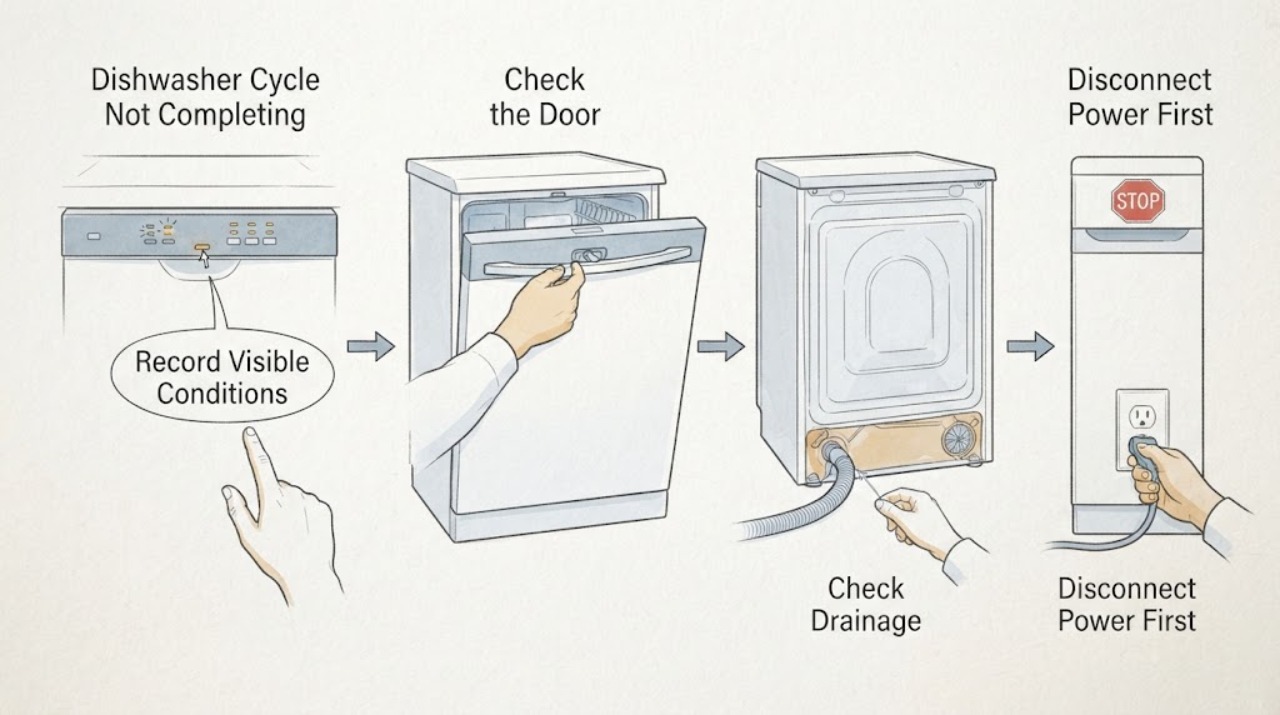
Work through in order
Diagnostic checks
Use only checks that match the exact appliance or system and its official guide.
-
Check 1
Before changing settings, record the exact Indesit model and region from the rating plate, the selected program, elapsed behavior, display or LED pattern, and the point where the cycle stops. Note whether the tub is empty, partly full, full of water, cold, steaming, or still actively pumping.
Expected result: The machine has no code and appears to be in a normal long or drying stage; it stops before filling; it stops with standing water; it pauses while heating; or a display or LED code is present.
Next step: Use the matching branch below and retrieve the exact manual or model-matched error page. Do not apply a code from another Indesit model or country.
Stop if: Stop and isolate power when safe for smoke, sparks, burning odor, abnormal heat, water near electrics, a damaged cord, or repeated breaker trips.
Why this matters
Why: The stopping stage separates a possible normal program or interruption from fill, drain, heating, pump, or control paths. Indesit manuals and service pages are model and region specific, so an LED pattern without the exact model is not enough to select a fault or part.
-
Check 2
Check from the front that the door closes fully and that no rack, dish, or utensil prevents the latch from engaging. Recall whether the door was opened or power was interrupted, then close the door and observe only the behavior described by the exact manual. Do not bypass or hold the door interlock closed.
Expected result: The cycle resumes from the same stage after the door is shut or power returns; the door will not latch; the controls remain unresponsive; or the cycle stops again at the same point.
Next step: Remove only a visible loading obstruction. If the door or controls remain faulty, use the exact manual and arrange service; do not repeatedly slam the door or cycle the power to mask an interlock fault.
Stop if: Stop if the latch, door, hinges, or surrounding cabinet is damaged, the door is hot or leaking, or continuing would require removing panels or defeating the safety interlock.
Why this matters
Why: For the covered Indesit EU guide, an opened door or power cut interrupts the cycle and the cycle resumes after the interruption ends. A door that cannot latch or a repeat stop suggests an interlock, control, or another stage fault rather than a simple pause.
-
Check 3
Switch the dishwasher off and unplug it before touching water connections or accessible filters. Check that the water tap is open and the inlet hose is not kinked, then inspect the accessible filter, drain hose, and under-sink connection for blockage or a trapped hose. Do not remove the pump protection, disconnect hidden plumbing, or reach into standing hot water.
Expected result: The machine stops before filling; the tub contains standing water; the filter or hose is visibly blocked or kinked; the sink connection is blocked or still capped; or the accessible water and drain path is clear.
Next step: Clean and refit only the user-accessible filter as the exact manual shows, correct a visible hose issue, and run one supervised program if there is no safety symptom. If water remains or the cycle still stops, arrange model-specific service.
Stop if: Stop for leaking connections, water near electrical parts, a hot tub, a blocked or inaccessible pump area, or any need to remove the base, tilt an integrated machine, or test a pump live.
Why this matters
Why: Indesit says the dishwasher must drain before filling, and its service guidance links failure to empty with the filter, waste hose, and under-sink plumbing. A clear accessible path with a repeated stop makes an internal drain pump, inlet valve, sensor, or control issue more likely, but does not identify which part.
-
Check 4
If the dishwasher fills and drains but pauses during washing or heating, note whether spray arms have room to rotate, whether the load is blocking them, whether the water remains cold, and whether the exact model displays a temperature, heater, or wash-pump code. Do not open the base or measure a heater, sensor, or wiring while connected to power.
Expected result: The arms are obstructed; water is circulating and the cycle completes; the cycle pauses with cold water or no drying; a pump runs continuously; or a model-matched temperature, heater, or pump code appears.
Next step: Rearrange only accessible dishes so the spray arms can rotate, then follow the exact manual. For a repeated heat-stage pause, continuously running pump, cold wash, or model-matched service code, stop troubleshooting at the exterior and arrange qualified service.
Stop if: Stop for steam escaping abnormally, scorching or burning odor, uncontrolled heat, smoke, electrical noise, water near electrics, or a need for live electrical testing.
Why this matters
Why: Loading or spray-arm interference can explain poor circulation but not every mid-cycle stop. Indesit’s official code list associates temperature timeout, heating-element, and wash-pump entries with service paths; a code or repeat symptom at the same stage makes an internal heater, pump, sensor, or control fault more likely.
-
Check 5
Only if the exact manual permits it and there is no leak or hazard, use its documented cancel, drain, or reset procedure once. Record whether the machine returns to a normal end indication, drains, repeats the same stop, or becomes unresponsive. Keep the manual and rating-plate information available for service.
Expected result: The exact procedure restores a normal end state; it drains but stops again; the same model-matched code returns; or the controls remain unresponsive.
Next step: Monitor only a completed cycle with no safety symptoms. For any repeat stop, standing water, heater or pump code, or control failure, contact Indesit or a qualified dishwasher technician and provide the model, code, stage, water state, and checks performed.
Stop if: Do not keep resetting, bypass the door lock, remove covers, perform live tests, or continue operation after smoke, burning odor, abnormal heat, water near electrics, or repeated breaker trips.
Why this matters
Why: A one-time recovery after a documented interruption or control reset does not prove the underlying fault is gone. A repeat stage stop or recurring code is evidence for service, while an unresponsive or electrically abnormal unit should not be repeatedly restarted.
Use your observations
Decision map
Find the observation that best matches what you see, then follow the next safe action.
-
PATH 01Safety boundary
What you see
The program is within the exact manual’s expected behavior, the machine responds to controls, there is no standing water or hazard, or the stop followed a door opening or power interruption and resumes when that condition ends.
Do this next
Follow the exact program and end indication, avoid opening the door unnecessarily, and monitor one safe cycle. Escalate if the same stage repeatedly stops or no end signal appears after the model’s documented duration.
Why this path and its safety boundary
Why it matters: A normal long stage or documented interruption is more likely than a failed component. The EU reference guide documents resume behavior for the covered model, but other Indesit models and regions may differ.
Safety stop: Do not keep operating if the cycle adds uncontrolled heat, leaks, smells burned, trips power, or leaves water near electrics.
-
PATH 02Safety boundary
What you see
The machine stops before filling, leaves water in the tub, or shows a model-matched fill or drain indication, and a visible tap, hose, filter, sink connection, or waste path issue is present.
Do this next
With power isolated, correct only the visible hose or accessible filter/connection issue allowed by the manual. If the path is clear or the stop returns, arrange service for the internal inlet valve, drain pump, sensor, or control path.
Why this path and its safety boundary
Why it matters: A water-supply or drain-path restriction is more likely. Indesit says the dishwasher must drain before filling and specifically calls out the accessible filter, waste hose, and under-sink plumbing.
Safety stop: Do not remove the base, reach a pump through standing hot water, tilt an integrated dishwasher, or test water valves or pumps live.
-
PATH 03Safety boundary
What you see
The dishwasher fills and drains but pauses at heat or wash, leaves water cold or dishes wet, runs the pump continuously, or shows a model-matched temperature, heater, or wash-pump code.
Do this next
Check only loading or spray-arm interference from the outside of the powered-off machine, then stop and arrange qualified model-specific diagnosis for a repeat heat or wash-stage stop.
Why this path and its safety boundary
Why it matters: An internal heater, temperature sensor, wash pump, circulation path, or control fault is more likely than a simple delay. Indesit lists temperature timeout, heating-element, and wash-pump faults as distinct service conditions.
Safety stop: Stop immediately for abnormal heat, smoke, burning odor, electrical noise, water near electrics, or any need to expose the heater, pump, sensor, or wiring.
-
PATH 04Safety boundary
What you see
The door will not latch, the cycle stops when the door is gently closed, the controls remain unresponsive, or the same interruption happens without a power event or visible loading obstruction.
Do this next
Do not bypass the interlock. Apply one exact-manual reset only if permitted and safe; if the problem repeats or a control code returns, arrange service.
Why this path and its safety boundary
Why it matters: A door-interlock, latch, control-panel, communication, or main-board issue is more likely. The exact manual is required because Indesit uses different controls and LED or display arrangements.
Safety stop: Do not force the door, defeat a latch, remove a control panel, or perform live electrical checks.
-
PATH 05Safety boundary
What you see
The dishwasher repeatedly stops at the same stage, returns a model-matched code after safe external checks, or shows smoke, burning odor, abnormal heat, leaking near electrics, damaged wiring, or repeated breaker trips.
Do this next
Disconnect power when safe, close the water tap if a leak is present, protect the surrounding area, and contact Indesit support or a qualified appliance technician. Provide the exact model, region, code, stopping stage, water state, and recording of indicators.
Why this path and its safety boundary
Why it matters: An internal electrical, heater, pump, sensor, control, or leak-protection fault is possible. The evidence is sufficient to stop and escalate, not to identify a safe replacement part.
Safety stop: Do not restart to test, remove panels, handle wiring, bypass safety controls, or work on energized or wet components.
Helpful context
Understand the symptom
Use the stopping stage, not just the elapsed time
A cycle that seems stuck may be waiting for a normal fill, wash, heat, drain, or drying stage, and program times and end indications differ across Indesit models. Record the selected program, display or LED pattern, whether the pump is running, whether water is left in the tub, and whether dishes are cold or wet. Do not assume a long cycle is a failed controller until the exact manual's expected stages and completion signal have been checked.
A pause, water fault, and heat fault point to different next steps
Indesit’s official material separates water-fill and drain problems from temperature, heater, wash-pump, and main-board faults. The UK troubleshooting page says the appliance must drain before it fills and calls out a kinked waste hose, a blocked sink connection, or a blocked filter. The error-code page lists examples such as F03 drain timeout, F06 water-fill timeout, F08 temperature timeout, F10 heating element fault, F11 wash-pump failure, and F12 communication error, but these labels and LED patterns are not a universal chart for every region or model.
Check interruption and accessible plumbing safely
For the covered EU model, the daily guide says a door opening or power cut interrupts the cycle and that it restarts after the door is closed or power is restored. Confirm that the door is fully latched and that the supply is stable, but do not defeat the interlock. If you need to clean the accessible filters or inspect the drain hose, switch off and unplug first, expect hot water, and keep the pump protection and internal wiring untouched. Integrated dishwashers may require an installer to access the rear connections.
When the evidence points inside the machine
A program that repeatedly stops at heat, runs a pump continuously, leaves water after the accessible drain path is clear, or returns a model-matched heater, pump, sensor, or control code needs service rather than a guessed part. Indesit’s official error guidance routes several such faults to an engineer. Stop immediately for burning odor, smoke, abnormal heat, water near electrical parts, a damaged cord, or repeated breaker trips; never perform live tests or open the base while energized.
Safety boundary
Stop conditions
- Stop and disconnect power when safe for smoke, sparks, flame, burning odor, abnormal heat, water near electrical parts, a hot or damaged cord, or repeated breaker trips.
- Close the water tap for a leak and do not restart until the source and electrical safety have been assessed.
- Do not bypass the door interlock, remove the base or control panel, perform live electrical tests, or handle wet wiring.
- Do not reach through standing hot water, remove the pump protection, or tilt or pull out an integrated dishwasher alone.
- Do not keep repeating resets when the same stage stop or model-matched code returns; arrange qualified service.
Only after diagnosis
Potential parts
- model-matched drain filter, drain hose, inlet hose, or hose connection component
Consider only when the exact model manual or visible inspection identifies a damaged or missing external plumbing component after a cycle stops at fill or drain.
Freestanding, integrated, slimline, and regional Indesit models differ. Confirm the rating-plate model and the manufacturer’s fit information before ordering. - model-matched drain pump, inlet valve, wash pump, heater, temperature sensor, door lock, or control board
Consider only after qualified diagnosis confirms the corresponding stage fault or model-matched error; a cycle that does not complete does not identify a replacement part.
Indesit error meanings, LED patterns, voltages, and assemblies vary by model and region. Internal electrical and water-bearing components require exact fitment and qualified service.
When checks do not resolve it
Need a professional?
Arrange Indesit or qualified dishwasher service when the cycle repeatedly stops at the same stage, a model-matched fill, drain, temperature, heater, wash-pump, sensor, or control code returns, the accessible water path is clear but the fault remains, the door interlock or controls fail, or a reset only provides temporary recovery. Stop and disconnect power when safe for smoke, sparks, burning odor, abnormal heat, water near electrical parts, a damaged cord, or repeated breaker trips; close the water tap for a leak. The user may record the stage and code, check door loading, inspect the accessible filter and visible hoses with power isolated, and follow the exact manual’s reset procedure once. Internal pumps, inlet valves, heaters, sensors, locks, controls, wiring, base access, live tests, and integrated-appliance movement belong to qualified personnel.
Safety scope: The user may record the stopping stage and model code, correct loading, inspect accessible filters and visible hoses with the machine unplugged, and follow the exact manual’s one-time reset procedure. Qualified personnel must handle base access, door locks, pumps, heaters, sensors, wiring, live tests, leaks inside the cabinet, and integrated-appliance movement.
Common questions
FAQ
Why does my Indesit dishwasher stop before the cycle finishes?
Find the stopping stage first. A door or power interruption, blocked drain path, failed fill, heat-stage timeout, wash pump, door interlock, or control fault can lead to different next steps. Record the exact model, water state, and display or LED pattern before using a model-matched guide.
Can opening the dishwasher door interrupt an Indesit cycle?
Yes, for the model covered by Indesit’s EU daily guide: opening the door or losing power stops the cycle, which resumes from the interruption point after the door is shut or electricity returns. Other models may differ, so use the exact manual and never bypass the latch.
What should I check if an Indesit dishwasher stops with water inside?
Unplug it first, then check only the accessible filter, waste hose, and under-sink connection for blockage or kinks. Indesit says the dishwasher must drain before it can fill. If the path is clear or water remains, arrange service rather than opening the pump area.
Does an Indesit dishwasher error code identify the failed part?
It narrows the path but does not authorize a guessed part. Indesit’s official list separates drain, fill, temperature, heater, wash-pump, and control faults, and the code or LED pattern must be matched to the exact model and region.
When should I stop using an Indesit dishwasher that will not complete a cycle?
Stop and disconnect power when safe for smoke, burning odor, abnormal heat, water near electrical parts, a damaged cord, or repeated breaker trips; close the water tap for a leak. Arrange qualified service for repeated stops, continuous pumping, a model-matched heater or pump code, or a failed door interlock.
Read the exact guide
Official sources
- Indesit | Dishwasher Error Codes | Indesit ServiceIndesit Service · Official Indesit Service UK error-code page; codes and LED presentations must be matched to the exact model and should not be generalized across regions.
- Download Your Indesit Appliance Manual | Indesit ServiceIndesit Service · Official Indesit Service manual portal; the user must select the actual appliance family and model.
- Safety Notice Dishwasher - Indesit Headless CMSIndesit Service · Official Indesit safety notice; it concerns affected historical models and is used here only to support stopping for electrical overheating or fire symptoms, not to claim every dishwasher is affected.
- EN Daily Reference GuideIndesit · Official Indesit EU guide for the model family identified in the PDF; use its interruption, reset, and timing behavior conditionally and verify the exact model.
- Indesit | Dishwasher Faq | Indesit ServiceIndesit Service · Official Indesit Service UK dishwasher troubleshooting page; exact appliance models, integrated variants, and regional support behavior differ.
Community feedback
Share a repair observation
Share a plain-text repair observation. Accepted observations are published automatically; this page may take a moment to update.