
On this page
Start here
Quick answer
A cold load does not by itself prove that an Indesit dishwasher heater has failed. First confirm that the dishwasher actually filled, circulated water, and reached a programme stage that calls for heat; some cycles and phases are not equally hot, and a drain or fill problem can prevent the heating stage. Record the exact model, product number, programme, whether the cycle pauses, whether water remains, and whether a code or flashing-LED pattern appears. Use the matching Indesit manual before interpreting a code: Indesit’s official dishwasher service page lists F10 as a heating-element fault only in its specified LED pattern and directs that condition to an engineer, while other codes cover drain, anti-flood, pump, or communication faults. Check only safe, accessible conditions such as a correct programme, adequate fill and drain, clean accessible filter, unobstructed spray arms, and appropriate detergent/scale maintenance as the manual allows. Do not remove the base, probe the heater, measure resistance, reach into wiring, run a cycle with panels removed, or replace a heater or sensor from the symptom alone. Stop immediately for smoke, sparks, burning odor, a hot cord or socket, water near electrical parts, overflow, or repeated protective-device trips; isolate power and water only when safe. If the dishwasher remains cold after a documented external check, pauses repeatedly, shows a model-specific heating code, or has a suspected internal electrical fault, leave it out of service and arrange authorized Indesit service.
Before you begin
Safety first
- The owner may use the exact manual, document the model/code, and perform safe accessible fill, drain, loading, filter, spray-arm, and programme checks. Qualified service must handle the heater, temperature sensor, wash pump, board, wiring, cabinet access, live diagnosis, and safety devices.
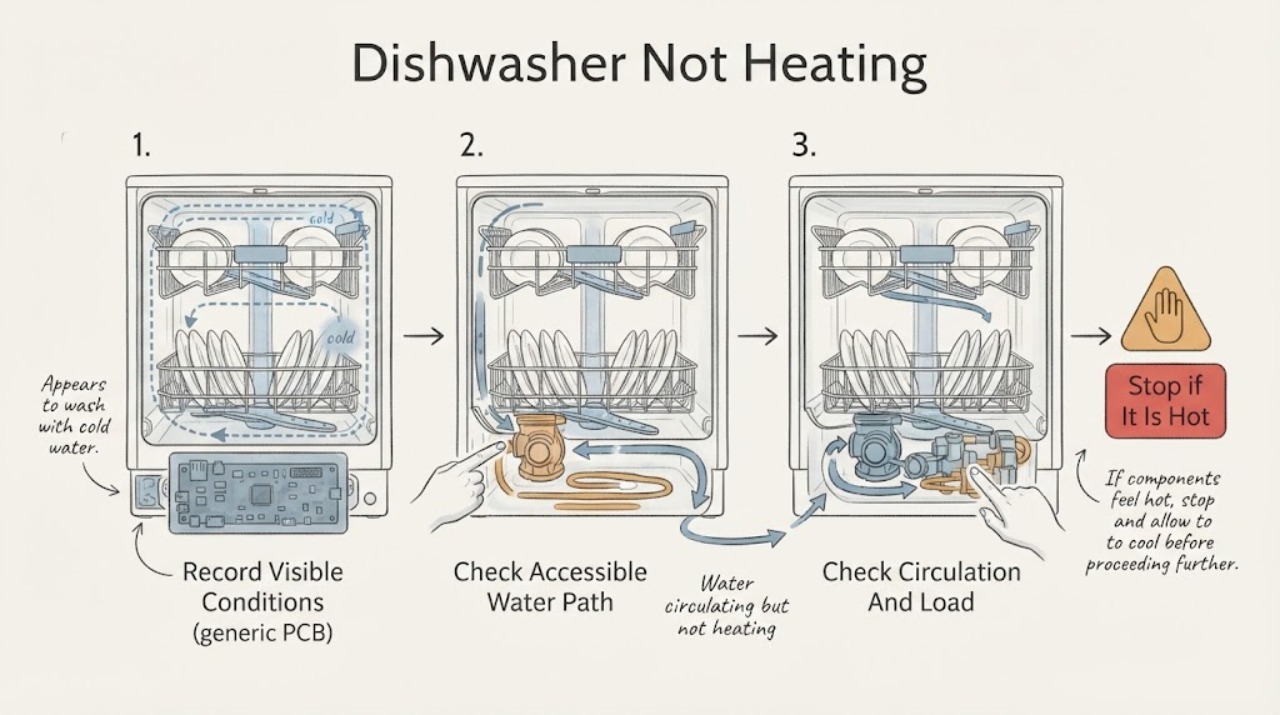
Work through in order
Diagnostic checks
Use only checks that match the exact appliance or system and its official guide.
-
Check 1
Record the exact Indesit model, programme, cycle stage, water state, drying result, pause behavior, displayed code, and complete flashing-LED pattern. Use only the programme instructions; do not open the door during a hot stage as a temperature test.
Expected result: The programme is a heat-using cycle and pauses or finishes cold; the selected cycle has a lower-temperature phase; the cycle never fills/drains; or a code/LED pattern is present.
Next step: Use the exact manual and code table for the model. If the cycle never reaches its heating stage because of fill/drain failure, follow that external branch first.
Stop if: Stop for steam/smoke beyond normal operation, burning odor, sparks, hot cord/socket, water near electrics, overflow, or repeated protective-device trips.
Why this matters
Why: Heating can be assessed only after the cycle reaches the relevant stage. A fill/drain or wrong-programme condition can mimic no heating, while a complete model-specific code can select a different fault family.
-
Check 2
With the dishwasher safely off, inspect only accessible conditions: water tap available, visible inlet hose not kinked, base filter clean if the manual permits removal, drain hose not trapped, and under-sink connection unobstructed where applicable.
Expected result: The dishwasher did not fill; water remains; a filter/hose/connection is visibly blocked or kinked; or fill and drain appear normal.
Next step: Correct only a visible, manual-approved condition and run no further cycle if water or electrical risk exists. If fill/drain is normal but heating still fails, continue with model-specific service diagnosis.
Stop if: Do not reach into standing water with power connected, dismantle pump or hose assemblies, move an integrated dishwasher, or bypass anti-flood protection.
Why this matters
Why: Indesit states that fill and drain faults can prevent normal programme progress. A preceding water-flow fault means the cold-water symptom does not yet isolate the heater.
-
Check 3
After the water path is normal and the appliance is safe, check that spray arms rotate freely by hand when unpowered, dishes do not block them, and detergent/scale maintenance matches the exact manual. Do not run a cycle with the door or panels altered.
Expected result: Spray arms are blocked by loading or residue; the filter is dirty; heavy scale or detergent residue is present; or circulation and loading are normal.
Next step: Correct only visible loading or cleaning conditions specified by the manual, then use the proper programme once if no hazard exists. Escalate if the result remains cold or the pump behaves abnormally.
Stop if: Do not dismantle spray-arm feeds, pump, heater, or sump, use chemical treatment outside the manual, or operate with a safety device bypassed.
Why this matters
Why: Poor circulation can leave dishes dirty or wet and can make a heating problem appear worse, but it does not prove a heater failure. Normal circulation shifts suspicion toward temperature sensing/heating/control only if the cycle reaches that stage.
-
Check 4
Compare any code or flashing LEDs with the exact Indesit model’s manual and the official dishwasher code page. Record the code, LED order, interface arrangement, and the cycle stage; do not infer a heater fault from the word “cold” alone.
Expected result: The complete model-specific pattern matches F10; another pattern matches a pump, drain, anti-flood, or communication family; or no reliable code is available.
Next step: Follow the model-specific user instruction if one is provided. For F10 or any internal/electronic code, stop at external checks and arrange authorized service rather than opening the appliance.
Stop if: Do not combine LED tables across models, enter undocumented service mode, clear a recurring code by repeated resets, or test live wiring.
Why this matters
Why: Indesit’s official table assigns different system families to different patterns. F10 can support a heating-element service path only when the exact interface and model context match; another pattern changes the next step.
-
Check 5
If a correct heat-using programme fills, circulates, and drains but repeatedly pauses or finishes cold, retain the model, code, cycle history, and checks and arrange authorized Indesit service. Leave the appliance disconnected when an electrical hazard is present.
Expected result: The heating result returns after a documented external correction; cold water persists; F10 or an internal code returns; the dishwasher stops mid-cycle; or smoke, odor, heat, sparks, or water near electrics is present.
Next step: Provide the technician with the model, complete code/LED pattern, selected programme, cycle stage, water state, and photos or notes. Keep the dishwasher out of service until assessed.
Stop if: Do not replace the heater or sensor, remove panels, measure resistance, run with covers off, bypass interlocks, or reconnect to reproduce a hazardous fault.
Why this matters
Why: A resolved external condition can be monitored, but persistent cold operation or a heating code may involve the heater, sensor, pump, board, wiring, or safety circuit. Hazard signs require immediate stop-use action.
Use your observations
Decision map
Find the observation that best matches what you see, then follow the next safe action.
-
PATH 01Safety boundary
What you see
The selected programme has not reached a heating stage, or the dishwasher did not fill, could not drain, or retains water.
Do this next
Use the exact manual to correct only the accessible tap, hose, filter, drain, or under-sink condition, then assess a full appropriate programme if safe.
Why this path and its safety boundary
Why it matters: The cold result is not yet evidence of a heater fault; Indesit treats fill and drain as separate preceding conditions.
Safety stop: Stop for standing water near electrics, overflow, a damaged hose, anti-flood activation, or a condition requiring pump/cabinet access.
-
PATH 02Safety boundary
What you see
The programme fills but spray arms are blocked, loading restricts rotation, the filter is dirty, or the wash action is weak while the heating result is uncertain.
Do this next
Correct visible loading/filter conditions as the manual allows and monitor one suitable cycle. Arrange service if circulation remains weak or the unit still pauses at heat.
Why this path and its safety boundary
Why it matters: Circulation or maintenance can leave dishes cold-looking, wet, or dirty without proving a heater failure.
Safety stop: Do not dismantle spray arms, pump, sump, heater, or wiring, and do not operate with covers or safety devices altered.
-
PATH 03Safety boundary
What you see
The complete model/interface pattern matches Indesit’s F10 heating-element indication and fill, circulation, and drain conditions are otherwise normal.
Do this next
Stop at safe external checks and arrange an Indesit engineer with the exact model and LED pattern. Keep the dishwasher out of service if the code returns.
Why this path and its safety boundary
Why it matters: The official F10 mapping supports a heating-element service path, but it does not authorize owner replacement or prove that the element alone is defective.
Safety stop: Do not open panels, measure the element, probe live connectors, or reset repeatedly to continue using the dishwasher.
-
PATH 04Safety boundary
What you see
The dishwasher remains cold or pauses, but the pattern is another code, the interface/model is unknown, or no reliable code is displayed.
Do this next
Use the exact manual and provide the complete evidence to authorized service. Do not borrow an F10 meaning or procedure from another model.
Why this path and its safety boundary
Why it matters: A pump, drain, anti-flood, communication, control, sensor, or programme condition remains possible; a heater cannot be selected from the symptom alone.
Safety stop: Do not enter service mode, bypass a sensor/interlock, or perform live tests.
-
PATH 05Safety boundary
What you see
Cold operation or a code is accompanied by smoke, sparks, burning odor, a hot cord/socket, water near electrical parts, overflow, or repeated protective-device trips.
Do this next
Stop the appliance and isolate water/power only from a dry, safe position. Keep it out of service and obtain emergency or qualified appliance/electrical help as appropriate.
Why this path and its safety boundary
Why it matters: Indesit identifies a possible overheating/fire hazard from an electrical component failure; safety takes priority over heating diagnosis.
Safety stop: Do not reconnect, reset protection repeatedly, touch wet electrical parts, open panels, or run another cycle to reproduce the event.
Helpful context
Understand the symptom
Confirm that the programme called for heat
Compare the selected programme and its stage with the exact Indesit manual. Judge the result from the whole cycle—water movement, final rinse behavior, drying result, and any pause—not from one brief door opening or a cool eco phase. If the cycle never filled, could not drain, or stopped before its heating stage, heating may be a consequence rather than the root fault. Do not open the door during a hot phase merely to test temperature; follow the manual’s safe observation guidance.
Identify the model before reading a code
Indesit’s service pages cover full-size, integrated, and slimline dishwasher families and provide a model manual path. Record the exact model and the complete display or LED pattern. The official page labels one F10 pattern as a heating-element fault, but also lists pump and electronic faults with their own patterns. Do not borrow an F10/F11/F12 meaning or a button sequence from another model.
Rule out fill, drain, and circulation conditions
With the appliance off and safe, check only what the manual makes accessible: the water supply is available, the inlet hose is not visibly kinked, the base filter is clean, the drain hose is not trapped, and spray arms can turn without a visible obstruction. Indesit notes that a dishwasher must drain before it can fill and that a blocked filter, hose, or under-sink connection can prevent normal operation. These checks do not prove that the heater is healthy; they merely ensure the heating symptom is not caused by a preceding water-flow stage.
Interpret cold dishes and a paused cycle together
Cold water, poor cleaning, wet dishes, and a programme that pauses can reflect several systems. If filling and draining are normal but the programme repeatedly pauses at the heating stage, a heater, temperature sensor, control, or circulation condition becomes more likely. If a model-specific F10 pattern is present, use the official code instruction and service route. If another code or a drain/anti-flood symptom appears, follow that model’s branch instead of calling it a heater fault.
Keep electrical work behind the service boundary
Do not remove the base or door panels, expose the heater, measure resistance, probe connectors, bypass a thermostat or interlock, or run the dishwasher with covers removed. Indesit’s safety notice warns of overheating and rare fire risk from an electrical component failure, and its official service page directs heating-element and other internal faults to an engineer. Keep the dishwasher out of service when the fault persists or any electrical hazard is present.
Safety boundary
Stop conditions
- Do not remove the dishwasher base or panels, probe the heater, measure resistance, test live wiring, or run a cycle with covers removed.
- Do not infer a failed heater from cold dishes, wet dishes, or one cool programme phase; confirm the programme stage and complete water path first.
- Do not combine Indesit LED/error tables across models or repeatedly reset a recurring code; use the exact manual and interface pattern.
- Stop for smoke, sparks, burning odor, hot cord/socket, water near electrics, overflow, or repeated protective-device trips; isolate only from a dry safe position.
- Do not bypass anti-flood, door, thermostat, or other safety devices, and do not replace a heater, sensor, pump, board, or wiring without authorized diagnosis.
Only after diagnosis
Potential parts
- dishwasher heating element
Consider only if the exact model’s code/manual or a qualified diagnosis identifies a heating-element fault after fill, drain, circulation, and programme-stage causes are ruled out.
Confirm the complete Indesit model and manufacturer fit information; heater assemblies are not universal. - temperature sensor
Consider only when a qualified model-specific diagnosis shows the sensor or its circuit is not regulating the heating stage; cold dishes alone do not select this part.
Verify exact model fitment and electrical specification through authorized service documentation before ordering. - wash circulation pump
Consider only if the manual/code or technician confirms weak circulation or a pump fault that prevents normal heating-stage operation.
Confirm the exact model and diagnosis; do not substitute a pump based only on cold or wet dishes.
When checks do not resolve it
Need a professional?
Arrange authorized Indesit dishwasher service when a complete appropriate programme remains cold after the documented external fill, drain, circulation, loading, and settings checks; the programme repeatedly pauses at heating; an exact model-specific F10 or other internal/electronic code appears; or a heater, sensor, pump, board, wiring, or safety-circuit fault is suspected. Stop immediately for smoke, sparks, burning odor, a hot cord or socket, water near electrical parts, overflow, or repeated protective-device trips; isolate power and water only when safe. The owner may record the model and code, inspect accessible hoses/filters/loading, and follow the manual’s user-level maintenance. Cabinet access, live testing, heater/sensor/pump replacement, and bypassing interlocks require qualified service.
Safety scope: The owner may use the exact manual, document the model/code, and perform safe accessible fill, drain, loading, filter, spray-arm, and programme checks. Qualified service must handle the heater, temperature sensor, wash pump, board, wiring, cabinet access, live diagnosis, and safety devices.
Common questions
FAQ
Why is my Indesit dishwasher not heating?
Cold water or wet dishes can follow a wrong programme phase, fill/drain problem, weak circulation, or a heating/sensor/control fault. Confirm the programme stage and model, check only accessible water-path and loading conditions, and use the exact code table before concluding the heater failed.
Can cold dishes prove the Indesit dishwasher heating element is bad?
No. A cold result alone does not select a heater. If the dishwasher did not fill, could not drain, circulated poorly, or never reached a heating stage, those conditions must be resolved or diagnosed first. A model-specific F10 pattern can support a heating-element service path, not owner replacement.
What does F10 mean on an Indesit dishwasher?
Indesit’s official dishwasher repair page labels one specified LED pattern as F10, a heating-element fault. Treat that as model/interface-specific: record the complete pattern and exact model, do not transfer it to another panel, and arrange an engineer rather than opening the appliance.
Could a drain or fill problem cause an Indesit dishwasher not to heat?
Yes. Indesit states that the dishwasher must drain before it can fill and provides separate checks for the tap, inlet hose, waste hose, under-sink connection, and base filter. A preceding water-flow problem can stop the programme before heating; correct only accessible manual-approved conditions.
Can I test or replace the Indesit dishwasher heater myself?
Do not remove panels, measure resistance, probe wiring, or run the dishwasher with covers removed. A heater, sensor, pump, board, or safety circuit needs model-specific diagnosis by qualified service, and power must be isolated before any authorized part work.
When does an Indesit dishwasher not heating require service?
Use service when a suitable programme fills, circulates, and drains but remains cold or pauses repeatedly, an exact F10 or other internal code returns, or a heater/sensor/pump/control issue is suspected. Stop immediately for smoke, sparks, burning odor, hot cord/socket, water near electrics, overflow, or repeated protective-device trips.
Read the exact guide
Official sources
- Safety Notice DishwasherIndesit Service · Opened official Indesit safety notice; used for the electrical-overheating boundary and model/serial safety check, not to claim that every no-heating symptom is a recall condition.
- Indesit | Dishwasher FAQIndesit Service · Opened official Indesit dishwasher troubleshooting page; used to separate fill/drain/power conditions from no-heating symptoms and to constrain user-level checks.
- Indesit Dishwasher RepairsIndesit Service · Opened official Indesit dishwasher repair page; used for the F10 heating-element example, separate F11/F12 fault families, manual lookup, and professional service boundary.
Community feedback
Share a repair observation
Share a plain-text repair observation. Accepted observations are published automatically; this page may take a moment to update.