
On this page
Start here
Quick answer
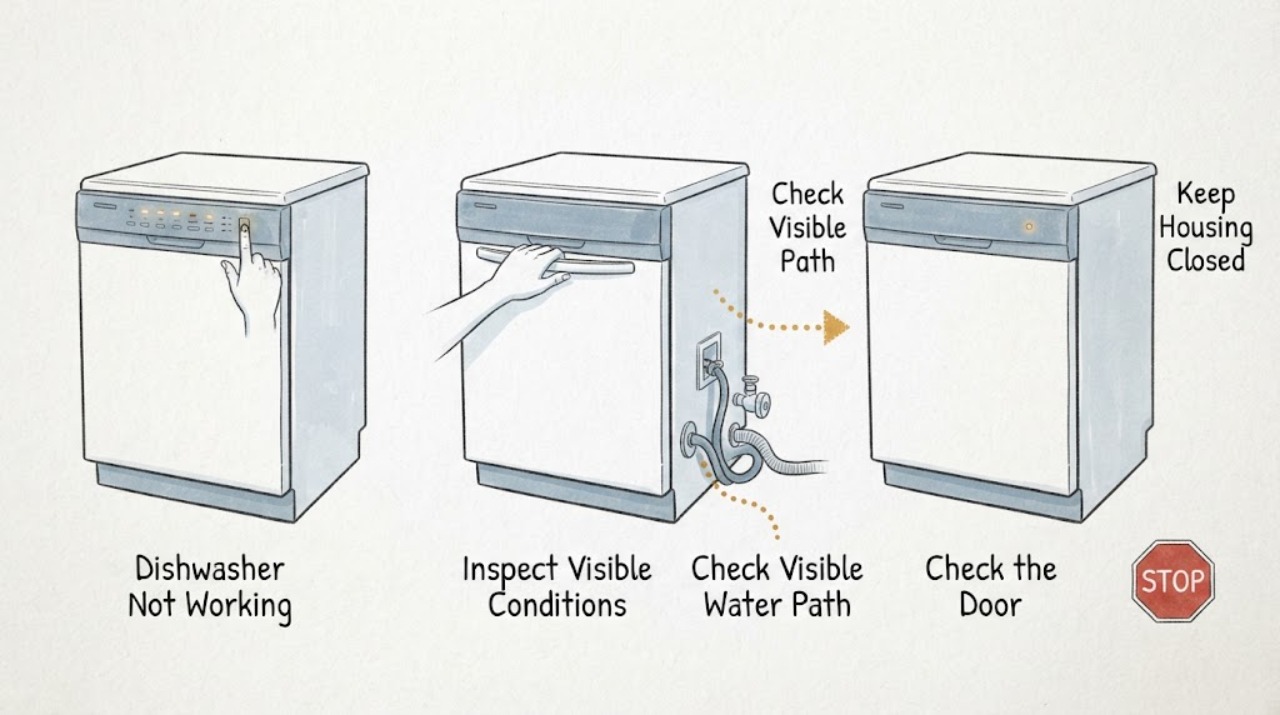
“Not working” is a symptom-routing problem, not one universal Indesit dishwasher fault. First observe what the machine actually does: no lights or response, lights on but no program start, a door that will not latch, no water entering, water left inside, a program that stops before completion, or a displayed light sequence or code. Indesit’s own troubleshooting separates these outcomes and directs the user to the exact model manual or authorized service for unresolved faults. Check only safe external items such as the plug, household supply, closed door, water tap, visible inlet or drain-hose restriction, and an exact model-specific indication. Do not open the dishwasher, defeat the door lock, reach into moving or hot parts, or use a live electrical test. Use the matching specific symptom route; if the machine has no power, shows an electrical hazard, repeatedly trips protection, leaks near electricity, or remains unresolved, stop using it and contact qualified service.
Before you begin
Safety first
- This page covers symptom classification, exact model identification, safe external power and door observations, and visible water-path observations described by the model manual. Door locks, pumps, valves, heaters, anti-flood devices, controls, wiring, internal panels, and live tests require authorized or otherwise qualified service.
Work through in order
Diagnostic checks
Use only checks that match the exact appliance or system and its official guide.
-
Check 1
With the dishwasher idle and safe to approach, identify the first observable symptom: no lights or response, lights on but no program starts, door will not latch, no water enters, water remains inside, a program stops early, or an exact code or light sequence appears.
Expected result: The symptom fits one route, several routes appear together, or the description remains only “not working.”
Next step: Choose the matching branch below and continue only with its safe external check. If no route can be identified, record the model and contact Indesit service rather than guessing.
Stop if: Stop for smoke, burning smell, sparks, shock, a hot plug, water near electrical parts, a leak into the base, or repeated operation of a circuit protection device.
Why this matters
Why: A specific observable outcome is more useful than the umbrella phrase. Combined symptoms should be routed by the most urgent hazard or the exact model indication first.
-
Check 2
For a dark or unresponsive control panel, check from a safe position whether the plug is seated, household power is available, and any accessible on/off switch is in its normal position. For a lit but non-starting machine, observe whether the door closes and latches normally; do not force or bypass the lock.
Expected result: There is no supply, the plug or cord is damaged, the panel is lit but the door does not latch, or power and normal door closure are present.
Next step: Route no power or a damaged power path to qualified electrical or appliance service. Route a door-latch or no-start symptom to the specific Indesit page and exact manual; do not keep cycling the machine.
Stop if: Do not open the plug or outlet, test voltage live, repair a cord, defeat the latch, or continue after smoke, heat, sparks, shock, or water near the electrical path.
Why this matters
Why: No supply or a damaged power path belongs to the power/no-response route. A lit machine with a door-latch symptom belongs to the door or not-starting route, while a normal door and stable power require the exact program or indication to be checked.
-
Check 3
If the machine does not fill or does not empty, observe only the accessible water tap, inlet hose, waste hose, under-sink connection, and filter area described by the exact manual. Look for a closed tap, kinked hose, blocked visible filter or sink connection, standing water, or a leak; isolate power before any permitted cleaning step.
Expected result: The tap is closed, an accessible hose is kinked, a visible drain or filter path is blocked, water remains, there is a leak, or these external checks are normal.
Next step: Use the matching water-fill or drain route for the model-approved external correction. If the leak, alarm, standing water, or fault persists, keep the dishwasher off and contact authorized service.
Stop if: Do not reach into a powered or hot tub, remove a pump or base panel, dismantle a valve, bypass an anti-flood device, or work where water is near electricity.
Why this matters
Why: Tap, hose, sink, and filter observations route to the water-fill or drain pages. A leak, standing water with an alarm, or normal external paths with a continuing fault can involve an internal valve, pump, anti-flood system, or control.
-
Check 4
Record whether the dishwasher never starts, pauses or stops mid-program, ends early, or reaches the end without draining or heating. Record every exact display code, flashing-light sequence, beep, and the model from the rating plate inside the door.
Expected result: The symptom is an initial start failure, a mid-cycle interruption, an early end, an end-state drain or heat issue, or a model-specific indication.
Next step: Open the specific Indesit route that matches the observed stage and use only the exact model manual. Escalate a persistent indication or internal component fault to authorized service.
Stop if: Do not repeatedly restart a halted program, force the door, use a different model’s code table, or test internal components while energized.
Why this matters
Why: These are different decision routes. Indesit publishes separate guidance for no start, premature completion, fill and drain faults, and fault families such as heating or pump problems; a generic reset or another model’s code cannot classify them safely.
-
Check 5
Use the product code or rating-plate information to retrieve the exact Indesit manual and compare the observed route with its troubleshooting section. Confirm whether the manual calls for a user-safe external check, a reset documented for that model, or authorized service.
Expected result: The manual matches the model and gives an external check, the manual directs service, the model cannot be identified, or the symptom does not match the manual.
Next step: Follow only a documented external step, then use the specific symptom page. If the manual directs service or does not match, stop and provide the rating-plate codes and symptom history to Indesit support.
Stop if: Do not improvise a wiring, pump, heater, lock, or board repair, and do not use a generic part or code recommendation without exact model confirmation.
Why this matters
Why: A matching manual can narrow the route without making the broad “not working” label a diagnosis. A mismatch or missing model identity is evidence that further generic instructions would be unsafe or misleading.
-
Check 6
Prepare the service handoff with the exact model and rating-plate codes, the first symptom, program stage, display or light indication, water status, power observations, and any leak or hazard. Keep the dishwasher disconnected when the fault is persistent or hazardous.
Expected result: The specific route does not resolve the issue, a fault indication persists, the dishwasher leaks, power is abnormal, or a protection device trips.
Next step: Contact Indesit authorized service; use a qualified electrician for the household supply, outlet, plug, or protection device. State that the dishwasher is not working and provide the exact observed route instead of requesting a guessed part.
Stop if: Do not remove panels, dismantle the tub or base, perform live measurements, bypass safety devices, or continue operation after a repeated trip, leak, smoke, burning smell, spark, or shock.
Why this matters
Why: The remaining possibilities include internal electrical, pump, valve, heater, lock, anti-flood, or control faults that this route page cannot safely distinguish.
Use your observations
Decision map
Find the observation that best matches what you see, then follow the next safe action.
-
PATH 01Safety boundary
What you see
The control panel and indicators are dark, the socket or household supply is unavailable, or the plug or cord is visibly damaged.
Do this next
Use the Indesit no-electrical-power or no-start route for safe external checks, and call qualified electrical or appliance service if supply or cord damage persists.
Why this path and its safety boundary
Why it matters: This is a power or no-response symptom, not evidence of a failed wash pump or heater.
Safety stop: Do not open the outlet, test live voltage, repair the cord, repeatedly restore power, or continue after heat, smoke, sparks, shock, or a tripped protection device.
-
PATH 02Safety boundary
What you see
The dishwasher has power but does not begin a program, does not respond to commands, or the door does not close or latch.
Do this next
Use the Indesit no-start or door-specific guidance and the exact model manual. Arrange service if the door, controls, or response remains abnormal.
Why this path and its safety boundary
Why it matters: This belongs to the starting, controls, or door route; it is distinct from a program that started and later stopped.
Safety stop: Do not force the door, bypass the latch, hold a safety switch closed, or repeatedly restart the controls.
-
PATH 03Safety boundary
What you see
The program starts or indicates a water problem, no water enters, water remains in the tub, or a fill or drain alarm appears.
Do this next
Use the matching Indesit fill or drain guidance for the exact model. Stop and arrange service for leaks, standing water with an alarm, or a persistent fault after the documented external check.
Why this path and its safety boundary
Why it matters: This belongs to the water-fill or drain route; external tap, hose, sink, and filter observations should be separated from pump or valve faults.
Safety stop: Do not remove the base, reach into moving or hot components, dismantle a pump or valve, or work around water and electricity while powered.
-
PATH 04Safety boundary
What you see
The dishwasher begins but pauses, ends early, or reaches an end state with a remaining drain, heating, cleaning, or completion symptom.
Do this next
Use the Indesit cycle-completion, drain, heating, or cleaning route that matches the observed stage and exact manual. Persistent pump, heater, sensor, or control indications require service.
Why this path and its safety boundary
Why it matters: This is a cycle-stage or specific performance route, not the initial no-start route. The next check depends on the stage and model indication.
Safety stop: Do not repeatedly restart a halted cycle, force a program, open hot water, or test internal components live.
-
PATH 05Safety boundary
What you see
An exact code or light sequence appears, the model cannot be identified, or there is a leak, smoke, burning smell, spark, shock, hot plug, or repeated protection-device trip.
Do this next
Record the rating-plate information and exact indication, keep the dishwasher off, and contact Indesit authorized service; use a qualified electrician for the household electrical path or protection device.
Why this path and its safety boundary
Why it matters: A model-specific fault or safety condition overrides generic “not working” checks.
Safety stop: Do not apply another model’s code table, keep resetting protection, bypass a safety device, remove panels, or reconnect after an electrical or water hazard.
Helpful context
Understand the symptom
Route the symptom before troubleshooting the appliance
Indesit’s official dishwasher material does not treat every “not working” report alike. It distinguishes no start or no response, a door that will not close, failure to fill, failure to drain, and a cycle that ends or stops unexpectedly. This page is a short triage route to the relevant symptom page; it does not substitute one model’s detailed procedure for another’s.
Use the exact model indication
Indesit dishwasher controls vary. Record the model and the exact display, flashing-light sequence, alarm, or point in the program where the behavior changed. The Indesit error guide lists distinct fill, drain, heating, pump, sensor, and board fault families; do not apply a code table from a different model or control layout.
Keep external checks separate from service work
The safe boundary for this broad route page is observation and model identification: power and plug context, door closure, a fully open water tap, visible hose kinks, and accessible signs of a leak. Internal pumps, valves, heaters, locks, wiring, control boards, and anti-flood devices require an appropriate authorized technician, especially when water and electricity are involved.
Safety boundary
Stop conditions
- Stop for smoke, burning smell, sparks, shock, a hot or damaged plug or cord, water near electrical parts, a leak into the base, or repeated operation of a circuit protection device.
- Do not force or bypass the door latch, defeat anti-flood protection, open electrical compartments, or perform live voltage or continuity tests.
- Do not use another Indesit model’s error table, wiring, program reset, or replacement-part guidance without exact model confirmation.
- Keep the dishwasher off and arrange service when a documented external check does not resolve the symptom or a code, leak, standing water, or abnormal heat persists.
- Protect against hot water and sharp items and do not reach into a powered, moving, or recently heated dishwasher.
When checks do not resolve it
Need a professional?
Contact Indesit authorized service when the exact route or manual does not resolve the problem, a code or flashing-light sequence persists, the door or controls remain abnormal, the dishwasher will not fill or drain after the documented external checks, or a cycle stops or ends with a fault. Call a qualified electrician for a damaged or overheated plug, cord, outlet, household supply, or protection device. Stop immediately for smoke, burning smell, sparks, shock, water near electricity, a leak into the base, or repeated trips.
Safety scope: This page covers symptom classification, exact model identification, safe external power and door observations, and visible water-path observations described by the model manual. Door locks, pumps, valves, heaters, anti-flood devices, controls, wiring, internal panels, and live tests require authorized or otherwise qualified service.
Common questions
FAQ
What does “Indesit dishwasher not working” actually mean?
It is an umbrella report. Identify whether there is no power, no start, a door-latch problem, no water fill, standing water, an interrupted cycle, or an exact code or light sequence, then use that specific route.
How do I tell not starting from a cycle that did not complete?
Not starting means the program never begins or the machine does not respond. A cycle-not-completing symptom means it began and later paused, stopped, ended early, or finished with a drain, heat, or other fault. Record the stage and route it accordingly.
What can I check if my Indesit dishwasher has no lights?
From a safe position, check whether household power is available, the plug is seated, and the accessible cord and outlet show no damage. Do not open the outlet or perform a live test; persistent no-power symptoms require qualified electrical or appliance service.
What if my Indesit dishwasher has power but will not start?
Observe whether the door closes and latches, whether a program was actually selected, and whether an exact model-specific indication appears. Use the no-start or door route for that model; do not force or bypass the latch.
What if my Indesit dishwasher does not fill or drain?
Use the matching water route. Safe external observations include the tap, visible hose kinks, under-sink connection, and the model-approved filter area after power is isolated. A persistent fault, leak, alarm, or standing water requires service.
Should I use a generic Indesit error-code list?
No. Record the exact code or flashing-light sequence and the rating-plate model, then use the matching Indesit manual or official code guide. Different fault families can represent fill, drain, heating, pump, sensor, control, or anti-flood conditions.
Read the exact guide
Official sources
- Indesit | Dishwasher Error Codes | Indesit ServiceIndesit Service · Indesit dishwasher error-code families and service guidance
- Indesit | Dishwasher Faq | Indesit ServiceIndesit Service · Indesit dishwasher troubleshooting, electrical-power, fill, drain, and service guidance
- TroubleshootingIndesit · Indesit dishwasher troubleshooting and user manual
- Daily Reference GuideIndesit · Indesit dishwasher daily reference and troubleshooting guide
Community feedback
Share a repair observation
Share a plain-text repair observation. Accepted observations are published automatically; this page may take a moment to update.