
On this page
Start here
Quick answer
An Indesit washing-machine door can stay locked while a programme is running, while the drum still contains water, or when the door interlock or a model-specific fault is active. Do not pull or pry the door. First note whether the cycle is still running, whether the water is hot or visible through the glass, and what code or flashing lights appear. If the programme has ended, allow the normal post-cycle release period; if water remains, keep the machine off and use only the model-approved drain and pump-filter procedure. Indesit identifies F05 with a drain or pump problem that can leave water in the drum and F06 with a door-lock fault; use the exact model manual before any emergency-release step. Stop for a leak, water near the electrical supply, hot water or steam, damaged glass, burning odour, smoke, sparks, or a repeated trip, and arrange qualified service.
Before you begin
Safety first
- This article covers external observation and only model-approved low-risk controls or drainage checks. A technician must handle a retained-water fault that cannot be drained safely, door-interlock or control work, wiring, panel removal, damaged glass, leaks, and any electrical or thermal hazard.
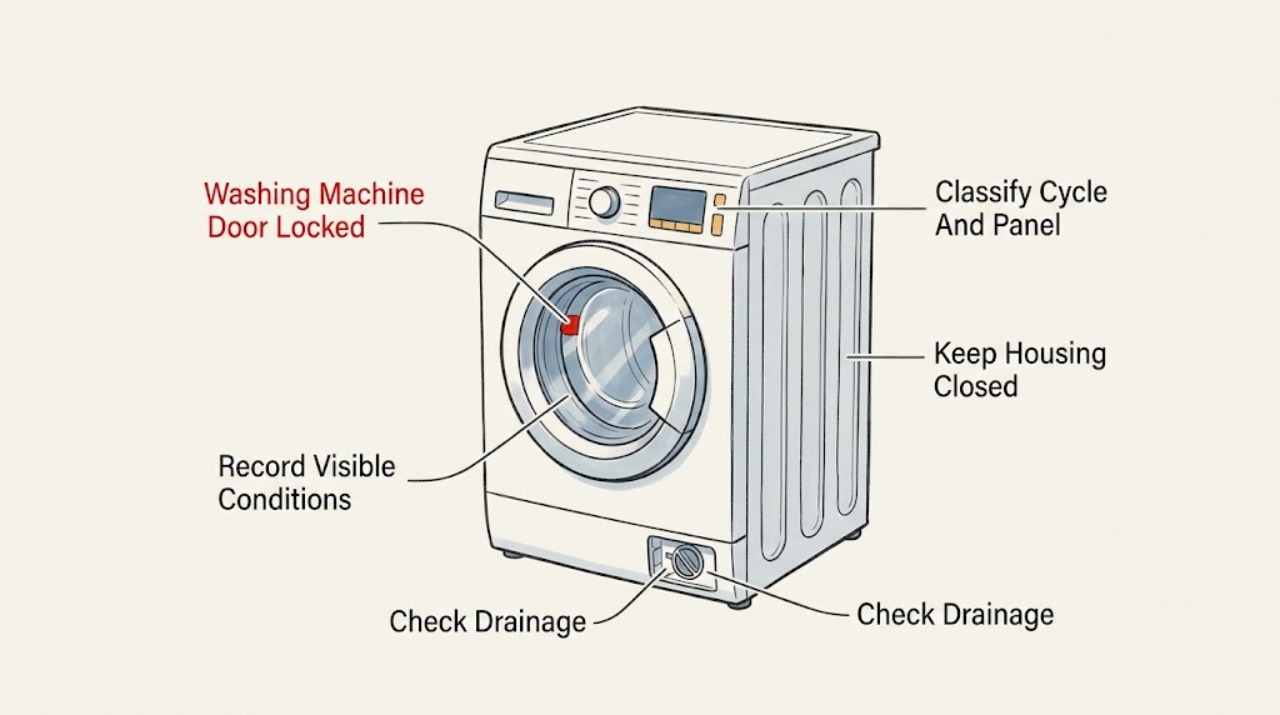
Work through in order
Diagnostic checks
Use only checks that match the exact appliance or system and its official guide.
-
Check 1
Keep the door closed and inspect from outside. If there is a leak, water touching the plug or socket, hot water or steam, smoke, burning odour, a spark, damaged glass, a loose door, or a repeated electrical trip, stop using the machine and isolate it only if this can be done without touching water or exposed electrical parts.
Expected result: Record whether the drum is moving, whether water is visible through the glass, whether the water appears hot, whether the appliance is powered, and any smell, sound, display code, or flashing-light pattern.
Next step: If no hazard is present, continue to classify the programme and panel state. For any hazard, leave the door shut, keep people away, and arrange qualified appliance service.
Stop if: Do not touch water near the electrical supply, open a hot or pressurised door, operate a damaged glass or hinge, or repeatedly reset a machine that smells burnt, sparks, smokes, or trips.
Why this matters
Why: A moving drum or hot or visible water indicates a normal safety lock or a drain/heating state; a hazard or damaged door makes further user checks unsafe. A powered machine with a lock code needs model-specific diagnosis rather than force.
-
Check 2
From the controls, note whether the selected programme is running, paused, finished, held at a rinse stage, or showing a control or child-lock symbol; do not pull the door or change several settings at once.
Expected result: Record the programme position, end or pause indication, remaining water, lock symbol, and the exact model number. If the cycle has just ended and the drum is empty and cool, wait for the model's normal post-cycle unlock period before checking the handle again.
Next step: Use the manual for the exact model to identify the control-lock command and post-cycle release behavior; if the door remains locked after that safe wait, continue with the water and code checks.
Stop if: Do not repeatedly start, cancel, or force a programme when water is visible, the drum is hot, the door is damaged, or the machine is making abnormal sounds.
Why this matters
Why: A running, paused, or recently finished programme can keep the interlock closed by design. A control-lock indication can prevent a new command. A finished programme with no water but a persistent lock points toward the interlock, control, or a model-specific fault.
-
Check 3
If water remains or the programme stopped before emptying, leave the machine off and unplug it only from a dry position. From ordinary safe access, check for a kinked or blocked waste hose and, where the exact handbook permits it, inspect the pump filter using a low container and towels; do not open the door to remove laundry.
Expected result: Record whether the drain hose is kinked, whether the under-sink connection is blocked, whether a user-serviceable filter is present, and whether water drains in a controlled way through the model-approved route.
Next step: Restore only a correctly routed hose or clear an accessible blockage as the manual permits, then stop and arrange service if the drum does not empty, water returns, or the door remains locked.
Stop if: Stop immediately if water is hot, discharge is uncontrolled, the filter will not turn by ordinary hand pressure, the machine rocks, water reaches the plug or socket, or access would require removing panels.
Why this matters
Why: A blocked hose, filter, or sink connection can leave water in the drum and keep the interlock closed; Indesit associates that pattern with F05. No flow, uncontrolled flow, a pump that only hums, or a filter that cannot be accessed safely suggests a pump or plumbing fault.
-
Check 4
With power isolated and the door still closed, inspect only the visible latch opening, seal edge, handle, hinge alignment, and door glass for a garment edge, debris, crack, distortion, or an obstruction; do not remove the interlock or insert a tool.
Expected result: Classify the visible area as clear and intact, obstructed by a removable item, misaligned or damaged, or inaccessible because the latch remains loaded.
Next step: Remove only a loose item that can be taken away without pulling the seal or latch; otherwise photograph the area, keep the door closed, and provide the observation and model number to service.
Stop if: Do not bend the frame, pull the seal, force the handle, defeat the interlock, or operate the machine with cracked glass, a loose hinge, or a damaged latch.
Why this matters
Why: A visible obstruction can prevent the latch from returning, while a broken handle, hinge, seal, or glass points to a mechanical or safety repair. A clear door area with a lock fault is consistent with the interlock or control and is not a reason to bypass it.
-
Check 5
Copy the complete display code or the order of flashing lights and match it with the exact Indesit model manual or official washing-machine error-code page; keep a photo of the panel before clearing anything.
Expected result: Determine whether the code is F05, F06, another listed code, or an unrecognized light pattern, and whether the model is a front-loader or a top-loader with a drum-position lock.
Next step: Follow only low-risk instructions for that exact model. If the code remains, the manual calls for service, or the pattern is not listed, stop and book qualified Indesit or appliance service.
Stop if: Do not bridge lock wires, remove the control panel, use an emergency release described for another model, or keep resetting an active fault.
Why this matters
Why: F05 directs attention to the waste path or pump when water remains; F06 directs attention to the door-lock system. Other codes can change the path to a control, motor, heater, or top-loader drum-position fault, so a generic code list is unsafe.
-
Check 6
Only if the exact manual explicitly shows an emergency door release, confirm that the machine is unplugged, cool, drained through the approved route, stable, and free of leaks before following that manual's release sequence exactly; otherwise leave the door closed.
Expected result: Record whether the manual names a release, whether the release operates without force, and whether the door opens only after the safety conditions are met.
Next step: If the door opens normally, remove items carefully and do not run another cycle until the cause is identified. If it does not open or any condition is uncertain, preserve the code and photos and arrange service.
Stop if: Never force the handle, pry the door, reach through the seal, remove panels, or use a release tool not specified for the exact model.
Why this matters
Why: A documented release can address a drained, cool load after a control or interlock fault. No documented release, resistance, retained water, heat, or damage means the lock must be handled by a qualified technician; forcing it can create flooding, glass, or latch damage.
-
Check 7
After water is absent, the machine is cool, the door and glass are intact, and no electrical hazard is present, perform at most one model-approved power reset; keep the machine unplugged for the interval specified by the exact Indesit support guidance, then reconnect without bypassing the lock.
Expected result: Record whether the panel returns normally, whether the door unlocks, whether the same code or lock returns, and whether the pump, latch, or control behaves abnormally.
Next step: Do not run a full wash to test a persistent fault. Give service the model, code, programme stage, water level, photos, and the result of the single reset.
Stop if: Do not repeat resets, hold a lock button indefinitely, bypass the door interlock, or continue if the machine leaks, heats unexpectedly, sparks, smokes, smells burnt, or trips.
Why this matters
Why: A one-time reset can clear a transient control state, but a recurring lock or code supports a drain, interlock, wiring, or control diagnosis. A repeated trip, smell, noise, or failed unlock is not a reset problem.
Use your observations
Decision map
Find the observation that best matches what you see, then follow the next safe action.
-
PATH 01Safety boundary
What you see
The programme is running, paused, or has just ended; the drum is moving or no water is visible and the machine is cool.
Do this next
Wait for the exact model's normal release period, then check the display and manual; do not pull the door.
Why this path and its safety boundary
Why it matters: The interlock may be operating normally until motion stops and the post-cycle release state is reached.
Safety stop: Stop for hot water, steam, abnormal movement, smoke, burning odour, sparks, damaged glass, or a repeated trip.
-
PATH 02Safety boundary
What you see
Water is visible in the drum, the machine stopped before emptying, or the panel shows F05.
Do this next
Keep the door closed, isolate power from a dry position, and follow only the exact manual's drain-hose or pump-filter procedure; arrange service if drainage is not restored.
Why this path and its safety boundary
Why it matters: Indesit associates F05 with a waste-pipe blockage or pump issue that can leave water inside and keep the door locked.
Safety stop: Stop for hot or uncontrolled discharge, water near the electrical supply, a seized filter, or any need to remove panels or force the door.
-
PATH 03Safety boundary
What you see
The panel shows F06, a lock fault, or the machine will not start despite a closed and visibly intact door.
Do this next
Check for a loose visible obstruction without tools, record the code and model, and arrange qualified service if the fault remains.
Why this path and its safety boundary
Why it matters: Indesit identifies F06 as a door-lock fault; the interlock, latch, wiring, or control may need model-specific service.
Safety stop: Do not bridge wires, defeat the lock, remove the interlock, or force the handle.
-
PATH 04Safety boundary
What you see
A control-lock symbol, pause state, or unrecognized flashing pattern appears and the drum is empty and cool.
Do this next
Use the exact model manual, record the light order, and try only the documented control command or one safe reset.
Why this path and its safety boundary
Why it matters: The machine may be waiting for a model-specific control command or reporting a code whose meaning depends on the panel layout.
Safety stop: Do not apply a key sequence from another model or keep changing programmes while the door is locked.
-
PATH 05Safety boundary
What you see
The handle, hinge, seal, latch opening, or glass is cracked, loose, distorted, or visibly damaged.
Do this next
Leave the door shut, keep the machine out of use, photograph the damage, and arrange qualified appliance service.
Why this path and its safety boundary
Why it matters: The door may not be safely aligned with the interlock, and continued operation can worsen a flood or glass hazard.
Safety stop: Do not pull the handle, bend the frame, push the glass, remove the seal, or operate the machine.
-
PATH 06Safety boundary
What you see
The exact manual documents an emergency release, and the appliance is unplugged, cool, drained, stable, and free of hazards.
Do this next
Follow that manual's sequence without force, then leave the appliance unused until the recurring cause is identified.
Why this path and its safety boundary
Why it matters: A documented release may be appropriate for a drained load after a lock or control fault, but it is not a universal procedure.
Safety stop: Stop if the release is absent, resists, leaves water in the drum, or requires tools, panel removal, or reaching into the latch.
Helpful context
Understand the symptom
A locked door is often a safety state, not a broken handle
Keep the door closed while the drum is moving, while water is visible, or while the water may still be hot. An end indicator can mean the programme has completed, but the lock may need its normal post-cycle release period. If the display shows a pause, child or control lock, or an error, record it before trying anything. Never pull the handle, lean on the door, or insert a tool between the seal and frame.
Use the water level to choose the safe path
Water visible through the glass, a wet drum, or a machine that stopped before draining changes the diagnosis. Keep the appliance off and do not try to open it. Indesit links F05 to a waste-pipe blockage or pump issue and recommends checking the pump filter where fitted, the waste-water hose, and under-sink plumbing according to the user handbook. A drain or filter cover can release water, so use only the exact model procedure with a container and towels, and stop if the discharge is hot, uncontrolled, or reaches the electrical supply.
Treat a door-lock code or flashing pattern as model evidence
Indesit lists F06 as a door-lock fault and notes that a machine may fail to start when the door is closed. Other codes can point to a pump, control, motor, or drum-position problem. Copy the full code or light sequence and the model number, then use the Indesit manual or error-code page for that exact machine. Do not treat a code from another model as a universal code, and do not bypass the interlock.
Emergency release is conditional and model-specific
Some machines provide a manual or emergency release near the pump-filter area, while others do not. Only use one when the exact Indesit manual explicitly describes it and the machine is unplugged, drained through the approved route, cool, stable, and free of leak or electrical hazards. If the manual does not show a release, the lock remains engaged after drainage, or the handle, hinge, seal, glass, or latch is damaged, stop and request service rather than forcing access.
Safety boundary
Stop conditions
- Do not pull, pry, bend, or force an Indesit washing-machine door or insert tools into the latch or seal.
- Stop when water is visible, hot, uncontrolled, or near the plug, socket, or other electrical equipment; keep the door closed and arrange service.
- Stop for a leak, cracked glass, loose hinge, damaged latch, burning odour, smoke, sparks, abnormal heat, or a repeated electrical trip.
- Do not bypass or bridge the door interlock, remove panels, or use an emergency release from another model.
- Use only the exact model manual for drain, pump-filter, control-lock, reset, and emergency-release instructions; stop if the manual does not document the step.
Only after diagnosis
Potential parts
- door interlock assembly
Consider this category only when the exact model evidence and service diagnosis identify an F06 or persistent lock fault after drainage and safe checks.
Confirm the full Indesit model and interlock revision with the manufacturer or qualified technician; do not bypass or substitute a lock by appearance. - drain pump or pump filter assembly
Consider this category only when water remains and the exact model diagnosis confirms a pump or filter failure beyond an accessible hose or blockage.
Confirm the model-specific pump, filter, seals, and electrical fit; retained water and panel access require qualified handling when the approved drain route is not safe. - door handle, hinge, or seal
Consider this category only when inspection confirms a damaged or misaligned door component that prevents safe latch engagement.
Confirm the exact door and seal configuration; cracked glass, a loose hinge, or a distorted frame is a service condition, not a reason to force the lock.
When checks do not resolve it
Need a professional?
Arrange qualified Indesit or appliance service when water remains after the model-approved drain checks, F05 or F06 returns, the door stays locked after the safe post-cycle state and one documented reset, the exact manual gives no release, the release resists, the latch or door is damaged, or any leak, hot water, electrical hazard, burning odour, smoke, spark, abnormal heat, or repeated trip is present.
Safety scope: This article covers external observation and only model-approved low-risk controls or drainage checks. A technician must handle a retained-water fault that cannot be drained safely, door-interlock or control work, wiring, panel removal, damaged glass, leaks, and any electrical or thermal hazard.
Common questions
FAQ
Why is my Indesit washing-machine door still locked after the cycle ends?
The interlock may still be completing its normal post-cycle release, or water may remain in the drum. Keep the door closed, wait according to the exact manual, and check the water level and display. If it remains locked with an empty, cool drum, use the model manual and arrange service rather than forcing the handle.
What does F05 mean when an Indesit door will not open?
Indesit links F05 to a waste-pipe blockage or pump issue and says the door may not open when water remains inside. Keep the door closed and follow only the exact handbook's hose or pump-filter check; stop for hot or uncontrolled water, water near the electrical supply, or unsafe access.
What does F06 mean on an Indesit washing machine?
Indesit identifies F06 as a door-lock fault that can prevent the door from opening or closing or keep a programme from starting. Check only for a visible obstruction as the official guidance allows, record the model and code, and arrange service if the fault remains. Do not bypass the interlock.
Can I use the emergency release to open the locked door?
Only when the exact Indesit manual documents that release and the appliance is unplugged, cool, drained through the approved route, stable, and free of leaks or electrical hazards. If the manual does not show one, or the release resists, leave the door closed and request qualified service.
Should I force the door if there is water in the drum?
No. Water may be hot or may flood the room, and forcing the door can damage the latch, seal, or glass. Keep the door closed, isolate power from a dry position, use only the model-approved drain procedure when safe, and arrange service when drainage is not restored.
Read the exact guide
Official sources
- Indesit Washing Machine RepairsIndesit Service · Official Indesit repair overview; current model instructions and local service arrangements still control.
- Indesit | Washing Machine Error CodesIndesit Service · Official Indesit Service guidance for the listed washing-machine code families; the exact model handbook controls a particular panel and procedure.
- Download Your Indesit Appliance ManualIndesit Service · Official Indesit manual portal; the manual for the exact appliance determines control-lock, drainage, reset, and any emergency-release procedure.
- Indesit Washing Machine FAQ and TroubleshootingIndesit Service · Official Indesit FAQ content; exact model handbook instructions take precedence for controls and access.
Community feedback
Share a repair observation
Share a plain-text repair observation. Accepted observations are published automatically; this page may take a moment to update.