
On this page
Start here
Quick answer
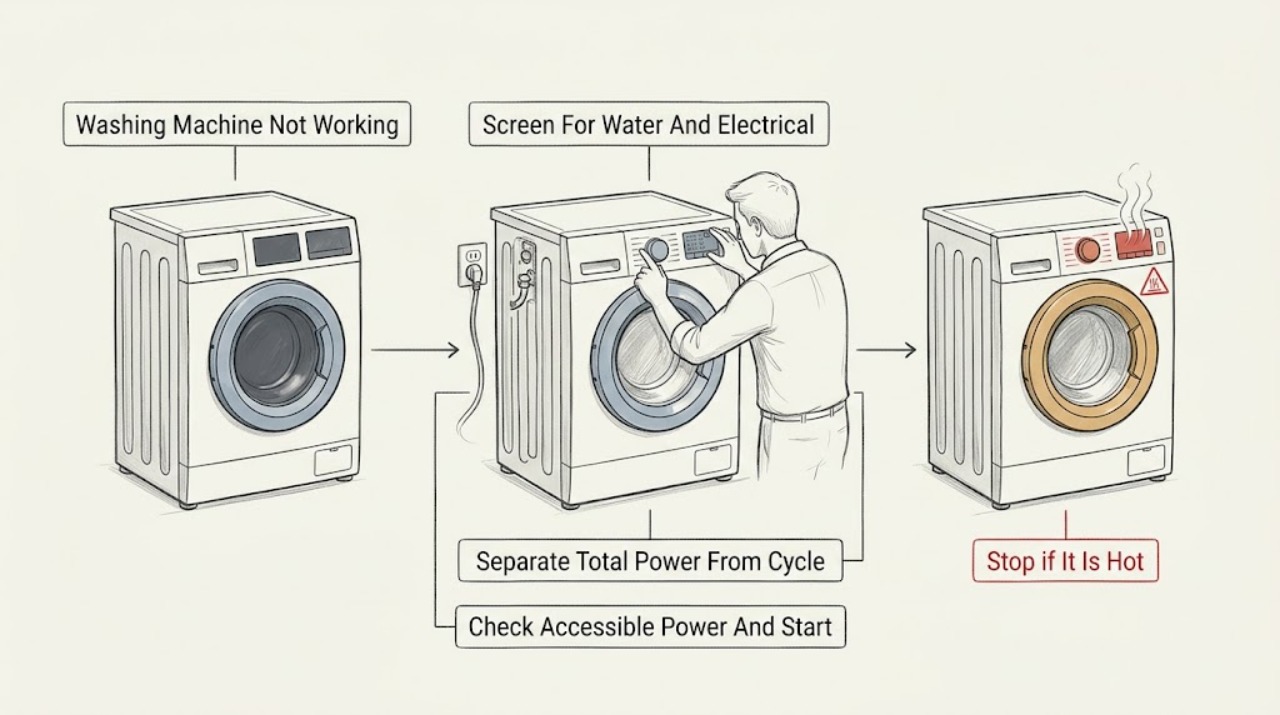
When an Indesit washing machine is not working, first stop for a leak, standing water near electrics, a burning smell, smoke, sparks, a damaged cord, violent movement, or a repeated breaker trip. If there is no hazard, separate a blank display from a cycle that will not start, fill, drain, or spin. Check the accessible power supply, make sure the door is firmly closed, select the correct programme, and press the normal Start control as the exact manual describes. Then check the water tap and inlet hose, the drain hose and household waste connection, the load balance, and any flashing light or exact error code. Do not open a wet electrical area, repeatedly reset a breaker, force the door, reach into a spinning drum, or replace a pump, lock, motor, heater, or control by symptom alone. Persistent or unsafe faults need qualified Indesit appliance service.
Before you begin
Safety first
- This article supports hazard screening, external supply and hose observation, normal controls, door and load checks, safe documentation, and model-manual steps only. Do not work on live electrical parts, internal water or pump components, the door lock, motor, heater, or control.
Work through in order
Diagnostic checks
Use only checks that match the exact appliance or system and its official guide.
-
Check 1
Before restarting anything, look from a dry, safe position for leaking water, standing water near the plug or outlet, smoke, sparks, a burning smell, a damaged cord, violent movement, or a breaker that has tripped repeatedly.
Expected result: Classify the machine as having an immediate water, electrical, fire, or movement warning, or as having no warning.
Next step: For a leak, close the water tap if safe and keep water away from electrics; for smoke, sparks, burning smell, or repeated trips, stop using the appliance and arrange qualified help.
Stop if: Do not touch wet electrical connections, reset a breaker repeatedly, run a cycle, or reach into the drum while a hazard is present.
Why this matters
Why: A warning changes the task from troubleshooting to safe isolation and service; no warning permits limited external checks.
-
Check 2
With no hazard, press no controls yet; observe whether the display and indicator lights are completely blank or whether the machine has power but refuses to start or stops later.
Expected result: Record blank display, normal display with no start, a door-lock indication, a mid-cycle stop, retained water, or a programme that stops at fill, drain, heat, or spin.
Next step: Use the matching power, start, fill, drain, spin, or error-code branch and preserve the exact stage and indication.
Stop if: Do not assume a powered display means the motor, heater, pump, or door lock is safe to test.
Why this matters
Why: A blank display points toward supply, plug, fuse, or control power; a powered machine narrows the decision to door, programme, water, drain, heating, motor, load, or control conditions.
-
Check 3
If the machine is dry and shows no damage, inspect the accessible plug, cord, socket, fuse or breaker, on/off control, programme selector, and Start or Pause control; make at most one normal reset if the exact manual permits it.
Expected result: Record a dead socket, loose or damaged plug or cord, tripped breaker, normal supply with a blank display, a missing Start command, or a machine that still will not begin.
Next step: Keep the machine off and use qualified electrical service for damage or recurring trips; arrange appliance service if the supply is sound but the display or controls remain dead.
Stop if: Do not use an extension lead, open the outlet or machine, tape a damaged cord, or repeatedly reset a breaker.
Why this matters
Why: Indesit identifies supply, fuse, on/off or Start position, and a firmly closed door as basic no-start checks. A damaged connection or recurring trip is an electrical service issue.
-
Check 4
Confirm that the door is closed firmly, no clothing is caught in the seal, the programme dial is in the intended position, any delay or pause is understood, and the exact manual does not require a control-lock or Start confirmation.
Expected result: Record a door that will not latch, a lock light that does not engage, a moved selector, a delay or pause indication, or a normal ready display that still refuses to start.
Next step: Remove only a visible obstruction and apply the manual's normal Start, cancel, or unlock step once; if the door or control remains abnormal, leave the machine off and arrange service.
Stop if: Do not force the door, defeat the lock, pull clothing through the seal, or start a cycle with a damaged latch or seal.
Why this matters
Why: An unlatched door or programme state can inhibit filling and movement without proving a failed motor or board; a returning lock fault needs service.
-
Check 5
If the machine is dry and safe, verify that the cold-water tap is open, the inlet hose is connected without a kink, and there is no leak at the accessible connections; do not remove a hose under pressure or reach behind an unsafe installation.
Expected result: Record a closed tap, kinked hose, low or absent household water supply, a tap symbol or fill light, a visible leak, or normal inlet conditions with no fill.
Next step: Correct only a clearly closed tap or safe external kink, then follow the model manual; stop and arrange service for a leak, damaged connection, or continued no-fill condition.
Stop if: Do not run the machine with a leaking hose, loosen pressurized connections, bypass a water-safety device, or continue when water approaches electrics.
Why this matters
Why: Indesit links fill indicators and mid-cycle stops to water-supply, hose, pressure, or connection conditions; a leak or normal inlet with no fill may require service.
-
Check 6
If water remains after a stop and the area is safe, keep the machine off, close the water tap, and inspect only the accessible drain hose, standpipe or under-sink connection for a kink, blockage, or incorrect insertion; use the exact manual before opening a pump filter.
Expected result: Record retained water, a kinked or blocked hose, a restricted household waste connection, a rinse-hold or crease-care option, or a clear external drain path with no pumping.
Next step: Follow the manual's safe drain procedure or arrange service; a clear path with retained water points toward a pump or control diagnosis.
Stop if: Do not open a filter with unsafe water pressure or temperature, touch a wet plug or outlet, tip the machine, or reach into the pump while connected.
Why this matters
Why: Indesit identifies drain-hose routing, household waste blockage, and hold options as reasons a machine may not empty or may stop; retained water also makes door opening and filter work hazardous.
-
Check 7
If the machine fills and washes but does not spin or becomes unstable, stop the cycle, wait for the drum to stop, and assess whether the load is excessive or uneven without reaching into a moving drum.
Expected result: Record soaking clothes, a spin indicator, repeated redistribution attempts, violent vibration, a single bulky item, or a balanced load that still will not spin.
Next step: When safe, redistribute a small load as the manual directs and select the appropriate spin option once; arrange service if instability or no-spin persists.
Stop if: Do not hold the machine, reach into the drum, continue violent vibration, or run it with a loose, damaged, or unstable installation.
Why this matters
Why: Indesit says an unbalanced load can cause spin to be aborted to limit excessive vibration; violent movement, persistent no-spin, or a balanced load points to installation or mechanical control service.
-
Check 8
Photograph or write down the exact error code or flashing-light sequence and model number, then use the exact Indesit manual or error guide for one permitted reset only; do not keep cycling a fault.
Expected result: Record whether the code identifies a door, pump, motor, heating, sensing, or control condition, whether it clears, and whether the same code returns.
Next step: Keep the machine off and provide the code, stage, water state, and previous observations to qualified Indesit appliance service.
Stop if: Do not apply another model's code meaning, bypass the door lock, open live panels, or replace a pump, motor, heater, sensor, or control by code alone.
Why this matters
Why: Indesit's error guide maps different codes to different subsystems and models; a returning code or no-code failure after the relevant safe checks needs a technician.
Use your observations
Decision map
Find the observation that best matches what you see, then follow the next safe action.
-
PATH 01Safety boundary
What you see
Water is leaking or standing near electrical parts, the cord or outlet is damaged, there is smoke, a burning smell, sparks, or a breaker trips again.
Do this next
Close the water tap if safe, keep people away from wet electrics, isolate power only from a dry safe location, and arrange qualified appliance or electrical service.
Why this path and its safety boundary
Why it matters: The machine presents a water or electrical hazard and should not be tested.
Safety stop: Do not touch wet plugs, outlets, cords, or internal parts; do not reset a breaker repeatedly or run another cycle.
-
PATH 02Safety boundary
What you see
The display and indicators are blank and there is no immediate water, fire, or electrical-damage warning.
Do this next
Check the accessible dry supply and one manual-approved reset; use qualified electrical or appliance service if the machine stays dead or the breaker trips again.
Why this path and its safety boundary
Why it matters: The decision path is the external supply, plug, fuse, breaker, or machine power/control circuit.
Safety stop: Do not use an extension lead, open the outlet or machine, or repeatedly reset power.
-
PATH 03Safety boundary
What you see
The machine has power but the door does not latch, a lock or delay indication remains, the programme selector is displaced, or Start does not begin a cycle.
Do this next
Remove only a visible obstruction and follow the exact model's normal Start, cancel, or unlock step once; arrange service if it remains blocked.
Why this path and its safety boundary
Why it matters: A door or control state may be inhibiting operation; a persistent lock fault needs service.
Safety stop: Do not force the door, defeat the lock, or repeatedly start and cancel the cycle.
-
PATH 04Safety boundary
What you see
The machine stops before or during filling, shows a tap or fill indication, or has a kinked hose, closed tap, or leak.
Do this next
Correct only a clearly closed tap or safe external kink; keep the machine off for a leak, no water supply, or continued no-fill and arrange service.
Why this path and its safety boundary
Why it matters: The water supply, inlet hose, pressure, or connection may be preventing safe progress.
Safety stop: Do not loosen pressurized hoses, run with a leak, or continue when water approaches electrical parts.
-
PATH 05Safety boundary
What you see
Water remains in the drum, the programme stops at drain, or the drain hose, standpipe, or household waste connection is blocked or kinked.
Do this next
Keep power and water isolated as safe, follow the exact manual's safe drain and filter procedure, and arrange service if the path is clear or water remains.
Why this path and its safety boundary
Why it matters: Drain routing, a household blockage, a hold option, pump, or control condition may be preventing the next stage.
Safety stop: Do not open a filter with unsafe retained water, touch wet electrics, tip the machine, or reach into a pump while connected.
-
PATH 06Safety boundary
What you see
The machine reaches spin but the load is uneven, the spin indicator flashes, or the cabinet vibrates violently.
Do this next
Stop and wait for the drum to stop, redistribute a safe load once as the manual directs, and arrange service if violent movement or no-spin persists.
Why this path and its safety boundary
Why it matters: Indesit may abort spin to limit excessive vibration; persistent instability can indicate installation or mechanical trouble.
Safety stop: Do not hold the machine, reach into a moving drum, or continue an unstable cycle.
-
PATH 07Safety boundary
What you see
An exact code returns, multiple functions fail, the machine will not heat or rotate, or safe external checks do not restore operation.
Do this next
Keep the machine off and arrange qualified Indesit appliance service with the model, code, stage, and symptom history.
Why this path and its safety boundary
Why it matters: A door-lock, pump, motor, heater, sensor, electronic, or control fault remains possible and requires model-specific testing.
Safety stop: Do not bypass safety devices, open panels, probe live parts, or replace an internal component by symptom or code alone.
Helpful context
Understand the symptom
Start with the symptom and the safety boundary
“Not working” can mean no lights, a programme that will not start, no water entering, a mid-cycle stop, retained water, or no drum movement. Write down which stage failed and what the indicators showed before changing anything. A leak, water near a plug or outlet, burning smell, smoke, sparks, a hot cord, or violent movement is a stop condition; isolate the appliance only when it is safe and arrange qualified help.
Use the exact model manual for lights and codes
Indesit uses model-dependent flashing lights and error codes. A tap or fill indicator may point to a water-supply issue, while a spin indicator can reflect an unbalanced load and several flashing functions can point to a filter or waste-pipe concern. Record the exact display or light sequence and model number rather than applying a code from another machine.
Do not turn a water or electrical fault into a test cycle
If the machine has retained water, a leak, or an electrical warning, do not keep pressing Start. Close the water tap when safe, keep water away from electrics, and follow the manual's safe drain or service instructions. Do not reach into a moving drum, remove a pump cover with an unsafe water level, or open panels to test the lock, pump, motor, heater, or control.
Safety boundary
Stop conditions
- Stop for leaks, standing water near electrics, smoke, burning smell, sparks, a damaged cord or outlet, repeated breaker trips, or violent movement; isolate only from a dry safe position and arrange qualified help.
- Do not reach into a moving drum, force or defeat the door lock, open wet electrical areas, tip the machine, or open a pump filter without the exact manual's safe water and power procedure.
- Do not keep cycling a machine that stops mid-cycle, fails to fill or drain, repeatedly shows a code, or makes abnormal noise; close the water tap when safe and keep it off pending service.
- Do not use an extension lead, repeatedly reset a breaker, probe live wiring, bypass a safety device, or replace a pump, motor, heater, sensor, lock, or control without diagnosis.
- Do not apply an error-code meaning or reset procedure from a different Indesit model; record the exact code and use the model manual.
Only after diagnosis
Potential parts
- washing-machine door interlock
Consider this category only when the door is physically clear and aligned but the lock does not engage or a model-specific door-lock fault returns.
Confirm the exact Indesit model and technician diagnosis; do not bypass or replace the interlock as a test. - washing-machine drain pump or drain hose
Consider this category only when safe external drain checks are clear but water remains or a qualified diagnosis finds a failed pump or damaged hose.
Confirm the exact model and water-safety procedure; isolate power and water and use qualified service for internal pump work. - washing-machine inlet valve or hose
Consider this category only when the tap and accessible hose are correct but the machine still fails to fill and a technician identifies an inlet component fault.
Confirm the exact model, inlet configuration, and diagnosis; do not loosen pressurized connections or run with a leak. - washing-machine motor, heater, sensor, or control component
Consider this category only after a qualified diagnosis identifies the internal component associated with a persistent no-spin, no-heat, sensing, or control failure.
Confirm the exact model and professional diagnosis; do not probe live circuits or substitute an internal part by code alone.
When checks do not resolve it
Need a professional?
Arrange emergency or qualified electrical help for smoke, sparks, burning smell, damaged or hot electrical connections, water near electrics, or repeated breaker trips. After safe isolation, arrange qualified Indesit appliance service for a blank display that persists, a door or lock that will not engage, a returning error code, continued no-fill or no-drain, retained water with a clear external path, no heat, no rotation, violent vibration, or a fault that remains after the exact manual's basic checks.
Safety scope: This article supports hazard screening, external supply and hose observation, normal controls, door and load checks, safe documentation, and model-manual steps only. Do not work on live electrical parts, internal water or pump components, the door lock, motor, heater, or control.
Common questions
FAQ
What should I check first when an Indesit washing machine is completely dead?
Screen for water, smoke, burning smell, sparks, cord or outlet damage, and repeated breaker trips first. If the area is dry and safe, check the accessible socket, plug, fuse or breaker, on/off control, and firmly closed door as the exact manual permits; a persistent blank display needs service.
Why does an Indesit washing machine stop in the middle of a cycle?
Indesit identifies water-supply and drain-hose conditions as common mid-cycle causes. Record the stage, tap or drain indication, and water level; check only safe external hoses and household connections, then arrange service if the machine still stops or water remains.
Why will an Indesit machine not spin?
An unbalanced or excessive load can cause spin to be aborted to limit vibration. Wait for the drum to stop, redistribute a safe load once as the manual directs, and stop for violent movement or persistent no-spin rather than reaching into the drum or repeatedly running it.
Should I reset an Indesit error code?
Record the exact code and model first. Use only the exact model's permitted reset procedure once; a returning code, retained water, no heat, no rotation, or multiple dead functions needs qualified service rather than repeated resets.
Read the exact guide
Official sources
- How to Videos - Washing MachinesIndesit Service · Official Indesit Service maintenance resource with model-dependent instructions.
- Indesit | Washing Machine FaqIndesit Service · Official Indesit Service troubleshooting guidance for washing machines; exact model manuals control where models differ.
- Indesit | Washing Machine Error CodesIndesit Service · Official Indesit Service error-code guidance; codes, displays, and reset instructions vary by model.
- Appliance and Electrical Fire SafetyU.S. Fire Administration · U.S. government household appliance and electrical fire-prevention guidance applicable to washing machines.
Community feedback
Share a repair observation
Share a plain-text repair observation. Accepted observations are published automatically; this page may take a moment to update.