
On this page
Start here
Quick answer
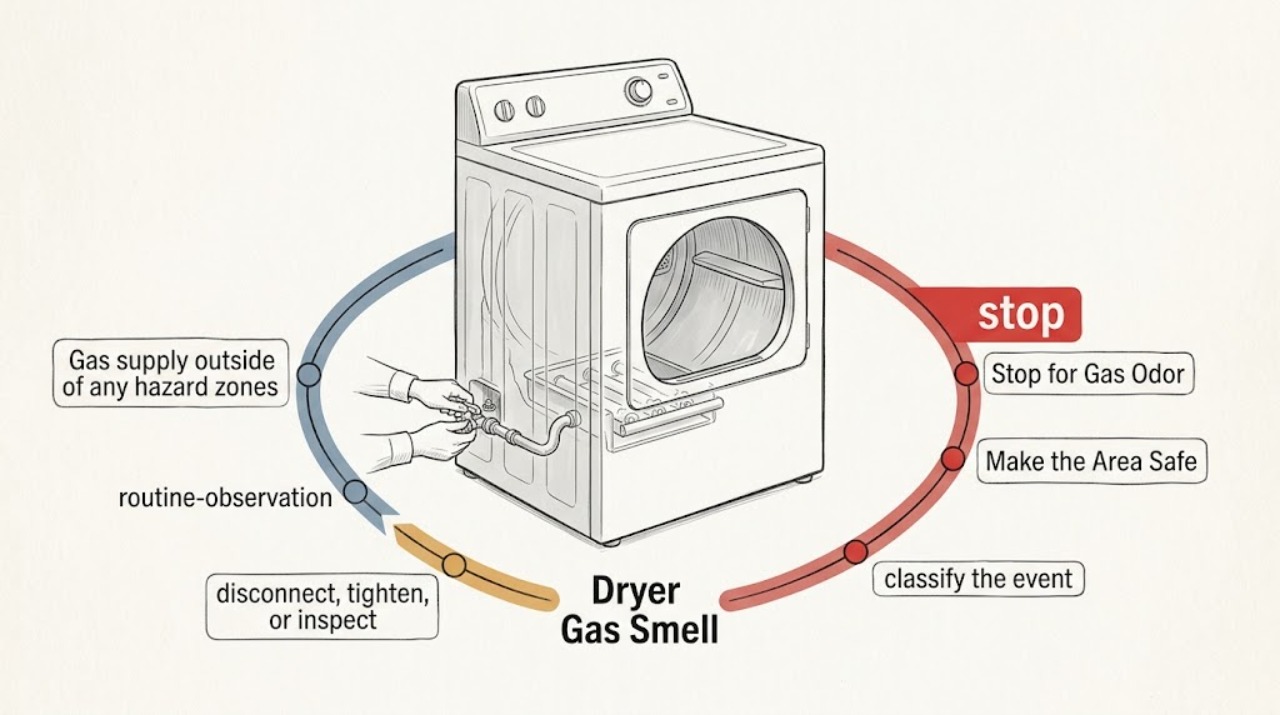
Treat a gas-like smell from a Kenmore gas dryer as a possible leak or unburned gas until a qualified person confirms otherwise. Do not start or relight the dryer, operate switches or electronics, use a phone inside, smoke, or create any flame. Leave the building immediately and contact the gas supplier or emergency services from outside or a neighbor's location. Do not move the dryer to inspect its connector. Once the area is declared safe, use the Kenmore model-number manual and support path; do not disassemble the gas train or attempt a leak test yourself.
Work through in order
Diagnostic checks
Use only checks that match the exact appliance or system and its official guide.
-
Check 1
If you smell gas or hear gas escaping, stop the dryer if it is already running only if you can do so without operating a switch or creating another ignition risk; otherwise leave immediately. Do not try to light the dryer, touch a light switch, use a phone inside, smoke, or make a flame.
Expected result: The odor is present, becomes stronger, or is accompanied by a hiss; or the smell is no longer detectable after you are already outside.
Next step: Leave all occupants and pets out of the building. From outside or a neighbor's location, contact the gas supplier or emergency services and follow their instructions. Do not re-enter until professionals say it is safe.
Why this matters
Why: An active or uncertain gas odor must be treated as a possible leak or unburned gas, not as a burner adjustment or an appliance reset.
-
Check 2
Do not pull the Kenmore dryer forward or bend, disconnect, tighten, or inspect the gas connector yourself. From a safe location, tell the gas supplier or technician whether the odor began after the dryer was moved, installed, or serviced.
Expected result: The appliance was recently moved or the odor started after installation or service; or there is no known change and the source is uncertain.
Next step: Leave connector inspection and any gas shutoff, leak testing, repair, or replacement to the gas supplier or qualified professional. Keep the dryer out of service until cleared.
Why this matters
Why: Movement, bending, corrosion, or a disturbed connection can affect a gas appliance connection, but the connector cannot be safely diagnosed by moving the dryer or handling the line as a homeowner.
-
Check 3
After the building has been declared safe, classify the event for the service report: odor while the dryer was idle, odor only during ignition or a heat cycle, odor inside the drum or on clothes, or odor throughout the room. Do not run another cycle merely to reproduce it.
Expected result: The odor is tied to a cycle or location; or it cannot be tied to the dryer and another gas source may be involved.
Next step: Give the exact timing and location to the gas supplier or technician. If the source is not clearly the dryer, have the building's gas system checked rather than ordering a dryer part.
Why this matters
Why: Timing and location help a professional distinguish the dryer from its gas connection, venting or another appliance, but they do not prove that a valve, igniter, burner, or control is defective.
-
Check 4
Once service has cleared the immediate gas hazard, locate the Kenmore model number and retrieve the matching owner's manual or support resources. Compare the manual's gas-type, installation, and safety instructions with the installed appliance; do not assume another Kenmore model uses the same procedure.
Expected result: The model number is readable and the matching manual is available; or the model cannot be identified.
Next step: Give the model number and manual to the qualified technician. If it cannot be identified, use Kenmore support to establish the product identity instead of guessing at compatibility.
Why this matters
Why: Kenmore documentation is selected by model number, and the brand's current gas-dryer range contains multiple models. Missing identity information makes part and procedure claims unreliable.
-
Check 5
Before any return to service, ask the qualified installer, gas supplier, or appliance technician to confirm the gas connection, appliance condition, ignition/burner operation, exhaust installation, and any required leak or safety checks according to the model manual and local requirements.
Expected result: The professional confirms the source was corrected and the appliance is safe; or the odor returns, the source remains uncertain, or the dryer has ignition or heat symptoms.
Next step: Do not operate the dryer if the odor returns. Leave again and contact the gas supplier or emergency services from outside; otherwise retain the technician's clearance and model-specific service record.
Why this matters
Why: A temporary loss of odor does not prove that a gas fault is fixed. A returning odor or ignition symptom means the appliance or gas system needs further professional diagnosis.
Use your observations
Decision map
Find the observation that best matches what you see, then follow the next safe action.
-
PATH 01Next step
What you see
Gas odor, hissing, or an uncertain gas-like smell is present now.
Do this next
Do not operate the dryer or electrical controls. Leave immediately and contact the gas supplier or emergency services from outside or a neighbor's location. Do not re-enter until cleared.
-
PATH 02Next step
What you see
The dryer or its gas connector was recently moved, installed, or serviced before the odor appeared.
Do this next
Do not move or inspect the connector yourself. Tell the gas supplier or qualified installer what changed and keep the dryer out of service until the connection is checked.
-
PATH 03Next step
What you see
The smell was reported after the immediate hazard was cleared, but its source is uncertain or another gas appliance may be involved.
Do this next
Report the timing and location to the gas supplier or technician and have the building's gas system assessed; do not assume the Kenmore dryer is the source.
-
PATH 04Next step
What you see
A qualified professional has cleared the area, but the odor returns during a dryer cycle or the dryer has ignition, flame, or heat symptoms.
Do this next
Stop using the dryer and request a model-specific gas-system and burner diagnosis. Do not repeat cycles to reproduce the odor or replace a valve, igniter, sensor, or control based on the symptom alone.
-
PATH 05Next step
What you see
The only smell was a mild new-appliance odor and there is no gas-like odor, hiss, or recurrence after professional confirmation.
Do this next
Follow the exact model's use-and-care instructions and monitor. If the smell resembles gas or returns, use the emergency branch rather than treating it as normal break-in odor.
Helpful context
Understand the symptom
Safety comes before diagnosis
A gas odor near a dryer is not a normal troubleshooting signal. The odor may come from the appliance, its connector or supply, another gas appliance, or a fuel source elsewhere in the building. You cannot identify the source safely by running another cycle. If the smell is present now, follow the emergency branch below and do not continue with the checks.
When a later check is appropriate
Only after the gas supplier, fire department, or qualified technician says it is safe to re-enter should you gather the model number and describe what happened. Kenmore manuals are model-specific, and gas dryers can differ in controls, installation, and service procedure. A brief oily or hot smell on a brand-new appliance is not the same diagnosis as a rotten-egg or sulfur-like gas odor, but any uncertain gas-like smell should be treated as a possible leak.
Safety boundary
Stop conditions
- Stop immediately and leave for fresh air if gas is smelled or heard escaping; do not light an appliance, touch switches, use a phone inside, smoke, or create a flame.
- Do not move the dryer to inspect a connector, and do not disconnect, tighten, leak-test, or replace gas fittings yourself.
- Do not operate the dryer again after a returning gas odor, ignition failure with odor, damaged connector, visible fire, smoke, or burning smell until a qualified professional clears it.
Only after diagnosis
Potential parts
- gas connector or approved connection component
Consider only if a qualified professional identifies a damaged, aged, disturbed, or otherwise unsuitable connector and specifies the correct replacement.
Do not move or disconnect the appliance to inspect it. The full model, local code, gas type, and installer requirements must be confirmed by a qualified professional. - gas valve or valve-control component
Consider only after professional diagnosis links a recurring odor during operation to a valve or control fault; odor alone does not identify this part.
Gas controls are model-specific and require qualified service. Confirm fitment and the repair diagnosis before ordering. - ignition or flame-sensing component
Consider only when a qualified technician confirms an ignition or flame-sensing failure that leaves unburned gas during the appliance's heat sequence.
Confirm the exact model and technician's diagnosis; do not substitute a part or test the burner based only on smell.
When checks do not resolve it
Need a professional?
Contact the gas supplier or emergency services immediately from outside if gas is smelled or heard escaping. After the immediate hazard is addressed, arrange qualified appliance service for any recurring odor, ignition or burner symptom, recently disturbed connection, uncertain source, or model-specific repair.
Common questions
FAQ
What should I do if my Kenmore gas dryer smells like gas right now?
Do not run or relight it, touch switches, use a phone inside, smoke, or create a flame. Leave immediately and contact the gas supplier or emergency services from outside or a neighbor's location.
Can I pull the dryer out to check the gas line?
No. Do not move or handle the connector yourself. The gas supplier or a qualified professional should inspect the connection and determine whether it needs service.
Could the smell be something other than gas?
Possibly, but an uncertain gas-like smell must be treated as a possible leak until professionals rule it out. A mild new-appliance odor is a different possibility, but do not use that explanation while a gas odor or hiss remains possible.
What information does a technician need?
Give the exact Kenmore model number, when the odor appears, where it is strongest, whether the dryer was recently moved or serviced, whether ignition or heating is affected, and what the gas supplier or emergency responder already found.
Read the exact guide
Official sources
- Contact UsKenmore · Kenmore product questions and support routing
- Kenmore ManualsKenmore · Kenmore model-specific appliance manuals and troubleshooting resources
- Certain Older Gas Connectors May Be DangerousU.S. Consumer Product Safety Commission · Gas appliance connector safety and emergency response when gas is smelled
- Gas DryersKenmore · Kenmore gas dryer product category and model identity
Community feedback
Share a repair observation
Share a plain-text repair observation. Accepted observations are published automatically; this page may take a moment to update.