
On this page
Start here
Quick answer
When a Kenmore dryer will not turn on, begin with safe external checks: look for a damaged cord, confirm the dryer is connected directly as specified by its model instructions, check whether the breaker or fuse has opened, verify the door is fully latched, select a valid cycle, and use the model-specific Start or Push to Start control correctly. Do not keep resetting a breaker, bypass the door switch, open the cabinet, or test live wiring. If there is a burning or electrical smell, smoke, sparking or arcing, a hot or damaged cord or outlet, repeated breaker trips, a gas odor, or a dryer that stopped after overheating, switch off power only if it can be done without entering a hazard and arrange qualified service. Kenmore's manual portal is model-specific, so use the exact model manual for control-lock behavior and any reset or diagnostic instructions.
Before you begin
Safety first
- Do not operate a dryer with smoke, burning odor, sparking/arcing, a hot or damaged cord/outlet, gas odor, repeated breaker trips, or unexplained overheating. Do not open the cabinet, bypass the door or thermal safety, test live wiring, or use an extension cord. If gas is suspected, leave and call the local gas emergency service from outside.
Work through in order
Diagnostic checks
Use only checks that match the exact appliance or system and its official guide.
-
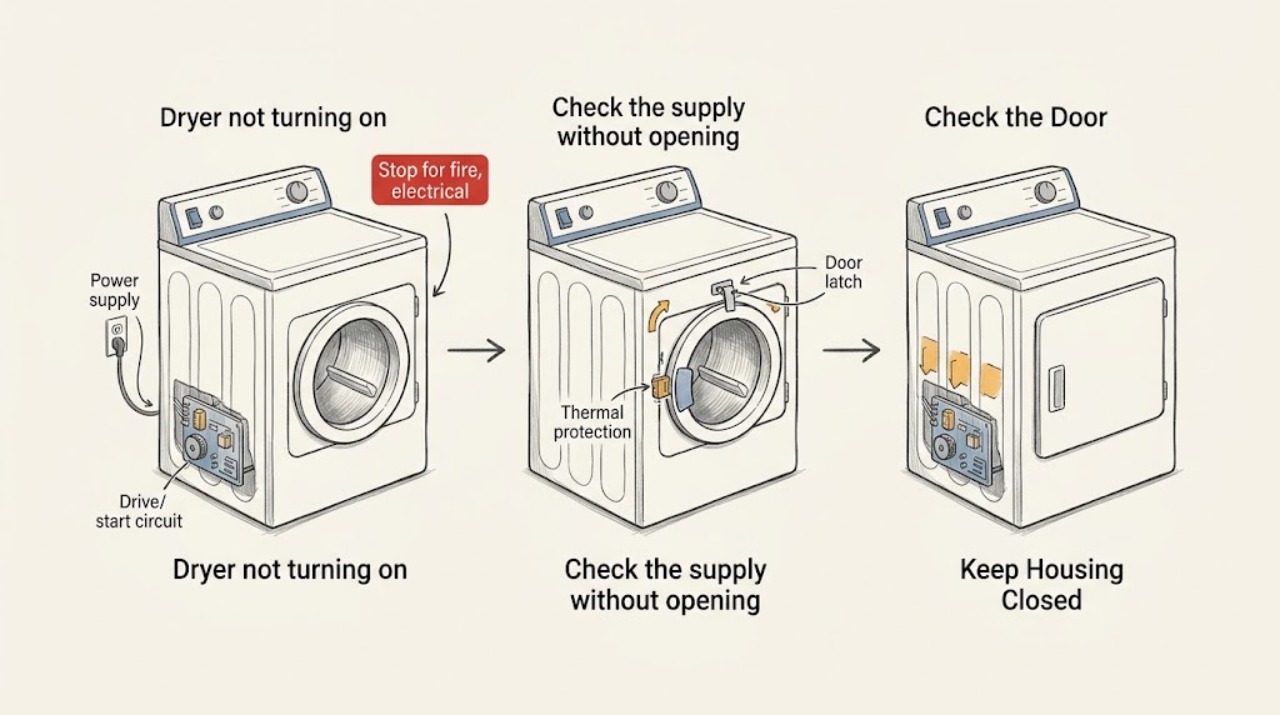
Stop for fire, electrical, or gas warning signs
Before pressing Start again, look and smell from a safe position for smoke, a burning or melted-plastic odor, visible sparking or arcing, a hot or damaged cord or outlet, a gas odor on a gas model, or signs that the dryer stopped after overheating.
Expected result: Classify the dryer as showing no hazard, a damaged or hot electrical connection, smoke/sparking/arc evidence, a gas odor, or an unexplained heat/burning event.
Next step: If any hazard is present, stop using the dryer and arrange qualified appliance, electrical, gas, or emergency service as appropriate. If there is no hazard, continue with external checks only.
Stop if: Do not operate the dryer, touch a damaged cord, bypass a safety device, use an extension cord, open the cabinet, or reset a repeatedly tripping breaker. If gas is smelled, leave the area and call the local gas emergency service from a safe location.
Why this matters
Why: No-start troubleshooting is secondary to a fire, shock, gas, or overheating risk. A dryer that stopped under a hazard may have a fault that a breaker reset or repeated start attempt will not safely fix.
-
Check the supply without opening the dryer
With the dryer off and the area dry, visually check that the power cord is fully seated in the intended wall outlet, the cord and plug are not cracked, scorched, loose, or pinched, and the household dryer breaker or fuses do not show an obvious trip or failure. Do not remove panels or probe the outlet.
Expected result: Record whether the control display is completely dark, the cord/outlet looks damaged, a breaker or fuse is open, or the external supply appears normal.
Next step: If the cord, plug, outlet, or panel is damaged, stop and call a qualified electrician or appliance technician. If there is one clearly tripped breaker and no hazard, follow the home's electrical instructions for one reset; if it trips again, leave it off and arrange service. If the supply is normal, continue to the door and controls.
Stop if: Do not repeatedly reset a breaker, replace a fuse with a different type, use an extension cord or power strip, touch exposed conductors, or work on a live outlet.
Why this matters
Why: A dark display with an open breaker/fuse or damaged connection points to a supply or installation issue. A normal-looking supply does not prove that internal voltage or the dryer control circuit is safe or functional.
-
Confirm the door and selected cycle
Remove any clothing caught at the opening, close the Kenmore dryer door normally until it latches, and select a model-supported timed or automatic dry cycle from the exact manual; do not press or bypass the door switch by hand.
Expected result: Record whether the door latches normally, clothing or debris was preventing closure, the display responds to the selection, or the dryer remains completely unresponsive.
Next step: If the door cannot latch, the latch or switch area is damaged, or the display stays unresponsive, keep the dryer off and arrange model-specific service. If the door and display respond, continue with the correct Start control.
Stop if: Do not tape, hold, short, remove, or bypass the door switch; stop for a cracked door, sharp metal, loose wiring, or any need to dismantle the front panel.
Why this matters
Why: A dryer may refuse to start when the door is not latched or an unsupported/non-running setting is selected. A door that will not latch or a dryer that remains dark after a normal close is a service clue, not an invitation to bridge the switch.
-
Use the model-specific Start control
Using the exact Kenmore manual, confirm that Control Lock or a similar lock is not active and press or hold the labeled Start, Push to Start, or equivalent control in the manner specified for that model; do not keep trying if the control or panel is wet, cracked, hot, or damaged.
Expected result: Record whether the panel acknowledges the command, a lock indicator remains on, the dryer hums or clicks without starting, or there is no response at all.
Next step: If the manual-supported control adjustment restores normal operation without any hazard, run only a supervised normal cycle. If it remains silent, hums without starting, or the lock will not clear, stop and provide the model, symptom, and observations to a qualified technician.
Stop if: Do not remove the control panel, spray cleaner into controls, apply a jumper, test switches with the dryer energized, or continue after a burning smell, arc, heat, or breaker trip.
Why this matters
Why: A control lock, a command that was only tapped, moisture on a sensitive panel, or a failed start/door circuit can all look like a no-start. A hum, click, or no response changes the technician's diagnostic path but does not identify a replaceable part by itself.
-
Escalate when the external checks pass
If the supply appears normal, the door latches, the model-supported cycle and Start command are correct, and the Kenmore dryer still will not turn on, stop external troubleshooting and request model-specific appliance service; if the breaker or outlet is suspect, request qualified electrical service instead.
Expected result: Give the technician the model number, electric or gas configuration, whether the display is dark or lit, whether the drum moved or hummed, the breaker history, door-latch result, recent overheating or long-dry symptoms, and any odor or noise.
Next step: Keep the dryer disconnected or its breaker off when the technician instructs, preserve the model manual and service history, and ask for the cause and the safety check that must pass before reuse.
Stop if: Do not open the cabinet, remove a thermal fuse, bypass thermal or door protection, test live wiring, or resume operation after an unexplained overheat, arc, smoke, gas odor, or repeat breaker trip.
Why this matters
Why: The remaining possibilities can include internal thermal protection, door/start circuit, wiring, motor, timer, or electronic control faults. Without the model's wiring and a de-energized professional test, the visible symptom cannot select a safe part.
Use your observations
Decision map
Find the observation that best matches what you see, then follow the next safe action.
-
PATH 01Safety boundary
What you see
There is smoke, a burning smell, sparking/arcing, a hot or damaged cord/outlet, repeated breaker tripping, gas odor, or an overheat event.
Do this next
Stop using the dryer, leave any gas-odor area, and contact the appropriate qualified appliance, electrical, gas, or emergency service from a safe location.
Why this path and its safety boundary
Why it matters: This is a fire, shock, gas, or overheating boundary, not a normal no-start check.
Safety stop: Do not restart, repeatedly reset, open the cabinet, bypass a fuse or switch, or use a phone in a suspected gas-odor area.
-
PATH 02Safety boundary
What you see
The cord, plug, outlet, breaker, or fuse shows a problem, or the dryer display is dark after a supply interruption.
Do this next
Have a qualified electrician or appliance technician evaluate the outlet, cord, breaker/fuses, and dryer connection; make no further reset if the breaker trips again.
Why this path and its safety boundary
Why it matters: The no-start may be upstream of the dryer, and the connection may be unsafe to manipulate.
Safety stop: Do not use an extension cord or power strip, alter the plug, replace a fuse with a different rating, or probe the outlet.
-
PATH 03Safety boundary
What you see
The supply appears normal but the door does not latch, the selected cycle is not supported, or a model-specific Control Lock remains active.
Do this next
Use only the exact Kenmore manual to select a valid cycle or clear a control lock; arrange service for a latch, switch, or panel that does not respond normally.
Why this path and its safety boundary
Why it matters: The dryer may be intentionally preventing a start or the door/control input may be faulty.
Safety stop: Do not bypass or hold the door switch, force the latch, or dismantle the control or front panel.
-
PATH 04Safety boundary
What you see
The supply, door, cycle, and Start command are normal but the dryer remains silent, hums without starting, or clicks and stops.
Do this next
Keep the dryer off and request model-specific qualified service. Provide the exact sound, display behavior, model, and any prior overheat or vent symptoms.
Why this path and its safety boundary
Why it matters: An internal start, thermal, motor, wiring, or control fault is possible, but the symptom does not identify a safe DIY part replacement.
Safety stop: Do not perform live tests, remove panels, bypass thermal protection, or replace a part without model-specific diagnosis.
-
PATH 05Safety boundary
What you see
A manual-supported control or cycle correction restores normal operation and there are no hazard signs.
Do this next
Supervise a normal cycle, keep the lint filter and venting maintained as instructed, and stop immediately if the dryer overheats, smells hot, sparks, trips the breaker, or stops again.
Why this path and its safety boundary
Why it matters: The original issue may have been a control or selection state, but a recurring no-start or abnormal heat still needs diagnosis.
Safety stop: Do not leave the dryer running unattended when it shows a new abnormal symptom, and do not continue after any fire or electrical warning.
Helpful context
Understand the symptom
Separate no response from a safety shutdown
A dark display or silent start attempt can be a supply or control problem, but a dryer that stopped with heat, a burning smell, smoke, sparking, an unusually hot cord, or a tripped breaker may have an underlying electrical, motor, heating, or airflow fault. Do not use the dryer to see whether the symptom repeats. The U.S. Fire Administration recommends professional installation and service, regular lint-filter care, and checking that the vent is not damaged, crushed, or restricted. Those are maintenance boundaries, not permission to open the cabinet or bypass a safety device.
Use the exact Kenmore manual for controls and model variations
Kenmore dryers have model-specific controls and manuals. A Start button may need a deliberate hold, some models have a control lock, and electric and gas dryers can differ in household supply arrangements. Record the model number from a safe location and use Kenmore's manual portal before interpreting a dark display or changing a setting. Do not apply a reset sequence from a different Kenmore model, and never defeat a door switch or thermal safety.
If external checks do not restore operation, stop at diagnosis
A dryer that has power, a latched door, a valid cycle, and an accepted Start command but remains silent may have a failed door switch, start circuit, thermal protection device, timer or electronic control, wiring fault, or motor problem. Those components require model-specific diagnosis and often access inside the cabinet. A continuity or voltage test is not an ordinary no-tools check: arrange a qualified appliance technician or electrician rather than probing a live or energized dryer.
When checks do not resolve it
Need a professional?
Safety scope: Do not operate a dryer with smoke, burning odor, sparking/arcing, a hot or damaged cord/outlet, gas odor, repeated breaker trips, or unexplained overheating. Do not open the cabinet, bypass the door or thermal safety, test live wiring, or use an extension cord. If gas is suspected, leave and call the local gas emergency service from outside.
Common questions
FAQ
Why is my Kenmore dryer completely silent when I press Start?
First check for safe external causes: supply or breaker trouble, a door that is not latched, an invalid cycle, or a model-specific control lock. If those checks pass, the fault may be in the start/door circuit, thermal protection, wiring, motor, timer, or control and needs model-specific service.
Can I reset the breaker to make the Kenmore dryer start?
If there is no heat, burning smell, smoke, arc, damaged cord, or other hazard and the breaker has clearly tripped once, follow the home's electrical instructions for one reset. If it trips again, leave it off and call a qualified professional. Do not keep resetting it.
Can I bypass the Kenmore dryer's door switch?
No. The door interlock is a safety device. Do not hold, tape, bridge, remove, or bypass it. If the door will not latch or the dryer will not recognize a closed door, arrange model-specific service.
Could a clogged vent cause a Kenmore dryer not to turn on?
Restricted venting can contribute to overheating and fire risk, and USFA recommends checking that the vent is not damaged, crushed, or restricted. It does not identify the cause of a dead control panel. Do not run the dryer after overheating or with a damaged vent; have the appliance and vent evaluated.
What if the dryer smells burnt or sparks when it will not start?
Stop using it immediately. Do not press Start again, open the cabinet, or reset a breaker repeatedly. If gas is suspected, leave the area and call the gas emergency service from outside; otherwise arrange qualified appliance or electrical service, and use emergency services for smoke or fire.
Where do I find the right Kenmore dryer instructions?
Use Kenmore's official manual portal and enter the exact model number. Controls, cycle selection, lock behavior, and electrical or gas installation details vary by model, so do not use a reset sequence or wiring advice from a different dryer.
Read the exact guide
Official sources
- Dryer Not Starting or No OperationWhirlpool Product Help · Whirlpool's official guidance for its dryer product family; Kenmore model instructions can differ, so it is used for general external-check categories only.
- Appliance and Electrical Fire SafetyU.S. Fire Administration, FEMA · U.S. government appliance/electrical fire-safety guidance; the exact dryer installation manual and local electrical requirements control.
- Kenmore ManualsKenmore · Kenmore's official manual portal; the exact manual and local electrical/gas requirements control the installed model.
- Clothes Dryer Fire SafetyU.S. Fire Administration, FEMA · U.S. government residential clothes-dryer fire-safety guidance; local codes and the installed model manual also apply.
Community feedback
Share a repair observation
Share a plain-text repair observation. Accepted observations are published automatically; this page may take a moment to update.