
On this page
Start here
Quick answer
If a Kenmore freezer appears not to turn on, first keep the door closed to protect the food, then check whether any interior or control light works. Confirm the temperature control is not set to Off, verify the dedicated wall outlet with a small lamp, and check the corresponding breaker or GFCI reset. If the outlet has power but the freezer remains silent, or a breaker trips again, stop resetting it and arrange qualified service; do not remove electrical covers.
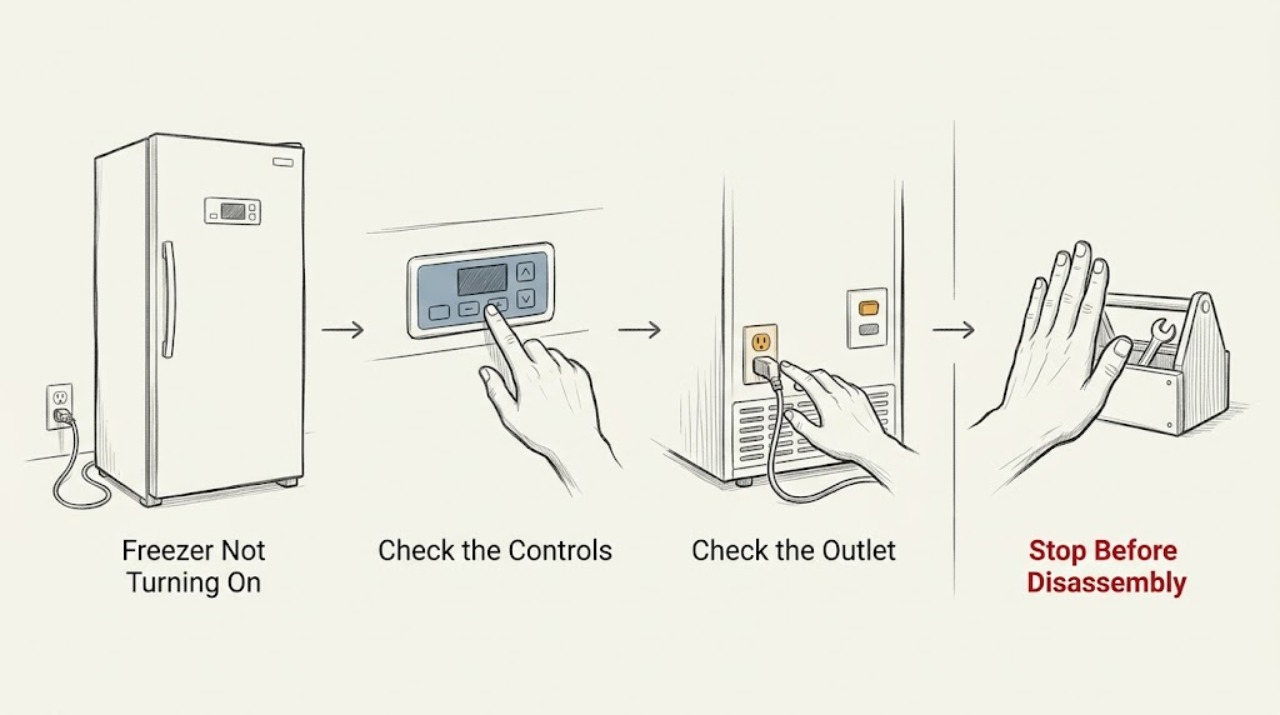
Work through in order
Diagnostic checks
Use only checks that match the exact appliance or system and its official guide.
-
Check 1
With the door closed, look through the gap only long enough to determine whether an interior light, display, or power indicator is on. Note whether the freezer is completely dark, has lights but no motor sound, or has a brief hum/click.
Expected result: Record the visible light state and any sound without opening electrical covers.
Next step: Continue to the control and outlet checks only when there is no smoke, burning odor, liquid at the electrical connection, or damaged cord.
Why this matters
Why: No light or sound makes a supply or Off-control condition more likely; lights with no cooling sound make an internal control or starting fault more likely; a repeated click, hot cord, smoke, or burning odor is a stop condition.
-
Check 2
Set the Kenmore temperature control to a normal cold setting rather than Off, using the model-specific manual if the control is electronic or not clearly labeled. Do not force a knob or open the control housing.
Expected result: After the setting is changed, listen for a compressor or fan response for about 10 minutes while keeping the door closed.
Next step: If it remains silent, perform the external outlet check; if it starts, allow time for the cabinet to cool and verify temperature with a thermometer.
Why this matters
Why: If the freezer starts, the prior setting was preventing operation; if it stays silent, the control setting was not the only cause and the power path must be checked.
-
Check 3
Check that the plug is fully seated in the wall outlet and that the outlet is the freezer's intended dedicated receptacle. Do not use an extension cord. Without unplugging or opening the freezer, plug a small lamp into the same outlet to test it.
Expected result: The lamp either works normally, or it does not work at that outlet.
Next step: If the lamp is off, inspect the labeled breaker or GFCI and perform one normal reset only if there is no damage or water. If the lamp works and the freezer remains off, stop external troubleshooting and arrange appliance service.
Why this matters
Why: A lamp that stays off indicates an outlet, breaker, GFCI, fuse, or household supply issue rather than a freezer-only fault; a working lamp confirms power is available at the receptacle but does not prove the freezer's internal components are healthy.
-
Check 4
If there was a recent power interruption, check the household supply and leave the freezer closed while power is restored. Once it runs, monitor the cabinet with an appliance thermometer rather than repeatedly opening the door.
Expected result: The breaker or GFCI holds and the freezer resumes operation, or the supply does not return/ trips again; the temperature either reaches a safe frozen range or continues rising.
Next step: Use a qualified electrician for an outlet or breaker problem, and appliance service for a powered freezer that will not start. Transfer or discard food according to the food-safety guidance if the temperature cannot be kept safe.
Why this matters
Why: A stable supply with a freezer that still will not run points to an appliance fault. A repeated trip indicates an electrical problem that should not be repeatedly reset. After an outage, food safety depends on measured temperature or ice crystals, not smell or appearance.
Use your observations
Decision map
Find the observation that best matches what you see, then follow the next safe action.
-
PATH 01Safety boundary
What you see
The test lamp does not work at the freezer outlet, or the breaker/GFCI will not remain reset.
Do this next
Keep the freezer closed, stop resetting the circuit, and have the household electrical supply checked by a qualified electrician. Use a safe alternate cold-storage plan for food.
Why this path and its safety boundary
Safety stop: Do not work inside the panel, change fuse ratings, or test a wet or damaged receptacle.
-
PATH 02Safety boundary
What you see
The test lamp works and the freezer has the correct control setting, but it remains silent or only clicks.
Do this next
Stop user-level checks and arrange qualified appliance service; provide the model number and describe the light, sound, and outlet-test results.
Why this path and its safety boundary
Safety stop: Do not remove the rear cover or test the compressor, relay, wiring, or refrigerant circuit yourself.
-
PATH 03Safety boundary
What you see
The freezer starts but does not become cold after a reasonable stabilization period, or food continues to warm.
Do this next
Check that the door closes and seals, that vents are not blocked, and that frost is not preventing airflow. If it still does not cool, arrange service.
Why this path and its safety boundary
Safety stop: Do not chip away heavy frost with a sharp tool or attempt sealed-system work.
Helpful context
Understand the symptom
Protect the food before troubleshooting
Leave the freezer door or lid closed while you check the power path. If there was a recent outage, use an appliance thermometer when available; do not rely on appearance or odor alone to decide whether food is safe. Move food to a suitable cooler or working freezer if the cabinet is warming or the outage may continue.
What the symptom usually means
A completely dark, silent freezer points first to the supply path or a control set to Off. Interior lights with no compressor sound point more toward a control, start, wiring, or compressor fault. A brief hum followed by a click, repeated trips, smoke, or a hot or damaged cord is not a cue to keep testing: disconnect power only if it is safe to do so and arrange service.
Use the model-specific manual for settings
Kenmore publishes manuals by model number. Record the model from the rating label before requesting help, and use the matching manual for the control location, reset instructions, and any model-specific alarm behavior.
Safety boundary
Stop conditions
- Stop immediately for smoke, a burning smell, arcing, a hot or damaged cord, water near the electrical connection, or a breaker that trips again.
- Do not remove covers, probe live wiring, replace a fuse with a different rating, or work on the compressor, refrigerant circuit, or sealed system.
- If food safety is uncertain after an outage, keep questionable perishables out of service until temperature or ice-crystal guidance supports a safe decision; appearance and odor are not reliable tests.
Only after diagnosis
Potential parts
- temperature control or electronic control
Only consider this category if the outlet has power, the control is set correctly, and a qualified diagnosis identifies a failed control rather than a supply or compressor fault.
Confirm the complete Kenmore model number and the matching manual or parts information before ordering; freezer controls are not universal. - compressor start component
Only consider this category after a qualified technician confirms a start failure from the symptom pattern and electrical tests.
Fit and electrical ratings depend on the exact model and compressor; do not substitute a part based only on appearance.
When checks do not resolve it
Need a professional?
Arrange appliance service when the freezer's outlet has power but the unit will not start, when the control setting does not restore operation, when it repeatedly clicks or trips protection, or when it runs without cooling. Arrange an electrician for a dead outlet, repeated breaker/GFCI trips, damaged wiring, or any household supply problem.
Common questions
FAQ
Why is my Kenmore freezer dark and silent?
Start with the temperature control, plug, outlet, breaker, and GFCI from outside the cabinet. A working outlet with a silent freezer points to an appliance fault that needs service rather than repeated resets.
Can I use an extension cord to test the freezer?
No. Confirm the intended wall outlet directly; manufacturer guidance for freezers says not to use an extension cord.
How long will frozen food stay safe during a power outage?
Keep the door closed. FDA guidance says a full freezer can hold its temperature for about 48 hours and a half-full freezer for about 24 hours; after that, use a thermometer or ice-crystal guidance rather than smell or appearance.
What should I give a technician?
Give the complete model number and the sequence of observations: whether lights work, whether the control was set to Off, whether the outlet powered a lamp, what the breaker or GFCI did, and whether you heard a hum or click.
Read the exact guide
Official sources
- Upright & Chest Freezer - Not WorkingGE Appliances · General freezer fault categories after power is confirmed
- Upright & Chest Freezer - How to Confirm Power to the FreezerGE Appliances · General upright and chest freezer power confirmation
- What should I do if my freezer isn’t running?Frigidaire · General freezer power and control checks
- Freezer - Not Freezing or Not CoolingFrigidaire · General freezer stabilization, door seal, airflow, and no-cooling checks
- Food and Water Safety During Power Outages and FloodsU.S. Food and Drug Administration · Food safety during and after freezer power outages
- Kenmore ManualsKenmore · Kenmore model-specific manuals and appliance resources
Community feedback
Share a repair observation
Share a plain-text repair observation. Accepted observations are published automatically; this page may take a moment to update.