
On this page
Start here
Quick answer
First decide whether the Kenmore freezer has no power, has power but is warm, or is running without maintaining temperature. Check the outlet and breaker without opening the appliance, confirm the control is set correctly, make sure the door closes and the gasket seals, and look for blocked vents or heavy frost. Kenmore explains that dirty condenser coils, leaking door seals, and heat around the cabinet can make a refrigerator or freezer work harder; a freezer in an unsuitable garage environment may also struggle. Do not chip frost with a sharp tool or open electrical or sealed-system panels. If there is a burning smell, smoke, a hot cord or outlet, repeated breaker operation, a refrigerant-like leak, or food has become unsafe, stop using the freezer and arrange qualified service while following local food-safety guidance.
Work through in order
Diagnostic checks
Use only checks that match the exact appliance or system and its official guide.
-
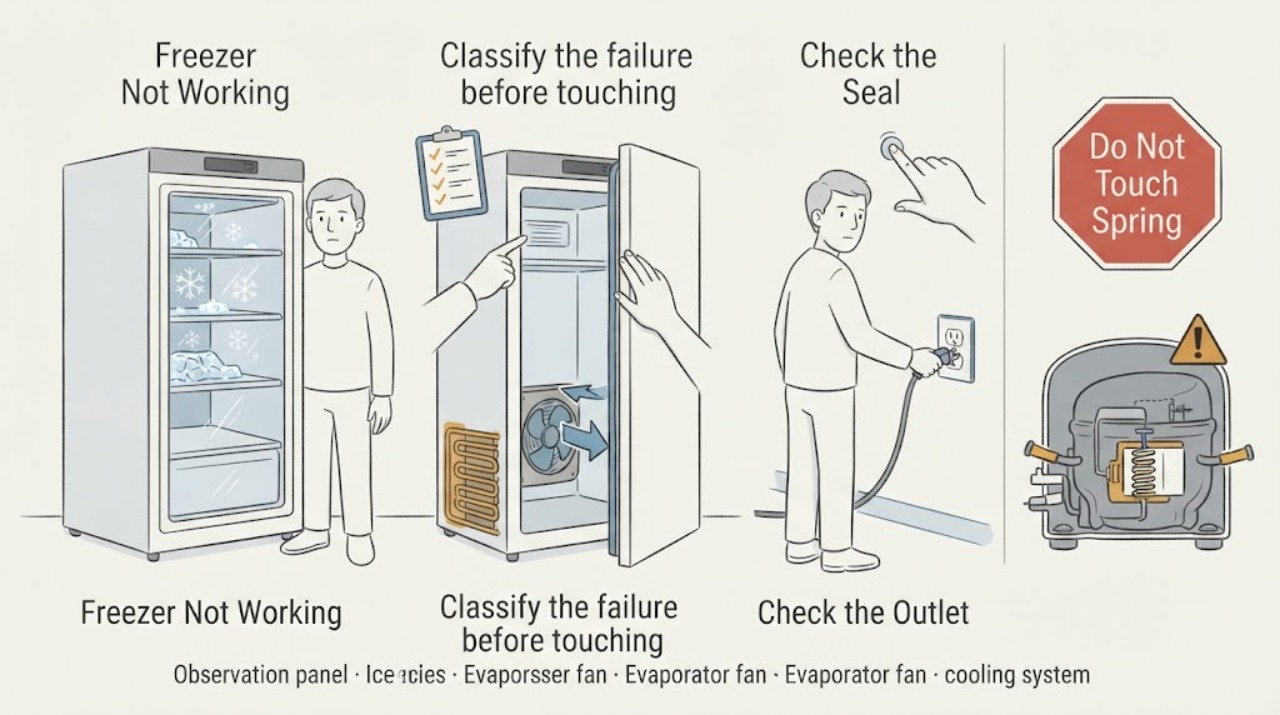
Classify the failure before touching anything
From a safe position, record whether the interior light or display works, whether the freezer makes a fan or compressor sound, whether the alarm is active, whether frost is covering a wall or vent, and whether food is soft or thawing. Do not repeatedly open the door or reach behind the unit while it is operating.
Expected result: No light or display suggests a power, control, or supply branch. A lit display with warm food points toward temperature, door, airflow, frost, fan, or cooling-system diagnosis. A running sound with no temperature recovery suggests the freezer is working but not removing heat effectively.
Next step: Follow the no-power branch if all indicators are dead. Otherwise continue with the control, door, airflow, and frost checks, and protect food if the temperature is rising.
Why this matters
Why: The same phrase, freezer not working, can describe a dead appliance, a warm cabinet, or a cooling system that runs continuously; the observed symptom determines the safe next check.
-
Verify the outlet and freezer control safely
With dry hands and the freezer in a stable position, confirm the plug is fully seated and check whether the same outlet powers another small appliance. Check the household breaker or fuse once, and confirm the temperature control has not been set to Off or a warm setting. Use the exact model manual for control locations; do not remove covers or test live wiring.
Expected result: If the outlet is dead, the breaker trips again, or the cord or receptacle is hot or damaged, the problem is outside a normal temperature adjustment. If power is present and the control is set correctly but the display or light remains dead, an internal control or supply fault is possible.
Next step: Stop and arrange qualified electrical or appliance service for a hot or damaged connection, a repeated trip, or a freezer that stays dead with a known-good outlet. If power and controls respond, continue to the door seal and temperature checks.
Why this matters
Why: A safe external power check can distinguish a supply issue from a freezer fault, while repeated breaker operation is a warning rather than an invitation to keep resetting it.
-
Check the temperature setting, door, and gasket
Confirm the control is at the model-recommended freezer setting and that the door is not held open by a package, basket, or ice buildup. Inspect the visible gasket for a gap, split, dirt, or a section pulled out of its channel, then close the door evenly without forcing it.
Expected result: Kenmore says a loose or ineffective seal lets cold air escape and makes the compressor work harder. A door that closes only when lifted, a visible gap, condensation around the frame, or frost concentrated near the opening supports an air-leak branch.
Next step: Remove only the obstruction and clean the accessible gasket as directed by the manual. If the gasket is torn, the door is misaligned, or the freezer remains warm after a closed-door observation, arrange service and avoid unnecessary door opening.
Why this matters
Why: A warm freezer can be caused by heat entering through the door rather than by an immediate compressor failure; a damaged gasket or misaligned door still needs correction if the temperature does not recover.
-
Look for blocked vents or an abnormal frost pattern
With the freezer door open only briefly, check that stored food is not packed against interior air vents and that the outside clearance specified by the model manual is available. Look for a heavy, spreading frost layer on an interior wall or around vents. Do not chip ice with a sharp object, pour boiling water into the cabinet, or disassemble the evaporator area.
Expected result: Blocked internal vents can prevent cold air from reaching the compartment. Heavy frost can obstruct airflow and may indicate a defrost, door-seal, or temperature-control problem rather than a simple setting issue. No frost but a warm cabinet points to other branches.
Next step: Rearrange only loose items that block a vent and follow the exact manual for any approved defrost procedure. If frost returns, covers the vents, or the freezer has no safe user defrost procedure, keep it out of use and call qualified service.
Why this matters
Why: Air must circulate through the freezer; the pattern and location of frost help separate an obstruction from a fault that needs a technician.
-
Check condenser access and the surrounding environment
If the model manual identifies an accessible condenser area, inspect it for a heavy dust layer and clean it only by the manual-approved method with the appliance safely disconnected as instructed. Confirm the freezer is not pressed against a wall and is not surrounded by boxes or heat sources. Do not move a loaded upright freezer or reach into a fan.
Expected result: Kenmore says dirty condenser coils make the compressor work harder. Kenmore also notes that a standard refrigerator or freezer in extreme garage temperatures may struggle and that the compressor or fan may run constantly. A clean, correctly installed freezer that is still warm needs deeper diagnosis.
Next step: Correct only an obvious clearance or accessible-cleaning issue that the manual permits, then monitor from a safe position. If the unit remains warm, runs constantly, or the coil area is inaccessible, arrange qualified appliance service.
Why this matters
Why: Heat rejection and ambient conditions affect cooling performance, but an accessible coil check cannot prove that the compressor, fan, sealed system, or control is healthy.
-
Observe the fan, compressor, and alarm without opening panels
After the external checks, listen from outside the cabinet for a normal cycle, an absent fan, repeated clicking, loud grinding, or a compressor that runs continuously. Note any alarm or display message and compare it with the exact model manual. Do not remove the rear cover or attempt to start a stalled motor.
Expected result: A repeated click with no cooling, no airflow when the freezer should be cooling, a grinding fan, or continuous operation with rising temperature suggests an internal electrical, motor, airflow, or sealed-system fault. A warning alarm with softening food confirms that food protection and service escalation are needed.
Next step: Record the sound, timing, display message, and temperature trend, then stop troubleshooting and arrange qualified service for a persistent abnormal cycle or alarm. Do not keep cycling power to clear the symptom.
Why this matters
Why: Sound and display observations can give a technician useful evidence, but they cannot safely identify a start device, motor, sensor, control, or compressor part from outside the cabinet.
-
Run one supervised confirmation only after a safe correction
Only if there was an obvious safe correction, such as a control set to Off, a blocked vent, a door obstruction, or an accessible cleaning issue, restore the condition according to the manual and observe one cooling cycle from outside the cabinet. Keep the door closed, stay nearby, and stop immediately for smoke, burning odor, a hot cord, sparks, a leak, repeated clicking, or a breaker trip.
Expected result: A stable cycle with the door sealed and temperature beginning to recover supports the corrected external cause. Continued warmth, continuous running, repeated clicking, a returning alarm, or no recovery after the correction indicates an unresolved fault.
Next step: Keep the freezer out of use and arrange qualified service when the confirmation fails. Give the technician the model, symptom classification, temperature setting, frost pattern, sound, alarm, and food-storage timeline.
Why this matters
Why: One controlled observation can confirm a simple external cause; repeated restarts can worsen a fault and risk food loss or electrical damage.
Use your observations
Decision map
Find the observation that best matches what you see, then follow the next safe action.
-
PATH 01Next step
What you see
The light and display are dead, the outlet is not supplying power, or the breaker trips again.
Do this next
Stop resetting the breaker, keep the freezer disconnected if safe, and arrange qualified electrical or appliance service. Do not open the electrical compartment.
-
PATH 02Next step
What you see
The display works but the freezer is warm, food is soft, or a temperature alarm remains active.
Do this next
Keep the door closed, move food to a known-safe cold location, perform only the control, door, vent, frost, and accessible clearance checks, and arrange service if temperature does not recover.
-
PATH 03Next step
What you see
A door gap, damaged gasket, blocked vent, or heavy frost is visible.
Do this next
Correct only the accessible obstruction or manual-approved cleaning/defrost step. Do not scrape ice or remove covers; call service if the seal, alignment, frost, or temperature problem returns.
-
PATH 04Next step
What you see
The freezer runs constantly, is installed in a hot or cold garage, or the condenser area is heavily dusty.
Do this next
Check the manual-approved clearance and accessible condenser cleaning, then monitor once. Persistent running or poor cooling needs qualified diagnosis of airflow, controls, fans, or the sealed system.
-
PATH 05Next step
What you see
There is smoke, a burning smell, sparks, a hot or damaged cord/outlet, an oily or hissing leak, a very hot cabinet, or a repeated breaker trip.
Do this next
Stop immediately, keep clear, and seek qualified help from a safe location. Do not restart the freezer, pierce tubing, or remove panels.
Helpful context
Understand the symptom
Separate no power from no cooling
A freezer that appears dead needs a power and control check. A freezer with a light or display but warm food needs an airflow, door, frost, temperature, or cooling-system check. A compressor or fan may cycle rather than run continuously, so one quiet moment does not by itself prove failure. Note whether the interior light, display, alarm, fan sound, and compressor vibration are present, and whether food is soft or only the cabinet feels warm.
Protect food and stop at electrical or refrigerant warning signs
Keep the door closed while deciding what to do, and move perishable food to a known-safe cold location if the freezer cannot maintain temperature. Do not open the electrical compartment, pierce tubing, bypass a control, or scrape ice with a knife. Smoke, a burning odor, sparks, a hot or damaged cord or outlet, repeated breaker trips, an oily residue or hissing leak, or a cabinet that becomes abnormally hot is a stop-use condition requiring qualified help.
Only after diagnosis
Potential parts
- door gasket or door-alignment hardware
Consider this only when inspection confirms a torn seal, persistent gap, or door-alignment problem after obstructions are removed.
Gaskets and hinges are model-specific; verify the exact model before ordering and do not force a warped door. - evaporator or condenser fan assembly
Consider this only when qualified testing confirms that a fan is stalled, noisy, or not moving air after vents and external clearance are correct.
Fan assemblies and connectors vary by model; do not reach into a moving fan or remove covers without qualified service. - temperature control, sensor, or defrost component
Consider this only after a technician confirms a control, sensor, or defrost fault consistent with the exact model and frost pattern.
Electrical and defrost components are model-specific and should not be bypassed or replaced based only on a warm cabinet. - compressor start device or sealed-system component
Consider this only when qualified testing finds repeated clicking, failure to start, or a sealed-system cooling fault after user-accessible checks are exhausted.
Compressor and sealed-system work requires qualified service; do not open refrigerant tubing or infer a part from sound alone.
When checks do not resolve it
Need a professional?
Arrange qualified Kenmore appliance service when the freezer remains warm after the control, door, vent, frost, clearance, and accessible condenser checks; when it runs continuously, clicks repeatedly, loses cooling, or repeatedly alarms; or when the gasket, door alignment, fan, or frost issue cannot be safely corrected. Stop immediately for smoke, burning odor, sparks, a hot or damaged cord or outlet, repeated breaker operation, a suspected refrigerant leak, or an abnormally hot cabinet. Do not open panels, bypass controls, or puncture sealed tubing.
Common questions
FAQ
Why is my Kenmore freezer not working but the light is on?
A working light means the freezer is receiving some power, but it does not prove that cooling is working. Check the temperature control, door seal, blocked vents, frost, clearance, and accessible condenser area. If the freezer stays warm or runs continuously, arrange qualified service.
Can a dirty condenser make a Kenmore freezer stop cooling?
Kenmore says dirty condenser coils can make the compressor work harder. Clean only an accessible area and only as the exact model manual allows. If cooling does not recover or the condenser is inaccessible, stop troubleshooting and call service.
What should I do if my Kenmore freezer has heavy frost?
Heavy frost can block airflow and may point to a door-seal, defrost, or control problem. Do not chip it with a knife or remove evaporator covers. Follow the exact model's approved defrost instructions or arrange qualified service.
Is a Kenmore freezer in a garage more likely to stop working?
Kenmore warns that standard refrigeration appliances can struggle in extreme garage temperatures and may run continuously. Verify the model's installation and ambient-temperature requirements; persistent poor cooling needs qualified diagnosis.
When should I stop using a Kenmore freezer immediately?
Stop for smoke, burning odor, sparks, a hot or damaged cord or outlet, repeated breaker trips, a suspected refrigerant leak, or an abnormally hot cabinet. Keep clear and seek qualified help from a safe location; do not restart or open panels.
Read the exact guide
Official sources
- Tips for Running Your Fridge More EfficientlyKenmore · Condenser cleanliness, door openings, door seals, and cooling workload
- Extra Storage for Holiday: NEW Garage Ready FridgesKenmore · Ambient-temperature and garage-installation conditions that can affect cooling performance
- Kenmore Elite 27002 20.5 cu. ft. Upright FreezerKenmore · Example of Kenmore upright-freezer controls and model-specific manual routing; not a universal fit claim
- Customer Care & SupportKenmore · Routing to the exact model's support and service information
- Appliance Maintenance Tips to Help Maximize EfficiencyKenmore · Condenser coils, door seals, freezer settings, performance warning signs, and professional service
Community feedback
Share a repair observation
Share a plain-text repair observation. Accepted observations are published automatically; this page may take a moment to update.