
On this page
Start here
Quick answer
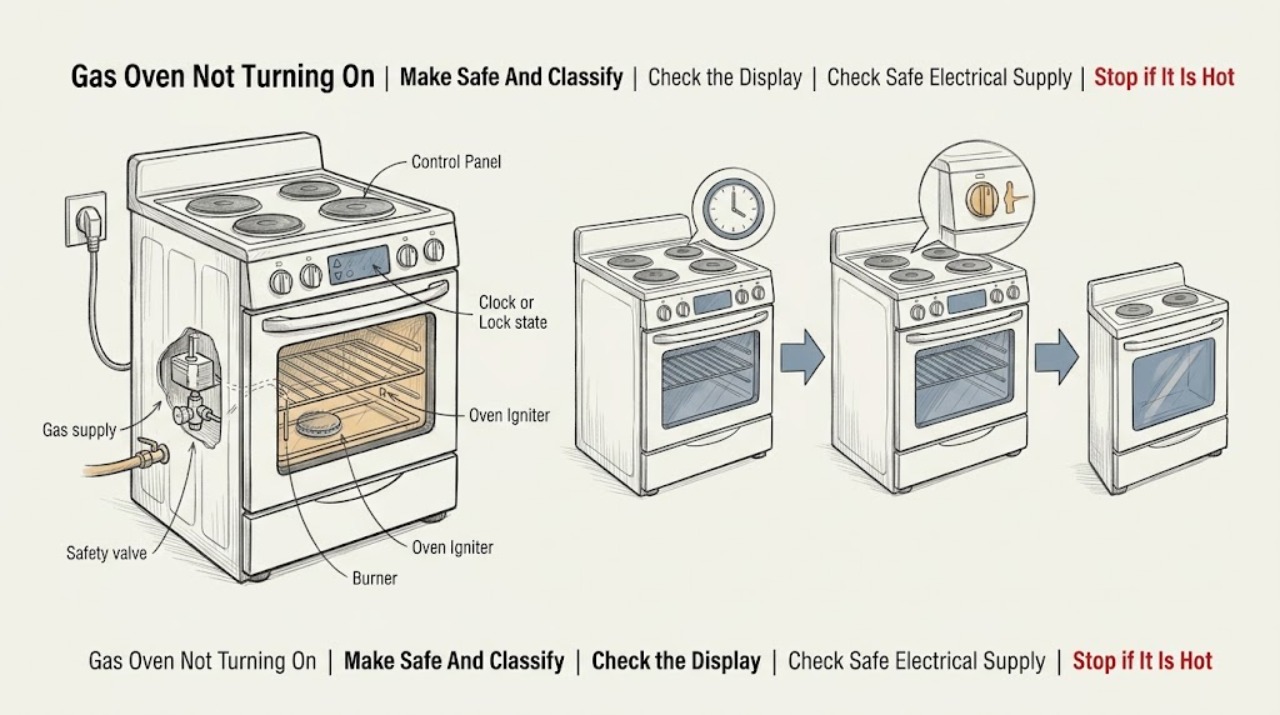
If a Kenmore gas oven will not turn on, first stop for a gas smell, delayed ignition, an abnormal flame, smoke, sparks, a burning odor, a hot or damaged cord, or a breaker that trips again. Leave the oven controls off; if gas is suspected, leave the area and contact the gas utility or emergency service from outside. When the area is safe, identify whether the display is blank, the display works but Bake will not start, the igniter does not appear to operate, or the oven starts but does not heat. Check power from a dry position, confirm the clock, mode, and control lock are not preventing a start, and verify the gas supply only without moving the range or opening gas connections. Use the exact Kenmore manual for the model before any reset or ignition procedure. Do not remove panels, bypass a safety valve, test live wiring, or repeatedly attempt ignition. A persistent no-start, no-ignition, no-heat, or recurring fault needs qualified appliance or gas service.
Work through in order
Diagnostic checks
Use only checks that match the exact appliance or system and its official guide.
-
Check 1
Turn all oven controls off and look only from a safe position. Classify the symptom as gas odor or abnormal flame, blank display, active display with no start, ignition attempt with no flame, or a started oven that stays cold. Record any exact code or indicator without repeatedly pressing Start.
Expected result: Gas is smelled or heard, the display is blank, controls respond but Bake does not begin, ignition is attempted without a stable flame, or the oven starts but remains cold.
Next step: For gas odor, leave immediately and contact local gas authorities from outside. If no hazard is present, continue with dry, external checks and keep the oven off until the symptom is identified.
Stop if: Stop for gas odor, delayed ignition, abnormal flame, smoke, sparks, burning smell, rapid heat, or a breaker that trips again.
Why this matters
Why: Gas odor or abnormal flame is an emergency branch. A blank display selects the electrical-supply branch. A lit display with no start selects controls or lock. An attempted ignition with no stable flame selects a gas-ignition service boundary, while cold operation after a start may involve ignition, heating control, or sensing.
-
Check 2
Find the complete Kenmore model number without moving the range or opening a gas connection. Use the official manual finder, then check that the clock or display is in its normal state, the control lock is not active, and Bake or the intended oven mode is selected according to that manual.
Expected result: The clock or display is blank, a lock or fault indication is present, the model manual specifies a start sequence, or the controls appear normal but the oven still does not start.
Next step: Follow only the exact model's ordinary unlock or programme-selection instruction. If the lock or fault returns, record it and arrange qualified service.
Stop if: Stop for an unfamiliar diagnostic mode, a control that starts by itself, a fault that returns, or any request to bypass a lock or safety interlock.
Why this matters
Why: A model-specific control state can prevent a start without proving a gas or igniter failure. A persistent no-start with normal controls needs service rather than an improvised button sequence.
-
Check 3
From a dry position, check whether the range's household breaker or fuse is on and whether the power cord or outlet shows no heat or damage. Do not touch wet equipment, open the terminal area, or keep resetting the breaker.
Expected result: The display remains blank, the breaker is off, the breaker trips again, or the display returns after the supply is restored safely.
Next step: If the supply remains stable and the display is normal, continue with the model-specific control and gas-supply observations. If the display stays blank or the breaker trips again, leave the range isolated and request qualified service.
Stop if: Stop for a repeated trip, a hot or discolored outlet, a damaged cord, moisture near the range, sparks, or any need to test live wiring.
Why this matters
Why: A blank display after a safe supply check can indicate an appliance or installation fault. A repeated trip is an electrical stop condition and can prevent safe ignition even when gas is available.
-
Check 4
Only when there is no gas odor and the area is safe, confirm from the normal accessible position that the appliance's gas shutoff is in its normal open position as described by the installation manual. Do not move the range, disconnect a connector, loosen a fitting, or attempt to test pressure.
Expected result: The shutoff appears closed, the supply arrangement is unknown, other gas appliances also lack fuel, or the supply appears normal but the oven still will not ignite.
Next step: If the supply state is uncertain, contact the gas utility or a qualified gas technician. If gas appears normal and the oven still fails, stop repeated ignition attempts and arrange appliance service.
Stop if: Stop for any gas smell, hissing, damaged connector, unknown valve position, abnormal flame, or any need to move the range or open a gas connection.
Why this matters
Why: A closed or interrupted gas supply can prevent ignition, but a normal-looking valve does not prove adequate pressure or a working safety valve. A problem affecting other gas appliances may be upstream of the range.
-
Check 5
Only if the model manual permits an ordinary start, there is no gas odor or electrical hazard, and the oven is cool, select the documented Bake mode once and observe only through the normal door window or indicators. Do not remove the oven bottom or reach inside to view the igniter.
Expected result: The oven starts normally, an ignition attempt occurs but no stable flame follows, the display cancels the request, or no ignition response occurs.
Next step: Turn the controls off after one unsuccessful attempt and provide the sequence to a qualified technician. Do not keep trying to light the oven or manually introduce fuel.
Stop if: Stop immediately for gas odor, delayed ignition, a loud ignition event, unstable or yellow flame, smoke, sparks, or heat outside the oven cavity.
Why this matters
Why: A normal start points away from a persistent no-start fault. An unsuccessful ignition attempt can involve the electrical ignition path, gas supply, safety valve, burner, or control, but the observation does not identify a replaceable part. No response after normal controls and power checks also needs service.
-
Check 6
If the model provides separate Bake and Broil functions and the first attempt was safe, record whether the other documented oven function responds; do not run repeated tests or leave the appliance unattended. Stop if either function produces odor, smoke, abnormal flame, or heat where it should not.
Expected result: Neither function responds, only one function fails, both produce no heat, or a function starts but the result is abnormal.
Next step: Turn all controls off and send the model, function tested, display state, and result to qualified service. Do not remove panels to compare ignition components.
Stop if: Stop for gas odor, unstable flame, smoke, sparks, burning smell, excessive heat, a tripped breaker, or a function that will not turn off.
Why this matters
Why: A failure limited to one oven function can help a technician distinguish a function-specific ignition or control path from a whole-range supply issue. Both functions failing keeps power, gas, control, or shared safety paths in scope; abnormal operation is a stop condition.
-
Check 7
Only when the range is cool, dry, free of gas odor, and electrically stable, perform one model-approved control or breaker reset if the Kenmore manual directs it. Restore the documented settings once and do not repeat the reset if the oven remains inactive or the fault returns.
Expected result: The oven returns to normal, remains inactive, ignition still fails, or the same display or safety symptom returns.
Next step: Leave the range off after any repeat failure and arrange qualified appliance or gas service with the model, display, function, power, gas-supply, and ignition observations.
Stop if: Stop for any gas odor, smoke, sparks, abnormal flame, burning smell, abnormal heat, breaker trip, or a range that will not shut off.
Why this matters
Why: A single successful reset may clear a temporary control state, but recurrence indicates an unresolved supply, control, ignition, gas, or safety fault. A reset cannot validate a gas connection or internal component.
Use your observations
Decision map
Find the observation that best matches what you see, then follow the next safe action.
-
PATH 01Next step
What you see
Gas is smelled or heard, ignition is delayed, the flame is abnormal, or smoke accompanies an attempted start.
Do this next
Arrange qualified service and follow the exact model guidance.
Why this path and its safety boundary
Why it matters: Turn controls off if this can be done without delay, leave the area immediately, avoid operating switches or electronics, and contact local gas authorities or emergency service from outside. Do not re-enter to test the oven.
-
PATH 02Next step
What you see
The display or clock is blank after a safe check of the range supply.
Do this next
Arrange qualified service and follow the exact model guidance.
Why this path and its safety boundary
Why it matters: Leave the range isolated and arrange qualified appliance service. Do not assume the gas supply is the cause and do not open the control or terminal area.
-
PATH 03Next step
What you see
The display is active but the oven does not start, or a lock, clock, or mode indication is present.
Do this next
Arrange qualified service and follow the exact model guidance.
Why this path and its safety boundary
Why it matters: Use the exact model manual to confirm the ordinary unlock and Bake selection sequence. If the state returns or the controls remain unresponsive, request service rather than bypassing it.
-
PATH 04Next step
What you see
The accessible gas shutoff state is unknown, other gas appliances are also affected, or the supply appears abnormal.
Do this next
Arrange qualified service and follow the exact model guidance.
Why this path and its safety boundary
Why it matters: Do not move the range or open a fitting. Keep the oven off and contact the gas utility or a qualified gas technician for supply and connector assessment.
-
PATH 05Next step
What you see
Power and controls are normal, but an ordinary Bake start produces no stable ignition or no ignition response.
Do this next
Arrange qualified service and follow the exact model guidance.
Why this path and its safety boundary
Why it matters: Turn the oven off after one safe observation and arrange qualified gas-appliance diagnosis. Do not manually light the oven, remove the bottom panel, or replace an igniter or valve from the symptom alone.
-
PATH 06Next step
What you see
One documented oven function responds while another does not, with no gas or electrical hazard.
Do this next
Arrange qualified service and follow the exact model guidance.
Why this path and its safety boundary
Why it matters: Record the function difference for the technician, turn the controls off, and avoid internal access. A function-specific result narrows diagnosis but does not identify a universal Kenmore part.
-
PATH 07Next step
What you see
The oven remains inactive after the model-specific controls, safe supply checks, one permitted start, and one permitted reset.
Do this next
Arrange qualified service and follow the exact model guidance.
Why this path and its safety boundary
Why it matters: Stop troubleshooting and arrange qualified appliance service with the model, display, power, gas-supply, and function observations. Do not continue cycling or bypass a safety device.
Helpful context
Understand the symptom
Define what not turning on means
A blank clock or display means the range may have no electrical supply or a control fault. A lit display with no response may involve the clock, control lock, mode selection, or a fault state. A Bake command that starts but produces no ignition is a gas-ignition branch. An oven that ignites but does not maintain heat is a different service problem. Record the exact model and any display message before changing settings.
Keep gas and electrical checks separate
A gas oven still needs electricity for its controls and ignition on many models, but gas availability does not prove that the electrical or ignition system is safe. Never move the range to inspect the connector, open a gas fitting, or probe wiring. If gas is smelled or a flame behaves abnormally, stop and leave the area rather than trying another start.
Use the model manual for controls
Kenmore's official manual finder asks for the complete model number. Use it to confirm the clock, control-lock, Bake or Broil selection, display messages, and any permitted reset. Do not copy a sequence from a similar-looking range: Kenmore models can use different controls and ignition arrangements.
Stop before internal diagnosis
Do not remove the lower panel, lift the cooktop, access the igniter, adjust the gas valve, bypass a safety device, or test voltage unless you are a qualified professional following the correct service documentation. A no-glow, no-flame, or no-heat observation is useful for a technician but is not permission to replace a part from a symptom alone.
Safety boundary
Stop conditions
- Gas is smelled or heard, ignition is delayed, or the flame is unstable, yellow, lifting, or otherwise abnormal.
- Smoke, sparks, arcing, burning odor, abnormal heat, or a breaker that trips again is present.
- The plug, cord, outlet, control panel, gas connector, or visible housing is hot, wet, damaged, or discolored.
- A check would require moving the range, opening a gas connection, removing panels, testing live wiring, or bypassing a safety valve or door.
- The oven will not turn off, the display behaves unpredictably, or the same fault returns after one model-approved reset.
- The oven produces no stable ignition or no heat after safe external checks.
Only after diagnosis
Potential parts
- oven igniter or ignition assembly
Consider this category only after qualified diagnosis confirms an ignition-component failure; no glow or no flame alone does not identify a compatible component.
Confirm the complete model, fuel configuration, connector, and approved service documentation before selecting any component. - oven safety gas valve
Consider this category only when a qualified gas-appliance technician confirms the valve is not opening correctly after supply and ignition checks.
Gas-valve selection and replacement require exact model and fuel information and qualified service; do not adjust or bypass the valve. - oven control or sensing component
Consider this category only when a recurring control, timing, or heat-response fault is confirmed after the manual checks.
Confirm the exact model and service documentation; a display or no-start symptom does not establish component fit.
When checks do not resolve it
Need a professional?
The display remains blank after a safe household supply check or the breaker trips again., The clock, control lock, mode, or display fault cannot be cleared using the exact model manual., The gas supply or connector state is unknown, abnormal, or shared by other affected gas appliances., Bake or Broil produces no ignition, only one function responds, or the oven stays cold after a permitted start., Any gas odor, delayed ignition, abnormal flame, smoke, sparks, burning smell, abnormal heat, or water near electricity is present.
Common questions
FAQ
Why is my Kenmore gas oven completely blank?
From a dry, safe position, check the range's household supply once. If the display stays blank or the breaker trips again, leave the range isolated and arrange qualified service; do not open the control or terminal area.
Why does the display work but Bake will not start?
Use the exact Kenmore manual to check the clock, control lock, selected mode, and ordinary Start sequence. If the controls remain unresponsive or the fault returns, stop rather than bypassing a lock or safety control.
What should I do if the oven tries to ignite but no flame appears?
Turn the controls off after one safe observation. Do not keep attempting ignition, manually light the oven, remove panels, or adjust a gas valve. A qualified gas-appliance technician should assess the supply, ignition, burner, and safety path.
Can I move the Kenmore range to check the gas connection?
Do not move it to inspect a gas connector. If the gas-supply state is unknown or abnormal, keep the oven off and contact the gas utility or a qualified gas technician. If gas is smelled or heard, leave immediately and contact help from outside.
When should I stop using a Kenmore gas oven?
Stop for gas odor, delayed ignition, abnormal flame, smoke, sparks, burning smell, abnormal heat, a repeated breaker trip, a damaged cord or connector, a failure to shut off, or a persistent no-heat fault after safe external checks.
Read the exact guide
Official sources
- Gas Ranges | Ranges | KenmoreKenmore · Kenmore gas range product category and model identity
- Customer Care & Support | Kenmore AppliancesKenmore · Kenmore manuals, safety and compliance, recalls, and repair-support pathways
- Certain Older Gas Connectors May Be DangerousU.S. Consumer Product Safety Commission · Gas-appliance connector movement warning and emergency response when gas is smelled or heard
- Kenmore ManualsKenmore · Kenmore model-based operating manual lookup for ovens and gas ranges
Community feedback
Share a repair observation
Share a plain-text repair observation. Accepted observations are published automatically; this page may take a moment to update.