
On this page
Start here
Quick answer
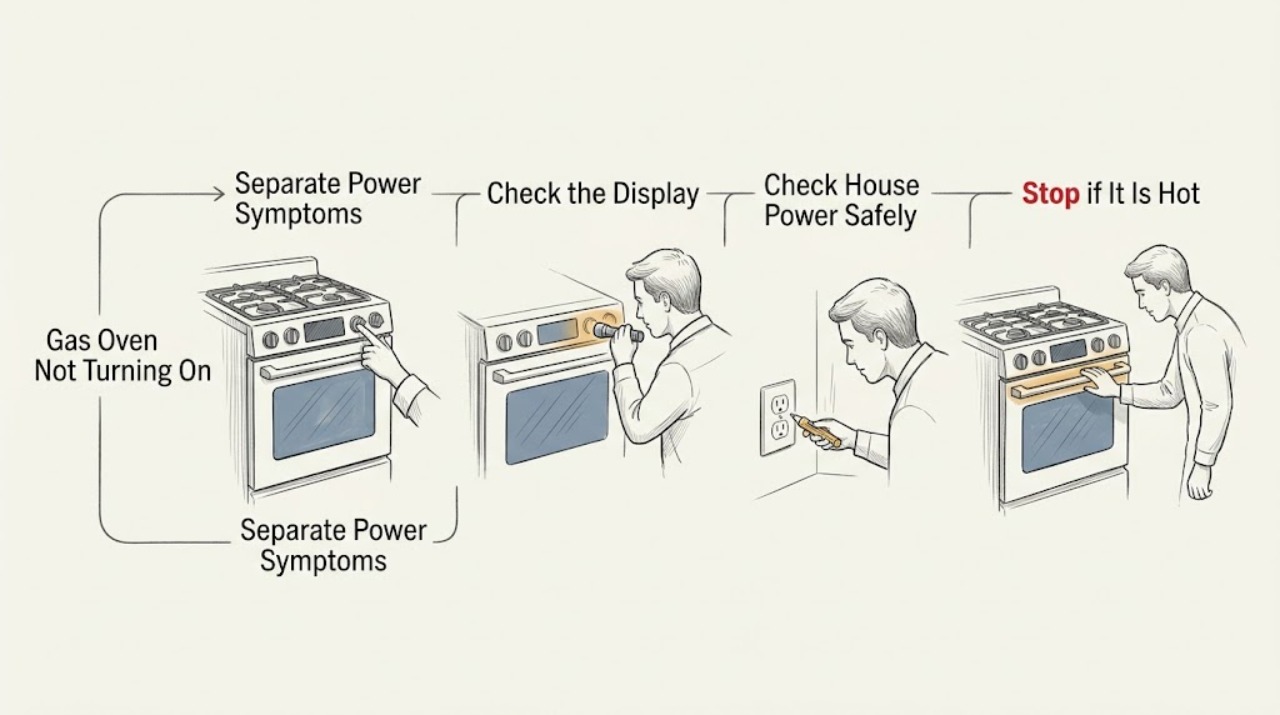
First separate a gas oven with no display or no electrical response from one that has power but will not start a cooking cycle. From a safe position, confirm the selected Bake or Broil mode, a closed door, the visible breaker or outlet condition, and the model's documented gas shutoff and control-lock state. A gas oven still needs electricity for many electronic controls and ignition systems, but the exact design varies: use the model manual before touching a control or pilot. Do not remove panels, test live wiring, manually light a pilot unless the exact manual explicitly permits it, or repeatedly try ignition. If you smell gas, hear hissing, see a delayed flare, abnormal flame, smoke, arcing, or a carbon-monoxide alarm, stop, leave the area, and use gas or emergency assistance from a safe location. If the oven remains dead after the model-appropriate low-risk checks, have a qualified appliance technician diagnose the electrical, control, gas-supply, and ignition system.
Before you begin
Safety first
- The homeowner's role is limited to normal controls and dry, visible, model-documented checks. A qualified professional handles internal ignition, gas pressure, regulator, wiring, burner, control, and combustion diagnosis.
Work through in order
Diagnostic checks
Use only checks that match the exact appliance or system and its official guide.
-
Check 1
From outside the heated cavity, note whether the clock or display is lit, whether control buttons or knobs respond, whether the oven light works, and whether the surface burners operate. Do not remove a drawer, reach behind the appliance, or touch wiring to make this comparison.
Expected result: The entire appliance is blank; the display is lit but a cycle will not start; or the cooktop works while the oven does not.
Next step: Follow the matching branch below and record the model and visible indicators. If the appliance is hot, smells of gas, or shows smoke or electrical damage, stop all checks and arrange urgent professional help.
Why this matters
Why: A blank appliance points first to supply, breaker, plug, or control power. A lit display with no start points toward mode, lock, door, timer, or control logic. Working surface burners do not prove that the oven gas path or oven ignition is available.
-
Check 2
Using the normal controls, select the documented Bake or Broil function and a temperature or setting, make sure the door is fully closed, and look for Control Lock, Sabbath, Demo, timer, delayed-start, or self-clean indicators described by the model manual. Do not force a latch or open the cavity during a failed ignition attempt.
Expected result: The wrong function, a lock or special mode, a timer state, an open or misaligned door, or an engaged self-clean latch is visible; or the controls appear correct but there is no response.
Next step: Cancel the mode only as the manual directs and make one normal start attempt. Do not bypass a door or latch interlock. If the correct mode still does not begin, continue to the safe power observation and then service boundary.
Why this matters
Why: A mode, timer, lock, or latch can inhibit a start without a failed gas component. If the documented controls are correct and the appliance remains unresponsive, a control, interlock, or power fault becomes more likely and needs model-specific service.
-
Check 3
From a dry, unobstructed location, look at the house breaker or fuse indicator and the oven's accessible plug only if the installation provides safe access without moving the appliance. Do not open the electrical panel, handle a wet plug, use an extension lead, or perform an energized meter check.
Expected result: The breaker is tripped, the plug is visibly loose or damaged, the outlet is dead, or power appears normal but the oven control remains dead.
Next step: If the installation is dry and there is no odor, smoke, heat, or damage, one normal breaker reset may be attempted only after the cause is not active and only as the appliance guidance allows. If it trips again, stays off, or the connection is wet or damaged, leave it isolated and use a qualified electrician or appliance technician.
Why this matters
Why: A tripped breaker or failed outlet can stop electronic ignition and controls. A normal supply with a blank or unresponsive oven points toward the appliance control or internal circuit. A damaged or wet connection is an immediate stop condition, not a reset opportunity.
-
Check 4
Without moving the appliance or loosening any fitting, check only the accessible, labeled gas shutoff position described in the installation manual. If the cooktop is designed to share the supply, note whether a surface burner operates normally, but do not use a flame or repeated ignition attempts to prove gas flow.
Expected result: The documented shutoff is closed, the cooktop and oven both lack gas, the cooktop works while the oven does not, or the valve location or position cannot be identified confidently.
Next step: If the valve identity and position are unambiguous and there is no gas odor, restore only the normal documented position; do not force a stiff valve. If the oven remains off, or the valve is inaccessible or uncertain, stop and request qualified appliance or gas service.
Why this matters
Why: A closed main supply can affect all gas functions. If surface burners work but the oven does not, an oven-specific valve, control, igniter, sensor, or regulator path remains possible. An unknown valve state or any gas odor requires professional handling rather than guesswork.
-
Check 5
Only when the exact manual permits normal operation, the room is free of gas odor, the door is closed, and no hazard sign is present, make one ordinary start attempt from the front controls and observe without opening the door. Do not use a match, lighter, spray, or improvised ignition, and do not repeat the attempt if ignition does not occur.
Expected result: There is no click or glow; there is a click or glow but no stable heat; ignition starts late with a bang or flare; or an abnormal flame, smoke, or odor appears.
Next step: Stop immediately for delayed ignition, flare, abnormal flame, smoke, or gas odor; leave the area as appropriate and seek gas or emergency assistance from a safe location. For a quiet failed start with no hazard signs, keep the oven unused and arrange qualified service rather than opening panels.
Why this matters
Why: No ignition sign can point to control, power, interlock, or igniter service. A click or glow without stable heat can involve gas delivery or ignition timing. A delayed bang, flare, abnormal flame, or odor is a combustion hazard and cannot be safely diagnosed by more attempts.
-
Check 6
Record the exact display text or code, model and serial information from the rating label, fuel type, selected function, and the point at which the start stops. Use the owner manual to determine whether that model supports one documented electronic reset or has a control-lock or special-mode procedure; do not guess a code meaning across models.
Expected result: A documented code, lock, special mode, or reset procedure matches the model; or no model-specific explanation is available.
Next step: Apply at most the manual's one safe reset with the gas hazard boundary still in place. If the code returns, the control remains dead, or the model procedure is unavailable, stop and provide the recorded details to a qualified technician.
Why this matters
Why: A model-specific procedure can clear a temporary control state, but an unrecognized code or absent manual evidence is not permission to replace a component or open the appliance. Repeated control failure after the documented single procedure indicates service is needed.
-
Check 7
Check whether a carbon-monoxide alarm has sounded and whether anyone has headache, dizziness, nausea, unusual fatigue, shortness of breath, confusion, or other possible exposure symptoms. Do not rely on smell to rule out carbon monoxide, and do not stay inside to continue testing.
Expected result: An alarm sounds, exposure symptoms occur, combustion appears abnormal, or there is no CO warning and no symptom.
Next step: Leave for fresh air and use emergency or medical assistance from a safe location when an alarm or symptoms are present. Do not operate the oven again until the appliance, venting, and fuel system have been professionally assessed.
Why this matters
Why: CO is odorless and colorless, so a silent alarm does not prove safe combustion. An alarm or symptoms make this an emergency exposure issue, not an oven repair branch. No warning only means this specific sign was not observed.
-
Check 8
Before requesting service, record the model, fuel type, display state, exact control setting, whether surface burners work, breaker behavior, accessible shutoff state, any click or glow, and the time and circumstances of the failure. Keep the oven off and do not remove panels or adjust gas components.
Expected result: The evidence points to supply or control power, a mode or door interlock, oven-specific ignition, gas delivery, or a safety event.
Next step: Give the record to a qualified appliance technician. Use a qualified electrician for a recurring breaker or outlet fault and the gas utility or emergency responders for a gas leak, hissing, fire, or immediate exposure risk.
Why this matters
Why: These observations help a technician choose the correct appliance, electrical, or gas diagnostic path without asking the occupant to expose wiring or repeatedly release unburned gas.
Use your observations
Decision map
Find the observation that best matches what you see, then follow the next safe action.
-
PATH 01Next step
What you see
Gas is smelled, hissing is heard, a CO alarm sounds, symptoms occur, or there is a flare, delayed bang, abnormal flame, smoke, or combustion odor.
Do this next
Stop operation, avoid switches, flames, and further tests, leave the area, and use gas or emergency assistance from a safe location. Do not re-enter or relight until professionals say it is safe.
-
PATH 02Next step
What you see
The display, light, and controls are all dead.
Do this next
Check only the visible breaker and safely accessible plug or outlet condition. A repeated trip, wet or damaged connection, or normal supply with a dead appliance requires qualified electrical or appliance service.
-
PATH 03Next step
What you see
The display is lit but the oven does not begin a cycle.
Do this next
Check the documented function, temperature, timer, lock, Sabbath or Demo state, and closed door. If the correct model procedure does not restore a start, stop and request service.
-
PATH 04Next step
What you see
Surface burners work but the oven does not start or heat.
Do this next
Do not assume the whole gas supply is good. An oven-specific shutoff, igniter, control, sensor, or interlock may be involved; keep the oven off and arrange model-specific service.
-
PATH 05Next step
What you see
The model manual documents a control reset or mode-clear procedure and no gas or electrical hazard is present.
Do this next
Perform that procedure once only. If the fault returns or the manual does not cover the appliance, do not improvise; provide the recorded code and model to a qualified technician.
-
PATH 06Next step
What you see
The oven remains inactive after the appropriate low-risk checks, the model is unknown, or a valve, panel, igniter, regulator, or wiring issue is suspected.
Do this next
Stop troubleshooting and arrange qualified appliance service. Gas-system and internal electrical work are not consumer checks for this article.
Helpful context
Understand the symptom
Define what not turning on means
A blank display and no response is different from a lit clock with a cycle that will not begin, and both differ from a burner that clicks without producing heat. A range may have working surface burners while the oven has a separate oven shutoff, igniter, control, latch, or mode issue. Record what remains powered, whether the cooktop works, whether any error appears, and whether the oven has a pilot, electronic ignition, or a control panel. Do not infer the design from appearance alone.
Keep gas safety ahead of diagnosis
A short click or glow can be part of normal ignition on some models, but repeated clicking without ignition, a whoosh or bang, a persistent gas odor, or an abnormal flame can indicate unburned gas or a combustion problem. CPSC testing found that some delayed-ignition conditions can create a hazardous flare when the oven door is opened. Stop instead of opening the door to investigate, repeatedly cycling the control, or trying a match.
Use representative manufacturer guidance carefully
GE and Whirlpool publish useful examples of low-risk checks, but an unbranded oven may use a different control layout, gas arrangement, ignition system, or pilot procedure. Treat those pages as general decision aids, not proof that a particular step fits every appliance. The model and installation manual control the exact reset, latch, gas-valve location, and ignition instructions.
Safety boundary
Stop conditions
- Stop immediately for a gas odor, hissing, delayed ignition, bang, flare, abnormal flame, smoke, or suspected combustion problem; leave and seek safe-location gas or emergency help.
- Treat a carbon-monoxide alarm or possible exposure symptoms as an emergency; leave for fresh air and do not use the oven again until professionally assessed.
- Do not open panels, remove the oven bottom, expose wiring, loosen gas fittings, adjust a regulator, or bypass a door or control interlock.
- Do not use a match, lighter, spray, or repeated ignition attempts to test a gas oven that did not start.
- Do not reset a breaker repeatedly, handle wet or damaged electrical connections, or continue if there is arcing, heat, a burning odor, or a tripped circuit.
Only after diagnosis
Potential parts
- Oven control or door interlock
Only consider this category if the appliance has normal supply and the model-specific control, door, and mode checks fail while the technician observes no gas emergency.
A technician must identify the exact model and control design before selecting a component; no universal fit is implied. - Gas oven igniter or ignition assembly
This is relevant only after a qualified technician confirms that the control is calling for heat but the model's ignition sequence does not establish safe burner operation.
Ignition systems differ by model and fuel configuration. Confirm the exact approved component and installation method with the technician. - Oven gas valve or burner assembly
Consider this only after professional testing identifies an oven-specific gas-delivery or burner fault and rules out controls, supply, and ignition safety issues.
Gas components require exact model and fuel compatibility and qualified installation; do not order or fit one from appearance alone.
When checks do not resolve it
Need a professional?
Arrange qualified appliance service when the oven remains off after the model-appropriate control, door, supply, and single documented reset checks; when the oven has power but no ignition response; when an oven-specific gas or ignition fault is suspected; or when the model or manual is unavailable. Use a qualified electrician for repeated breaker trips, a damaged or dead outlet, or electrical arcing. Use gas or emergency assistance for gas odor, hissing, delayed ignition, fire, a CO alarm, or possible exposure.
Safety scope: The homeowner's role is limited to normal controls and dry, visible, model-documented checks. A qualified professional handles internal ignition, gas pressure, regulator, wiring, burner, control, and combustion diagnosis.
Common questions
FAQ
Why does a gas oven have power but not turn on?
A lit display does not prove that the selected mode, door or latch, control lock, gas supply, oven-specific shutoff, or ignition sequence is working. Check only the model-documented controls and visible conditions; keep the oven off if there is odor, smoke, a flare, or any abnormal ignition.
Can I light the oven with a match if electronic ignition fails?
Do not improvise. Manual lighting is safe only where the exact model's instructions explicitly provide it and the required conditions are met. A failed or delayed ignition can allow gas to accumulate, so repeated lighting or opening the door to investigate is unsafe.
What if the cooktop burners work but the oven does not?
That observation does not clear the oven. Some ranges have oven-specific controls, ignition, gas delivery, or interlocks. Record the behavior and use qualified appliance service rather than adjusting an internal valve or igniter.
Should I reset the breaker when the oven will not start?
Only one normal reset is reasonable when the installation is dry, there is no odor, heat, smoke, arcing, or active fault, and the model guidance allows it. If it trips again or the oven stays dead, leave it unused and obtain qualified electrical or appliance diagnosis.
Can carbon monoxide be present if I do not smell gas?
Yes. CPSC explains that carbon monoxide is odorless and colorless. Treat a CO alarm or possible symptoms as an emergency, leave for fresh air, and do not operate the oven until the appliance and venting are professionally assessed.
Read the exact guide
Official sources
- Range and Oven SafetyU.S. Consumer Product Safety Commission · General range and oven safety and official safety-alert access
- Protect Your Family from Carbon Monoxide PoisoningU.S. Consumer Product Safety Commission · Carbon-monoxide hazards, gas ranges and ovens, alarms, and possible exposure symptoms
- Gas Range Delayed Ignitions - Tests and Examinations of RangesU.S. Consumer Product Safety Commission · Gas-oven delayed ignition, accumulated unburned gas, flare-up, igniter, and exhaust-draft hazards
- Gas Range & Wall Oven - Oven Will Not Come OnGE Appliances · Representative manufacturer guidance for model-specific gas range and wall-oven power, gas, control, latch, and reset checks
- Oven Not Working - Cooktop Working - Not Clicking - Product HelpWhirlpool · Representative manufacturer guidance for gas range door, burner clearance, gas shutoff, and grounded power checks
Community feedback
Share a repair observation
Share a plain-text repair observation. Accepted observations are published automatically; this page may take a moment to update.