
On this page
Start here
Quick answer
A Kenmore gas oven can make a brief ignition sound or visible spark during a normal start or re-ignition, but a spark that continues with the control off, jumps to the cabinet, appears with smoke or a burning odor, or occurs after unburned gas has collected is not a routine adjustment. Stop immediately for a gas odor, delayed whoosh, abnormal flame, flare-up, smoke, scorching, visible arcing, water at electrical controls, or a breaker that trips again. If there is no hazard, identify whether the spark occurs at the oven burner, a surface control, or the control panel; record whether the burner lights and stays lit; keep the oven cool and dry; and use the exact Kenmore manual for the model. Do not open the gas path or perform live electrical tests. Persistent or abnormal sparking needs qualified gas-appliance service.
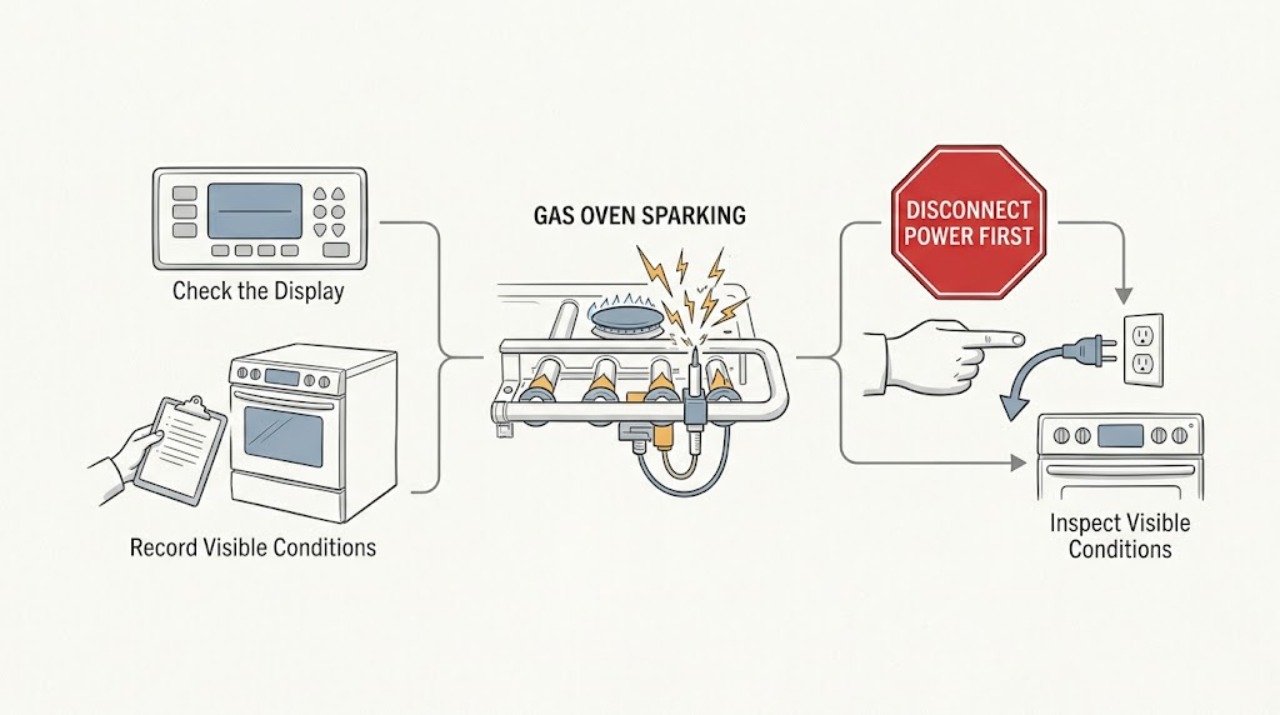
Work through in order
Diagnostic checks
Use only checks that match the exact appliance or system and its official guide.
-
Check 1
Turn the oven control to OFF and look from a safe position for a gas odor, smoke, a flare-up, a burning or electrical odor, scorching, visible arcing, an abnormal flame, water near controls, or a breaker that opens again.
Expected result: Any gas odor, delayed ignition, smoke, flame abnormality, visible arc, fire, water at electrical controls, or repeat breaker trip is present.
Next step: Do not relight the oven or operate electrical switches. Leave the area for gas, smoke, or fire danger and follow local emergency or gas-supplier instructions from a safe location; obtain qualified gas-appliance or electrical service.
Why this matters
Why: This is a gas, fire, heat, or electrical safety condition rather than a harmless ignition click.
-
Check 2
With no hazard present, identify where the spark is seen or heard: inside the oven during Bake or Broil, at a surface burner while its knob is being operated, behind a control, or at the cabinet or cord. Record whether the spark stops after ignition and whether the control is OFF.
Expected result: The event is brief and tied to a start command, repeats after a flame is established, occurs while all controls are OFF, or appears away from the intended igniter.
Next step: Stop after locating the event. Do not remove oven panels or reach toward the igniter. Give the location, timing, flame state, and control position to qualified service.
Why this matters
Why: A start-linked spark may be part of ignition; continued or misplaced arcing makes a wet, damaged, misaligned, switched, wired, or control fault more relevant.
-
Check 3
If the spark occurs during a normal start and there is no odor, observe only through the closed oven door or from the normal user position whether a steady flame appears and remains established. Do not open the door during a delayed start, lean into the cavity, or repeat ignition attempts.
Expected result: The burner lights promptly and stays stable, the igniter sparks but no flame appears, ignition is delayed with a whoosh, or the flame goes out and sparking resumes.
Next step: Turn the control OFF for no flame, delayed ignition, repeated sparking, or an unstable flame. Ventilate only as local safety guidance permits without operating switches, and arrange qualified gas-appliance service.
Why this matters
Why: A stable flame after the intended start is different from spark-without-ignition, delayed ignition, or repeated re-ignition. The latter can allow unburned gas to collect and requires a stop.
-
Check 4
After the appliance is off and fully cool, inspect only visible, user-accessible areas identified by the Kenmore manual for moisture, food residue, a displaced surface cap if the spark is actually at a surface burner, or a control that is wet or stuck. Do not spray cleaner into gaps.
Expected result: A spill or cleaning left moisture, visible residue is near the intended spark point, a removable surface part is visibly out of position, or the visible area is clean and dry.
Next step: Dry and clean only as the exact manual directs, restore only a clearly user-removable part, and make no more than one normal test when there is no odor or other hazard. Stop if the spark persists, jumps to metal, or the part is cracked.
Why this matters
Why: Moisture, residue, or a displaced user-removable part can redirect a surface spark, but a clean dry appliance with continued sparking points to ignition, wiring, valve, or control hardware.
-
Check 5
Compare the affected oven ignition with the rest of the appliance without forcing any control: note whether surface ignition works, whether the oven display and controls remain responsive, and whether the spark is isolated to one mode or occurs across modes.
Expected result: Only the oven fails, all ignition functions are affected, controls are dark or erratic, or one mode sparks while another does not.
Next step: Do not swap wires, change gas settings, or use an alternate ignition method. Stop for dark or erratic controls, and provide the comparison to qualified service.
Why this matters
Why: An isolated oven result makes the oven igniter, burner, valve, or local wiring more relevant; an all-function result makes shared power, spark control, or supply more relevant; mode-specific behavior requires the model manual and service diagnosis.
-
Check 6
Read the exact model and serial information from the appliance label and use Kenmore's official manual lookup. Check whether a safety notice applies to that exact identity; do not apply a recall or ignition sequence from a different Kenmore model.
Expected result: The model is unknown, the manual describes a different ignition type, or an official notice matches the model and serial range.
Next step: Follow the exact manual and any matching official safety remedy. If identity is uncertain or a notice matches, leave the appliance off and contact the listed qualified service path.
Why this matters
Why: Kenmore gas ovens are not one universal design. A model mismatch can lead to unsafe instructions, while a matching safety notice overrides normal troubleshooting.
-
Check 7
Only when no gas or electrical hazard is present and the manual permits it, isolate the appliance at its normal external supply once, restore it, and perform one normal control test. Record whether the spark returns with the control OFF, whether a flame establishes, and any code or odor.
Expected result: Sparking stops, the same arc returns, the breaker opens, no flame appears, a code returns, or gas odor is present after the test.
Next step: Stop after this test. Keep the gas oven off and provide the model, ignition location, control mode, flame result, spark timing, code, and safety symptoms to qualified service.
Why this matters
Why: One reset may clear a temporary control state but cannot establish that the igniter, spark module, valve, wiring, burner, or flame supervision is safe.
Use your observations
Decision map
Find the observation that best matches what you see, then follow the next safe action.
-
PATH 01Next step
What you see
Gas odor, delayed whoosh, flare-up, abnormal flame, smoke, scorching, visible arc to metal, or fire is present.
Do this next
Stop immediately. Do not relight or operate electrical switches; leave the area and follow local emergency or gas-supplier instructions from a safe location, then obtain qualified service.
-
PATH 02Next step
What you see
A brief spark occurs only during a normal start and a stable flame appears and remains, with no odor or abnormal heat.
Do this next
Treat the start event as potentially normal for that model, but verify the sequence in the exact Kenmore manual. Stop if sparking continues after ignition or returns with the control OFF.
-
PATH 03Next step
What you see
The igniter sparks but the oven burner does not light, ignition is delayed, or the flame goes out and sparking resumes.
Do this next
Turn the control OFF and do not repeat ignition attempts. Have the igniter, burner, valve, gas supply, and control sequence assessed by a qualified gas-appliance technician.
-
PATH 04Next step
What you see
Sparking occurs while every control is OFF, behind the panel, at the cabinet, or at a cord or connector.
Do this next
Stop use and isolate power only if safe and dry. Do not remove covers or touch wiring; arrange qualified appliance or electrical service.
-
PATH 05Next step
What you see
The event began after cleaning or a spill and is limited to a visible, user-accessible surface area.
Do this next
Leave the appliance off until the manual's permitted visible cleaning and drying are complete. Make one normal test only when there is no odor; persistent or redirected sparking requires service.
-
PATH 06Next step
What you see
The model or serial identity is uncertain, or an official safety notice matches the appliance.
Do this next
Do not use a generic ignition sequence or substitute parts. Use the exact Kenmore manual and official safety remedy, and keep the oven off until qualified help confirms the path.
Helpful context
Understand the symptom
First locate the sound or flash without putting your face or hands near the burner. A brief ignition event that stops after a stable flame is established is different from repeated sparking, an arc to metal, or sparking while every control is off. The oven may use a different ignition arrangement from the surface burners, so do not transfer a surface-burner diagnosis to the oven cavity.
Kenmore models vary by manufacturer, age, fuel configuration, and ignition design. The model number and its manual determine which parts are visible and which controls are user-serviceable. Keep troubleshooting to external controls and cool, visible areas. Never loosen a gas fitting, bypass an ignition or door safety device, or remove a live appliance cover.
Only after diagnosis
Potential parts
- oven igniter or spark electrode
Relevant only when qualified testing confirms that the intended ignition point is not producing a proper spark or is arcing away from the burner after safe visible checks.
Gas oven igniters differ by model and ignition design; confirm the complete model identity before replacement. - spark module or ignition control
Relevant only when multiple ignition points or a control-off spark pattern leads qualified testing to the shared ignition control.
Use model-confirmed electrical and mounting information; do not select a module from appearance alone. - oven gas valve or flame-sensing component
Relevant only when the igniter behavior is verified but the burner does not establish or hold a safe flame and a qualified technician isolates the gas-control path.
Gas-path parts require qualified diagnosis and model-specific fit confirmation. - ignition wiring or control harness
Relevant only when arcing location, intermittent spark, or professional testing identifies damaged insulation, a connector, or a harness fault.
Do not work on live wiring; verify the exact model and qualified repair method.
When checks do not resolve it
Need a professional?
Stop and seek qualified help for any gas odor, delayed ignition, flare-up, abnormal flame, smoke, burning odor, visible arcing, sparking with controls off, water near electrical controls, a repeat breaker trip, a stuck control, a cracked igniter, a matching safety notice, or failure after one normal model-approved test. Do not open the gas path, adjust a regulator, bypass flame or door safety, use an alternate ignition method, or perform live electrical tests.
Common questions
FAQ
Is a spark in a Kenmore gas oven always a fault?
Not necessarily. Some gas ignition systems produce a brief spark during a start or re-ignition. It is not routine when the spark continues after a stable flame, occurs with the control off, jumps to metal, or accompanies odor, smoke, or abnormal heat. Verify the exact sequence in the Kenmore model manual.
What does sparking with no flame mean?
It means the ignition event is not establishing a flame. Turn the control off and do not repeat attempts, because delayed ignition can allow unburned gas to collect. A qualified technician should assess the igniter, burner, gas valve, supply, and control sequence.
Why does the oven spark again after the flame goes out?
Some systems may re-ignite during normal cycling, but repeated re-ignition with an unstable flame, delayed lighting, gas odor, or a flame that will not remain established is a stop condition. Keep the oven off and arrange qualified gas-appliance service.
Can I clean the igniter to stop the sparking?
Only clean or dry a cool, visible, user-accessible area when the exact Kenmore manual permits it. Do not spray cleaner into openings, remove panels, scrape an electrode, or touch wiring. Persistent or redirected sparking needs service.
When should I stop using a Kenmore gas oven that is sparking?
Stop for gas odor, delayed ignition, a whoosh or flare-up, abnormal flame, smoke, burning odor, sparks with every control off, arcing to metal, water near controls, a repeat breaker trip, or a matching safety notice. Do not bypass a safety device or attempt gas-path repair.
Read the exact guide
Official sources
- Kenmore Elite Ranges Recalled by ElectroluxU.S. Consumer Product Safety Commission · Government recall notice identifying certain Kenmore Elite gas ranges, model and serial identification, and stop-use remedy for listed products
- Gas Range Delayed Ignitions - Tests and Examinations of RangesU.S. Consumer Product Safety Commission · Government safety research on delayed ignition, unburned gas accumulation, flare-ups, ignition systems, and gas range hood interaction
- Kenmore ManualsKenmore / Transform SR Brands LLC · Kenmore official manuals for ovens, ranges, stovetops, and other appliances, including model-specific operation and safety instructions
Community feedback
Share a repair observation
Share a plain-text repair observation. Accepted observations are published automatically; this page may take a moment to update.