
On this page
Start here
Quick answer
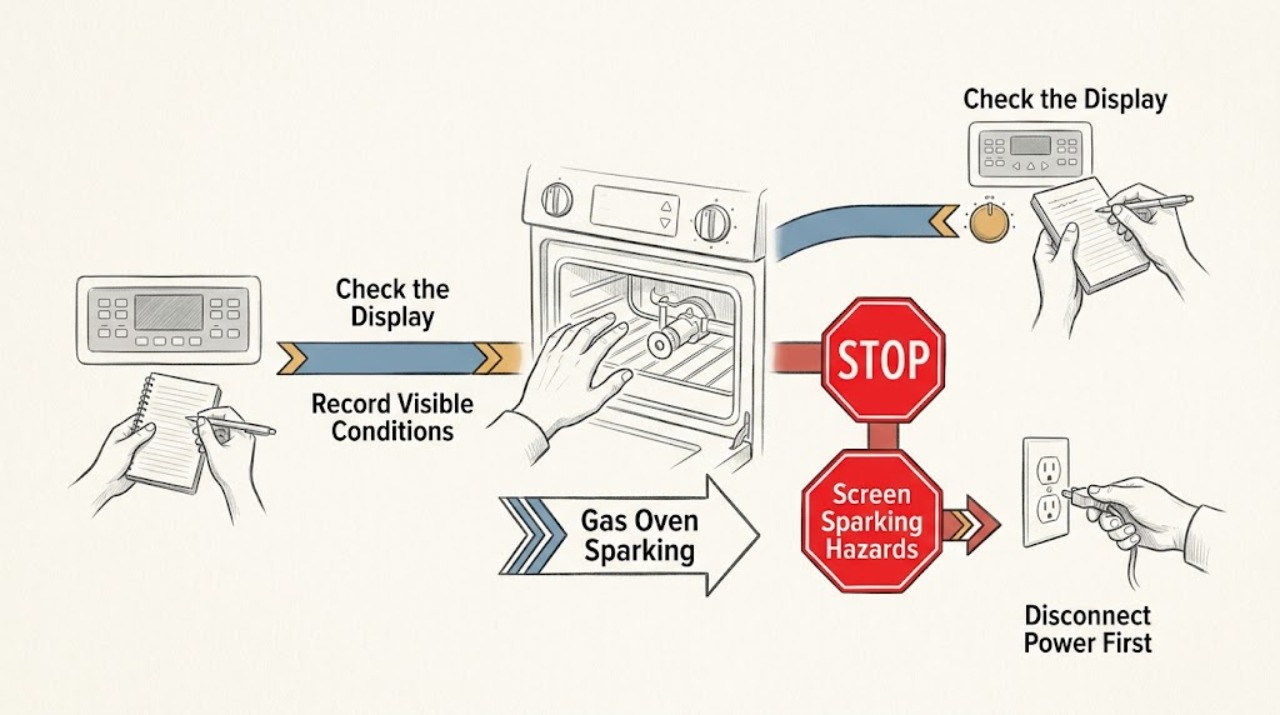
A Viking gas oven may make a brief, model-authorized ignition click or spark while it lights, but visible sparking that continues, occurs away from the intended igniter, is accompanied by no flame, delayed ignition, a boom, an abnormal flame, gas smell, smoke, burning odor, carbon-monoxide alarm, or breaker trip is not a normal cooking sound. Stop the oven and do not repeat the ignition attempt. Record the exact model, fuel configuration, selected mode, when the sparking starts, whether a flame appears, and whether the spark is at the intended ignition point. With no gas or electrical hazard, only check the normal controls, external power state, and the exact Viking manual; do not remove panels, adjust gas pressure, test a leak with flame, or probe live wiring. Persistent sparking needs qualified Viking appliance or gas service.
Work through in order
Diagnostic checks
Use only checks that match the exact appliance or system and its official guide.
-
Check 1
Before touching a control, observe from ordinary access for gas odor, delayed ignition or a boom, sparks or arcing outside the intended ignition point, abnormal flame, smoke, burning odor, a carbon-monoxide alarm, hot or damaged wiring, cracked glass, or a breaker that has tripped.
Expected result: Record which warning occurred, whether a flame is present, and whether the odor is gas-like or electrical. Do not move the range or look behind panels to investigate.
Next step: Stop using the oven. For suspected gas, avoid ignition and electrical switches, leave the area, and seek gas-emergency help from a safe location. For smoke, arcing, or a hot electrical part, keep clear and arrange emergency or qualified electrical/appliance help.
Stop if: Do not relight, reset a repeatedly tripping breaker, touch damaged wiring, or operate switches while gas is suspected.
Why this matters
Why: Any fuel, combustion, fire, heat, or electrical warning takes priority over diagnosis. It can make another ignition attempt unsafe.
-
Check 2
With the oven off and cool, record the exact Viking model, gas or dual-fuel configuration, selected function, and the sparking pattern: brief click at start, continuous click, visible arc, sparking with no flame, sparking after flame, or sparking when no start command was given.
Expected result: A spark only during a documented start is a normal-ignition candidate; a spark with no command, away from the intended igniter, or after a stable flame is present is an abnormal pattern. A blank display or unrelated control failure changes the first check.
Next step: Open the matching Viking use-and-care and installation manual and use its terminology for the next safe check.
Stop if: Stop if the model cannot be identified, the spark location is unsafe to view, or any gas, fire, smoke, or electrical warning appears.
Why this matters
Why: Model and timing distinguish an expected ignition sequence from an ignition-control, grounding, moisture, wiring, or burner condition that requires service; the observation alone does not identify a user-replaceable part.
-
Check 3
If there is no hazard and the display or controls are available, confirm the normal appliance power state from the user-accessible control area, then follow the exact manual to select the intended bake or broil function, temperature, Start command, timer, lock, or delay state.
Expected result: A blank display or controls that do not respond points toward power or control service. A responsive display that starts a cycle but sparks abnormally points back to the ignition branch. A breaker that trips again is a fault signal.
Next step: Correct only an obvious user control setting described by the matching manual. If the display remains dead, the controls misbehave, or the breaker trips, keep the oven off and arrange qualified service.
Stop if: Do not use an extension cord, open an electrical enclosure, perform a live voltage test, or repeatedly reset a breaker.
Why this matters
Why: Viking gas ignition needs electrical power, and an incomplete mode, delay, or lock state can be mistaken for an ignition failure. Correcting a clearly selected control state does not authorize electrical disassembly.
-
Check 4
For a confirmed gas or dual-fuel model with no gas odor, compare the matching installation manual with the visible external appliance shut-off arrangement and note whether another gas appliance has normal service; do not move the appliance or disconnect a line.
Expected result: A clearly identified closed shut-off or broader supply interruption can explain sparking without flame. Normal supply elsewhere with the Viking oven still sparking leaves an appliance ignition or control branch. An unfamiliar valve, piping, or fuel conversion is not a user test.
Next step: If the supply state is uncertain or the valve is not clearly identified for normal user access, leave the appliance off and arrange qualified gas or Viking service. Do not change pressure or conversion settings.
Stop if: Do not turn an unfamiliar valve, disconnect gas piping, adjust a regulator or air shutter, remove panels, or use a flame to test for a leak.
Why this matters
Why: The presence of a spark does not prove that gas is flowing correctly. Viking assigns gas installation, adjustment, and service to qualified personnel.
-
Check 5
Only if the exact manual permits a normal start, the oven is cool, the door closes normally, there is no gas smell or electrical warning, and no earlier hazard occurred, select the documented heating function once and observe from a safe position without opening panels or reaching into the cavity.
Expected result: Note whether the expected brief click or spark occurs at the intended point, whether a flame appears promptly, whether the spark continues, and whether the flame is stable. Do not repeat the start to obtain a clearer view.
Next step: Turn the control off and arrange qualified Viking appliance or gas service for continuous sparking, no ignition, delayed ignition, flame dropout, or an unexpected arc.
Stop if: Stop immediately for a boom, gas odor, abnormal flame, smoke, burning odor, carbon-monoxide alarm, electrical arc, or breaker trip; do not perform another ignition test.
Why this matters
Why: Clicking without flame suggests a gas-delivery or ignition condition; continued sparking after ignition can be associated with moisture, grounding or polarity issues in Viking troubleshooting; an arc in an unexpected place suggests an electrical fault. These require professional diagnosis.
-
Check 6
If the one normal observation produced a stable flame and no hazard, use the exact manual's indicator or preheat behavior to distinguish a stable heating cycle from repeated reignition or a flame that drops out; do not touch the door, burner, oven bottom, or vent.
Expected result: A stable flame with normal cycling is different from repeated sparks, a flame that goes out, an unstable or yellow flame, or an oven that remains cold. Record the stage and any display message rather than extending the test.
Next step: For any repeat spark, flame dropout, abnormal flame, or failure to heat, stop and provide the model, serial number, function, timing, and observations to qualified service.
Stop if: Do not continue a cycle with unstable flame, smoke, burning odor, unusual heat, or any arc.
Why this matters
Why: The distinction directs service toward normal operation, ignition/flame sensing, combustion, or heating-control diagnosis. It does not justify cleaning a hidden igniter or adjusting combustion parts while energized.
-
Check 7
If the oven displays an error, lock state, or service indication, photograph or write the exact message and record the model, fuel configuration, and point in the start sequence where it appeared; consult only the matching Viking documentation.
Expected result: A code or lock may inhibit gas and ignition, while the same-looking display behavior can have different meanings across Viking families. A recurring code after the documented user reset, if any, is a service condition.
Next step: Follow only the manual's single user-level acknowledgment or reset, and only after the appliance is safe and cool. If the condition returns, leave the oven off and arrange qualified service.
Stop if: Do not bypass a lock or safety interlock, clear a code by disconnecting random wiring, or keep restarting an oven that sparks.
Why this matters
Why: Model-specific documentation is needed to avoid a false interpretation or an unsafe reset. A reset cannot repair a continuing spark or combustion fault.
-
Check 8
Prepare a service handoff with the model and serial information, gas type if known, selected mode, whether the spark was visible, whether a flame appeared, the exact timing, any error, and every safety symptom observed.
Expected result: If sparking persists after the oven is off, returns without a normal start, or is accompanied by no heat, flame dropout, an abnormal flame, or a trip, the condition is not resolved by a user control check.
Next step: Keep the oven out of service and request qualified diagnosis. If gas, fire, smoke, carbon monoxide, or electrical danger occurred, use the appropriate emergency or utility path before ordinary appliance service.
Stop if: Do not remove panels, replace an igniter by guesswork, adjust gas pressure, or resume cooking to see whether the spark returns.
Why this matters
Why: A qualified Viking appliance or gas technician needs to inspect the ignition, flame-sensing, grounding, wiring, gas delivery, and control sequence with proper safety controls.
Use your observations
Decision map
Find the observation that best matches what you see, then follow the next safe action.
-
PATH 01Next step
What you see
Gas smell, delayed ignition or boom, abnormal flame, smoke, burning odor, carbon-monoxide alarm, arc, hot wiring, or repeated breaker trip
Do this next
Stop immediately. Avoid ignition and electrical controls when gas is suspected, leave from a safe route, and seek the appropriate gas, emergency, electrical, or qualified appliance help from a safe location.
-
PATH 02Next step
What you see
A brief spark or click occurs only during the exact model's normal start and a stable flame follows without hazard
Do this next
Treat it as a normal-ignition candidate; follow the model manual's preheat behavior and stop if sparking continues or heating fails.
-
PATH 03Next step
What you see
The intended ignition point sparks but no flame appears promptly
Do this next
Turn the control off, do not retry, and arrange qualified gas/appliance service; gas supply and ignition sequence need safe diagnosis.
-
PATH 04Next step
What you see
Sparking continues after flame, appears with no start command, or occurs away from the intended ignition point
Do this next
Keep the oven off and request qualified service for the ignition, grounding, wiring, moisture, flame-sensing, and control sequence. Do not open panels.
-
PATH 05Next step
What you see
The display is blank or the controls do not accept the documented start sequence
Do this next
Check only the normal external power state described by the manual. Persistent loss of power, misbehavior, or a tripping breaker needs qualified electrical/appliance service.
-
PATH 06Next step
What you see
A model-specific error, lock, or service indication appears
Do this next
Record the exact message and follow only the matching manual's user-level instruction once; if it returns, stop and arrange service.
Helpful context
Understand the symptom
A short ignition click is different from uncontrolled sparking
Gas ovens use electricity for controls and ignition, but the exact ignition sequence varies by Viking family. A brief spark or click during a normal start can be part of ignition. Continuous clicking, a spark visible in an unexpected location, sparking with no flame, or a spark that remains after a stable flame is established is a different fault pattern. Note the timing and location from a safe position; do not open the oven or keep testing.
Identify the exact model before interpreting the symptom
Viking documentation covers several gas and dual-fuel families with different selectors, electronic controls, bake and broil arrangements, and self-clean features. Use the model and serial information to locate the matching manual. Do not import a spark location, error meaning, or ignition timing from a different Viking range.
Sparking has a strict gas and electrical safety boundary
If you smell gas, hear a delayed ignition or boom, see an abnormal yellow or unstable flame, smell burning insulation, see smoke or an arc, receive a carbon-monoxide alarm, or trip a breaker, stop using the appliance. Do not relight it, touch electrical switches during a suspected gas leak, remove covers, adjust a burner or regulator, or try to prove the fault with another cycle. Leave and seek the appropriate gas, emergency, electrical, or qualified appliance help from a safe location.
Safety boundary
Stop conditions
- Stop the oven and do not repeat an ignition attempt for gas smell, delayed ignition or boom, abnormal flame, smoke, burning odor, carbon-monoxide alarm, visible arc, hot or damaged wiring, cracked glass, or breaker trip. Do not touch electrical switches during a suspected gas leak, remove panels, adjust gas pressure or air shutters, test leaks with flame, bypass an interlock, or perform live electrical testing.
When checks do not resolve it
Need a professional?
Arrange qualified Viking appliance or gas service for continuous or unexpected sparking, sparking without flame, delayed ignition, flame dropout, abnormal flame, persistent no heat, recurring error or lock, or any electrical symptom. Treat gas smell, a boom, smoke, burning odor, carbon-monoxide alarm, visible arc, hot wiring, or a repeatedly tripping breaker as an immediate stop and use the appropriate emergency, utility, electrical, or qualified service path from a safe location.
Common questions
FAQ
Is a clicking sound from a Viking gas oven always a failure?
No. A brief model-authorized ignition click or spark during a normal start may be expected. Continuous clicking, an unexpected arc, no flame, delayed ignition, or sparking after a stable flame is established is a stop-and-service pattern.
Can I keep trying to ignite the oven if it sparks but does not light?
No. Turn the control off and do not repeat the attempt. If gas odor, a boom, smoke, or an abnormal flame occurred, leave and seek help from a safe location. Otherwise arrange qualified gas-appliance service.
What if the Viking oven sparks after the flame appears?
Stop the cycle and record the timing. Viking troubleshooting material identifies continued ignition activity after flame as a condition that can involve grounding, polarity, moisture, or related ignition faults; it needs qualified diagnosis rather than continued use.
Can I clean or reposition the igniter myself?
Do not remove panels or reach into the burner or ignition system. Follow only a cleaning step explicitly given for your exact model and only with the oven cool, controls off, and power safely isolated as directed. Persistent sparking belongs with qualified service.
Why does the exact Viking model matter?
Viking has multiple gas and dual-fuel oven families with different controls and ignition arrangements. Use the matching Viking documentation for the model, and do not apply an error meaning or ignition sequence from another range.
Read the exact guide
Official sources
- Viking Range, LLC | Support and Docs | DocumentationViking Range, LLC · Viking cooking-product documentation portal with model-specific installation and use-and-care manuals
- Viking Range, LLC | High-End OvensViking Range, LLC · Viking oven product families and model-specific cooking documentation
- Viking Use & Care Manual — Professional Freestanding Gas Open Burner RangesViking Range Corporation · Viking professional freestanding gas open burner ranges; ignition, power-failure, safety, troubleshooting, and service guidance
- CPSC News Feature: Getting Ready For Cold WeatherU.S. Consumer Product Safety Commission · Government consumer safety guidance for suspected gas odor and carbon-monoxide/fire risk
Community feedback
Share a repair observation
Share a plain-text repair observation. Accepted observations are published automatically; this page may take a moment to update.