
On this page
Start here
Quick answer
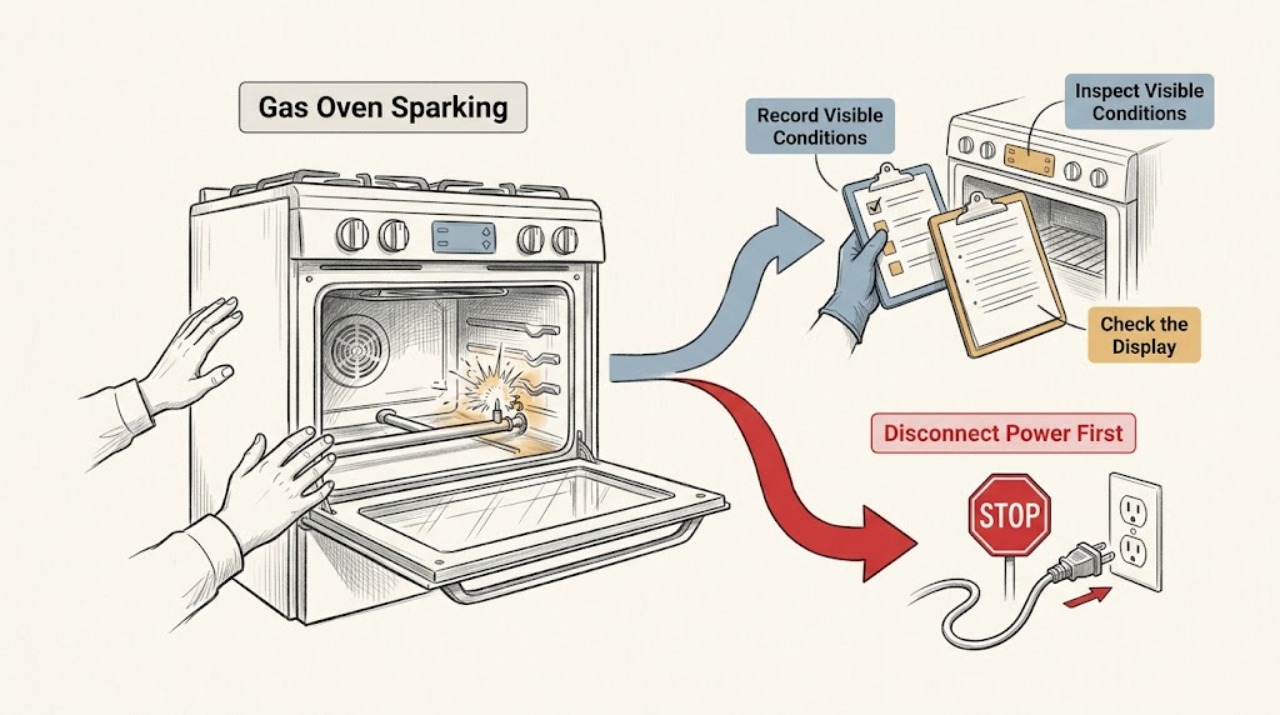
A brief, controlled click or spark at a surface gas burner while its control is intentionally being turned on can be part of ignition on a Thermador gas range, but that does not make a visible spark in the oven cavity, control area, outlet, cord, or cabinet normal. A spark that continues with controls off, smoke, a gas odor, delayed ignition, an abnormal flame, heat damage, or a repeated breaker trip is a stop-use condition. Do not keep testing, open panels, touch ignition parts, or alter gas or electrical connections. If gas is suspected, leave without operating switches or using a device inside and seek help from outside.
Work through in order
Diagnostic checks
Use only checks that match the exact appliance or system and its official guide.
-
Check 1
With the appliance off and cool enough to approach, record the complete Thermador model, fuel configuration, spark location, and the exact moment it occurs.
Expected result: The event is a brief click at a surface burner during an intentional ignition, repeated clicking with every control off, or a flash in the oven cavity, control area, outlet, cord, or cabinet.
Next step: Keep the appliance out of service for a cavity, control, outlet, cord, or cabinet spark, and give the location and timing to a qualified technician.
Why this matters
Why: The first pattern can be part of a surface-burner ignition sequence; the other patterns are not established as normal by a burner-ignition explanation and need a safety assessment.
-
Check 2
For a surface burner only, observe the control position from the front and note whether the click is tied to the selected ignition position; do not reach toward the burner or ignition parts.
Expected result: The click stops after the expected flame is established, or it continues after the control is returned off or no control is selected.
Next step: If clicking continues with controls off, stop using the range and request qualified service rather than repeating ignition attempts.
Why this matters
Why: A brief control-linked event is consistent with the intended ignition sequence. Persistent clicking can be associated with moisture, burner-cap or port conditions, drafts, gas supply, or an ignition control fault.
-
Check 3
From a safe standing position, inspect only visible burner flames, the oven opening, the control surface, and the plug or cord area; do not move the range or open a panel.
Expected result: There is an expected stable flame and no odor or smoke, or there is delayed ignition, flame rollout, an unstable or unusual flame, soot, scorch marking, smoke, gas odor, or a hot or discolored connection.
Next step: Stop immediately for any warning sign. If gas is suspected, leave and seek help from outside; if there is smoke, fire, or an active electrical arc, use the local emergency route and do not resume testing.
Why this matters
Why: The second group indicates a possible combustion, gas, fire, or electrical hazard rather than a harmless click. A clean external view cannot make a hidden arc safe.
-
Check 4
If the spark was in the oven cavity or around the control, outlet, plug, or cord, turn the appliance off from a safe control location only when there is no gas odor, smoke, flame, or active arc; do not touch the affected area.
Expected result: The event stops without further heat, smoke, odor, or tripping, or it continues, leaves visible damage, or trips the circuit again.
Next step: Keep the appliance isolated and arrange qualified service; do not restore power to reproduce the fault.
Why this matters
Why: A stopped event still may involve wiring, ignition, heating, or control damage. A continuing event or visible damage is an immediate stop condition.
-
Check 5
Read and record any display message or error code, along with the operating mode and whether the code appeared before or after the spark; do not enter service diagnostics.
Expected result: An E-code or other message returns, the display becomes blank or erratic, or no message is shown.
Next step: Provide the exact text, model, fuel configuration, operating mode, and spark location to Thermador support or a qualified appliance technician.
Why this matters
Why: A returning code or abnormal display supports a control or power-path fault, while no code does not rule out an ignition or arc hazard.
-
Check 6
Only when there has been no gas odor, smoke, visible arc, heat damage, water contact, or repeated trip, follow the exact model manual for one approved control or power reset.
Expected result: The display and controls recover and remain quiet, or the spark, clicking, error, or breaker trip returns.
Next step: Do not repeat the reset. Keep the appliance off and request service if any symptom returns.
Why this matters
Why: A reset can clear a minor control condition but cannot prove that an ignition, heating, wiring, or gas fault is safe or repaired.
-
Check 7
Prepare a service handoff with the exact model, fuel type, spark location, timing, mode, display code, odor or smoke details, and whether the appliance is now isolated.
Expected result: The service provider can match the symptom to the model manual and determine whether it concerns the igniter, burner, control, heating circuit, wiring, or supply.
Next step: Follow the model-specific service direction and do not use the appliance until the qualified assessment says it is safe.
Why this matters
Why: Model-specific evidence is needed because Thermador configurations and ignition behavior vary; a part cannot be selected from the word sparking alone.
Use your observations
Decision map
Find the observation that best matches what you see, then follow the next safe action.
-
PATH 01Next step
What you see
The click or spark is brief, occurs only while a surface gas burner is intentionally igniting, and stops after the expected flame is established with no odor, smoke, or abnormal flame.
Do this next
Use the exact model instructions and monitor without repeated testing. If it becomes continuous or changes location, stop and request service.
Why this path and its safety boundary
Why it matters: This can be the normal surface-burner ignition event described in Thermador gas-ignition guidance.
-
PATH 02Next step
What you see
Clicking or sparking continues with all gas controls off, or the burner does not establish an expected flame.
Do this next
Stop operation and do not reach into the burner area or keep attempting ignition.
Why this path and its safety boundary
Why it matters: Thermador identifies moisture, burner-cap or port conditions, drafts, gas supply, and ignition controls as possible causes depending on the model; a persistent fault needs service.
-
PATH 03Next step
What you see
A visible arc appears in the oven cavity or around the control, outlet, plug, cord, or cabinet, or there is smoke, scorching, or a hot connection.
Do this next
Stop using the appliance and do not restore power or reproduce the fault. Use the local emergency route for active smoke or fire.
Why this path and its safety boundary
Why it matters: Treat the event as an electrical or fire hazard, not as an ordinary ignition sound.
-
PATH 04Next step
What you see
A gas odor, delayed ignition, flame rollout, unstable flame, or suspected gas leak accompanies the spark.
Do this next
Leave immediately, avoid flames and electrical switches, and seek gas or emergency help from outside the home. Do not return to relight or inspect the appliance.
Why this path and its safety boundary
Why it matters: Gas may be present where an ignition event could cause fire or explosion.
-
PATH 05Next step
What you see
The appliance trips a breaker, the panel becomes blank or erratic, or the symptom returns after the one model-approved reset.
Do this next
Leave the appliance off and provide the technician with the model, mode, code, timing, and spark location.
Why this path and its safety boundary
Why it matters: The fault may involve the power path, controls, heating circuit, or ignition system and is not resolved by repeated resets.
Helpful context
Understand the symptom
Start with the spark location
A Thermador gas oven may be part of a gas range that also has surface burners. Record whether the sound or flash comes from a surface burner, inside the oven cavity, near the controls, or at the plug, cord, or wall connection. Note whether it occurs only during a deliberate ignition command, during oven heating, or with every control off. Thermador's gas-ignition guidance is about the intended ignition sequence; it should not be used to dismiss an arc in another location.
What may be a normal ignition sound
A short click while a gas burner is being ignited can be the igniter doing its job. The event should be tied to the selected burner and stop once the expected flame is established. Continuous clicking, a spark that jumps somewhere other than the intended ignition point, a delayed light, an unstable flame, or any odor or smoke changes the situation from an ordinary ignition observation to a stop-and-service decision. Check the exact Thermador manual for the model and fuel configuration before interpreting an oven ignition behavior.
Do not reproduce an arc
Repeated tests can add unburned gas or worsen electrical heat damage. Use only safe external observations and record the sequence for service. Do not remove panels, lift the cooktop, touch electrodes or wiring, measure energized parts, change gas connections, or defeat a protective device.
Safety boundary
Stop conditions
- Stop immediately for a gas odor, delayed ignition, loud ignition pop, flame rollout, unusual or unstable flame, smoke, fire, carbon-monoxide concern, or visible arc.
- Stop for a hot or discolored plug, cord, outlet, control, or cabinet; water near the appliance; a burning or plastic odor; or a repeated breaker trip.
- Do not open panels, lift the cooktop, touch ignition parts, measure energized parts, alter gas connections, bypass a protective device, or keep resetting the breaker.
- If gas is suspected, leave without operating switches or using a device inside and seek help from outside.
Only after diagnosis
Potential parts
- gas igniter or electrode
Consider only if a qualified diagnosis links the symptom to the gas ignition electrode or igniter on the exact model.
Confirm the complete model and fuel configuration through Thermador or the service technician before any part decision. - ignition switch or control assembly
Consider only if persistent clicking with controls off is diagnosed as an ignition switch or control fault.
Do not infer fit from appearance; model-specific service information is required. - wiring or power-control component
Consider only after a qualified technician identifies an arc, heat-damaged connection, or control fault.
Electrical diagnosis and replacement require qualified service; never select or install a component from the symptom alone.
When checks do not resolve it
Need a professional?
Request qualified Thermador or appliance service when clicking continues with controls off, any visible arc occurs outside a brief intended gas-ignition event, an error returns, the appliance trips a breaker, there is heat damage or unusual odor, or the cause is not clear from safe external observation.
Common questions
FAQ
Is clicking normal on a Thermador gas oven or range?
A brief click while a surface gas burner is intentionally igniting can be normal. It should stop after the expected flame is established. Continuous clicking with controls off, or a visible spark away from the intended ignition point, needs service.
What should I do if I see a spark inside the oven cavity?
Stop using the appliance and do not run another cycle to reproduce it. Keep clear of the cavity and internal parts, turn it off only from a safe location when no gas odor, smoke, or active arc is present, and arrange qualified service.
What if sparking is accompanied by a gas smell?
Leave immediately, avoid flames and electrical switches, and seek gas or emergency help from outside. Do not return to relight the appliance or inspect its gas connection yourself.
Can a reset prove that the Thermador oven is repaired?
No. A single model-approved reset may clear a minor display condition, but it cannot prove that an ignition, heating, wiring, or control fault is safe. If the spark, code, or trip returns, keep the appliance off and request service.
Read the exact guide
Official sources
- Oven TroubleshootingThermador · Thermador oven operation, venting, heating behavior, latch reset, and service escalation
- Gas Cooktop TroubleshootingThermador · Thermador gas cooktop and rangetop ignition, clicking, sparking, flame, and gas-odor troubleshooting
- Oven Error CodesThermador · Thermador oven display error-code handling and service escalation
- Certain Older Gas Connectors May Be DangerousU.S. Consumer Product Safety Commission · Household gas-appliance leak emergency actions
- Appliance Information - Gas Professional Range | PRG304WH/01Thermador · Thermador gas professional range identity, model-specific manuals, parts, and service support
Community feedback
Share a repair observation
Share a plain-text repair observation. Accepted observations are published automatically; this page may take a moment to update.