
On this page
Start here
Quick answer
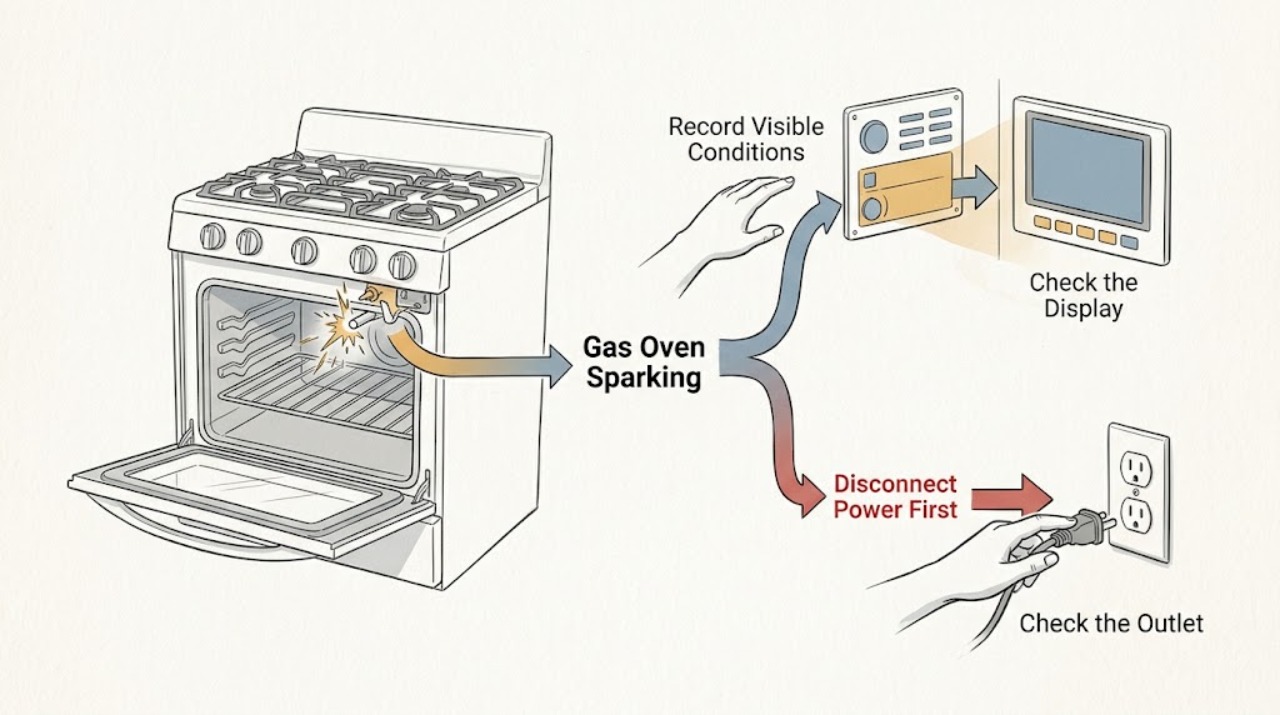
Stop using an LG gas oven if you see a spark where the oven igniter should operate, hear continuous clicking after controls are off, smell gas, see delayed ignition or an abnormal flame, or notice smoke, a carbon-monoxide alarm, or an electrical arc. A brief click while a surface burner is intentionally being lit can be normal, but it does not make persistent sparking safe. From a safe position, note whether the spark is in the oven or at a surface burner, check the exact model's settings and display, and inspect only cool, dry, visible parts. Do not repeatedly ignite the gas, open the appliance, or work on gas or live electrical components; arrange qualified LG appliance service, and use emergency help for gas, fire, or carbon-monoxide danger.
Work through in order
Diagnostic checks
Use only checks that match the exact appliance or system and its official guide.
-
Check 1
Turn all oven and surface controls off without attempting another ignition, and record where the spark or clicking was seen: inside the oven, near a surface burner, at the rear or control area, or at the plug or outlet.
Expected result: The event is a brief click during a deliberate surface-burner lighting action, continuous clicking after controls are off, a spark in the oven cavity, or an arc at an electrical connection.
Next step: Keep the range off and use the matching branch. Give the location, timing, selected mode, and any smell, flame, smoke, or error to qualified service.
Stop if: If gas odor, smoke, flame, carbon-monoxide alarm, or electrical arcing is present, leave the area and use emergency help as appropriate; do not try to reproduce the event.
Why this matters
Why: Location and timing separate a potentially normal surface ignition click from persistent ignition, oven-ignitor, control, or electrical-fault symptoms.
-
Check 2
Read the complete LG model number and note the oven mode, temperature setting, Start state, display message, and whether the symptom began after cleaning, a spill, or a power interruption.
Expected result: A model-specific code or lock state is shown, the settings were not confirmed, or the oven shows no code but still sparks or clicks.
Next step: Use the exact LG owner documentation for the model and preserve the code or display state. Do not clear an unresolved fault by repeatedly cycling the ignition.
Stop if: Do not remove control panels or attempt to interpret a code from another LG model.
Why this matters
Why: LG says error codes and controls vary by model, and an unconfirmed setting can look like a heating or ignition failure. A visible spark with no matching normal control action remains abnormal.
-
Check 3
From a dry, safe position, inspect the plug, cord, outlet face, and visible power connection for looseness, heat discoloration, moisture, buzzing, or damage; do not touch a wet or damaged connection.
Expected result: The outlet or cord is hot, scorched, wet, cracked, loose, or making an electrical sound, or no external damage is visible.
Next step: If the connection is damaged or wet, leave the appliance off and have power isolated by a qualified person from a safe location. Otherwise continue only with the cool, external gas-oven checks and service boundary.
Stop if: Do not reset a breaker repeatedly, use an extension cord, operate wet equipment, or test the outlet by running the oven again.
Why this matters
Why: The spark may be an electrical arc or a protection event rather than a gas-ignition issue. No visible damage does not rule out a fault inside the range.
-
Check 4
When the oven is cool and all controls are off, check only the visible door closure and the surrounding, accessible area for spilled liquid, cleaner residue, or obvious moisture; do not remove the oven bottom, ignitor shield, or burner cover.
Expected result: A spill or wet residue is visible near controls or ignition areas, the door does not close normally, or the visible area is clean and dry.
Next step: Leave the appliance off until an accessible area is fully dry and the exact LG manual allows ordinary cleaning. If moisture entered an opening, the door will not close, or the spark remains, arrange service.
Stop if: Do not spray cleaner, pour water, scrape an ignitor, remove internal parts, or ignite the oven to check whether it dried.
Why this matters
Why: Moisture or cleaning residue can interfere with ignition and create a shock or delayed-ignition risk. A door or setting problem can affect the bake cycle, but it does not justify a spark test.
-
Check 5
If the spark was actually at a surface burner, observe only after the burner is cool and the gas controls are off whether the cap and head are visibly tilted, wet, or contaminated; do not turn the knob to LITE for a test.
Expected result: A cap or head is visibly mis-seated, moisture or debris is present, or the parts look correctly seated and dry.
Next step: Use only the model-approved cool, dry cleaning and reassembly instructions, if applicable, and stop if the spark persists. Keep an oven-specific spark fault for qualified service.
Stop if: Do not poke gas ports, bend an igniter, remove gas fittings, or attempt repeated ignition after gas has accumulated.
Why this matters
Why: LG identifies incorrect cap or head placement and moisture or debris around the igniter as causes of ignition difficulty. Persistent sparking or an oven-cavity spark is not resolved by a surface-burner observation.
-
Check 6
Without moving the range or touching gas fittings, record whether other surface burners operate normally, whether the oven has any flame or only a delayed ignition attempt, and whether the gas supply or regulator was recently disturbed.
Expected result: Only the oven is affected, all burners are affected, the flame is delayed or abnormal, or no gas reaches the appliance.
Next step: Leave all gas controls off and arrange a qualified gas-appliance technician. Do not inspect, adjust, convert, or reconnect a gas line or regulator yourself.
Stop if: At any gas odor, repeated clicking with no flame, delayed ignition, yellow or unstable flame, soot, smoke, or carbon-monoxide concern, stop immediately and follow the emergency branch.
Why this matters
Why: A single oven symptom may involve the oven ignitor or burner control; multiple burner symptoms may involve supply or control. Delayed ignition or an abnormal flame can release unburned gas and needs professional assessment.
-
Check 7
If no emergency symptom is present but the oven spark or click persists after controls are off, preserve the exact model, symptom location, mode, display state, cleaning history, and power or gas observations for service.
Expected result: The spark returns without a normal lighting action, the oven fails to heat, a code returns, or the appliance is quiet and behaves normally after a clearly model-approved dry condition.
Next step: Do not use the oven until qualified service confirms it is safe. A technician can inspect the correct ignition and gas-control path without live or gas-line work by the owner.
Stop if: Do not open the appliance, make live electrical measurements, bypass an interlock, adjust gas pressure, or repeat ignition tests.
Why this matters
Why: Persistent or unscheduled sparking points to an ignition module, ignitor, control, wiring, or gas-burner fault that cannot be identified safely by trial. A normal one-time surface click does not explain an oven-cavity spark.
Use your observations
Decision map
Find the observation that best matches what you see, then follow the next safe action.
-
PATH 01Next step
What you see
There is only a brief click while a surface burner is intentionally being lit, and the flame appears promptly with no odor or abnormal flame.
Do this next
Turn the control off normally and use the oven only according to the exact LG manual; stop if clicking continues after the control is off or the flame is abnormal.
Why this path and its safety boundary
Why it matters: The click can be normal surface-burner ignition behavior, not an oven-cavity spark fault.
-
PATH 02Next step
What you see
Clicking or sparking continues after every control is off, occurs without a lighting action, or is visible inside the oven.
Do this next
Keep the appliance off and request qualified LG gas-appliance service; do not recreate the spark.
Why this path and its safety boundary
Why it matters: The behavior is not explained by normal surface ignition and may involve an ignitor, spark module, control, wiring, or gas-burner fault.
-
PATH 03Next step
What you see
A recent spill or cleaning event left moisture or residue near the visible control or ignition area.
Do this next
Keep all controls off, allow only the accessible area to dry as the manual permits, and arrange service if moisture entered an opening or the spark persists.
Why this path and its safety boundary
Why it matters: Moisture or contamination may interfere with ignition, but the appliance should not be energized while wet.
-
PATH 04Next step
What you see
There is no gas odor, but the oven never establishes a stable flame or shows an ignition-related display state.
Do this next
Record the exact model and display and have the gas appliance diagnosed; do not repeatedly turn the control or attempt to light the oven.
Why this path and its safety boundary
Why it matters: A supply, ignitor, control, or model-specific error condition may be involved.
-
PATH 05Next step
What you see
Gas odor, delayed ignition, abnormal or yellow flame, soot, smoke, a carbon-monoxide alarm, or symptoms of exposure occur.
Do this next
Do not operate switches or flames or search for the leak. Leave the area, contact emergency or gas-safety help from outside or another safe location, and do not re-enter or use the range until cleared by qualified personnel.
Why this path and its safety boundary
Why it matters: There may be a gas, combustion, fire, or carbon-monoxide emergency.
-
PATH 06Next step
What you see
The plug, outlet, cord, or control area is wet, hot, scorched, cracked, buzzing, or arcing.
Do this next
Leave the appliance off and have power isolated by a qualified person from a dry, safe location; request appliance service before reuse.
Why this path and its safety boundary
Why it matters: The condition is an electrical shock or fire risk regardless of the gas symptom.
Helpful context
Understand the symptom
First identify where the spark is
LG gas ranges can have more than one ignition behavior. A short click while a surface burner is deliberately being lit is the spark module working; a spark or arc continuing after the control is off, appearing in the oven cavity, or occurring without a controlled lighting action is not a normal oven cycle. LG's oven guidance describes a hot-surface ignitor for the bake burner, so do not assume a visible cooktop spark explains an oven fault.
Use the model boundary
LG's help pages state that images and steps can differ by model. Record the complete model number, whether the spark is in the oven or at the cooktop, the selected mode, the display or error code, and whether the event followed cleaning or a spill. With the controls off and the appliance cool, keep checks external and dry; do not remove oven panels, the burner assembly, wiring covers, or gas connections.
Treat gas and electricity as stop conditions
Gas odor, delayed ignition, a yellow or unstable flame, smoke, soot, an arc, a hot plug or outlet, or a carbon-monoxide alarm changes this from troubleshooting to emergency safety. Avoid switches, flames, and further ignition attempts; leave the area as appropriate and contact emergency or qualified professional help from a safe location.
Only after diagnosis
Potential parts
- LG gas-oven hot-surface ignitor
Consider this only after qualified diagnosis identifies an oven ignitor failure; a visible spark or delayed ignition alone does not establish the correct part.
Confirm the complete LG model number and manufacturer fit information; installation involves heat and gas-appliance safety. - LG gas-range spark electrode or ignition module
Consider this only when a qualified technician confirms that persistent surface or control-area sparking is caused by the ignition path.
Gas and electric control configurations vary by model; do not order from symptom timing alone or bypass the ignition system. - LG gas-oven burner or gas-control component
Consider this only after professional testing identifies a burner or gas-control fault and confirms that the gas supply and ignition system are otherwise safe.
Gas connections, pressure, and combustion require qualified service and exact model documentation.
When checks do not resolve it
Need a professional?
Arrange qualified LG gas-appliance service when sparking continues after controls are off, a spark appears in the oven cavity, the oven does not establish a stable flame, an ignition code returns, or the external dry checks do not resolve the symptom. Provide the complete model number, spark location, mode, display state, cleaning or spill history, and any gas, flame, smoke, or electrical observations. Use emergency or gas-safety help for gas odor, fire, or carbon-monoxide danger.
Common questions
FAQ
Is a clicking sound from an LG gas range always dangerous?
A brief click while a surface burner is being intentionally lit can be normal. Continuous clicking after controls are off, a spark in the oven cavity, an arc, gas odor, or delayed ignition is not normal and requires the appliance to remain off.
Why can an LG gas oven spark after cleaning?
Moisture, debris, or an incorrectly seated burner component can interfere with ignition, but do not test the oven while wet or repeatedly ignite it. Use only the exact model's cool, dry cleaning guidance and arrange service if the symptom persists.
Should I keep trying to ignite the oven if I hear clicking?
No. Repeated ignition can allow unburned gas to accumulate. Turn controls off, record the symptom, and stop immediately for gas odor, delayed ignition, an abnormal flame, smoke, or a carbon-monoxide concern.
Can an oven igniter be cleaned or replaced by the owner?
Limit yourself to the accessible, dry observations and cleaning explicitly allowed by the exact LG manual. Do not remove panels, gas fittings, or ignition wiring; an oven igniter or control fault needs qualified gas-appliance service.
What if the carbon-monoxide alarm sounds while the LG oven is sparking?
Move outside to fresh air, use emergency help, and do not re-enter or operate the appliance until responders and trained personnel say it is safe. Do not search for the source while inside.
Read the exact guide
Official sources
- Carbon Monoxide Fact SheetU.S. Consumer Product Safety Commission · U.S. consumer carbon-monoxide alarm and fuel-burning-appliance safety
- LG Range – How to Install a Gas RangeLG Electronics · LG gas-range installation, ignition, flame, and gas-connection safety boundaries
- LG Range - Troubleshooting a Burner Not Igniting After CleaningLG Electronics · LG gas-range post-cleaning burner-cap and head alignment and gas-odor warning
- LG Range - Why Won't My Burner LightLG Electronics · LG gas-range burner ignition, cap, head, moisture, debris, and gas-supply guidance
- Oven Not Heating - Gas RangesLG Electronics · LG gas-oven settings, electrical supply, gas valve, hot-surface ignitor, and model-specific error guidance
- LG Range – Troubleshooting Noises During OperationLG Electronics · LG gas-range normal ignition clicking, burner contamination, overheating indicator, and service guidance
- LG Range - Troubleshooting a Burner Not Igniting On My LG RangeLG Electronics · LG range electrical supply and dry igniter-cleaning observations
Community feedback
Share a repair observation
Share a plain-text repair observation. Accepted observations are published automatically; this page may take a moment to update.