
On this page
Start here
Quick answer
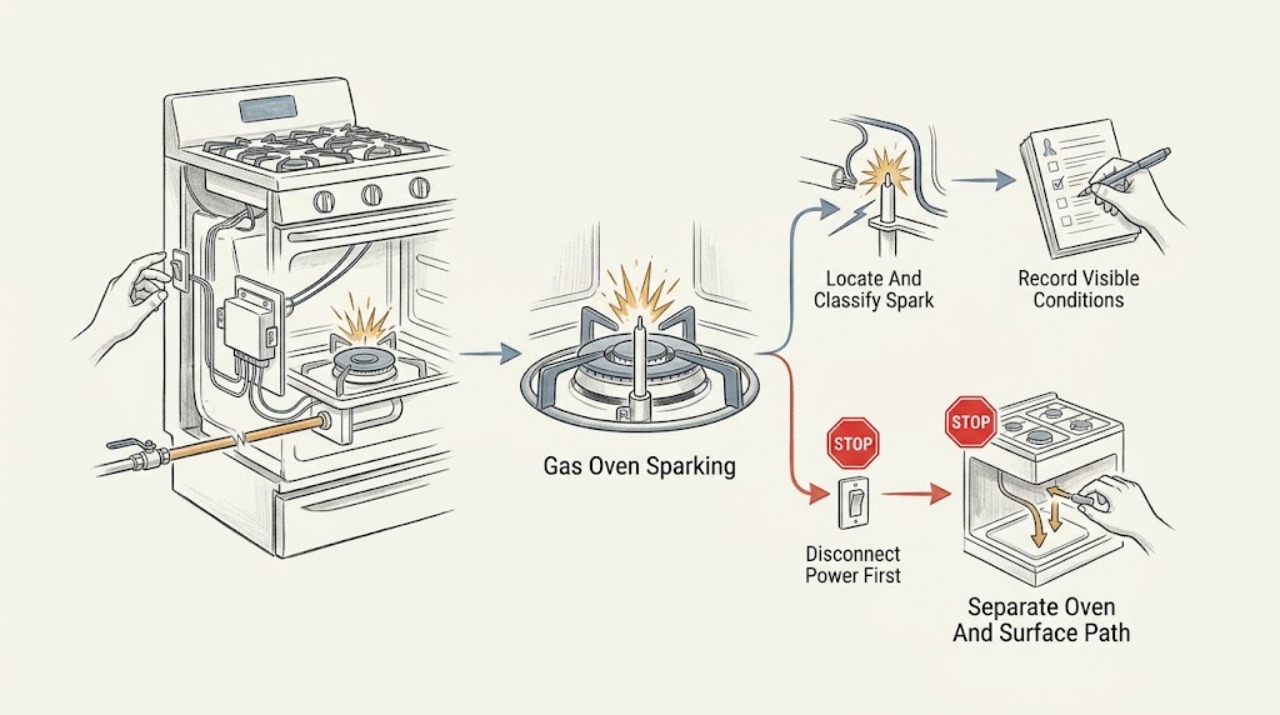
A gas oven may make a brief, controlled spark while its ignition system is starting, but a spark that continues without a stable flame, jumps outside the intended ignition point, appears behind the control panel, or occurs with gas odor is not a user repair. First identify the exact model, whether the spark is at the oven burner or elsewhere, whether it happens only during a normal start, and whether the flame follows promptly and normally. Keep the oven off if sparking is continuous, ignition is delayed, the flame is yellow or unstable, there is a bang, smoke, burning odor, carbon-monoxide alarm, or a breaker trip. Do not remove burner parts, move the range, use a match, search for a gas leak, or open electrical panels. Persistent or abnormal sparking requires qualified gas-appliance service; gas odor or suspected escaping gas requires leaving immediately and contacting gas authorities from outside.
Before you begin
Safety first
- This article supports ordinary external observation and exact model or symptom recording when no hazard exists. It does not authorize repeated ignition, match lighting, leak searching, appliance movement, connector or burner work, panel removal, live electrical work, or safety-device bypass.
Work through in order
Diagnostic checks
Use only checks that match the exact appliance or system and its official guide.
-
Check 1
From a safe position, record the model, fuel arrangement, selected mode, and the exact place where the spark is seen: the intended oven ignition area, a surface burner, a control or wiring area, or an uncertain location. Note whether the spark occurs only after a start command or while the controls are idle.
Expected result: The spark is a brief start-up event at the intended igniter, continues without flame, occurs outside the burner area, appears when no start command is active, or cannot be located safely.
Next step: Keep the oven off unless the exact guide describes the observed start sequence and no hazard is present; otherwise arrange qualified service with the model and location record.
Stop if: Stop for gas odor, smoke, visible arc, burning smell, heat damage, a bang, abnormal flame, a carbon-monoxide alarm or symptoms, or a breaker trip.
Why this matters
Why: Location and timing separate a model-designed ignition event from a possible wiring, control, or unintended ignition fault. An uncertain or non-burner spark is not safe to classify by repeated observation.
-
Check 2
If the exact model guide permits ordinary operation and there is no odor or other warning, record whether a normal start produces a stable flame promptly after the intended ignition event. Do not repeat the start request, use a match, or reach toward the burner.
Expected result: A stable flame follows and the sparking stops, clicking continues without flame, ignition is delayed, the flame is yellow or unstable, or sparking continues after ignition.
Next step: Turn the control off if safe, leave the oven out of service, and arrange qualified gas-appliance service for anything other than the model's documented normal sequence.
Stop if: Stop immediately for gas odor, delayed ignition or a boom, flame outside the intended burner, yellow or unstable flame, smoke, carbon-monoxide alarm or symptoms, or electrical sparking.
Why this matters
Why: A brief controlled spark followed by a stable flame can fit normal ignition, but continuing spark, no flame, delayed ignition, or an abnormal flame indicates an ignition, gas, control, or combustion issue that cannot be selected by sight alone.
-
Check 3
Note whether surface burners work normally, whether the oven spark happens in bake or broil, and whether the oven display responds. Do not infer that working surface burners prove the oven regulator, igniter, or control path is healthy.
Expected result: Surface burners work while the oven sparks abnormally, both oven and surface functions are affected, only one oven mode sparks, or the display is blank or unresponsive.
Next step: Give the technician the affected mode and working functions. Use only ordinary external power checks; leave the oven off for persistent or abnormal sparking.
Stop if: Do not open panels, remove the storage drawer or oven bottom, access wiring, bypass controls, or continue after odor, smoke, heat, arc, or a trip.
Why this matters
Why: Gas and control paths can differ between surface burners and the oven. A mode-specific spark suggests a model-specific ignition branch; a blank display or whole-appliance symptom adds a power or control branch.
-
Check 4
With the appliance cool and the area dry, check the normal user-visible power status, clock, control lock, delayed-start, demo or showroom state, and selected bake or broil mode. Use the exact owner's guide for the model; do not access live wiring or repeatedly reset a breaker.
Expected result: A lock, delay, demo state, blank display, affected breaker, or incorrect mode is present, or the controls appear ready while sparking continues.
Next step: Clear only a documented user state when no hazard exists. If the display stays abnormal, the breaker trips, or sparking persists, leave the oven off and request appliance or electrical service.
Stop if: Do not bypass a lock, use an adapter, reset repeatedly, open an electrical panel, or continue after an odor, arc, smoke, hot control, shock, or water exposure.
Why this matters
Why: A user state or supply issue can change when an igniter is commanded, but it does not justify diagnosing an internal ignition component. A spark that remains after controls are off is an escalation clue.
-
Check 5
If there is no gas odor and the model installation guide identifies a normal accessible shutoff, note whether the main gas supply and any appliance regulator shutoff are in the expected state. Do not move the range, loosen a connector, remove a panel, or change a gas setting to chase the spark.
Expected result: The appliance was recently installed or reconnected, a regulator or main shutoff appears off, the cooktop works but the oven does not, or the accessible supply appears normal.
Next step: Follow the exact model guide for any ordinary accessible control only. If supply is uncertain or the symptom persists, keep the appliance in place and contact qualified gas-appliance service.
Stop if: If gas odor or an escaping-gas sound appears, do not touch the appliance or electrical controls; leave immediately and contact gas authorities from outside.
Why this matters
Why: A gas supply or regulator condition can affect oven ignition separately from surface burners. A normal-looking valve does not establish gas pressure or rule out a faulty igniter, control, or valve.
-
Check 6
From a safe distance, note any crackle, flash behind the panel, burning-plastic odor, smoke, hot control, damaged cord, flickering display, shock, or breaker event associated with the sparking. Do not open the panel or use test instruments.
Expected result: No electrical warning is present, or the spark is accompanied by heat, odor, smoke, arc, flicker, shock, or a trip.
Next step: For an electrical warning, keep the oven off, stay clear, and contact a qualified electrician or appliance professional; use emergency services for active smoke or fire.
Stop if: Do not touch hot or wet equipment, restore a tripped breaker, use water on an energized fire, or continue observing from close range.
Why this matters
Why: An isolated documented ignition event is different from an electrical arc or overheating fault. Any warning sign can remain dangerous even after the control is turned off because the appliance may still be energized.
-
Check 7
Prepare the service record with model and serial information, fuel arrangement, spark location, mode, timing, flame behavior, cooktop and display status, recent installation or reconnection, visible damage, odor or smoke, and breaker events. Do not perform another ignition attempt once a service trigger is present.
Expected result: The record identifies a brief model-authorized ignition sequence or persistent/abnormal spark, no flame, delayed ignition, electrical warning, or gas-safety symptom.
Next step: Keep the oven out of service and give the record to qualified gas-appliance service; use emergency or gas response from a safe location for immediate danger.
Stop if: Do not move the range, inspect the connector, remove burner parts, open panels, bypass an interlock, or restore a breaker that trips with the oven.
Why this matters
Why: A precise external record lets the professional distinguish ignition, gas-supply, control, wiring, and combustion paths without guessing across models or repeating a hazardous test.
Use your observations
Decision map
Find the observation that best matches what you see, then follow the next safe action.
-
PATH 01Safety boundary
What you see
A spark occurs only during the documented start sequence at the intended ignition area, a stable flame follows promptly, the spark stops, and there is no odor, smoke, abnormal flame, or electrical warning.
Do this next
Use the exact owner's guide and monitor without repeating unnecessary ignition tests. Arrange service if the duration, location, sound, or flame changes.
Why this path and its safety boundary
Why it matters: This may be normal ignition behavior for that model, but a surface-burner example or another model's guide cannot certify an oven's behavior.
Safety stop: Do not use a match, open the burner area, or continue if the spark persists, flame is abnormal, gas odor appears, or a safety symptom occurs.
-
PATH 02Safety boundary
What you see
Sparking or clicking continues without a stable flame, ignition is delayed, or the spark returns after the control is off.
Do this next
Turn the control off if safe, leave the oven out of service, and arrange qualified gas-appliance service without repeating ignition.
Why this path and its safety boundary
Why it matters: An ignition, gas supply, valve, control, grounding, or installation issue is possible; the internal cause is not a safe user diagnosis.
Safety stop: Do not relight, use a match, remove the burner or igniter, find a leak, or continue with gas odor, boom, abnormal flame, smoke, or carbon-monoxide alarm or symptoms.
-
PATH 03Safety boundary
What you see
The flash is seen behind controls, at a connector or wiring area, between metal surfaces, or when no oven start command is active.
Do this next
Keep clear and keep the oven off. Contact a qualified appliance professional or electrician; use emergency services for smoke, fire, or immediate danger.
Why this path and its safety boundary
Why it matters: This is not a normal burner-ignition conclusion and may be an electrical or control fault with shock or fire risk.
Safety stop: Do not open panels, touch wiring, restore a breaker, or make another start attempt.
-
PATH 04Safety boundary
What you see
The display or controls work but ignition is absent, the cooktop works while the oven does not, the range was recently reconnected, or a lock, delay, demo, or regulator state is visible.
Do this next
Use only the exact model guide for ordinary external state checks. If the condition persists or gas supply is uncertain, request qualified appliance or gas service without moving the range.
Why this path and its safety boundary
Why it matters: The oven may be blocked by a user state, power/grounding issue, or oven-specific gas path; surface-burner operation does not rule those out.
Safety stop: If odor or escaping gas appears, leave immediately without operating electronics and contact gas authorities from outside.
-
PATH 05Safety boundary
What you see
Gas odor remains, gas is heard escaping, ignition is delayed with a bang, flame is outside the intended burner, smoke appears, or a carbon-monoxide alarm or symptoms occur.
Do this next
Leave immediately, avoid flames and electrical controls, and contact local gas authorities or emergency services from outside or another safe location.
Why this path and its safety boundary
Why it matters: This is an emergency safety boundary, not a reset or ignition branch.
Safety stop: Do not light a match, operate lights or electronics, use a phone inside, search for a leak, move the range, or re-enter while danger persists.
Helpful context
Understand the symptom
A spark at startup is not the same as an electrical arc
The first question is where and when the spark occurs. A model-designed igniter can spark as a gas burner starts, but an oven should not be treated like a surface burner, and one appliance family's normal behavior cannot be applied to every model. Record whether the spark is visible at the intended burner ignition point, whether it stops when a stable flame appears, and whether it returns after the control is turned off. A bright flash behind the panel, a spark that travels to metal, repeated clicking with no flame, or sparking while no start command is active is an abnormal branch.
Check only what is visible and model-authorized
Safe external information includes the model and fuel arrangement, the selected mode, exact timing, display messages, whether the cooktop works, and whether the oven was recently installed or reconnected. Whirlpool notes that oven igniters depend on a proper electrical ground and that a gas range can have an oven-specific regulator shutoff even when surface burners work. Do not remove a bottom panel, burner, igniter, storage drawer, or gas connector to investigate a spark.
Gas odor or combustion symptoms stop troubleshooting
If gas odor remains, gas is heard escaping, ignition is delayed with a bang, or the flame is abnormal, turn the control off only if doing so is safe and leave the area. The CPSC says to leave immediately and contact gas authorities from outside, without operating lights, phones, or other electronics before leaving. Smoke, an alarm, dizziness, weakness, nausea, or confusion also requires fresh air and emergency response rather than another ignition attempt.
Safety boundary
Stop conditions
- If gas odor remains or gas is heard escaping, leave immediately and contact local gas authorities or emergency services from outside; do not operate lights, electronics, or phones before leaving.
- Stop for delayed ignition, a boom, flame outside the intended burner, yellow or unstable flame, smoke, carbon-monoxide alarm or symptoms, or a spark that continues without a stable flame; do not attempt another ignition.
- Stop for a flash behind the panel, electrical crackling, burning-plastic odor, hot controls, shock, damaged cord, water exposure, or a breaker that trips again; keep the oven off and use qualified electrical or appliance service.
- Do not move the appliance, inspect or replace a gas connector, remove burner or igniter parts, open gas or electrical panels, bypass a safety device, use a match, or search for a leak.
- Keep the oven out of service and arrange qualified gas-appliance service for persistent or abnormal sparking, no ignition, a returning error, an uncertain gas path, or a symptom that cannot be matched to the exact model guide.
When checks do not resolve it
Need a professional?
Arrange qualified gas-appliance service when the spark is persistent, outside the intended ignition area, accompanied by no flame or delayed ignition, or returns after the control is off. Also call when a gas supply, grounding, regulator, control, door, or model-specific setting remains uncertain. For gas odor, escaping gas, abnormal flame, smoke, carbon-monoxide alarm or symptoms, electrical arc, or fire, stop immediately and use the appropriate emergency or gas response from a safe location.
Safety scope: This article supports ordinary external observation and exact model or symptom recording when no hazard exists. It does not authorize repeated ignition, match lighting, leak searching, appliance movement, connector or burner work, panel removal, live electrical work, or safety-device bypass.
Common questions
FAQ
Is a spark from a gas oven always dangerous?
No. Some gas appliances use a brief controlled spark during an ignition sequence, but the exact oven model determines what is normal. A spark that continues without a stable flame, appears outside the intended ignition area, returns when idle, or occurs with odor, smoke, abnormal flame, or electrical warning requires the oven to remain off and professional service.
Why does the gas oven spark but not light?
Power or grounding, gas supply or an oven regulator state, the igniter, control, valve, or installation can affect ignition. Working surface burners do not prove that the oven path is healthy. Do not repeat ignition, use a match, move the range, or remove burner parts; arrange qualified service.
What should I do if the oven keeps clicking and sparking?
Turn the control off if safe, keep the oven out of service, and arrange qualified gas-appliance service. Do not keep trying to ignite it. If gas odor, delayed ignition, an abnormal flame, smoke, a carbon-monoxide alarm or symptoms, or an electrical arc occurs, leave immediately and use the appropriate emergency or gas response from outside.
Can I move the gas range to inspect the spark or connector?
No. Moving a gas appliance or inspecting its connector can create or worsen a leak. Keep the range in place and have a qualified professional inspect it. If gas is smelled or heard escaping, leave immediately and contact gas authorities from outside without operating electrical controls inside.
Read the exact guide
Official sources
- Gas Range & Cooktop - Surface Burners SparkingGE Appliances · GE sealed surface-burner guidance only; it is an analogy for controlled ignition and does not certify an oven spark or another model.
- Certain Older Gas Connectors May Be DangerousU.S. Consumer Product Safety Commission · U.S. CPSC general safety guidance; local emergency and gas-utility procedures may differ.
- Nothing is Working - GasWhirlpool Product Help · Whirlpool official support for applicable gas ranges; exact model guide controls whether a setting exists.
- Oven Not Working - Cooktop Working - Not ClickingWhirlpool Product Help · Whirlpool official support for applicable gas ranges; do not generalize regulator location or controls to another model.
- Oven Not Working - GasWhirlpool Product Help · Whirlpool official support; exact model instructions control for a different gas oven.
Community feedback
Share a repair observation
Share a plain-text repair observation. Accepted observations are published automatically; this page may take a moment to update.