
On this page
Start here
Quick answer
Do not use a Kenmore oven when a door spring is broken, the door is sagging, will not stay open or closed, rubs the frame, or no longer seals evenly. Keep the door supported and cool, do not force it, remove it, stretch a spring or run self-clean. From outside, record whether the door is misaligned, the seal is loose, glass is damaged or heat escapes. Kenmore says its manuals are model-specific and that door disassembly should follow the exact User Guide; its Customer Care page provides repair routes. Record the full model and serial number and arrange qualified Kenmore or appliance service. Do not copy a spring-routing or hinge-removal procedure from another Kenmore model.
Before you begin
Safety first
- Do not operate an oven with an unstable or damaged door, run self-clean, force or remove the door, stretch/unhook/bend a spring, open hinge covers, touch wiring or copy another model’s repair. Keep the appliance cool and supported and use the exact User Guide with qualified service.
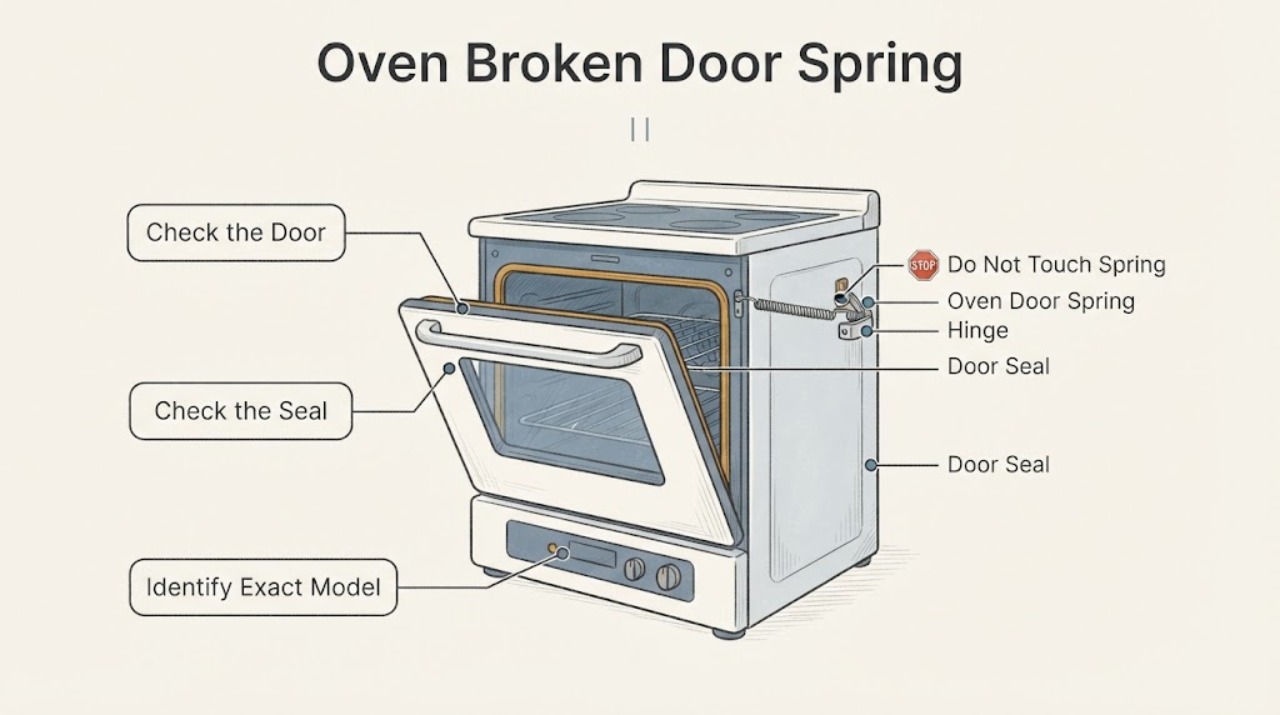
Work through in order
Diagnostic checks
Use only checks that match the exact appliance or system and its official guide.
-
Check 1
Turn the oven off and stop using it if the door sags, drops, rises unexpectedly, rubs the frame, will not close or no longer stays in its normal position.
Expected result: The door is unstable, misaligned, damaged or cannot seal evenly.
Next step: Keep the appliance out of service, keep the door supported without forcing it, and do not run bake, broil or self-clean.
Why this matters
Why: The door may no longer be safely supported or sealed; a spring or hinge cannot be confirmed from movement alone.
-
Check 2
With the oven cool and stopped, observe the door, glass, hinge-side alignment and perimeter seal from outside without lifting, twisting or removing the door.
Expected result: A gap, displaced seal, glass damage, exposed hardware or frame contact is visible, or the exterior appears normal.
Next step: Photograph the condition and keep the oven off if any damage or uneven sealing is present.
Why this matters
Why: These observations distinguish a door-support/seal problem from a vague spring description, but do not identify the spring or hinge geometry.
-
Check 3
Record the complete model and serial number and locate the exact Kenmore User Guide before any door or spring decision.
Expected result: The model is available, or the label is missing/unreadable.
Next step: Use the exact manual and give the identity to qualified service; do not apply a procedure from another model.
Why this matters
Why: Kenmore’s manual system requires the model number; spring routing, hinge access and door removal vary by appliance.
-
Check 4
Without heating the oven, note whether the door closes evenly and whether the seal sits uniformly around the opening; do not pull the seal or adjust the hinges.
Expected result: The seal is loose, uneven, torn or the door cannot close squarely, or the seal appears intact.
Next step: Keep the oven off for any seal or alignment abnormality and arrange model-matched service.
Why this matters
Why: Kenmore recommends checking the oven-door seal; an uneven seal is a performance and heat-loss clue but does not prove a broken spring.
-
Check 5
Send the servicer the model, serial number, photos, door position, seal result and event history, including any impact or self-clean use.
Expected result: Diagnosis would require removing the door, accessing a hinge/spring, handling stored tension or touching wiring.
Next step: Use Kenmore Customer Care or qualified appliance service; do not stretch, unhook, bend or replace the spring yourself.
Why this matters
Why: Kenmore’s public guidance does not provide a model-independent spring removal or replacement procedure.
Use your observations
Decision map
Find the observation that best matches what you see, then follow the next safe action.
-
PATH 01Next step
What you see
The door sags, drops, rises unexpectedly, rubs the frame or cannot stay in position.
Do this next
Keep the oven off and arrange qualified service with the exact model; do not force or remove the door.
Why this path and its safety boundary
Why it matters: The door-support system is abnormal, but the symptom does not identify whether a spring, hinge, cable, mount or another part is involved.
-
PATH 02Next step
What you see
The door glass is damaged, the seal is displaced or the door does not close evenly.
Do this next
Do not heat-test or run self-clean. Photograph the condition and follow the exact manual/service route.
Why this path and its safety boundary
Why it matters: The oven may not contain heat safely and a visible door issue requires model-specific inspection.
-
PATH 03Next step
What you see
The external door appears aligned and the complaint is only that a spring may be broken.
Do this next
Keep the oven out of use until the model manual and a qualified servicer establish the safe next step.
Why this path and its safety boundary
Why it matters: A hidden spring fault cannot be confirmed by appearance, and opening the hinge area may release stored tension.
-
PATH 04Next step
What you see
The model label is missing or unreadable, or the proposed repair requires door removal or access to a spring/hinge.
Do this next
Do not order a generic spring or copy another model’s procedure; obtain qualified service and model identification.
Why this path and its safety boundary
Why it matters: The construction, spring routing and safe disassembly method cannot be scoped from the Kenmore name alone.
-
PATH 05Next step
What you see
Smoke, burning odor, arcing, unexpected heat or a breaker trip occurs with the door problem.
Do this next
Stay clear, isolate power only from a safe location and obtain qualified appliance/electrical help; do not reproduce the event.
Why this path and its safety boundary
Why it matters: This is an electrical or fire stop-use condition beyond a door-alignment check.
Helpful context
Understand the symptom
Stop using a door with a broken spring
Leave the oven off when the door sags, drops, springs upward unexpectedly, will not remain in position, rubs the frame or no longer closes evenly. Keep hands and children away from the moving door and do not use the oven or self-clean cycle to test it. A spring under tension can change the door movement without warning.
Make only a stopped, external observation
When the oven is cool, look from outside for a door gap, a loose or displaced seal, glass damage, a hinge-side shift or contact with the frame. Do not lift, remove or twist the door. Kenmore says door construction and safe disassembly are model-dependent.
Record the exact appliance identity
Find the complete model and serial number on the appliance label or paperwork, and record whether the problem started after an impact, cleaning cycle, door movement or other event. Kenmore’s manual system requires the model number and includes oven and range literature.
Do not copy a spring repair
Do not stretch, unhook, bend or substitute a door spring, hinge or cable from a different Kenmore model. Do not remove the door or open the hinge area unless the exact User Guide explicitly covers that work and a qualified person can perform it safely.
Arrange qualified service
Give Kenmore or a qualified appliance servicer the model, serial number, photos of the door alignment and seal, and the symptoms that make the spring seem broken. Kenmore Customer Care provides manuals and appliance repair routes; persistent misalignment, exposed hardware, damaged glass or heat escaping requires service.
When checks do not resolve it
Need a professional?
Use Kenmore Customer Care, the exact model manual and qualified appliance service for suspected spring or hinge failure, door misalignment, seal/glass damage or any electrical symptom.
Safety scope: Do not operate an oven with an unstable or damaged door, run self-clean, force or remove the door, stretch/unhook/bend a spring, open hinge covers, touch wiring or copy another model’s repair. Keep the appliance cool and supported and use the exact User Guide with qualified service.
Common questions
FAQ
Can I keep using a Kenmore oven if the door spring is broken?
No. Keep it out of service when the door is unstable, misaligned or no longer seals evenly. Do not run a heated cycle or self-clean to see whether it still works; arrange model-matched service.
Can I remove the Kenmore oven door to reach the spring?
Do not use a generic door-removal sequence. Kenmore says door disassembly should follow the exact User Guide, and a spring or hinge can store tension. Use qualified service unless the exact model documentation and trained procedure clearly authorize the work.
Does a door gap prove the spring is broken?
No. A gap or uneven seal shows a door/alignment symptom, not a confirmed spring. Record the model and have the door, hinge, spring, seal and mounting inspected by qualified service.
Read the exact guide
Official sources
- Customer CareKenmore Appliances · Kenmore support hub for qualified repair routing.
- Hot Oven Cleaning Tips and TricksLivemore / Kenmore · Opened Kenmore guidance for door care; it says some oven doors can be disassembled only with the model User Guide.
- Appliance Maintenance Tips to Help Maximize EfficiencyLivemore / Kenmore · General Kenmore maintenance page used for oven-door seal observations and professional service escalation.
- Find Your Manual | Kenmore Appliance Manuals & GuidesKenmore Appliances · Exact-model lookup for Kenmore ovens and ranges.
Community feedback
Share a repair observation
Share a plain-text repair observation. Accepted observations are published automatically; this page may take a moment to update.