
On this page
Start here
Quick answer
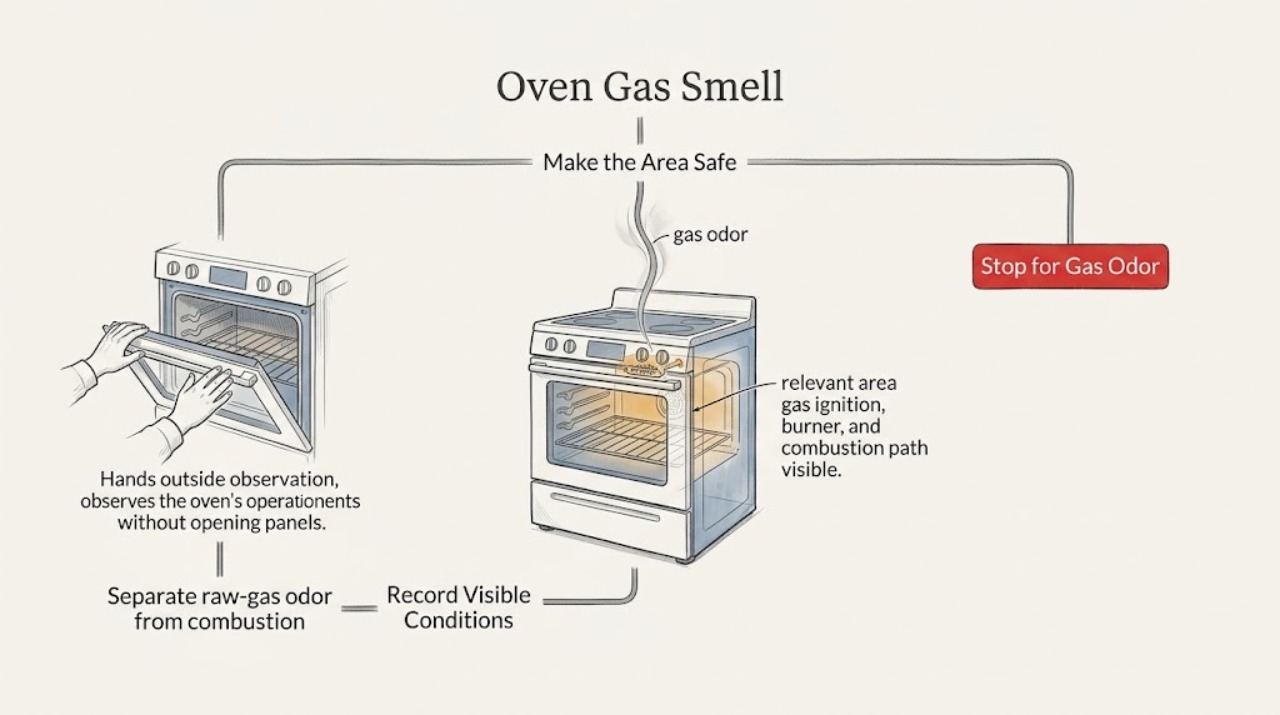
Treat a persistent or unexplained gas smell from a Kenmore gas oven as a safety problem first, not a normal setting to test. If the odor is present now, turn the gas appliance Off only if that can be done without delay or risk, do not operate switches or flames, leave the area, and contact emergency or gas assistance from a safe location. Do not open the oven door to look for a delayed ignition or repeatedly restart it. Once the area has been declared safe, record the exact Kenmore model and whether the odor occurred at startup, during baking or broiling, after the flame went out, or while the oven was off. Use the model's instructions and qualified service to investigate ignition timing, burner operation, ventilation, or controls. Headache, dizziness, nausea, confusion, or a carbon-monoxide alarm also requires leaving and getting emergency help; carbon monoxide itself has no smell.
Work through in order
Diagnostic checks
Use only checks that match the exact appliance or system and its official guide.
-
Stop and leave if gas odor is present now
If you smell raw gas or a rotten-egg odor now, do not light anything, operate electrical switches, use a phone in the area, open the oven door to inspect it, or continue the ignition cycle. If it can be done without delay or risk, turn the gas appliance Off, leave the building, and seek emergency or gas assistance from a safe location.
Expected result: The odor is present, becomes stronger, or is accompanied by hissing, a flare, smoke, or an uncontrolled flame; or the odor is absent and the area has been made safe by the appropriate responder.
Next step: Do not return to test the oven or search for the leak. Resume appliance-specific checks only after the area is declared safe and the appliance is released for inspection.
Why this matters
Why: An active gas odor is an emergency response path, not a troubleshooting observation. Gas can ignite, and opening an oven after delayed combustion can expose someone to a flare-up.
-
Separate raw-gas odor from combustion or material odor
After the area is safe and the oven remains Off, record what the odor resembled without deliberately recreating it: raw gas or rotten eggs, exhaust, smoke, burning food, cleaner, plastic, or a new-appliance odor. Note whether the smell was present with the oven off, only during ignition, during steady heating, after the flame went out, or near the vent.
Expected result: A raw-gas odor persists outside the normal ignition event, an exhaust odor appears while operating, or a non-gas odor is limited to food, cleaner, or new materials.
Next step: Do not restart the oven to compare odors. Give the description and timing to qualified service, together with the model and operating mode.
Why this matters
Why: Odor type and timing change the risk path. A gas odor or delayed ignition needs gas-safety escalation; an exhaust odor can indicate a combustion or venting concern; a material odor still needs service if it includes smoke, scorching, or electrical symptoms.
-
Record the exact Kenmore model and mode
When there is no active hazard, photograph the Kenmore rating label and write down the complete model number, fuel type, and whether the odor occurred in Bake, Broil, a self-clean cycle, preheat, or while the oven was idle. Record whether the display, clock, or any fault indicator changed.
Expected result: The model and mode are known, or the label and operating mode are unavailable.
Next step: Use the model-specific manual or Kenmore support resources. If the model cannot be identified, arrange service using photographs and the odor timeline rather than applying another model's procedure.
Why this matters
Why: Kenmore gas ovens can differ by generation and design; a generic web instruction cannot establish the correct ignition, burner, control, or ventilation behavior for an unidentified unit.
-
Document ignition and flame symptoms without relighting
Only from a safe account of what already happened, note whether ignition was immediate or delayed, whether there was a pop or flare, whether the burner flame was stable or went out, and whether the odor continued after the control was turned Off. Do not relight a questionable burner, open panels, or remove burner and gas-system parts.
Expected result: The odor followed delayed ignition, a flame-out, a flare, an unstable flame, or a cycle in which the burner never visibly lit.
Next step: Keep the oven out of service and provide the exact sequence to qualified gas-appliance service. Do not repeat the cycle to obtain a better look.
Why this matters
Why: Unburned gas can accumulate during an ignition failure or delayed ignition. A flame that goes out or an odor that continues after Off is not a normal user-adjustment issue.
-
Check for carbon-monoxide or combustion-warning signs
From outside the affected area or after it has been made safe, note whether a carbon-monoxide alarm sounded or anyone developed headache, fatigue, shortness of breath, nausea, dizziness, confusion, or unusual weakness while the oven operated. Do not use the oven as a room heater and do not dismiss symptoms because the fuel odor stopped.
Expected result: A carbon-monoxide alarm or compatible symptoms occurred, or no alarm and no symptoms occurred.
Next step: Leave the area and obtain emergency help if an alarm or symptoms occurred. Keep the oven out of service until qualified personnel assess the appliance and combustion path.
Why this matters
Why: Carbon monoxide cannot be detected by smell. An alarm or symptoms can indicate a dangerous combustion or ventilation problem and require emergency treatment and professional investigation, not an oven restart.
-
Escalate persistent odor, smoke, or control failure
Once the area is safe, assemble the model number, odor description, operating mode, timing, flame or ignition history, alarm or symptom details, and any displayed message for Kenmore support or a qualified gas-appliance technician. Keep all safety controls intact; do not remove the oven, reconnect gas components, or repeat a cycle that produced an odor.
Expected result: The odor or combustion symptom is unexplained, returns after any permitted professional check, or is accompanied by smoke, scorching, an abnormal flame, a flare, or a control that does not turn the appliance Off.
Next step: Keep the oven out of service and arrange qualified repair. Use emergency assistance for an active gas odor, fire, smoke, or suspected carbon-monoxide exposure.
Why this matters
Why: The remaining possibilities include ignition timing, burner or gas-control behavior, venting, or electronic control faults that require model-specific diagnosis and safety equipment.
Use your observations
Decision map
Find the observation that best matches what you see, then follow the next safe action.
-
PATH 01Next step
What you see
A raw-gas or rotten-egg odor is present now, or the odor persists while the oven is Off.
Do this next
Stop testing, avoid electrical switches and flames, leave the area, and obtain emergency or gas assistance from a safe location. Do not return to locate the source yourself.
-
PATH 02Next step
What you see
A delayed pop, flare, flame-out, or odor after an attempted ignition occurred.
Do this next
Keep the oven out of service and do not open the door or repeat the ignition cycle. Give the exact event sequence to qualified gas-appliance service.
-
PATH 03Next step
What you see
A carbon-monoxide alarm sounded or occupants developed compatible symptoms while the oven was operating.
Do this next
Leave the area and obtain emergency help. Do not use the oven again until qualified personnel evaluate the appliance and combustion or venting path.
-
PATH 04Next step
What you see
A smell occurs only during a documented normal startup event, stops promptly, and there was no delayed ignition, smoke, alarm, or abnormal flame.
Do this next
Do not assume it is normal for every Kenmore model. Record the model and event, check the exact manual, and stop using the oven if the odor is stronger, lasts longer, or returns outside the documented condition.
-
PATH 05Next step
What you see
The odor is exhaust-like, burning, plastic-like, or chemical rather than raw gas, or smoke or scorching is visible.
Do this next
Turn the oven Off and keep it out of service. Arrange qualified diagnosis of combustion, venting, materials, and controls; treat smoke or fire as an emergency.
-
PATH 06Next step
What you see
The smell or ignition problem returns after the area is safe, or the exact model instructions do not resolve the concern.
Do this next
Stop all home troubleshooting and provide Kenmore support or a qualified technician with the model, mode, odor timeline, flame behavior, displayed message, and any alarm or symptom information.
Helpful context
Understand the symptom
Decide whether this is an emergency
A brief odor during an ignition event cannot be safely classified at home if the smell is strong, persists, appears when the oven is off, or comes with a delayed pop, flare, smoke, or unusual flame. Treat those signs as a stop-use event. Do not use the oven to warm the room, and do not rely on smell to rule out carbon monoxide because carbon monoxide is odorless.
What to record after the area is safe
Kenmore appliances do not share one universal gas-oven procedure. Record the full model number, fuel type, whether the smell was raw gas or a burning or exhaust odor, the operating mode, the point in the cycle, whether the burner lit, and whether the odor stopped after the appliance was turned Off. Give those facts to Kenmore support or a qualified gas-appliance technician rather than guessing at a valve or igniter fault.
Safety boundary
Stop conditions
- Stop immediately for a raw-gas or rotten-egg odor, especially when the oven is Off, or for hissing, delayed ignition, a flare, or an uncontrolled flame.
- Stop and leave the area for smoke, fire, a carbon-monoxide alarm, or headache, dizziness, nausea, confusion, or breathing symptoms associated with oven use.
- Stop for an odor that continues after the control is Off, a flame that goes out unexpectedly, a burning or plastic odor, scorching, or a control that will not turn the appliance Off.
- Do not open the oven after suspected delayed ignition, relight a questionable burner, open panels, alter gas components, bypass a safety control, or repeatedly restart the appliance.
Only after diagnosis
Potential parts
- oven igniter or ignition assembly
Consider only when qualified model-specific diagnosis links delayed or failed ignition to the igniter or ignition assembly.
Confirm the complete Kenmore model and manufacturer fit information before ordering; do not replace it based on odor alone. - oven safety gas valve or burner-control component
Relevant only after qualified diagnosis identifies a gas-control fault and the appliance is safe to service.
Gas-system work requires qualified service and exact model confirmation. - oven burner or burner-support component
Consider only when the model-specific inspection identifies burner damage, contamination, or flame-distribution failure without an active gas emergency.
Confirm the exact model and service documentation; do not infer a part from a generic gas smell. - electronic control or flame-sensing component
Relevant only when a qualified technician connects the recurring ignition or shutoff symptom to the control or sensing path.
Do not bypass safety controls or attempt internal electrical work.
When checks do not resolve it
Need a professional?
Keep the Kenmore oven out of service and arrange qualified gas-appliance repair for any persistent or recurring gas odor, delayed ignition, flame-out, abnormal flame, exhaust odor, smoke, scorching, unexplained control behavior, or symptom that cannot be matched to the exact model instructions. For active gas odor, fire, smoke, a carbon-monoxide alarm, or suspected exposure, leave the area and use emergency assistance from a safe location.
Common questions
FAQ
Is a gas smell from a Kenmore oven ever normal?
Do not classify it by smell alone. A persistent odor, an odor while the oven is Off, delayed ignition, a flare, smoke, or an abnormal flame is a stop-use condition. Record the exact model and have the documented behavior reviewed by qualified service.
What should I do if I smell gas from the oven right now?
Do not use flames or electrical switches, do not open the oven to inspect it, and do not continue the cycle. If safe without delay, turn the gas appliance Off, leave the area, and seek emergency or gas assistance from a safe location.
Why might an oven smell like gas during startup?
Ignition timing, a burner that does not light correctly, a flame-out, or a combustion problem can allow an odor. CPSC describes delayed ignition as hazardous, so do not repeatedly restart the oven to compare the smell.
Can carbon monoxide be detected by the gas smell?
No. Carbon monoxide is odorless. A carbon-monoxide alarm or symptoms such as headache, dizziness, nausea, confusion, or breathing difficulty require leaving the area and obtaining emergency help.
What information should I give a Kenmore oven technician?
Give the complete model number, fuel type, operating mode, exact odor description, when it started and stopped, ignition or flame behavior, any pop or flare, displayed message, and any alarm or symptoms. Do not include a repeated test just to produce more evidence.
Read the exact guide
Official sources
- Contact Us | Kenmore Customer SupportKenmore · Kenmore product support, product manuals, and repair-resource routing for model-specific assistance
- Protect Your Family from Carbon Monoxide PoisoningU.S. Consumer Product Safety Commission · Carbon-monoxide warning signs, odorless nature, alarms, symptoms, and safe use of gas ranges and ovens
- Recognizing and Responding to Pipeline EmergenciesU.S. Department of Transportation, Pipeline and Hazardous Materials Safety Administration · Gas-odor emergency response: avoid electrical switches and flames, turn gas appliances off if safe, leave the area, and seek help from a safe location
- Gas Range Delayed Ignitions: Tests and Examinations of RangesU.S. Consumer Product Safety Commission · Gas-oven delayed ignition and flare-up hazards involving accumulated unburned gas, ignition timing, combustion, and range-hood draft
Community feedback
Share a repair observation
Share a plain-text repair observation. Accepted observations are published automatically; this page may take a moment to update.