
On this page
Start here
Quick answer
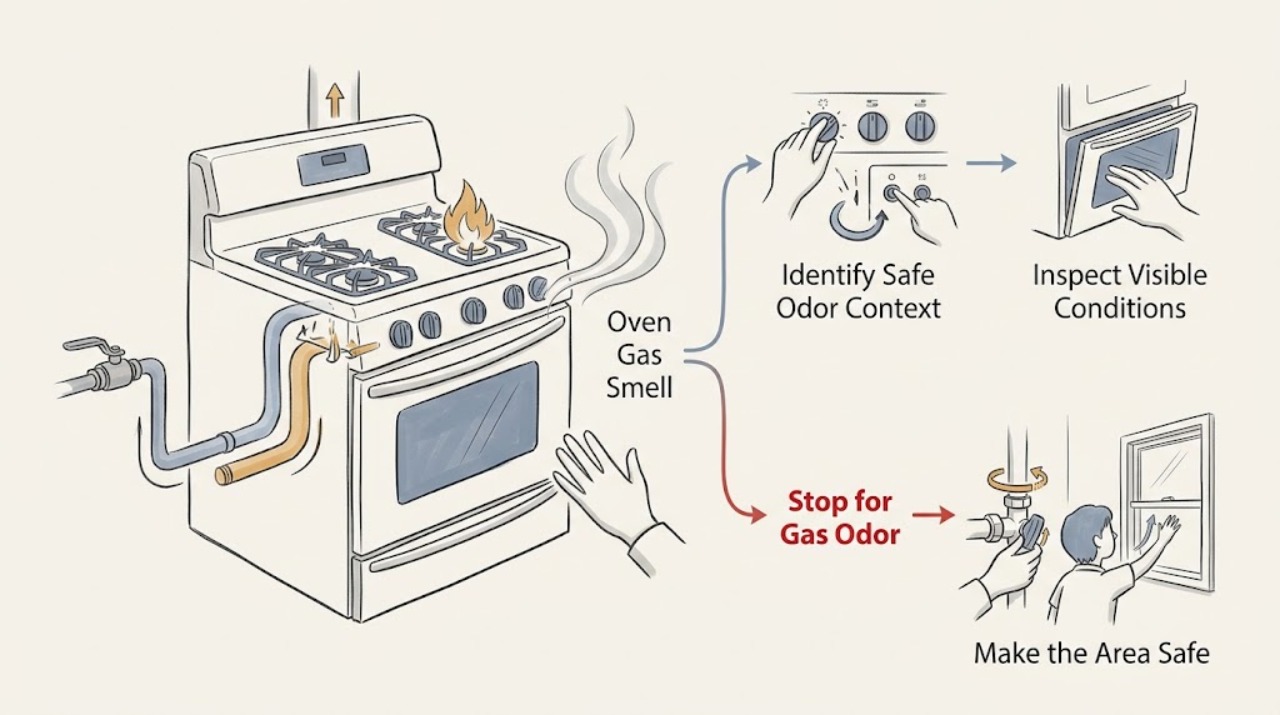
A gas smell from a Belling gas oven is not a normal DIY fault to troubleshoot while the appliance is operating. Do not try to light the oven or another appliance, do not turn electrical switches on or off, and do not create a flame. If it is safe to do so from a position away from the suspected appliance, turn the appliance and gas supply off, open doors and windows without operating powered controls, leave the property if the odor is strong or persists, and contact your local gas emergency service. Belling's manual gives the same core warning, while HSE says a suspected unsafe gas appliance must remain off until checked by a Gas Safe registered engineer in the UK. Only when you have confirmed there is no gas odor should you distinguish a new-oven protective-oil smell, ordinary cooking odor, or cooling-fan air from a gas event. A recurring smell, yellow or unstable flame, soot, condensation, headache, dizziness, nausea, or any suspected carbon-monoxide exposure requires immediate evacuation or qualified gas service, not a burner adjustment.
Before you begin
Safety first
- Do not relight, switch, plug, probe, dismantle, adjust, or repair the gas appliance or its flue. Keep it off until the qualified professional or emergency service confirms the next safe step.
Work through in order
Diagnostic checks
Use only checks that match the exact appliance or system and its official guide.
-
Check 1
If you smell gas, do not light the Belling oven, do not operate electrical switches or powered controls, do not smoke or use a flame, and move away from the appliance; from a safe position, turn off the appliance and gas supply at the meter control valve only if you know how and can do so without risk.
Expected result: Record whether the odor stops after the appliance and supply are isolated, continues or becomes stronger, or is present throughout the room or property.
Next step: Open doors and windows only in a way that does not operate powered switches, leave if the odor is strong or persists, and contact the local gas emergency service or qualified gas professional from a safe location.
Stop if: Do not touch switches, plugs, igniters, appliance controls, or the meter if doing so could create a spark or bring you closer to the odor source.
Why this matters
Why: A persistent or spreading odor is consistent with a possible gas escape and cannot be cleared by cleaning or relighting. Even if the smell decreases, a suspected unsafe gas appliance remains off until checked.
-
Check 2
Only after the room has been assessed as free of gas odor and the oven is cold, record when the smell occurred: first use of a new oven, normal cooking, burner ignition, after the oven was turned off, or while all controls were off.
Expected result: Classify the odor as a one-time new-appliance smell or smoke, food or grease odor, warm air from a cooling fan, fuel-like gas odor, or an unknown/recurrent smell.
Next step: Follow the new-oven or cooling-fan information in the exact manual only when the odor is clearly non-gas; otherwise keep the gas supply off and arrange qualified inspection.
Stop if: Stop the check immediately if gas odor returns, smoke is heavy, a flame is abnormal, or anyone develops headache, dizziness, nausea, breathlessness, or unusual tiredness.
Why this matters
Why: Belling documents protective oils or agents during first use and cooling-fan warm air after operation, but those explanations do not account for a fuel-like, recurrent, or unexplained odor. Unknown or recurrent odor remains a service boundary.
-
Check 3
If and only if there is no gas odor, no smoke, and no other safety warning, observe the flame during ordinary use from a safe distance; do not remove the burner or adjust gas hardware.
Expected result: Record a stable flame as described by the model manual, a yellow or orange flame, soot or yellow-brown staining, a pilot or burner that goes out, unusual condensation, or a flame that lifts, roars, or behaves unpredictably.
Next step: Turn the appliance off, close the gas supply if safe, ventilate without operating electrical switches, and obtain qualified gas service for any abnormal flame or combustion sign.
Stop if: Do not continue observing or cooking if the flame is unstable, the odor returns, soot appears, the appliance overheats, or a carbon-monoxide alarm sounds.
Why this matters
Why: HSE identifies yellow or orange flames, soot or staining, extinguished pilot lights, and increased condensation as signs of incomplete combustion that may produce carbon monoxide. These findings do not identify a user-serviceable part and should not be corrected by changing gas settings.
-
Check 4
For a genuinely new oven with no fuel odor or combustion warning, follow Belling's exact user-manual first-use instructions in a well-ventilated room; for an oven that is merely warm after use, allow the documented cooling-fan period without blocking vents.
Expected result: Note whether the smell and smoke occur only during the initial burn-off, whether they fade as documented, or whether a gas-like or unexplained smell returns during later use or while the controls are off.
Next step: Stop using the oven and arrange qualified inspection if the odor does not fit the documented first-use or cooling pattern; never use first-use instructions to explain away a suspected gas leak.
Stop if: Do not perform a burn-off cycle, use the oven, or test the fan when there is any gas odor, smoke beyond the documented first-use context, abnormal flame, or carbon-monoxide concern.
Why this matters
Why: A one-time protective-oil smell or normal cooling air can be consistent with Belling's published guidance. A later, fuel-like, persistent, or unexplained smell is not established as normal by first-use guidance and requires gas safety escalation.
-
Check 5
Ask whether anyone has headache, dizziness, breathlessness, nausea, unusual tiredness, confusion, or other symptoms, and whether a carbon-monoxide alarm has sounded; do not remain in the property to reproduce the odor or alarm.
Expected result: Record symptoms or alarm status only from a safe location outside or after emergency responders have said it is safe to return.
Next step: Leave the property, seek urgent medical advice or emergency help as appropriate, and report the suspected appliance or combustion issue to the gas emergency service or qualified registered engineer.
Stop if: Do not re-enter to inspect the oven, reset an alarm, relight a burner, or ventilate by operating electrical equipment while exposure is suspected.
Why this matters
Why: HSE says carbon monoxide cannot be smelled and lists these symptoms as possible exposure signs; a gas odor is not required for a combustion hazard. Symptoms or an alarm require urgent medical and gas-safety action.
-
Check 6
Once you are in a safe place, document the Belling model, whether the smell was present with the controls off, when it began, which gas function was running, the flame or soot observations, any alarm or symptoms, and whether the gas supply was isolated.
Expected result: Provide a clear timeline and the exact odor context to the gas emergency service, registered gas engineer, or Belling support without attempting another test.
Next step: Keep the oven and gas supply off until the qualified professional confirms it is safe; follow any local emergency instructions and the exact model manual after clearance.
Stop if: Stop all DIY diagnosis at the appliance boundary; gas controls, jets, regulators, flues, and combustion adjustments require qualified gas work.
Why this matters
Why: Timing and context help a qualified professional decide whether to assess the appliance, supply, ventilation, or flue. They do not make it safe for an owner to open gas controls or alter combustion components.
Use your observations
Decision map
Find the observation that best matches what you see, then follow the next safe action.
-
PATH 01Next step
What you see
The smell is fuel-like, persists with the oven off, returns after ventilation, is strong or spreading, or cannot be confidently identified as food or a first-use odor.
Do this next
Do not light or operate any appliance or electrical switch; leave if needed, isolate the gas supply only if safe, ventilate without creating a spark, and contact the local gas emergency service from a safe location.
-
PATH 02Next step
What you see
The oven is genuinely new, there is no fuel odor or combustion warning, and smell or light smoke occurs only during first use.
Do this next
Follow the exact Belling manual's first-use ventilation and burn-off directions; stop and seek gas service if the odor is fuel-like, recurs later, or does not fit the manual.
-
PATH 03Next step
What you see
There is no gas odor, and warm air or a fan is present only while the oven is operating or cooling after use.
Do this next
Keep vents clear and allow the documented cooling period; arrange service if the fan becomes harsh, the smell becomes fuel-like, or abnormal heat or smoke appears.
-
PATH 04Next step
What you see
There is a yellow or orange flame, soot or staining, a pilot or burner that goes out, unusual condensation, or other unstable combustion sign, even without a fuel odor.
Do this next
Turn the appliance off, isolate gas if safe, ventilate without operating electrical switches, and arrange qualified gas inspection; do not adjust jets, regulators, or burner settings.
-
PATH 05Next step
What you see
A carbon-monoxide alarm sounds or anyone has possible exposure symptoms such as headache, dizziness, breathlessness, nausea, or unusual tiredness.
Do this next
Leave immediately, seek urgent medical or emergency assistance, and report the suspected combustion appliance; do not re-enter until advised it is safe.
-
PATH 06Next step
What you see
A qualified professional has not cleared the appliance, the odor recurs, or the source remains unknown after the safe emergency response.
Do this next
Keep the oven and gas supply off and obtain qualified gas service; do not use a first-use explanation or a visual check as clearance to restart.
Helpful context
Understand the symptom
Gas smell comes before oven troubleshooting
A suspected gas leak is a safety event, not a reason to test the igniter, remove a burner, or repeatedly relight the oven. Belling's manual says not to try to light any appliance and not to touch an electrical switch when gas is smelled. HSE says an appliance suspected to be unsafe must be turned off and left alone until checked by a registered gas engineer. If the smell is strong, spreading, or accompanied by symptoms, move outside and contact the appropriate local emergency service from a safe location. Do not return or restart the oven until cleared.
Do not confuse new-oven odor or cooling air with gas
Belling's troubleshooting guidance says a new oven can emit an unpleasant smell and smoke as protective oils or agents burn off during first use, and that cooling fans can expel warm air while the oven is in use or cooling down. Those are conditional explanations only after there is no gas odor, no unsafe flame, and no combustion warning. A smell that resembles fuel, appears with the burner off, returns after the initial use, or cannot be confidently identified should be treated as gas-related and escalated.
Carbon monoxide has a different warning profile
HSE notes that carbon monoxide is colorless, odorless, and tasteless, so the absence of a gas smell does not prove safe combustion. Yellow or orange flames, soot or yellow-brown staining, pilot lights that go out, increased window condensation, headache, dizziness, breathlessness, nausea, or unusual tiredness are reasons to stop using the gas appliance and seek urgent help. Do not attempt to confirm combustion quality by changing jets, shutters, regulators, or flue parts.
Safety boundary
Stop conditions
- Do not light the oven or any appliance, touch electrical switches, smoke, use a flame, or operate powered controls when gas is smelled.
- Leave and contact local gas emergency services for a strong, persistent, or spreading fuel odor; ventilate and isolate the meter only if safe and without creating a spark.
- Keep the appliance off until a qualified registered gas engineer checks an appliance suspected to be unsafe.
- Stop for yellow or orange flames, soot or staining, unstable or extinguished flames, unusual condensation, a carbon-monoxide alarm, or possible exposure symptoms.
- Do not open gas controls, alter jets or regulators, work on flues, or repeatedly relight the oven to identify the smell.
When checks do not resolve it
Need a professional?
Treat any fuel-like, persistent, recurrent, or unexplained smell as a gas-safety escalation. Leave or ventilate only without creating a spark, keep the oven and gas supply off, and contact the local gas emergency service or a qualified registered gas engineer. Seek urgent medical help for a carbon-monoxide alarm or possible exposure symptoms. Do not resume use based only on a smell disappearing.
Safety scope: Do not relight, switch, plug, probe, dismantle, adjust, or repair the gas appliance or its flue. Keep it off until the qualified professional or emergency service confirms the next safe step.
Common questions
FAQ
Is a gas smell from a Belling oven normal?
Treat a fuel-like, persistent, recurrent, or unexplained smell as unsafe. Belling documents protective-oil odor and light smoke during first use of a new oven, but that explanation does not apply to a suspected gas smell or abnormal flame.
What should I do immediately if I smell gas?
Do not light the oven, touch electrical switches, smoke, or use a flame. Move away, isolate the gas supply only if safe, ventilate without creating a spark, leave if the odor persists or is strong, and contact the local gas emergency service from a safe location.
Can a new Belling oven smell during its first use?
Belling says protective oils or agents can cause an unpleasant smell and smoke during first use. Follow the exact model manual only after ruling out a fuel odor, abnormal flame, and other gas-safety warning; stop if the smell recurs or is uncertain.
Why does my Belling oven smell after it is turned off?
Belling says a cooling fan may continue running and expel warm air after use. Warm air alone is not a gas diagnosis; a fuel-like or recurring smell with the controls off is a stop-use and gas-service condition.
Can I smell carbon monoxide from the oven?
No. HSE says carbon monoxide cannot be seen, tasted, or smelled. Yellow or orange flames, soot, pilot lights going out, condensation, an alarm, headache, dizziness, nausea, or unusual tiredness require immediate gas-safety and medical action.
Can I adjust the burner or gas pressure to fix the smell?
No. Do not change jets, regulators, burner settings, flues, or gas controls. Belling and HSE place gas appliance servicing with authorised or registered qualified personnel; keep the oven off until it is checked.
Read the exact guide
Official sources
- Gas safety - Home ownersHealth and Safety Executive · UK HSE domestic gas-safety guidance; readers elsewhere should use their local gas emergency service and qualified registration system.
- Gas safety - Carbon monoxide awareness frequently asked questionsHealth and Safety Executive · UK HSE carbon-monoxide guidance; emergency and medical pathways should be localized by the reader's jurisdiction.
- Belling CookCentre & Farmhouse Gas 60cm User ManualBelling · Belling gas cooker manual; exact model controls and regional emergency instructions vary, so the installed model manual and local gas authority take precedence.
- Ovens - TroubleshootBelling · Belling Australia troubleshooting page for oven families; it is used for general manufacturer guidance and does not replace the exact model manual or local gas-safety requirements.
Community feedback
Share a repair observation
Share a plain-text repair observation. Accepted observations are published automatically; this page may take a moment to update.