
On this page
Start here
Quick answer
Treat a gas smell from a Beko gas oven as a safety event, not as a cleaning or ignition problem. Stop trying to light the oven, turn all controls off if you can do so without remaining in danger, extinguish open flames, and leave the area. Do not smoke, operate electrical switches, use the oven, or investigate fittings while the odor is present; from a safe location, contact your local emergency gas service and follow its instructions. Do not re-enter or reuse the oven until the responsible service provider says it is safe. If there is no current odor but the oven previously produced soot, smoke, an abnormal flame, delayed ignition, or repeated smell after lighting, keep it out of use and arrange a qualified Beko appliance or gas-service inspection. Never adjust gas pressure, change fuel parts, open the gas line, or attempt an internal repair yourself.
Before you begin
Safety first
- This article is limited to evacuation, safe reporting, and non-invasive documentation. Gas-line access, pressure or fuel adjustment, burner or jet work, leak testing, cabinet removal, and internal electrical repair require qualified service.
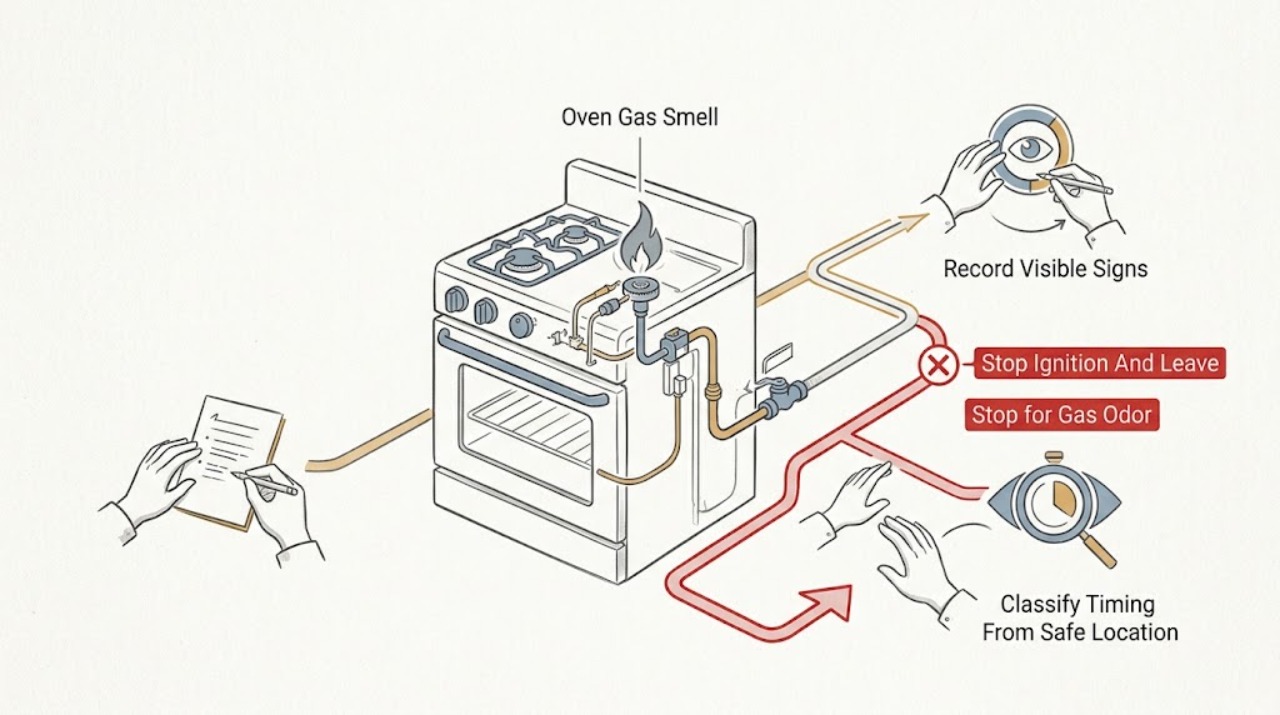
Work through in order
Diagnostic checks
Use only checks that match the exact appliance or system and its official guide.
-
Check 1
If gas odor is present, stop ignition attempts, extinguish any open flame if this can be done immediately and safely, leave the kitchen or property, and contact the local gas emergency service from a safe location; do not operate electrical switches or use the oven.
Expected result: The odor is strong or getting stronger, a hissing sound or visible flame is present, people are still inside, or the odor is no longer detectable after leaving.
Next step: Stay out and follow the emergency service's instructions. Do not re-enter or operate the appliance until the responsible gas professional says it is safe.
Stop if: Do not relight, smoke, use a lighter or match, operate a light or appliance switch, or search for the leak while odor or hissing is present.
Why this matters
Why: Odor, hissing, or flame can indicate unburned gas or an active gas fault, but smell intensity cannot measure risk. The safe decision is evacuation and emergency guidance, not a closer inspection or another lighting attempt.
-
Check 2
Only if you are already at the controls and can leave without exposure, turn the oven and other gas-appliance controls to OFF; do not remain inside to reach a remote valve or gas meter and do not touch a valve in a confined or unsafe location.
Expected result: All visible controls are OFF, one control is not fully OFF, or the control cannot be reached without re-entering the affected area.
Next step: Leave the area and report which controls were or were not visibly OFF; let the gas professional direct any main shutoff or isolation step.
Stop if: Do not open the oven, move the appliance, remove a cover, manipulate gas fittings, or stay inside to confirm that the odor has gone.
Why this matters
Why: Turning a control off can stop a user-selected gas flow, but it does not prove that a valve, connection, burner, or supply is sound. An unreachable or uncertain control is a reason to leave it alone and tell the emergency service.
-
Check 3
After the area is safe and only from memory or a safe position, record whether the smell occurred with all controls OFF, during ignition, after the burner lit, after the oven was turned off, or after a spill; do not recreate the condition to identify its source.
Expected result: The odor was present with controls OFF, appeared only during a lighting attempt, returned after the flame was established, or its timing is unknown.
Next step: Give the timing, duration, controls state, and whether anyone experienced symptoms to the gas emergency service or qualified technician; keep the oven unused.
Stop if: Do not perform another ignition test, sniff the burner, spray a leak-check product, or use a flame to locate gas.
Why this matters
Why: Odor with controls OFF is especially concerning for gas escaping outside normal burner operation. Odor during or after ignition can involve delayed or incomplete combustion, but timing alone cannot distinguish a burner, valve, connection, pressure, or ventilation fault.
-
Check 4
From outside the immediate appliance area, record any prior soot, smoke, abnormal flame color or shape, delayed ignition, repeated clicking, or smell that returned when the oven was lit; do not turn the oven on to observe it again.
Expected result: Soot or smoke was present, the flame was abnormal or unstable, ignition was delayed, or the only symptom was a brief smell during an otherwise normal event.
Next step: Keep the oven out of use, preserve photos taken from a safe position if available, and arrange an authorized Beko or qualified gas-appliance inspection.
Stop if: Do not use the oven with soot, smoke, abnormal flames, repeated odor, or any sign of incomplete combustion.
Why this matters
Why: Soot or smoke when lit can indicate a burner problem, and a delayed or unstable flame can leave unburned gas; neither condition is safe to validate by repeated operation. A brief smell still needs model-specific assessment if it recurs or its source is uncertain.
-
Check 5
Prepare the exact model and installation details, the odor timing, controls state, any visible combustion symptom, recent cleaning or installation work, and whether anyone felt unwell; do not remove parts or attempt a repair before service.
Expected result: The model and event history are available, the installation or fuel type is uncertain, or the event included symptoms, repeated odor, or visible damage.
Next step: Share the record with the emergency gas service or qualified appliance technician and keep the oven isolated until cleared for use.
Stop if: Stop documenting and leave immediately if odor returns, anyone feels dizzy or unwell, smoke or flame appears, or the appliance becomes hot or damaged.
Why this matters
Why: Accurate identity and timing help the gas or appliance professional choose the correct safety procedure. Uncertain fuel or installation details and any occupant symptom increase the need for professional assessment, not a broader user test.
Use your observations
Decision map
Find the observation that best matches what you see, then follow the next safe action.
-
PATH 01Safety boundary
What you see
Gas can be smelled while the Beko oven or cooker controls are known to be OFF.
Do this next
Leave the area and contact the local gas emergency service from a safe location. Do not re-enter or use the appliance until cleared.
Why this path and its safety boundary
Why it matters: Beko directs this situation to the Emergency Gas Service; it is not a cleaning or ignition adjustment problem.
Safety stop: No relighting, smoking, electrical switching, or leak search while odor persists.
-
PATH 02Safety boundary
What you see
The smell occurred during an ignition attempt or returned after the oven burner lit.
Do this next
Turn the appliance off if safe, leave it unused, and arrange qualified gas-appliance service. If odor is present now, use the emergency branch immediately.
Why this path and its safety boundary
Why it matters: Delayed or incomplete combustion, gas flow, burner, valve, connection, or ventilation issues remain possible; timing does not identify the cause.
Safety stop: Do not repeat ignition, hold the control open, adjust pressure, or inspect the burner while gas may be present.
-
PATH 03Safety boundary
What you see
The oven produces soot or smoke when lit, or the flame is visibly abnormal.
Do this next
Turn the oven off, keep it out of use, and arrange authorized Beko or qualified gas-appliance service.
Why this path and its safety boundary
Why it matters: Beko says this can indicate that the burner is not working correctly and requires an authorized engineer check before further use.
Safety stop: Do not continue cooking, clean while hot, alter burner openings, or attempt a gas repair.
-
PATH 04Safety boundary
What you see
The odor has stopped but its source is uncertain, or it returns on later use.
Do this next
Keep the oven unused, record when the odor appeared, and request qualified gas-appliance assessment before another use. Use emergency service if odor returns.
Why this path and its safety boundary
Why it matters: A stopped odor does not prove the appliance is safe; intermittent gas or combustion faults can require a professional inspection.
Safety stop: Do not recreate the smell, use improvised leak tests, or assume a first-use or cleaning odor is harmless without the exact manual and professional guidance.
-
PATH 05Safety boundary
What you see
Anyone feels unwell, or there is active flame outside the burner, smoke, hissing, heat damage, or a suspected leak.
Do this next
Leave immediately, contact the appropriate emergency service from outside or another safe location, and do not return until authorities or the gas professional says it is safe.
Why this path and its safety boundary
Why it matters: This exceeds appliance troubleshooting and may be a gas, fire, or indoor-air emergency.
Safety stop: Do not operate controls or electrical equipment, search for the leak, or attempt to ventilate by entering the affected area.
Helpful context
Understand the symptom
A gas smell changes the next step immediately
Do not try to identify the smell by leaning into the oven or lighting another burner. If odor is present, stop the appliance, avoid flames and unnecessary electrical operation, leave the area, and contact the local gas emergency service from a safe location. Beko's support answer treats gas odor with the appliance off as an emergency-service matter.
Do not confuse combustion symptoms with a normal oven odor
Soot, smoke, an unstable flame, delayed ignition, or a smell that returns whenever the burner is used is not a reason to keep testing. Beko says soot or smoke when the oven is lit can indicate that the burner is not working correctly and requires an authorized engineer check before further use.
Keep gas and electrical repairs outside the user boundary
The visible record can help a technician, but it cannot establish that a valve, burner, pressure setting, connection, or combustion path is safe. Do not remove panels, adjust gas settings, change jets or fuel type, test with a flame, or use improvised leak checks. The exact model manual and qualified service provider control any repair.
Safety boundary
Stop conditions
- If gas is smelled, stop ignition, leave the area, avoid flames and unnecessary electrical operation, and contact the local gas emergency service from a safe location.
- Do not re-enter or use the oven until the responsible gas or appliance professional says it is safe.
- Do not open gas fittings, adjust pressure, change fuel type or burner parts, remove panels, or test with a flame or improvised leak method.
- Do not use the oven when soot, smoke, abnormal flames, delayed ignition, repeated odor, or suspected incomplete combustion is present.
- Treat dizziness, breathing difficulty, active flame, hissing, smoke, or fire as an emergency rather than a troubleshooting condition.
When checks do not resolve it
Need a professional?
Use local gas emergency service immediately for a current gas odor, hissing, active flame outside the burner, or suspected leak, especially when controls are OFF. Arrange qualified Beko appliance or gas service before reuse for recurring odor, delayed ignition, soot, smoke, abnormal flames, or an uncertain source. Do not perform gas-line, pressure, fuel-conversion, burner, or internal electrical work yourself.
Safety scope: This article is limited to evacuation, safe reporting, and non-invasive documentation. Gas-line access, pressure or fuel adjustment, burner or jet work, leak testing, cabinet removal, and internal electrical repair require qualified service.
Common questions
FAQ
What should I do first if my Beko oven smells of gas?
Stop trying to light it, turn controls off only if you can do so without danger, leave the area, avoid flames and unnecessary electrical operation, and contact the local gas emergency service from a safe location. Do not re-enter or reuse it until cleared.
What if I smell gas when the Beko oven controls are off?
Beko directs users to contact the Emergency Gas Service when gas is smelled while the appliance is known to be off. Do not investigate fittings or relight the oven to find the cause.
Can soot or smoke explain a gas smell from the oven?
Soot or smoke when the oven is lit can indicate that the burner is not working correctly. Turn it off, keep it out of use, and arrange an authorized engineer inspection before using it again.
Can I adjust the burner or gas pressure myself?
No. Do not adjust pressure, change fuel parts, open gas fittings, remove panels, or repeat ignition tests. These tasks require a qualified gas-appliance professional and the exact model instructions.
When is a Beko oven gas smell an emergency?
Treat a current odor, odor with controls off, hissing, active flame outside the burner, smoke, or anyone feeling unwell as an emergency. Leave immediately and contact the appropriate emergency service from a safe location; do not return until cleared.
Read the exact guide
Official sources
- I can smell gas but none of the control knobs are turned on.Beko UK · Official Beko UK gas-appliance safety FAQ; the same emergency boundary applies to a gas oven when gas odor is present, while local emergency guidance controls the response.
- Why is my oven smokingBeko UK · Official Beko oven support page; its warning about soot or smoke when lit supports keeping a gas oven out of use pending an authorized inspection.
Community feedback
Share a repair observation
Share a plain-text repair observation. Accepted observations are published automatically; this page may take a moment to update.