
On this page
Start here
Quick answer
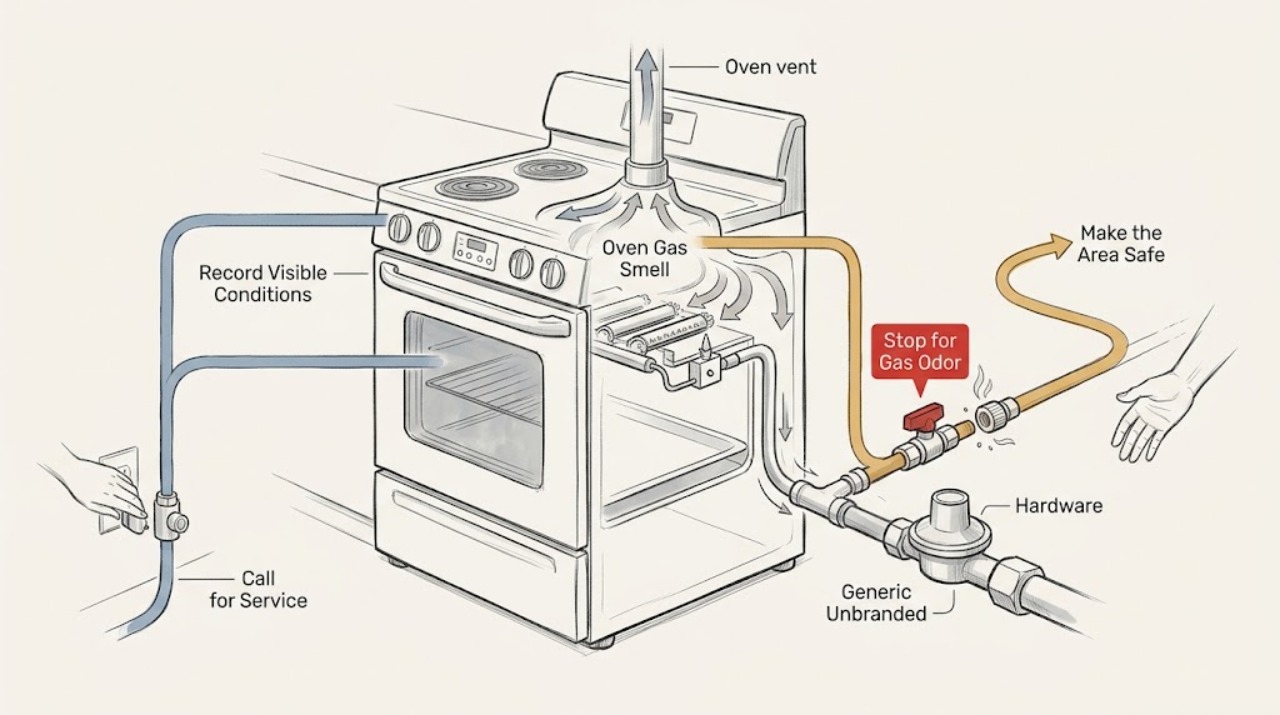
If you smell gas when no burner or oven burner is intentionally operating, or the odor is strong or persistent, do not light the appliance, operate electrical switches, or use a phone inside; leave the building and contact the gas supplier from outside, and contact the fire department if the supplier cannot be reached. A brief odor on a first use can come from new parts or coatings, but it should dissipate with ventilation. Any recurring odor, abnormal flame, delayed ignition, or odor that continues after the appliance is off needs the appliance left unused and assessed by a qualified gas-appliance professional.
Work through in order
Diagnostic checks
Use only checks that match the exact appliance or system and its official guide.
-
Check 1
If the odor is present now, stop using the oven and determine only from where you already are whether any burner is intentionally operating. If no burner is operating, or the smell is strong, spreading, persistent, or accompanied by hissing, dizziness, headache, or nausea, leave everyone and pets without switching anything on or off.
Expected result: There is an unaccounted-for gas odor, or there are no clear signs that the odor is limited to a brief ignition event.
Next step: From outside or a neighbor's location, contact the gas supplier; contact the fire department if the supplier cannot be reached. Do not re-enter to test, relight, or inspect the appliance.
Why this matters
Why: Amana treats gas smell when no burner is on as a possible gas leak, not as a normal oven-performance symptom.
-
Check 2
After the immediate-risk screen is clear and professionals have not directed an evacuation, record when the smell occurs: only during a first use of a new oven, briefly as a burner ignites, during every bake, after shutdown, or while the oven is off.
Expected result: The odor is brief and limited to first use, brief during intended ignition, recurring during operation, present after shutdown, or present while off.
Next step: Use the matching branch below. Persistent, strong, or off-cycle odor overrides the normal-odor explanation and requires the emergency or professional-service boundary.
Why this matters
Why: Timing separates a possible new-coating or ignition odor from a combustion, supply, or leak concern; timing alone cannot prove that a gas odor is safe.
-
Check 3
If there is no active odor and the appliance is cool, verify from the normal user position that all oven and cooktop control knobs are fully off. Do not move the range, pull the connector, or open any panel to inspect the gas path.
Expected result: A control was left partly on, all controls are off but odor remains, or the odor returns after controls are off.
Next step: If odor remains or returns with controls off, leave the building and contact the gas supplier as an emergency. If there is no odor, continue only with model-specific, non-invasive observations.
Why this matters
Why: An accidentally operating burner can explain some odor, but an odor that remains with controls off is not resolved by the knob position and may indicate a supply or appliance fault.
-
Check 4
For a genuinely new installation with no current gas odor or safety symptom, check that packaging, tape, and shipping materials were removed as directed and ventilate the room normally. Do not line the oven bottom with foil or use an unapproved liner.
Expected result: The smell was limited to the first cycle and fades, or it persists beyond initial use or becomes stronger.
Next step: If it does not dissipate, stop using the oven and arrange qualified service or installer review. If it smells like raw gas or appears while off, follow the emergency branch immediately rather than repeating a burn-in cycle.
Why this matters
Why: Amana says a small first-use smoke or odor can come from new parts, coatings, or materials and should dissipate; persistence is not a normal completion signal.
-
Check 5
Only during an otherwise normal, supervised operation with no gas-leak warning, observe the flame or ignition result without reaching into the burner area. Note yellow or sooting flames, delayed ignition, a loud ignition, repeated failure to ignite, or an odor that continues after the flame should be established.
Expected result: The flame is abnormal, soot appears, ignition is delayed or forceful, the burner repeatedly fails, or odor continues during or after operation.
Next step: Stop using the affected burner/oven. If gas odor is present while off or is strong/persistent, leave and contact the gas supplier; otherwise arrange a qualified gas-appliance service visit and do not adjust jets, regulators, or pressure.
Why this matters
Why: Amana associates flame color, soot, fuel type, regulator, and line-pressure conditions with combustion suitability; the symptom needs qualified assessment rather than user adjustment.
-
Check 6
If the odor began after installation, reconnection, a move, conversion between natural gas and LP, or nearby gas work, stop relighting the appliance and record that context for the installer or gas supplier. Do not retighten fittings or alter the regulator yourself.
Expected result: The odor started after installation or fuel-system work, or the appliance's fuel type is uncertain.
Next step: Use the gas supplier for a suspected leak and the qualified installer or appliance technician for installation/compatibility review. Keep the appliance unused until they clear it.
Why this matters
Why: A connection, fuel-type, regulator, or supply-pressure issue can affect both odor and combustion, and the exact installation instructions and qualified assessment control the repair.
-
Check 7
Stop user troubleshooting for any recurring gas smell, odor with all controls off, delayed or forceful ignition, abnormal flame or soot, a damaged connector, suspected leak, symptoms, or an oven that cannot ignite normally.
Expected result: Any gas-supply, combustion, ignition, installation, or persistent-odor warning remains.
Next step: Keep the appliance out of service. Use the gas supplier/fire department emergency path for an active or unaccounted-for gas odor; otherwise schedule a qualified gas-appliance technician and provide the model number, fuel type, timing, and observed symptoms.
Why this matters
Why: The cause may be in the supply, connector, valve, regulator, igniter, burner, vent, or combustion setup and cannot be safely identified by repeated user tests.
Use your observations
Decision map
Find the observation that best matches what you see, then follow the next safe action.
-
PATH 01Next step
What you see
Gas odor is present while no burner or oven burner is intentionally operating, or the odor is strong, spreading, or persistent
Do this next
Do not light the appliance, touch switches, or use a phone inside. Leave immediately, contact the gas supplier from outside or a neighbor's location, and contact the fire department if the supplier cannot be reached.
-
PATH 02Next step
What you see
A small odor occurs only during the first use of a newly installed oven and is fading, with no raw-gas smell or other warning
Do this next
Ventilate normally and follow the model's first-use instructions after confirming packaging was removed. Stop and seek service if the odor persists, intensifies, or changes to an unaccounted-for gas smell.
-
PATH 03Next step
What you see
A slight odor is noticed only during intended cooking and disappears promptly after ignition
Do this next
Do not assume this covers a strong, recurring, off-cycle, or post-shutdown odor. Stop operation and use the gas-supplier emergency path if the odor is unaccounted for or persistent; otherwise have recurrent symptoms assessed.
-
PATH 04Next step
What you see
There is no current gas odor, but accessible foil, packaging, spills, or blocked airflow could explain a cooking smell
Do this next
When cool, remove only accessible packaging or residue according to the model instructions; do not use foil or liners to cover the oven bottom or vents. A fuel-like or persistent smell still needs professional assessment.
-
PATH 05Next step
What you see
Yellow/sooting flames, delayed ignition, forceful ignition, or repeated failure to ignite is observed
Do this next
Stop using the affected burner or oven and do not adjust the regulator, jets, line pressure, or fuel conversion. Arrange qualified service; an active or unaccounted-for gas odor is an emergency.
-
PATH 06Next step
What you see
The smell began after installation, reconnection, relocation, or natural-gas/LP work
Do this next
Keep the appliance unused and contact the gas supplier for a suspected leak or the qualified installer/technician for installation and fuel-type review. Do not relight repeatedly or loosen fittings.
Helpful context
Understand the symptom
Treat an unaccounted-for gas odor as an emergency
The first question is not whether the oven will still heat; it is whether gas may be escaping. Amana says not to light the appliance, touch electrical switches, or use a phone in the building when gas is smelled with no burner operating. Leave immediately, then contact the gas supplier from a neighbor's phone or another location; contact the fire department if the supplier cannot be reached. Do not return to test the oven or search for the leak.
A new-oven smell is a different branch
A small smoke or odor during the first use of a newly installed range or oven can come from new parts, protective coatings, or installation materials and should diminish. That explanation does not make a strong raw-gas odor safe: if the smell is persistent, appears while the oven is off, or is accompanied by hissing or symptoms, use the emergency branch instead.
Do not turn odor into a DIY gas test
Do not use a match, lighter, flame, electrical tester, or a soapy-water experiment around the appliance, and do not remove the rear cover or loosen a connector. Gas can be difficult to detect reliably by smell, so an approved gas detector can add warning but cannot replace the gas supplier or a qualified technician's inspection.
Airflow and foil can create cooking odors without fixing a gas fault
Only when there is no current gas odor and the appliance is cool, inspect from the user-accessible area for leftover packaging or blocked vent openings. Amana warns that foil or liners can trap spills and debris and can interfere with airflow or combustion on a gas range. Remove only accessible packaging or residue according to the model instructions; never cover the oven bottom or vent and do not treat cleaning as a repair for a persistent fuel smell.
Only after diagnosis
Potential parts
- oven safety valve or gas valve
Consider only after a qualified technician confirms that the valve leaks, fails to close, or causes an ignition/combustion fault; a gas odor alone is not proof of a bad valve.
Gas valves are exact-model and fuel-configuration specific and require qualified installation and leak testing. - oven igniter or burner assembly
Consider only when qualified diagnosis links delayed ignition, repeated failure, abnormal flame, or an ignition odor to the igniter or burner rather than the supply.
Confirm the exact Amana model, fuel type, burner design, and approved replacement before any professional repair. - gas regulator
Consider only after the installer or gas-appliance technician verifies fuel type, regulator operation, and supply-pressure conditions.
Natural-gas/LP configuration and regulator specification must match the model and local installation requirements; do not adjust it yourself. - approved gas connector
Consider only if a qualified inspection identifies connector damage, age, routing, or a connection fault; do not move the appliance to inspect it.
Connector selection and installation are governed by the model instructions and local code and require qualified service.
When checks do not resolve it
Need a professional?
Use the gas supplier or fire department emergency route for an active, strong, persistent, or unaccounted-for gas odor, especially when no burner is on or anyone has symptoms. For a fading first-use odor without a gas-leak sign, seek qualified appliance service if it persists. Arrange qualified gas-appliance service for abnormal flames, soot, delayed ignition, repeated ignition failure, post-installation odor, a damaged connector, or any recurring odor.
Common questions
FAQ
Is a gas smell from an Amana oven ever normal?
A small odor during the first use of a newly installed oven can come from new parts or coatings and should fade. An odor that is strong, persistent, present when the oven is off, or not clearly tied to first use should be treated as a safety concern, not a normal break-in smell.
What should I do if I smell gas but the Amana oven is off?
Do not light anything, operate switches, or use a phone inside. Leave immediately and contact the gas supplier from outside or a neighbor's location; contact the fire department if the supplier cannot be reached. Do not return to test the oven.
Can foil or a dirty oven cause an Amana gas smell?
Foil, liners, spills, or blocked airflow can create cooking odors and can interfere with airflow on a gas range, but they do not make a raw-gas odor safe. Only when no gas odor is present and the appliance is cool should accessible residue or packaging be addressed according to the model instructions.
What does a yellow flame or soot mean on a gas oven or range?
Yellow or sooting flames can point to a fuel-type, regulator, supply-pressure, burner, or combustion issue. Stop using the affected appliance and arrange qualified assessment; do not adjust the gas system yourself. If gas odor is active or unaccounted for, leave and use the emergency gas-supplier route.
Read the exact guide
Official sources
- Owner's ManualAmana · Official Amana owner's manual; verify the exact model manual before applying model-specific controls or installation details.
- Odors and Smells of Newly Installed Range or OvenAmana Product Help · Official Amana product-help guidance for newly installed ranges/ovens; exact model first-use instructions control.
- Range Troubleshooting: Cleaning, Maintenance and OdorsAmana · Official Amana range support article; the exact model's instructions and local gas-safety requirements take precedence.
- Odors or SmellsAmana Product Help · Official Amana gas-cooktop guidance; apply flame and fuel-type observations only to the applicable model and installation.
Community feedback
Share a repair observation
Share a plain-text repair observation. Accepted observations are published automatically; this page may take a moment to update.