
On this page
Start here
Quick answer
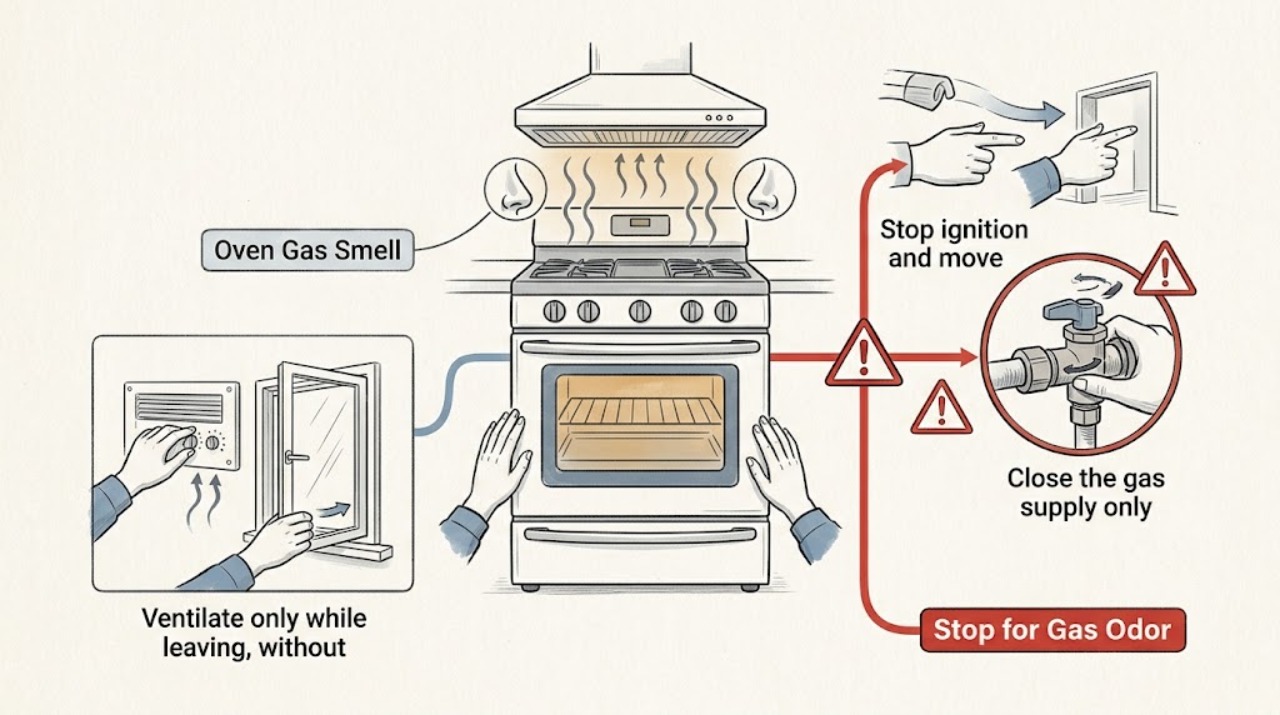
Treat a rotten-egg or sulfur-like smell from a Bosch gas oven as possible unburned gas, not as a routine cooking odor. Do not try to light the oven or burner, do not operate electrical switches, and do not use a phone inside. If it is safe to do so without moving through a strong odor, stop the appliance and close the accessible gas shutoff; otherwise leave immediately. From outside or a neighbor's location, contact the gas supplier or emergency service and follow its instructions. Do not return to test the oven, inspect fittings, or remove panels until a qualified professional has declared it safe.
Work through in order
Diagnostic checks
Use only checks that match the exact appliance or system and its official guide.
-
Stop ignition and move to a safe location
If you smell rotten eggs, sulfur, or unburned gas, do not light the Bosch oven or any burner, do not smoke, and do not touch light switches, appliance controls, plugs, or other electrical switches. If the odor is not strong and the control is immediately reachable without moving through the odor, turn the oven off; otherwise leave the area immediately and take people and pets with you.
Expected result: The odor may lessen after leaving, or it may remain strong around the kitchen or appliance; either result is compatible with a condition that needs professional or gas-supplier assessment.
Next step: Stay outside or at a neighbor's location and continue with the gas-safety contact branch. Do not go back inside merely to check whether the smell has gone away.
Why this matters
Why: You cannot safely identify the source by ignition or electrical testing. A gas odor is not a normal reason to restart the oven, even if the smell later becomes less noticeable.
-
Close the gas supply only if it is immediately safe
From a safe position, and only if you already know the location and can reach the gas shutoff without entering a strong-smelling area, close the appliance or household gas supply as instructed for the installation. Do not search for a hidden valve, move the oven, or handle a fitting while gas may be present.
Expected result: The valve may be closed without approaching the appliance, or it may be inaccessible or unknown; do not spend time looking for it while an odor is present.
Next step: Leave the area and contact the gas supplier or emergency service from outside. If the valve cannot be reached safely, leave it alone and report that fact.
Why this matters
Why: Closing a known, accessible supply can stop further gas flow, but it does not establish that the oven or installation is leak-free and does not replace professional testing.
-
Ventilate only while leaving, without operating equipment
If a window or door is directly on your exit path and can be opened without entering or crossing the strongest odor, leave it open as you exit. Do not turn on an extractor fan, lights, the oven, or any other electrical device, and do not use a phone inside the building.
Expected result: You may notice the odor becoming weaker outdoors or remaining noticeable; do not use that change as a clearance test and do not re-enter to check it.
Next step: From outside or a neighbor's location, call the gas supplier or emergency service and follow its instructions. If anyone feels unwell or there is fire, call the appropriate emergency service from a safe location.
Why this matters
Why: Ventilation and extinguishing open flames reduce immediate hazards, but only the gas supplier or a qualified professional can determine whether the appliance and gas installation are safe.
-
Give the professional the timing details without reproducing the smell
Once you are in a safe location, write down whether the odor was first noticed while preheating, after a flame went out, while the oven was off, or after recent installation. Use the owner's manual or the appliance rating information only if it can be accessed without returning to the hazard.
Expected result: A brief odor associated with first use or preheating is different context from a rotten-egg odor while the oven is off or a smell that returns after a flame goes out, but none of these patterns should be recreated by the user.
Next step: Keep the oven out of use until the responsible professional gives clearance. Do not remove panels, loosen gas connections, relight a burner, or run a self-clean or preheat cycle.
Why this matters
Why: Timing helps the gas supplier or qualified Bosch service professional choose an inspection path; it is not a basis for declaring the oven safe or identifying a failed part remotely.
Use your observations
Decision map
Find the observation that best matches what you see, then follow the next safe action.
-
PATH 01Safety boundary
What you see
The odor is a rotten-egg, sulfur-like, or otherwise suspected unburned-gas smell.
Do this next
Do not ignite anything or operate electrical switches. Leave, close a known accessible gas shutoff only if safe, and contact the gas supplier or emergency service from outside or a neighbor's location.
Why this path and its safety boundary
Safety stop: True
-
PATH 02Safety boundary
What you see
A burner went out and gas may have escaped.
Do this next
Do not relight it. Leave the area, allow the gas supplier or qualified professional to direct the response, and do not use the oven until the installation has been checked.
Why this path and its safety boundary
Safety stop: True
-
PATH 03Next step
What you see
The odor is only a mild, brief smell during first use or preheating and is not like unburned gas.
Do this next
Do not assume this is gas-safe from smell alone. After the appliance is cool and there is no active gas odor, consult the exact Bosch owner's manual for first-use guidance; if the odor is persistent, sulfur-like, electrical, smoky, or returns unexpectedly, stop using the oven and contact qualified service.
-
PATH 04Safety boundary
What you see
The gas odor is strong, unexplained, recurring, accompanied by hissing, fire, or physical symptoms, or the source is inside the cabinet or connection.
Do this next
Do not investigate or test. Evacuate, call the relevant emergency service or gas supplier from a safe location, and wait for instructions. Qualified installation, gas-supplier, or authorized appliance service is required before reuse.
Why this path and its safety boundary
Safety stop: True
Helpful context
Understand the symptom
First separate a gas warning from an ordinary oven odor
A new oven can have a temporary manufacturing or insulation odor, and Bosch notes that a gas burner may produce an unusual odor briefly while preheating. That does not make a continuing rotten-egg or sulfur-like smell safe. Because smell alone cannot prove whether gas is present, treat an active or unexplained gas odor as a safety event and do not run a test cycle.
Keep the response outside the repair boundary
A homeowner can stop using the oven, move people and pets away, and provide the gas supplier or technician with the Bosch model information from a safe location. Finding a gas leak may require controls to be operated while testing, which Bosch identifies as qualified-technician work. Do not loosen fittings, use a flame, use a switch to improve ventilation, or remove the oven from its cabinet.
What to tell the professional
Record whether the odor was noticed with the oven off, during preheating, or after a flame went out, but do not reproduce the condition. Tell the gas supplier or qualified appliance professional whether the smell persists outdoors, whether any burner went out, and whether the oven is new or recently installed. This information helps them choose the safe inspection path without asking you to diagnose a gas line.
When checks do not resolve it
Need a professional?
Professional help is required for any suspected gas leak, unexplained or recurring odor, an odor from the cabinet or connection, or an oven that has been newly installed and smells of gas.
Common questions
FAQ
Is a gas smell from a Bosch oven normal during preheating?
Bosch notes that a brief unusual odor can occur while a gas burner preheats, but an unburned-gas or rotten-egg odor is not normal. Do not try to distinguish the cause by relighting or testing; leave and contact the gas supplier if gas is suspected.
What should I do first if my Bosch oven smells like rotten eggs?
Do not light the oven, touch electrical switches, or use a phone inside. Leave the building, close a known accessible gas shutoff only if you can do it without approaching the odor, and call the gas supplier or emergency service from outside or a neighbor's location.
Can I check the gas connection on my Bosch oven myself?
Do not loosen fittings or perform a gas-leak test yourself. Bosch states that gas-leak detection and installation/service belong to a qualified installer, authorized service agency, or gas supplier.
Can I use the Bosch oven again after the gas smell disappears?
Not until the gas supplier or a qualified professional has assessed the situation and says it is safe. A weaker odor is not proof that the appliance or installation is leak-free.
Read the exact guide
Official sources
- Use and Care Manual HBNxxx1UC, HBLxxx1UC, HBLxxx2UCBosch Home Appliances · Bosch oven first-use odor context and professional service boundary
- Common Oven Smells & How To Get Rid Of ThemBosch Home Appliances · Bosch guidance distinguishing ordinary oven odors from unburned-gas or rotten-egg odor
- Problems with the gas installation / smell of gasBosch Home Appliances · Bosch instructions for gas-installation defects or smell of gas
- 9000466733_5V0GRT_RevA.bookBosch Home Appliances · Bosch gas-safety warnings, qualified service boundary, and what to do when gas is smelled
Community feedback
Share a repair observation
Share a plain-text repair observation. Accepted observations are published automatically; this page may take a moment to update.