
On this page
Start here
Quick answer
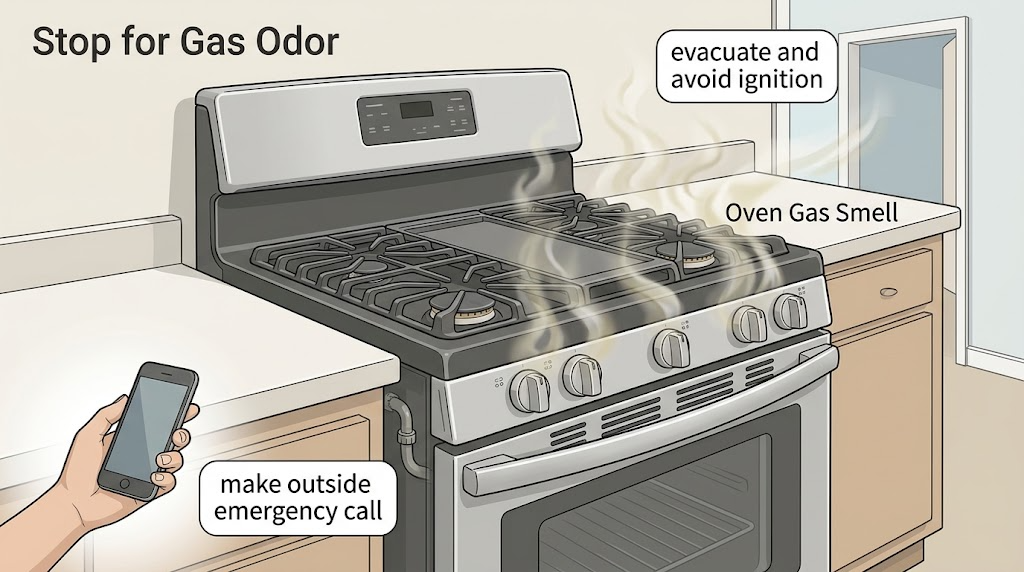
If an Admiral oven or the surrounding room smells like gas, treat it as a possible leak: do not light the oven or cooktop, operate switches, use a phone indoors, or create any flame. Get everyone and pets outside immediately, then call the local gas emergency service or 911 from a safe location. Do not re-enter, move the oven, test a connector, relight the burners, or work on gas components until emergency responders or a qualified gas-appliance professional says it is safe.
Before you begin
Safety first
- This article stops at evacuation, outside emergency contact, safe observation after clearance, and professional handoff. Do not use switches or flames, call from indoors, move the oven, inspect or test the connector, relight burners, open panels, adjust controls, or repair any gas component.
Work through in order
Diagnostic checks
Use only checks that match the exact appliance or system and its official guide.
-
Check 1
If a fuel-like odor is present near the Admiral oven or anywhere in the home, leave immediately with people and pets using the safest available exit; do not turn lights or appliances on or off, use a phone indoors, light a match, start the oven, or relight a burner.
Expected result: The odor is strong, persistent, spreading, or accompanied by hissing, an ignition failure, soot, an abnormal flame, dizziness, headache, nausea, or breathing trouble; or the source cannot be identified from outside.
Next step: Stay outside, keep others away, and call 911 or the local gas emergency service from a safe location. Follow the responder's instructions and do not re-enter until the site is declared safe.
Stop if: Stop all homeowner troubleshooting. Do not touch controls, switches, thermostats, fans, circuit breakers, connectors, valves, panels, or the oven itself while the odor or hazard is present.
Why this matters
Why: Any of those observations keeps an active gas leak or combustion hazard possible. The location of the Admiral oven does not make it safe to investigate indoors, and symptoms require fresh air and urgent medical or emergency help.
-
Check 2
From outside and away from the suspected leak, report the address, that an Admiral oven or nearby area smells like gas, when the odor began, whether anyone has symptoms, and whether the oven was recently used or installed.
Expected result: The gas utility, fire service, or emergency dispatcher gives evacuation, isolation, medical, or re-entry instructions; or asks for more information about the appliance and timing.
Next step: Remain outside and follow the responder's instructions. Tell the qualified appliance professional that the oven was removed from use after a gas odor and provide the observed timeline only after emergency clearance.
Stop if: Do not go back inside to retrieve a phone, model label, tools, or belongings, and do not call from inside the home or garage.
Why this matters
Why: Emergency responders—not a visual homeowner check—must decide whether the building is safe and whether the source is the oven, connector, another appliance, or the supply system. A request for model or timing information does not authorize re-entry or testing.
-
Check 3
Only after emergency responders or the gas professional says re-entry is safe, record the odor timeline and any already-observed pattern without operating the Admiral oven: oven mode, whether an ignition attempt had failed, whether the odor returned after the oven was off, and any soot, flame-color change, or visible damage noted from a safe position.
Expected result: The odor returns, was present while the oven was off, followed an ignition failure, or was paired with soot, an abnormal flame, visible damage, or a carbon-monoxide alarm; alternatively, there is no current odor and the only event was a brief smell during the first use of a newly installed oven.
Next step: Give the record and photos to the gas utility, fire service, or qualified appliance professional. Keep the oven out of service until that professional clears it; never use a first-use explanation to override a fuel-like or persistent odor.
Stop if: Do not relight burners, repeat ignition attempts, remove panels, move the oven, inspect the connector by touch, or use a flame, leak spray, or other test as a homeowner experiment.
Why this matters
Why: A returning or unexplained fuel odor, an odor while the appliance is off, combustion warning signs, or an alarm requires continued non-use and qualified gas-appliance assessment. A brief first-use odor may fit Whirlpool's new-oven guidance only when emergency concerns have been ruled out and the professional or manual confirms the situation; it does not justify repeated ignition tests.
-
Check 4
Prepare the Admiral model and serial information from an existing manual, service record, or a label that can be read without moving or opening the oven, together with the odor timeline and the emergency response record.
Expected result: The model, fuel type if already documented, installation or relocation history, and symptom timeline are available without entering an unsafe area or disturbing the appliance; or the information cannot be obtained safely.
Next step: Give the safe-to-obtain information to a qualified gas-appliance technician and ask for a complete leak and combustion-safety assessment before using the oven again.
Stop if: Do not disconnect, tighten, replace, adjust, bypass, or test any gas connector, shutoff, regulator, valve, burner, igniter, or other gas component yourself.
Why this matters
Why: Model and fuel information lets a qualified professional select the correct service instructions and assess the connector, regulator, ignition, burner, and gas-control system. Missing information is safer than moving the oven or opening a panel to obtain it.
-
Check 5
After the emergency response, ask whether the qualified professional has explicitly cleared the Admiral oven for use after inspecting the gas path and combustion behavior.
Expected result: The oven has not been inspected or has not been explicitly cleared, or the odor recurs after clearance.
Next step: Keep the oven off, keep people away from the appliance area, and contact the gas emergency service or qualified gas-appliance professional again if the odor is present or returns.
Stop if: No gas-component DIY, leak testing, burner adjustment, connector replacement, repeated relighting, or appliance movement is included.
Why this matters
Why: A lack of current odor does not prove that a leak or unsafe combustion condition is fixed. Recurrence means the oven must return to the stop-and-service state, and the cause may be outside the oven itself.
Use your observations
Decision map
Find the observation that best matches what you see, then follow the next safe action.
-
PATH 01Next step
What you see
A fuel-like odor is active, persistent, strong, spreading, accompanied by hissing or symptoms, or its source is unclear.
Do this next
Evacuate immediately, avoid flames and electrical controls, call 911 or local gas emergency service from outside, and do not re-enter until responders say it is safe.
-
PATH 02Next step
What you see
The odor followed an ignition failure or returned after the oven was turned off.
Do this next
Treat it as a possible gas leak: keep the oven out of service, do not try to relight it, and obtain emergency or qualified gas-appliance assessment after leaving the area.
-
PATH 03Next step
What you see
Soot, an abnormal flame, visible damage, a carbon-monoxide alarm, or symptoms were observed.
Do this next
Leave, get fresh air, call emergency services, and do not use the appliance until responders and a qualified professional address the hazard.
-
PATH 04Next step
What you see
After emergency concerns have been ruled out, there was only a brief odor or smoke during the first uses of a newly installed oven, with no fuel-like smell, recurrence, alarm, or combustion warning.
Do this next
Follow the exact model manual or qualified professional's guidance for first-use odor; stop and use the gas-leak response if the smell is fuel-like, unexplained, persistent, or returns.
-
PATH 05Next step
What you see
The oven has not been inspected and cleared, or the gas odor returns after a prior visit.
Do this next
Keep it out of service and call the gas emergency service again for an active odor or a qualified gas-appliance professional for follow-up; do not assume a prior reset or adjustment solved the cause.
Helpful context
Understand the symptom
Treat a gas smell as an emergency first
The odor may come from the oven, its connector, another gas appliance, or the building supply, and a room-level smell cannot identify the source safely. CPSC advises leaving immediately, avoiding lights, phones, matches, and other electrical equipment, and calling for help from outside. This page does not include a gas-component diagnosis or repair procedure.
A normal new-oven odor is a different situation
Whirlpool's product guidance says a small amount of smoke or odor can occur during the first uses of a newly installed oven. That guidance is not a reason to dismiss an odor that smells like fuel, persists, is unexplained, or is accompanied by ignition trouble, soot, an abnormal flame, or symptoms. If there is any doubt, use the gas-leak response and obtain professional clearance.
Do not move or open the Admiral oven
CPSC specifically warns that moving an appliance can cause an older weakened gas connector to fail and says connector inspection and replacement belong to a qualified professional. Keep the oven out of service and give responders the observations and model information they need without pulling the appliance out, removing panels, testing for leaks, or replacing a gas part.
Only after diagnosis
Potential parts
- gas appliance connector
Consider this only if a qualified professional identifies the connector as leaking, damaged, corroded, or otherwise unsuitable after the emergency response. CPSC warns that moving the appliance to inspect an older connector can cause it to fail.
The professional must confirm the exact Admiral model, fuel type, installation requirements, connector specification, and local code; do not move or disconnect the oven yourself. - oven burner ignition assembly
Consider this only if qualified diagnosis links an ignition failure or combustion problem to the ignition or burner assembly after the gas system is made safe; a gas odor alone does not identify this part.
Confirm the exact model and fuel configuration from the manufacturer's documentation and have gas-component work performed by a qualified professional. - oven gas control valve
Consider this only when a qualified technician confirms a valve fault after leak and combustion-safety checks. Do not use a replacement part as a leak test or substitute for emergency response.
Fit depends on the exact model, fuel type, valve design, and approved service procedure; no universal compatibility is implied.
When checks do not resolve it
Need a professional?
Call 911 or the local gas emergency service from outside immediately for any active, persistent, strong, spreading, or unexplained gas odor, hissing, symptoms, an alarm, soot, abnormal flame, visible damage, or an odor after an ignition failure. After the emergency response, arrange qualified gas-appliance service before using the Admiral oven again.
Safety scope: This article stops at evacuation, outside emergency contact, safe observation after clearance, and professional handoff. Do not use switches or flames, call from indoors, move the oven, inspect or test the connector, relight burners, open panels, adjust controls, or repair any gas component.
Have this ready
- The address and safe callback location
- That an Admiral oven or nearby area smelled like gas and when it began
- Whether anyone has symptoms, whether an alarm sounded, and whether the odor is still present
- Safe-to-obtain model and fuel information without moving or opening the appliance
- Any already-observed ignition failure, recurrence, soot, abnormal flame, or installation/relocation history
Common questions
FAQ
What should I do first if my Admiral oven smells like gas?
Leave immediately with people and pets, avoid lights, electrical equipment, phones indoors, matches, and appliance controls, then call 911 or the local gas emergency service from outside. Do not re-enter until responders say it is safe.
Should I turn off the oven or gas valve when I smell gas?
Do not approach the oven or operate its controls, valves, switches, or connectors while the odor is present. Evacuate and follow instructions from emergency responders or a qualified gas professional; this article does not provide gas-component shutoff or repair steps.
Can a new Admiral oven have a normal smell?
Whirlpool says a small amount of smoke or odor can occur during the first uses of a newly installed oven. That explanation applies only after an emergency gas concern has been ruled out and does not override a fuel-like, unexplained, persistent, recurring, or combustion-related odor.
Can I pull the oven out to inspect the gas connector?
No. CPSC warns that moving an appliance can cause an older weakened connector to fail and says connector inspection or replacement is for a qualified professional. Keep the oven out of service and arrange professional assessment.
What if the gas smell stops before help arrives?
A stopped odor does not prove the source is safe. Stay out until responders provide guidance, do not relight or test the oven, and arrange qualified gas-appliance assessment before use; evacuate again if the odor returns.
Read the exact guide
Official sources
- Whirlpool Corporation 2019 Annual ReportWhirlpool Corporation · Confirms that Admiral is a Whirlpool Corporation North American appliance brand; it does not provide model-specific gas repair instructions.
- Statement from CPSC Acting Chairman Ann Marie Buerkle Regarding Hurricane HarveyU.S. Consumer Product Safety Commission · General household response when gas is smelled: immediate exit, outside emergency call, and no lights or electrical equipment.
- Odors and Smells of Newly Installed Range or OvenWhirlpool Product Help · Used only to distinguish a small first-use oven odor or smoke from a fuel-like, persistent, unexplained, or recurring gas odor.
- Certain Older Gas Connectors May Be DangerousU.S. Consumer Product Safety Commission · Supports immediate departure, avoiding phones, flames, lights, and electrical switches, and not moving or inspecting a gas appliance connector yourself.
Community feedback
Share a repair observation
Share a plain-text repair observation. Accepted observations are published automatically; this page may take a moment to update.