
On this page
Start here
Quick answer
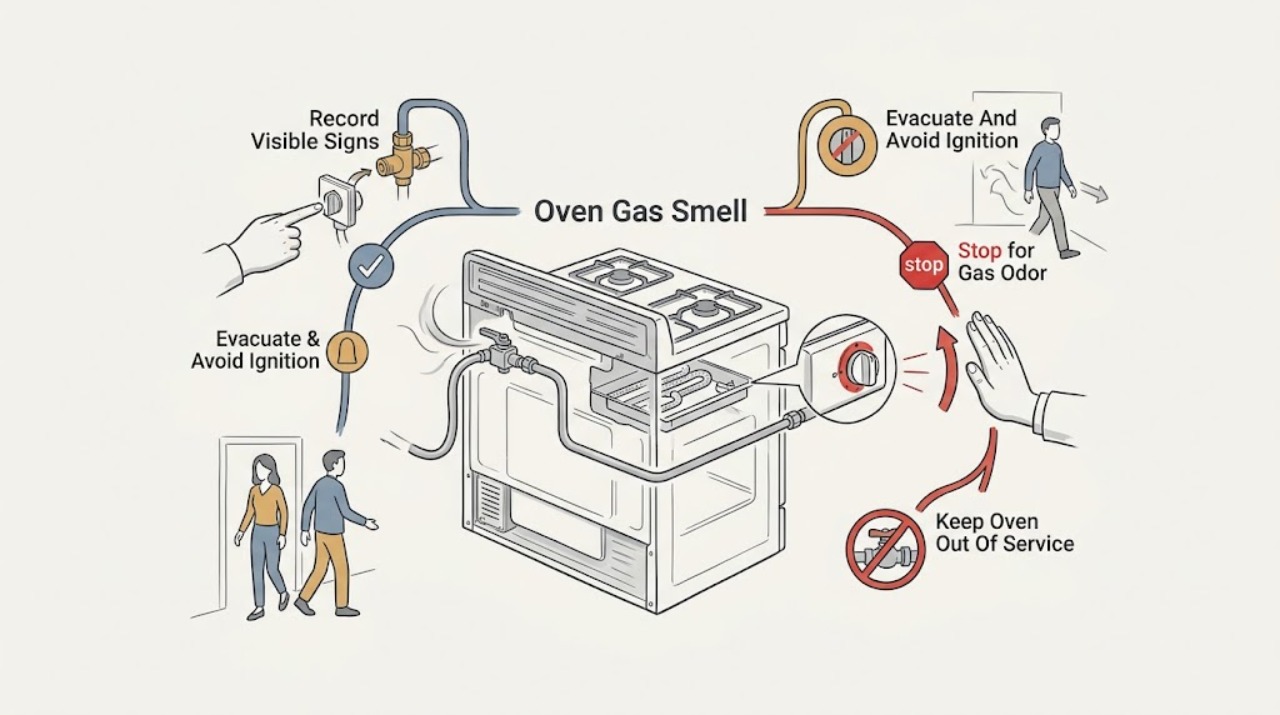
Do not troubleshoot an AEG gas oven by relighting it or repeatedly turning the controls when you smell gas. Treat the odor as a potential leak: extinguish flames only if that can be done without entering a hazardous area, avoid switches, plugs, phones and other ignition sources, leave the building, and contact the local gas emergency provider or emergency service from outside. Do not re-enter or use the oven until the gas authority or a registered gas professional says it is safe. AEG notes that a smell around a cooker may be related to an installation connection or fitting and should be investigated urgently; a persistent or recurring odor needs professional repair, not a user replacement part.
Work through in order
Diagnostic checks
Use only checks that match the exact appliance or system and its official guide.
-
Check 1
If gas odor is present, stop using the oven, warn others without creating an ignition source, leave the building and move to fresh air; do not relight the oven or pilot.
Expected result: From outside, note only whether the odor was strong, an alarm sounded, anyone feels ill, or a hissing sound was heard. Do not return inside to locate or confirm the smell.
Next step: From outside, contact the local gas emergency provider or emergency service and follow its instructions. Keep everyone away until the area is declared safe.
Stop if: Stop all checks immediately for strong odor, hissing, smoke, fire, an alarm, headache, dizziness, nausea, confusion or breathing difficulty; stay outside and request emergency help.
Why this matters
Why: A suspected gas release can ignite or expose occupants before a user can identify its cause; the safe result is evacuation, not a diagnostic test.
-
Check 2
While still outside or evacuating, do not switch lights or appliances, plug or unplug anything, use a phone inside, smoke, strike a match or operate the oven controls.
Expected result: There is no safe user observation that can clear a gas-filled room; a quiet room or a smell that seems weaker is not a safety confirmation.
Next step: Make the report from outside and tell the gas provider that the appliance is an AEG gas cooker or oven, where the odor was noticed and whether anyone has symptoms.
Stop if: Do not re-enter to turn a valve at the meter or inspect a connection unless the emergency provider specifically directs it and the approach is clearly safe; never manipulate the appliance gas controls or fittings.
Why this matters
Why: Electrical switching, flames and appliance operation can provide an ignition source, and a fading odor cannot establish that gas is absent.
-
Check 3
After the gas authority or emergency responder has assessed the property, keep the AEG oven shut down and out of use until a registered gas installer or qualified appliance professional has identified and corrected the cause.
Expected result: The professional may report a supply connection, fitting, valve, burner, combustion or installation issue; a report that the odor has gone away without an inspection is not a repair result.
Next step: Provide the installer with the model identification, where and when the odor was noticed, whether the oven was on or off, and any gas-provider findings. Follow the installer’s clearance and operating instructions.
Stop if: Do not open the cabinet, adjust a gas valve, remove a burner, alter a regulator or make a connection repair yourself.
Why this matters
Why: AEG identifies installation connections or fittings as a possible link and separates gas-supply testing from the registered installer’s repair work.
-
Check 4
If a carbon-monoxide alarm sounds or anyone develops headache, dizziness, nausea, unusual fatigue, confusion or breathing difficulty around the oven, leave immediately and request emergency medical and fire or gas assistance from outside.
Expected result: Carbon monoxide itself has no smell, so the absence of a gas odor does not rule out a combustion or venting hazard; symptoms or an alarm are sufficient reason to stay out.
Next step: Do not re-enter until emergency responders give permission. Have fuel-burning appliances and venting inspected by trained personnel before use.
Stop if: Do not use the oven for space heating, silence an alarm by removing its batteries, or operate the appliance after a suspected carbon-monoxide event.
Why this matters
Why: A gas oven can create a separate combustion-product danger, and symptom-based exposure cannot be safely investigated by operating the appliance.
-
Check 5
Only after the gas professional has cleared the appliance, use the oven exactly as its manual directs and stop immediately if the odor returns while controls are off, during ignition or during cooking.
Expected result: A recurring odor after professional clearance is a new failure report, not evidence that the earlier event was harmless. Note the operating state and location from a safe distance, without repeating ignition attempts.
Next step: Turn away from the appliance, evacuate if odor is present and contact the gas emergency provider from outside again; keep the oven out of use until reassessed.
Stop if: Stop immediately for any odor, flame abnormality, soot, smoke, alarm, hissing or symptoms; do not continue cooking to reproduce the condition.
Why this matters
Why: Recurrence requires the gas provider or registered installer to reassess the installation or appliance; it is not resolved by a different setting or a consumer part.
Use your observations
Decision map
Find the observation that best matches what you see, then follow the next safe action.
-
PATH 01Next step
What you see
Gas odor is present now, regardless of whether the oven is on or off.
Do this next
Leave immediately, avoid ignition sources and call for help from outside; do not re-enter or relight the oven.
Why this path and its safety boundary
Why it matters: Treat it as a possible gas leak until the gas authority or emergency responder assesses it.
-
PATH 02Next step
What you see
The odor was noticed around the cooker while all controls appeared off.
Do this next
Keep the appliance out of use and obtain urgent gas-supply assessment followed by registered installer repair if required.
Why this path and its safety boundary
Why it matters: AEG notes that installation connections or fittings may be involved; an off control does not clear the supply path.
-
PATH 03Next step
What you see
The odor is noticed only during or after use, or seems to fade.
Do this next
Do not repeat the cycle; report the event and have the appliance and installation assessed before use.
Why this path and its safety boundary
Why it matters: A changing odor cannot distinguish normal combustion, a leak or a venting problem safely.
-
PATH 04Next step
What you see
A carbon-monoxide alarm sounds or anyone has possible exposure symptoms.
Do this next
Move outside, call emergency help and do not re-enter or operate the oven until responders and trained professionals clear it.
Why this path and its safety boundary
Why it matters: This is an emergency even if no gas odor is detectable.
-
PATH 05Next step
What you see
The smell returns after a gas professional has cleared a prior issue.
Do this next
Evacuate and contact the gas emergency provider from outside again; do not attempt a replacement part or ignition test.
Why this path and its safety boundary
Why it matters: The condition is unresolved or has recurred and requires reassessment.
Helpful context
Understand the symptom
Gas odor is an emergency boundary, not a normal adjustment
A gas smell can come from a supply connection, fitting, valve or an appliance fault, but smell alone cannot identify the source or prove that the level is safe. Do not test the oven by lighting it again. The correct first decision is to get people away from the possible gas and obtain an external assessment.
Leave before making calls or checks
Do not operate light switches, extractor controls, plugs, thermostats or other electrical equipment in the affected area. Do not smoke, use a lighter, relight a pilot or start the oven. If the odor is strong, someone feels unwell, an alarm sounds or there is an audible leak, evacuate immediately and contact emergency help from outside.
Do not use a disappearing smell as a pass
An odor that fades after leaving does not show that the appliance is safe; gas can disperse or the supply can change. The oven stays out of use until the gas utility, emergency responder or registered gas professional has assessed the installation and cleared it.
When checks do not resolve it
Need a professional?
Leave immediately and contact the local gas emergency provider or emergency service from outside whenever gas odor is present. Keep the AEG oven out of use until the gas authority or a registered gas professional has inspected and cleared it; call emergency help for alarms, symptoms, hissing, smoke or fire.
Common questions
FAQ
Is a small gas smell from an AEG oven normal?
Do not assume any gas smell is normal. AEG treats smell around a cooker as a possible leak requiring urgent investigation. Leave, avoid ignition sources and obtain an external gas assessment.
Can I relight the oven to see whether the smell goes away?
No. CPSC says not to relight an appliance when gas is smelled. Do not operate the oven again until the gas authority or a registered professional has cleared it.
What if the smell disappears after I leave the room?
A fading odor does not prove the oven or installation is safe. Report the suspected leak from outside and wait for professional assessment before re-entry or use.
What if the carbon-monoxide alarm sounds but I cannot smell gas?
Leave immediately and call emergency help from outside. Carbon monoxide is odorless, and the oven must not be operated or used for heating until trained personnel inspect the appliance and venting.
Read the exact guide
Official sources
- Cookers: Smell of gas, potential gas leakAEG Support · AEG guidance for gas smell around a cooker, possible leaks, installation connections and registered installer escalation.
- CPSC Issues Winter Safety WarningU.S. Consumer Product Safety Commission · CPSC instruction not to relight when gas is smelled, to leave the area and contact the utility or qualified contractor, and not to adjust gas safety controls.
- Protect Your Family from Carbon Monoxide PoisoningU.S. Consumer Product Safety Commission · CPSC guidance that carbon monoxide is odorless, lists symptoms and prohibits using a gas oven for home heating.
Community feedback
Share a repair observation
Share a plain-text repair observation. Accepted observations are published automatically; this page may take a moment to update.