
On this page
Start here
Quick answer
A Kenmore oven error display is not enough to identify a part: record the complete code exactly as shown, the model number, whether the oven is electric or gas, and what the oven was doing when it appeared. Kenmore manuals are model-specific. If there is a gas smell, smoke, arcing, a burning smell, uncontrolled heating, or a breaker that trips again, stop using the oven and leave the hazardous condition to qualified or emergency help. If the oven is cool and there is no immediate hazard, use the exact model manual for one permitted CLEAR/OFF or reset attempt; if the code returns, keep the oven out of service and arrange repair.
Work through in order
Diagnostic checks
Use only checks that match the exact appliance or system and its official guide.
-
Check 1
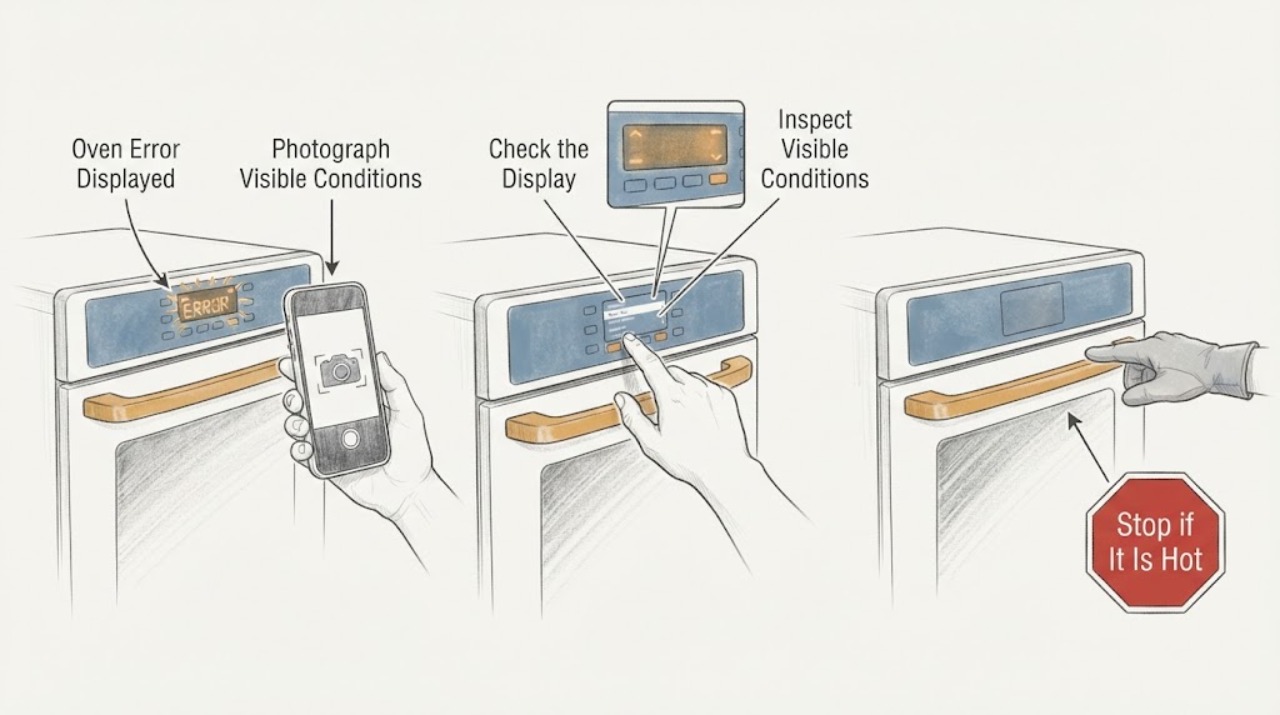
Without starting a cooking or cleaning cycle, photograph and transcribe the entire display, including every letter, digit, dash, decimal, alternating message, and whether it is flashing or beeping. Record the oven model number, serial number if available, fuel type, and the cycle or event immediately before the code.
Expected result: The display contains a complete reproducible code and the model and operating context are known, or the display is only a setting message such as an invalid entry or a request to press Start.
Next step: Use the exact model manual before interpreting the message. If the display is not readable or the model cannot be identified, stop at documentation and arrange qualified support rather than guessing.
Why this matters
Why: The exact model and complete display determine which manual section applies; a partial code or a guessed code can send troubleshooting down the wrong branch.
-
Check 2
Open the exact model's Kenmore manual and search for the complete displayed code and the operating phase in which it appeared. Check whether the manual identifies a setting condition, control problem, temperature-sensing issue, door-lock state, or a service-only fault.
Expected result: The manual has a matching code and gives an explicit user step, or it has no matching code for that model.
Next step: Follow only the matching low-risk instruction. If there is no exact match, retain the photo and code and request model-specific service.
Why this matters
Why: A matching entry supports only that model's documented procedure; an unmatched code is not evidence that a part is defective or that another model's code table applies.
-
Check 3
Before any reset, check the immediate safety state from a safe position: look for a gas smell, smoke, flame outside the burner area, visible arcing, a burning odor, abnormal heat that does not stop, a damaged cord, or a breaker that has tripped repeatedly.
Expected result: Any gas, smoke, flame, arcing, burning odor, uncontrolled heating, damaged electrical part, or repeated trip is present.
Next step: Stop using the oven. For suspected gas, leave immediately and contact the gas supplier or emergency services from outside or another safe location. For fire or smoke, leave and contact emergency services. For electrical danger, keep clear and use qualified electrical or appliance service.
Why this matters
Why: The condition can involve fire, gas, carbon-monoxide, or electrical risk and cannot be safely narrowed by repeated button presses.
-
Check 4
If the oven is cool and no hazard is present, perform only the one CLEAR/OFF or reset sequence explicitly allowed by the exact manual. Let the oven cool for the manual's stated interval when the code appeared during cooking or cleaning, and do not remove panels or probe wiring.
Expected result: The display clears and remains clear after the documented reset, or the same code returns immediately or after the next permitted operation.
Next step: If it returns, stop resetting and keep the oven out of service. Give the technician the exact code, model, phase, and reset result.
Why this matters
Why: A cleared message may have been a transient control or setting state, but a returning code confirms that the underlying condition still needs model-specific diagnosis.
-
Check 5
If the code appeared during or after self-cleaning, note whether the oven is still hot, whether the door-lock indicator is active, and whether the manual permits the control to be canceled. Do not force the door or defeat the lock.
Expected result: The oven is still hot or the lock indicator remains active, or the code returns after the manual's cool-down and permitted cancel procedure.
Next step: Keep the door closed until the manual says it is safe to open. If it remains locked or the code returns, arrange service without forcing the latch or opening the control area.
Why this matters
Why: Heat and the door-lock system can intentionally keep the door secured; a persistent lock or code after the documented cool-down can indicate a lock, sensor, or control fault.
-
Check 6
From a dry, safe position, check whether the display and other range functions have power, and whether a household breaker or fuse has opened. Do not repeatedly reset a breaker or open the range.
Expected result: The display is blank, the breaker trips again, the cord or outlet is damaged, or the display is present but the oven alone reports the code.
Next step: Leave a recurring trip or damaged electrical equipment off and call qualified electrical or appliance service. For a stable display, use the exact manual and do not infer a part from the code alone.
Why this matters
Why: A supply or electrical fault may be involved when the appliance loses power or trips protection; an oven-only code with stable power points back to the model's control, sensor, lock, or heating path.
-
Check 7
Prepare a service record with the full code, model and serial information, fuel type, cycle, whether the door was locked, whether heating continued, any power interruption, and the result of the one permitted reset. Keep the oven unused while an unresolved code remains.
Expected result: The code is repeatable or the safety symptom is repeatable, or the event cannot be reproduced but the log and photograph are complete.
Next step: Use Kenmore customer care or qualified appliance service for model-specific diagnosis; mention any gas, smoke, heat, arcing, or breaker event before scheduling ordinary troubleshooting.
Why this matters
Why: A precise event record helps service distinguish a control message from a sensor, lock, power, heating, or gas-ignition fault without unsafe exploratory testing.
Use your observations
Decision map
Find the observation that best matches what you see, then follow the next safe action.
-
PATH 01Safety boundary
What you see
Is there a gas smell, smoke, flame outside its intended burner area, visible arcing, burning odor, uncontrolled heating, or repeated breaker trip?
Do this next
Stop using the oven and move to a safe location. For suspected gas, leave immediately and contact the gas supplier or emergency services from outside; for smoke or fire, evacuate and contact emergency services.
Why this path and its safety boundary
Safety stop: Do not operate switches, lights, phones, or ignition controls in a suspected gas leak area, and do not test an oven showing electrical or fire danger.
-
PATH 02Safety boundary
What you see
Is the full code and exact Kenmore model number available?
Do this next
Use the manual for that model and record the code's operating phase before taking any action.
Why this path and its safety boundary
Safety stop: Stop troubleshooting if the display cannot be read or model identity remains uncertain after safe documentation.
-
PATH 03Safety boundary
What you see
Does the exact manual identify the display as a setting message with a permitted CLEAR/OFF step?
Do this next
Perform only that documented clear step with the oven cool and no safety warning, then verify whether the message stays clear.
Why this path and its safety boundary
Safety stop: Stop if the code returns, the oven behaves abnormally, or the manual requires service.
-
PATH 04Safety boundary
What you see
Did the same code return after the one permitted reset or documented cool-down?
Do this next
Keep the oven out of service and provide the code, model, phase, and reset result to qualified appliance service.
Why this path and its safety boundary
Safety stop: Never repeat resets to suppress a recurring fault or continue cooking when heating, locking, or control behavior is abnormal.
-
PATH 05Safety boundary
What you see
Did the code appear during or after a self-clean cycle while the oven is still hot or locked?
Do this next
Keep the door closed until the exact manual's cool-down and release conditions are met; request service if the code or lock persists.
Why this path and its safety boundary
Safety stop: Do not force the door, defeat the lock, or remove a panel to release it.
-
PATH 06Safety boundary
What you see
Is the display blank or is household power unstable?
Do this next
Leave the appliance off if the breaker trips again or electrical damage is visible, and arrange qualified electrical or appliance service.
Why this path and its safety boundary
Safety stop: Do not repeatedly reset a breaker or touch wet, damaged, or overheated electrical equipment.
Helpful context
Understand the symptom
Do not diagnose the code by its letters alone
Kenmore ovens and ranges have changed controls and code meanings across model families. A code that means a sensor or lock problem on one model may be a different control or operating condition on another. Photograph the display and use the manual for the exact model before treating any code as a diagnosis.
Separate a harmless setting message from a fault
Some displays report an invalid setting, an incomplete start sequence, or a control lock; others indicate a fault. The manual should tell you whether CLEAR/OFF, a cooling period, or a single power reset is allowed. Do not repeat resets to keep an oven operating when the code returns.
Gas and electrical warnings override troubleshooting
For a gas model, a gas smell is an evacuation and gas-safety event, not an error-code exercise. Do not light anything or operate switches or a phone in the suspected leak area. For any model, smoke, fire, visible arcing, a burning odor, uncontrolled heat, a damaged cord, or repeated breaker trips requires the oven to remain off and qualified help.
Safety boundary
Stop conditions
- Stop immediately for a gas smell, smoke, fire, visible arcing, burning odor, uncontrolled heating, repeated breaker trips, or a damaged cord or outlet.
- For suspected gas, leave the area and call the gas supplier or emergency services from outside; do not operate switches, light a flame, or use a phone in the suspected leak area.
- Do not force an oven door, defeat a lock, remove panels, test live wiring, or replace a sensor, control, igniter, or heating element based only on a code.
- Do not repeat a reset when the code returns or when the oven's heat, lock, or control behavior is abnormal.
- Do not use an unmatched code table from another model family; keep the exact model and display record for service.
Only after diagnosis
Potential parts
- oven electronic control
Consider only when the exact manual or technician diagnosis links a returning control code to the control assembly.
Kenmore control designs vary by model and revision; confirm exact model fitment and manufacturer documentation before ordering. - oven temperature sensor
Consider only when the exact model's code documentation and a qualified diagnosis identify the temperature-sensing path.
Do not infer sensor failure from a generic code; verify the exact model and approved replacement information. - oven door-lock assembly
Consider only when a documented self-clean or door-lock code persists after safe cool-down and the technician confirms a lock fault.
Lock mechanisms differ across models; confirm exact fitment and do not bypass the lock. - oven heating or ignition component
Consider only after the exact model and fuel type are confirmed and qualified service identifies a heating or ignition component fault.
Electric elements and gas ignition parts are not interchangeable; verify model, fuel type, and manufacturer fit information.
When checks do not resolve it
Need a professional?
Call qualified appliance service when the exact code is not documented for the model, returns after the permitted reset, or is accompanied by a door-lock, temperature, heating, or control problem., Use qualified electrical service when the range loses power, a breaker trips again, or the cord, outlet, or wiring shows damage., Use the gas supplier or emergency services for a suspected gas leak, and emergency services for smoke or fire.
Have this ready
- Provide the complete code exactly as displayed, model and serial information, electric or gas type, cycle and phase, door-lock state, whether heating continued, any power event, and the result of one documented reset.
Common questions
FAQ
What does an F code mean on a Kenmore oven?
It means the control has detected a model-specific oven condition, but the letters alone do not identify the failed part. Record the full code and exact model, then use that model's manual. Some manuals use F plus a number or letter for an oven problem, while other displays report a setting condition.
Can I reset a Kenmore oven error code?
Only if the exact model manual permits it and the oven is cool with no gas, smoke, fire, arcing, burning odor, or abnormal heating. Perform one documented clear or reset attempt. If the code returns, stop using the oven and arrange service.
What if the error appeared during self-cleaning and the door is locked?
Keep the door closed until the exact manual's cool-down and release conditions are met. Never force or bypass the lock. A persistent lock or returning code needs qualified service.
Should I keep using the oven if the error code disappears?
Do not continue if heating is uncontrolled, the oven is unusually hot, a breaker trips, or there is smoke, arcing, burning odor, or a gas smell. If the manual documents a harmless setting message and it remains clear after one permitted action, follow the manual and stop at any recurrence.
Why do I need the model number before looking up the code?
Kenmore sells electric, induction, and gas ranges and has multiple control generations. The official manual lookup uses the model number so you do not apply another appliance's code meaning or reset procedure.
Read the exact guide
Official sources
- Customer Care & Support | Kenmore AppliancesKenmore · Kenmore customer care, warranty, manuals, and repair-support routing
- Kenmore Owner's Manual: Double 30-inch Electric Self-Cleaning Wall Oven with Upper MicrowaveKenmore · Kenmore owner manual models 911.41475 and 911.41479 only; example of model-specific error-display and reset guidance
- Find Your Manual | Kenmore Appliance Manuals & GuidesKenmore · Kenmore official owner-manual lookup for ovens, ranges, and other appliances
- CookingU.S. Fire Administration · U.S. government cooking and oven-fire safety guidance
- Certain Older Gas Connectors May Be DangerousU.S. Consumer Product Safety Commission · Government gas-leak evacuation and no-switch/no-flame safety guidance for gas appliances
- Appliance and Electrical Fire SafetyU.S. Fire Administration · U.S. government appliance cord, outlet, and electrical fire-safety guidance
- Ranges | Cooking | KenmoreKenmore · Kenmore range product identity and electric, induction, and gas range distinctions
Community feedback
Share a repair observation
Share a plain-text repair observation. Accepted observations are published automatically; this page may take a moment to update.