
On this page
Start here
Quick answer
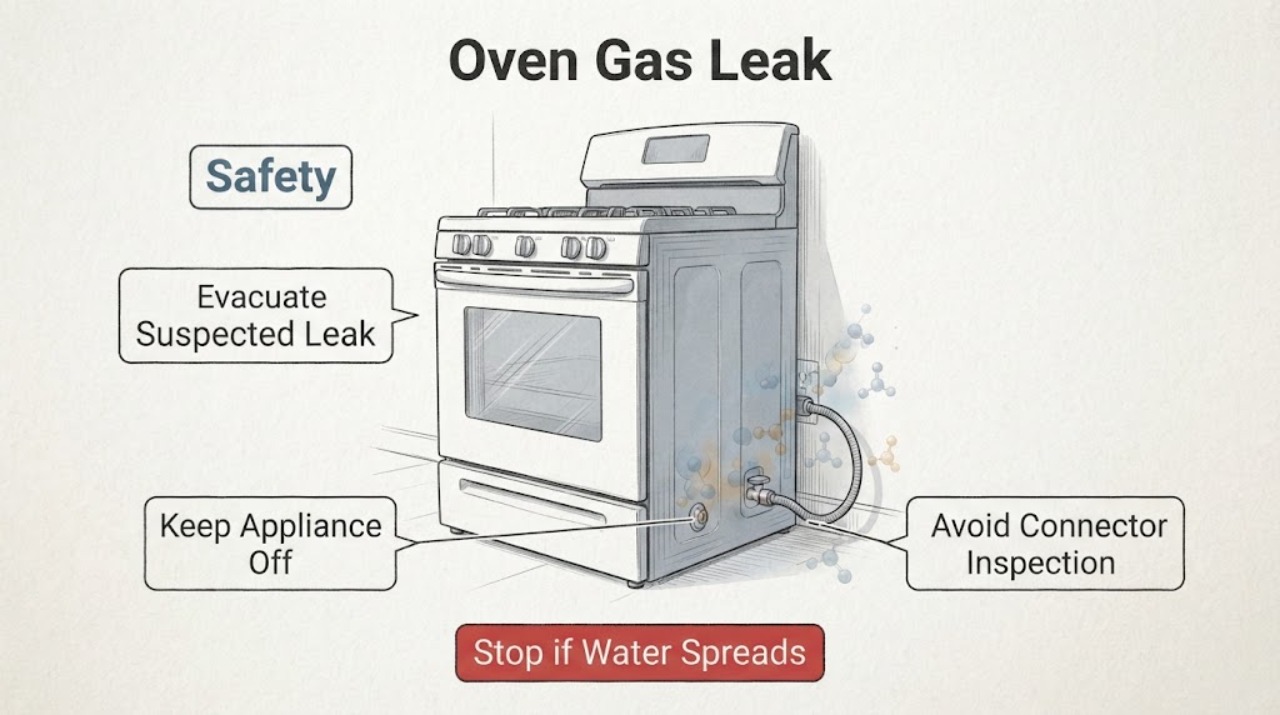
Treat a suspected Kenmore oven gas leak as an emergency, not as a normal oven odor or a troubleshooting test. If gas odor is present or a leak is suspected, leave immediately, do not operate switches, lights, flames, the oven controls or a phone inside, and call the gas supplier or 911 from a neighbor's location. Do not move the oven, inspect its connector, relight it, or restart it; the U.S. Consumer Product Safety Commission says connector inspection and replacement belong to a qualified professional. Once the gas situation is declared safe, use the exact Kenmore model manual and customer-care route for any follow-up; a missing model does not justify a generic gas-check or relight procedure.
Work through in order
Diagnostic checks
Use only checks that match the exact appliance or system and its official guide.
-
Check 1
If you smell gas, suspect a leak, or already noticed a credible gas release, leave the home immediately with people and pets; do not operate the oven, lights, electrical switches or flames while leaving.
Expected result: People are outside at a safe distance, and the suspected oven and possible ignition sources are no longer being handled.
Next step: From a neighbor's location or another safe location, call the gas supplier or 911 and follow their instructions. Do not re-enter to investigate or retrieve information.
Why this matters
Why: The situation is an active gas-leak emergency rather than an ordinary oven-odor question; the appliance cannot be safely diagnosed from inside.
-
Check 2
Do not pull the Kenmore oven out, move it to see the connector, remove panels, check fittings, light a flame, or attempt a relight while the leak concern is unresolved.
Expected result: The appliance remains undisturbed and no user-performed connector or flame test has been attempted.
Next step: Tell the gas supplier, emergency responder or qualified appliance professional what was observed and let that professional inspect the connection and appliance.
Why this matters
Why: The connector and gas path remain an unverified professional-safety issue; moving or manipulating an older or weakened connector can worsen a leak.
-
Check 3
Keep the oven off after evacuation and do not restart it to distinguish a normal burn-off smell from a leak, even if the odor fades.
Expected result: The smell has stopped, or the appliance has been off long enough that no odor is currently noticed, but no qualified person has cleared it.
Next step: Maintain the no-use boundary and obtain gas-supplier or qualified appliance-service clearance before any operation.
Why this matters
Why: A temporary absence of odor does not establish that the gas supply, connector, valve or burner path is safe.
-
Check 4
After the hazard is cleared, record the complete Kenmore model number from a safe, accessible location and use Kenmore's manual and customer-care pages for the matching documentation and repair route.
Expected result: A complete model number is available, or the model remains unknown or inaccessible because the oven must stay undisturbed.
Next step: Give the exact model and the observed gas event to the authorized or qualified service provider. If the model cannot be confirmed, keep the request at the professional inspection level.
Why this matters
Why: Kenmore uses the model number to locate the correct oven manual; an unknown model cannot support a generic gas procedure or parts conclusion.
-
Check 5
From a safe location, write down only the time, location and circumstances of the odor or suspected release; do not return to photograph the connector or collect a serial plate during the emergency.
Expected result: The service provider has the symptom description without anyone re-entering or manipulating the oven for evidence.
Next step: Wait for the professional disposition. Do not resume use based only on a fading smell, a visual guess or an internet procedure.
Why this matters
Why: A factual handoff helps the gas supplier or service professional triage the event without creating another ignition or connector risk.
Use your observations
Decision map
Find the observation that best matches what you see, then follow the next safe action.
-
PATH 01Next step
What you see
Gas odor is present, a leak is suspected, or anyone reports a recent unexplained gas release from the oven.
Do this next
Leave immediately, avoid switches, flames and phones inside, and call the gas supplier or 911 from a neighbor's location. Do not re-enter until authorities or the gas professional says it is safe.
Why this path and its safety boundary
Why it matters: This is an active gas-safety emergency; the cause cannot be safely narrowed by user testing.
-
PATH 02Next step
What you see
The odor has faded, but the oven has not been professionally cleared or the appliance was moved, struck or otherwise disturbed.
Do this next
Keep the oven off and arrange qualified gas or appliance service; do not move it again or attempt a relight.
Why this path and its safety boundary
Why it matters: The absence of a current smell does not prove that the gas path or connector is safe, and movement can worsen a compromised connector.
-
PATH 03Next step
What you see
A professional has cleared the gas hazard and the exact Kenmore model is known.
Do this next
Use the matching Kenmore manual and customer-care/service route for follow-up, keeping the model number attached to any repair request.
Why this path and its safety boundary
Why it matters: Only now is model-specific owner documentation an appropriate source for ordinary operating questions; it still does not replace the professional leak disposition.
-
PATH 04Next step
What you see
The model cannot be confirmed, or the professional reports an unresolved gas-supply, connector or appliance fault.
Do this next
Leave the oven out of service and follow the gas supplier or qualified technician's written disposition rather than using a generic repair procedure.
Why this path and its safety boundary
Why it matters: The evidence cannot support a model-specific reset, flame check, parts recommendation or restart instruction.
Helpful context
Understand the symptom
A gas smell changes the next step
A suspected gas leak is not narrowed safely by trying the oven again. Odor, an unexplained gas event, or another credible leak concern should be handled from a safe location. The immediate objective is to get people away from a possible ignition source and reach the gas supplier or emergency services, not to identify a valve, connector or burner at home.
Do not move or inspect the oven connection
Kenmore oven model information can help after the hazard is cleared, but it does not make an unknown gas connection safe to inspect. The CPSC warns that moving an appliance even slightly can cause a weakened connector to fail, and says connector inspection or replacement is for a qualified professional. Do not pull the range out, remove a panel, test a fitting, light a burner, or relight the oven while the leak concern is unresolved.
Use Kenmore documentation only after clearance
After the gas supplier, emergency responder or qualified appliance professional has declared the situation safe, record the complete model number and retrieve the matching Kenmore manual. Kenmore says its manuals cover ovens and that customer care provides warranty, repair, manuals and service resources. Those pages are useful for identifying the appliance and arranging service; they are not permission to improvise a leak test or restart procedure for an unknown model.
When checks do not resolve it
Need a professional?
Call the gas supplier or 911 immediately from a safe location when gas is smelled or a leak is suspected. For any unresolved concern after the emergency response, keep the oven off and use qualified appliance service.
Have this ready
- Provide the Kenmore model if safely available, where the odor or suspected release was noticed, when it occurred, whether anyone was evacuated, and whether the appliance was moved or operated after the observation.
Common questions
FAQ
What should I do first if my Kenmore oven smells like gas?
Leave immediately. Do not use a phone, match, light switch, electrical switch or oven control inside. Call the gas supplier or 911 from a neighbor's location and follow their instructions.
Should I pull the Kenmore oven out to check the gas connector?
No. The CPSC warns that moving an appliance can cause a weakened connector to fail and says a qualified professional should check or replace the connector. Keep the oven undisturbed and out of service.
Can I restart the oven after the gas smell disappears?
No. A fading odor does not establish that the gas path is safe. Wait for clearance from the gas supplier, emergency responder or qualified appliance professional before operating it.
How do I find the right Kenmore instructions after the hazard is cleared?
Record the complete model number and use Kenmore's manuals page, which includes ovens, plus its customer-care page for repair and service resources. Do not use a generic gas procedure for an unknown model.
Read the exact guide
Official sources
- Customer Care & Support | Kenmore AppliancesKenmore / Transform SR Brands LLC · Opened official Kenmore customer-care page. It identifies warranty and repair information, parts/literature, manuals and repairs/services; it is used to route a cleared appliance to model-specific support, not to authorize user gas work.
- Certain Older Gas Connectors May Be DangerousU.S. Consumer Product Safety Commission · Opened official CPSC one-page gas-safety PDF. Used for the emergency response, no-switch/no-flame boundary, prohibition on moving the appliance, and qualified-professional connector inspection; it does not identify a Kenmore oven model or diagnose an internal component.
- Find Your Manual | Kenmore Appliance Manuals & GuidesKenmore / Transform SR Brands LLC · Opened official Kenmore manuals page. It says the model number is used to locate the manual and explicitly lists ovens among supported appliances; it is used only for post-clearance model routing, not as gas-leak diagnosis.
Community feedback
Share a repair observation
Share a plain-text repair observation. Accepted observations are published automatically; this page may take a moment to update.