
On this page
Start here
Quick answer
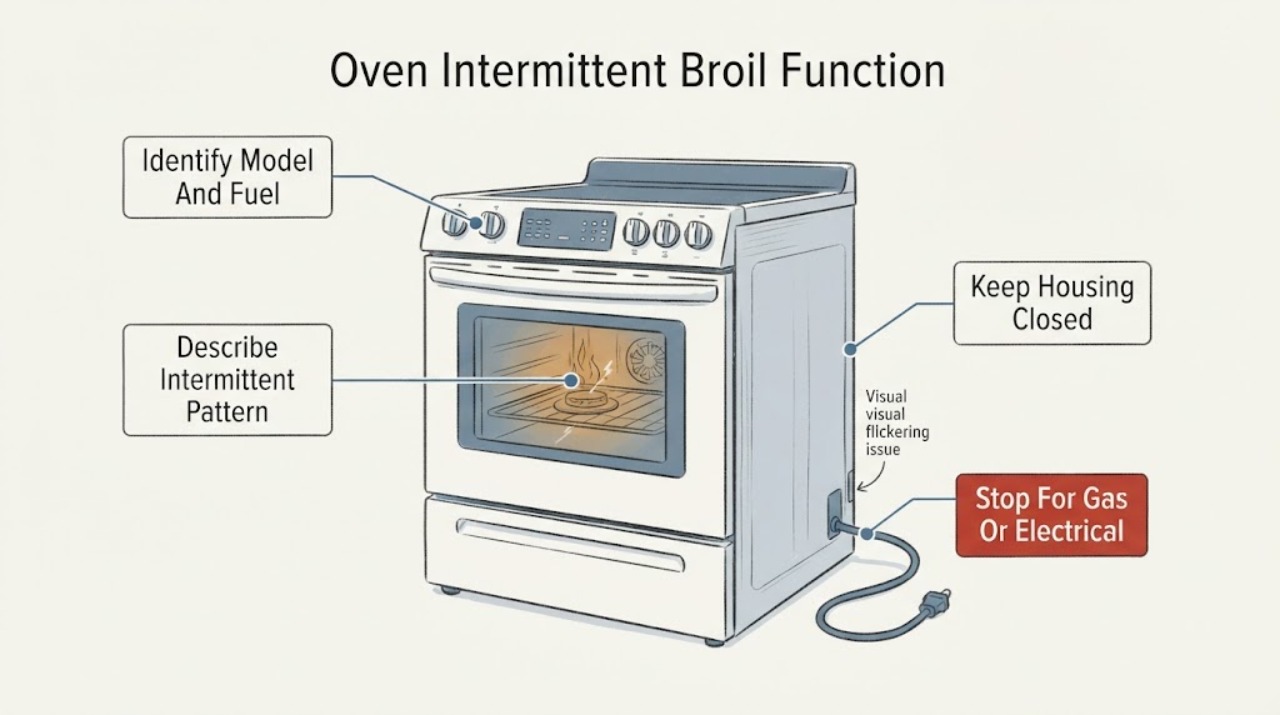
First identify the full Kenmore model and whether the oven is electric or gas; Kenmore says its manuals are retrieved by model number and cover ovens and ranges. Do not keep testing if there is a gas smell, flame flare, smoke, scorching, a breaker trip or a damaged cord. With the oven cool, the area clear and the exact manual available, record whether the broiler fails to start, starts and cuts out, heats weakly, or works only after Bake; also note whether the display, clock, control lock or other heating mode behaves normally. Use the matching manual for the broil control, door position and any reset or lock procedure. A persistent or hazardous intermittent broil fault needs Kenmore or qualified appliance service; the symptom alone does not prove a broil element, igniter, sensor, relay or control-board failure.
Before you begin
Safety first
- Do not repeat gas ignition to reproduce a fault, bypass a door or safety control, open panels, touch live terminals, measure a gas/electrical circuit without qualification, replace an element/igniter/relay from a symptom, or continue using an oven with smoke, scorching or gas odor.
Work through in order
Diagnostic checks
Use only checks that match the exact appliance or system and its official guide.
-
Check 1
Stop using the oven if you smell gas, see delayed ignition or flame flare, smell burning insulation, see smoke/scorching, feel abnormal heat at the cord or cabinet, or the breaker trips; do not relight, reset repeatedly or open the appliance.
Expected result: A gas, flame, smoke, scorching or electrical symptom is present, or the broil function is intermittent without any hazard sign.
Next step: For a gas concern, leave the area and contact the gas utility or emergency service from a safe location; for electrical/fire symptoms, isolate power only if safe and use qualified appliance/electrical service. Otherwise continue with identity and observation checks only when the oven is cool and safe.
Why this matters
Why: The first group is a fuel/fire/electrical safety condition, not a routine broil adjustment; an intermittent but odor-free symptom can be documented with the model manual if safe.
-
Check 2
Record the complete Kenmore model number, serial information, region and fuel type before choosing any broil, lock, door or reset procedure.
Expected result: The model and fuel type are known, or the model/fuel cannot be confirmed.
Next step: Use the exact Kenmore manual and support route. If identity remains incomplete, limit work to safe external observations and provide the model information to service rather than borrowing another model's procedure.
Why this matters
Why: Kenmore's manual portal requires a model number and covers multiple oven/range families; gas and electric broil systems cannot be treated as interchangeable.
-
Check 3
With the oven cool, record whether Broil never starts, starts and then stops, heats weakly, works only after Bake, or changes when the control/display is locked or unlocked; do not repeat a cycle solely to reproduce a hazardous symptom.
Expected result: The failure is repeatable in one pattern, changes with temperature/time, or cannot be reproduced safely.
Next step: Save the observation with the model and any display code. If the pattern cannot be safely reproduced, stop testing and arrange service with the recorded history.
Why this matters
Why: Different patterns can point a technician toward an operating/control, ignition or heating-circuit review, but none proves a particular component without model-specific testing.
-
Check 4
Use the exact Kenmore manual to confirm the Broil selection, temperature/range setting, door position and control-lock behavior; do not assume an unknown oven uses the same sequence as Kenmore model 49423.
Expected result: The manual confirms the selected control and the oven responds as documented, or the control/door state does not match the manual.
Next step: Correct only a documented user-setting or lock state. If controls are correct and broil remains intermittent, stop repeating cycles and arrange service.
Why this matters
Why: A lock, door position or model-specific operating requirement can prevent or change broil behavior, while a documented control state with intermittent heat keeps a service condition in scope.
-
Check 5
Only when the exact manual permits normal operation and there is no gas/electrical hazard, note whether the display, clock and Bake function operate normally when Broil fails; do not use repeated heating as a diagnostic test.
Expected result: Bake and the display work while Broil fails, or multiple oven functions also fail/reset.
Next step: Stop if heat cuts out, an odor appears or the control resets. Give the exact comparison to Kenmore service and do not open the electrical compartment.
Why this matters
Why: An isolated broil symptom gives the servicer a different starting scope from a wider power/control symptom, but the comparison does not identify an element, igniter, relay or board.
-
Check 6
After power/fuel isolation and complete cooling, inspect only user-visible areas allowed by the exact manual for obvious damage such as a cracked or visibly separated electric element, damaged insulation, soot or a loose external control; do not remove panels or touch terminals.
Expected result: Visible damage or scorching is present, or no external damage is visible.
Next step: Keep the appliance off and arrange qualified service for visible damage or persistent intermittent heat. Do not order a part from appearance alone.
Why this matters
Why: Visible damage is a reason to stop and give service evidence; a clean-looking surface does not rule out an internal electrical, ignition or control fault.
-
Check 7
Arrange Kenmore or qualified appliance service when the exact control procedure is correct but Broil remains intermittent, when multiple functions fail, or when diagnosis would require live measurement, gas access, a panel or a heating/ignition component.
Expected result: The problem persists, returns after a setting correction, or cannot be safely tested at home.
Next step: Provide the model, fuel type, region, exact broil sequence, whether Bake/display work, any lock/code behavior, odor or breaker history and visible observations. Keep the oven off if any hazard symptom occurred.
Why this matters
Why: Kenmore provides model manuals and repair/support routes, but the public pages do not prove which internal component is responsible for an unidentified intermittent broil symptom.
Use your observations
Decision map
Find the observation that best matches what you see, then follow the next safe action.
-
PATH 01Next step
What you see
Broil fails but the model manual's control/lock state is wrong or the door requirement is not met.
Do this next
Correct only the documented control or door state, then stop if the intermittent fault returns.
Why this path and its safety boundary
Why it matters: The symptom may be an operating-state issue, but the exact manual is required to establish the correct condition.
-
PATH 02Next step
What you see
Bake and the display work normally while Broil repeatedly fails or cuts out.
Do this next
Record the comparison and arrange model-specific appliance service; do not open the oven or order a guessed part.
Why this path and its safety boundary
Why it matters: The observed fault appears isolated to the broil path, but this does not identify an element, igniter, relay or control failure.
-
PATH 03Next step
What you see
Broil failure is accompanied by a gas smell, delayed ignition, flame flare, smoke or scorching.
Do this next
Stop use, leave the area as appropriate and contact the gas utility/emergency service or qualified appliance service from a safe location.
Why this path and its safety boundary
Why it matters: This is a fuel/fire safety event rather than a routine intermittent heating symptom.
-
PATH 04Next step
What you see
The display resets, the breaker trips, or Bake and Broil both become unreliable.
Do this next
Stop repeated tests and arrange qualified appliance/electrical service with the model and event history.
Why this path and its safety boundary
Why it matters: The observation indicates a broader power/control or safety condition, not a proven broil-element fault.
-
PATH 05Next step
What you see
The exact model or fuel type cannot be established.
Do this next
Locate the model information, use Kenmore's official manual portal, and limit the user action to safe external observation until identity is confirmed.
Why this path and its safety boundary
Why it matters: Kenmore's multi-family manual path cannot support a model-specific broil sequence or component interpretation.
Helpful context
Understand the symptom
Define what intermittent means before naming a part
Intermittent broil can mean the broiler never starts, starts after a delay, cycles normally but seems weak, cuts out during a use, or works in one mode but not another. Those observations do not identify the failed part. Record the exact control response, whether the oven is electric or gas, whether Bake works, and whether the problem follows a warm-up or self-clean cycle. Avoid treating a generic Kenmore label as a model-specific circuit diagram.
Use the model manual before a control test
Kenmore's official manual portal says to enter the full model number and provides manuals for ovens and ranges. Use that document to confirm how the broil function is selected, whether the door must be in a particular position, how a control lock is shown, and which user checks are permitted. A product page for Kenmore model 49423, for example, describes a variable broiler and a push-button control lockout; those features cannot be copied to an unknown model.
Keep electric and gas hazards separate
An electric oven may show a heating element or control response, while a gas oven has fuel and ignition risks. Do not open panels, probe live terminals, bypass a door or safety control, or repeat a gas-broil attempt to make an intermittent fault appear. Stop immediately for a gas smell, delayed ignition, flame rollout, smoke, scorching or a breaker trip and arrange qualified service.
Use the other oven mode only as an observation
If the exact manual permits normal use and there is no safety symptom, record whether Bake, the clock/display and the cooktop or other functions work when Broil does not. This comparison can help a servicer determine whether the symptom is isolated to broil or affects the oven's power/control path, but it is not a diagnosis. Do not keep cycling the oven when heat cuts out, the control resets or any odor appears.
Leave internal heating checks to service
After the model and symptom are documented, a technician can use the model's wiring and service information to inspect the broil heating or ignition circuit. An intermittent result alone does not prove an element, igniter, thermostat, relay, selector or control board. Kenmore's official customer-care and contact pages provide the manual and repair pathways needed for a model-specific handoff.
When checks do not resolve it
Need a professional?
Contact Kenmore or qualified appliance service when intermittent Broil persists after the exact manual's control/lock checks, when multiple functions fail, or immediately for gas odor, flame abnormality, smoke, scorching, breaker trips or electrical damage.
Safety scope: Do not repeat gas ignition to reproduce a fault, bypass a door or safety control, open panels, touch live terminals, measure a gas/electrical circuit without qualification, replace an element/igniter/relay from a symptom, or continue using an oven with smoke, scorching or gas odor.
Have this ready
- Provide the full model and serial information, region, electric/gas type, exact Broil behavior, whether Bake and the display work, door/lock state, any code, odor or breaker event, and safe visible observations.
Common questions
FAQ
Why does my Kenmore broiler work sometimes and not other times?
Intermittent Broil can involve a model-specific control or lock state, the heating or ignition path, or a wider power/control condition. Record whether Bake and the display work, identify the exact model and fuel type, and use the matching Kenmore manual. The symptom alone does not prove a failed element or igniter.
Can I use another Kenmore oven's broil instructions?
No. Kenmore's official manual portal requires the exact model, and its product pages show model-specific broiler and control features. Use the manual for your model; do not copy a door position, lock sequence or reset from a different Kenmore family.
Should I keep testing if the broiler smells like gas or trips the breaker?
No. Stop using the oven. A gas smell, flame abnormality, smoke, scorching or a breaker trip is a safety boundary, not a reason to repeat the Broil cycle. Leave the area or isolate power only when safe and contact the appropriate qualified service or emergency provider.
Read the exact guide
Official sources
- Contact Us | Kenmore Customer SupportKenmore / Transform SR Brands LLC · Official Kenmore contact page used for service handoff; no public source claim about internal broil parts is taken from it.
- Find Your Manual | Kenmore Appliance Manuals & GuidesKenmore / Transform SR Brands LLC · Official Kenmore manual portal used to require exact model matching for ovens/ranges and to avoid transferring procedures across unidentified families.
- 30 inch Electric Self-Clean Single Wall Oven - Stainless SteelKenmore / Transform SR Brands LLC · Official product page opened as a bounded example only: model 49423 lists a variable broiler and control lockout. It is not treated as evidence for every Kenmore oven.
- Customer Care & Support | Kenmore AppliancesKenmore / Transform SR Brands LLC · Official Kenmore customer-care page used for manual, repair and support routing; it does not establish a component diagnosis for an unidentified oven.
Community feedback
Share a repair observation
Share a plain-text repair observation. Accepted observations are published automatically; this page may take a moment to update.