
On this page
Start here
Quick answer
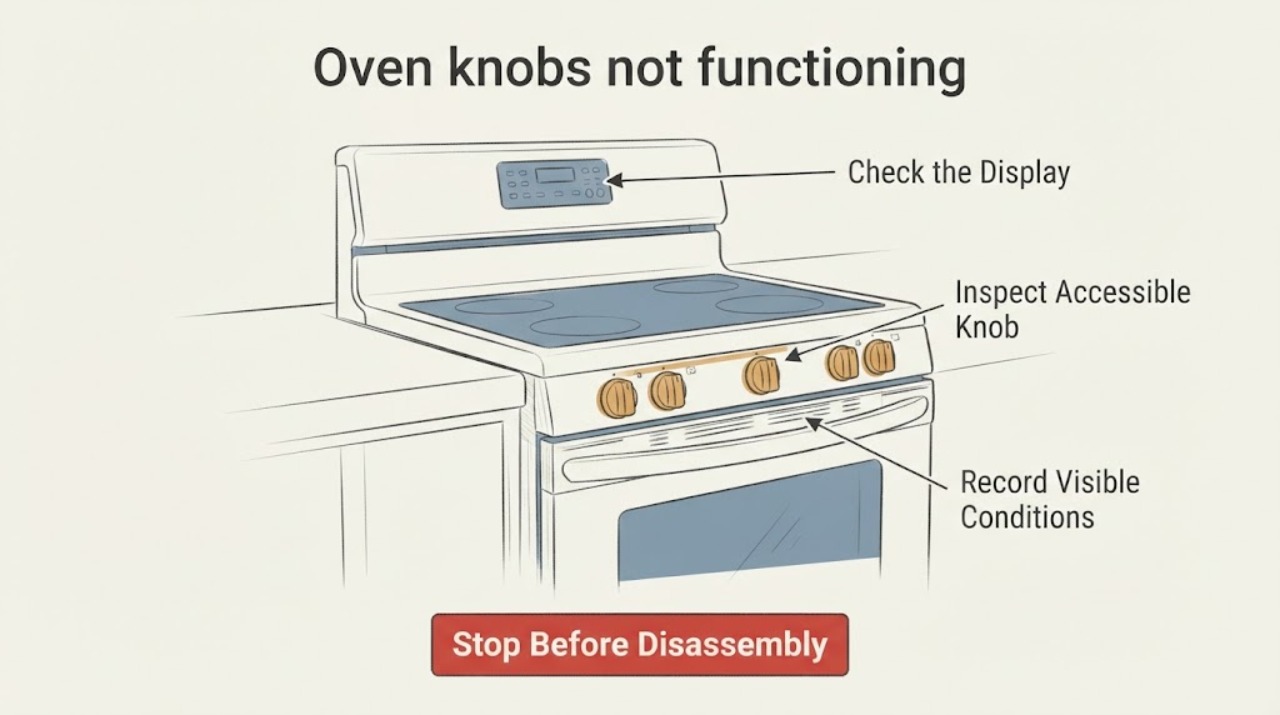
First determine whether the knob itself is loose or damaged, whether it turns but the oven does not respond, or whether a control is stuck and the appliance remains on. Stop using the range if a knob cannot return the oven or burner to OFF, if heat continues unexpectedly, or if there is gas odor, smoke, sparking or a burning smell. Do not force a stuck knob, remove the control panel, or keep cycling a gas control to test it. With the appliance cool and off, record which knob is affected and inspect only the accessible knob and surrounding panel for cracks, looseness or heat damage. Kenmore requires the exact model number for the correct manual, and CPSC warns that unsafe gas-range control-panel operation can contribute to gas leaks, fire or explosion; persistent or unsafe symptoms need qualified service.
Work through in order
Diagnostic checks
Use only checks that match the exact appliance or system and its official guide.
-
Check 1
Stop using the oven if a knob is stuck away from OFF, the oven or burner stays on after the control is set to OFF, or there is gas odor, smoke, sparking, heat damage or a burning smell. Do not force the knob, keep cycling it, or open the control panel.
Expected result: The appliance is still heating or supplying gas, the knob cannot reach OFF, or a hazard sign is present; or the appliance is fully off with no hazard sign.
Next step: Keep clear and arrange qualified service. If gas odor is present, leave immediately, do not touch electrical switches, and call the gas supplier or 911 from a neighbor's house. If fully off, continue only with cool external observation.
Why this matters
Why: A control that cannot reliably stop the appliance is an unsafe operating condition. CPSC says unsafe gas-range control-panel operation can contribute to gas leaks, fire or explosion; no component is confirmed from the symptom alone.
-
Check 2
After the appliance is cool and confirmed off, look at the affected knob and the surrounding panel without removing the panel. Note whether the knob is cracked, missing, loose, pushed inward, rubbing, or visibly heat-damaged. Do not force a knob or pull on a shaft.
Expected result: The knob is damaged/loose, the knob appears intact but turns freely without changing a setting, or it does not turn at all.
Next step: Photograph the condition and use the exact model manual or qualified service. Do not install a generic knob or expose the control shaft while the model and fuel type are unknown.
Why this matters
Why: These observations distinguish an accessible knob condition from an unresolved control-interface or underlying appliance fault; they do not establish a compatible replacement or prove that the internal switch/valve is defective.
-
Check 3
Write down whether one knob or several are affected, whether the display/lights have power, whether the oven heats, and whether the problem began after cleaning, a spill, power loss or a hot event. Do not re-energize the appliance merely to reproduce a fault.
Expected result: Only one knob is affected, multiple controls are unresponsive, the display is blank, or the appliance otherwise operates normally.
Next step: Give the symptom timeline and model number to Kenmore service. Keep the appliance off if a control can activate unexpectedly or cannot stop heating/gas.
Why this matters
Why: The pattern helps service distinguish a local user-interface symptom from a broader power/control condition, but no model-free pattern identifies a part.
-
Check 4
Read the model number from the accessible rating label or existing documents and enter it in Kenmore's official manual lookup. Use only that manual for control-lock, knob removal, cleaning and service instructions; do not borrow steps from a different Kenmore series.
Expected result: The full model is matched, or the model label is missing/ambiguous.
Next step: If the model cannot be matched, stop at external observation and contact Kenmore Customer Care or qualified service. If matched, follow the exact manual and do not exceed its user-service boundary.
Why this matters
Why: Kenmore states that the model number is used to access the correct oven/range manual and resources. Without it, control layout, knob retention and fuel-specific safety instructions remain unresolved.
-
Check 5
Arrange qualified appliance service for a knob that remains nonfunctional, turns without response, cannot be fitted securely, or is associated with heat, gas, electrical or control-panel symptoms. Provide the model, fuel type, affected knob and symptom timeline.
Expected result: The problem persists after the appliance is safely off and the accessible knob condition is recorded, or the control can activate unexpectedly.
Next step: Keep the appliance out of use until service evaluates it. Do not remove the control panel, alter wiring/gas components or buy an unverified replacement knob.
Why this matters
Why: Kenmore provides repair/service routes and CPSC identifies gas-range control-panel hazards; the evidence does not support naming a switch, valve, control board, shaft or knob part.
Use your observations
Decision map
Find the observation that best matches what you see, then follow the next safe action.
-
PATH 01Next step
What you see
The knob cannot return the oven or burner to OFF, or the appliance continues heating.
Do this next
Stop using the appliance and arrange qualified service. If gas odor is present, leave immediately and call the gas supplier or 911 from outside.
Why this path and its safety boundary
Why it matters: The control cannot reliably stop operation and should be treated as an unsafe control symptom.
-
PATH 02Next step
What you see
The knob is cracked, missing, loose or visibly heat-damaged, while the appliance is confirmed off.
Do this next
Use the exact Kenmore manual or authorized service route to identify the correct repair. Do not force a generic knob or expose the control shaft.
Why this path and its safety boundary
Why it matters: The accessible knob condition is documented, but fit and compatibility remain model-specific.
-
PATH 03Next step
What you see
The knob turns normally but the oven does not respond, or several controls/display functions fail.
Do this next
Keep the appliance off if it can activate unexpectedly, record the pattern and arrange model-specific service.
Why this path and its safety boundary
Why it matters: The symptom may involve the control interface, power or another internal condition; no part is diagnosed.
-
PATH 04Next step
What you see
Gas odor, sparking, smoke or burning smell is present.
Do this next
Leave immediately, avoid switches and flames, call the gas supplier or 911 from a safe location, and do not move the appliance to inspect its connector.
Why this path and its safety boundary
Why it matters: This exceeds a knob check and may involve fire or gas-leak risk.
Helpful context
Understand the symptom
Identify whether the knob or the appliance control is failing
With the appliance cool and off, note whether the knob is cracked, loose, missing, stuck, or turns without changing the oven setting. A visual symptom does not establish a compatible part or an internal switch/valve fault.
Keep gas and electrical hazards outside the user check
CPSC identifies unsafe gas-range control-panel operation as a potential contributor to gas leaks, fire or explosion. If a control cannot return to OFF, the appliance remains on, or there is gas odor, smoke, sparking or burning smell, stop using it and use qualified service.
Use the exact Kenmore model path
Kenmore says its model lookup provides the correct manuals for ovens and ranges, while Customer Care lists manuals, safety/compliance, parts literature and repair/service routes. Do not transfer knob removal or control instructions from another series.
When checks do not resolve it
Need a professional?
Arrange qualified Kenmore appliance service for a knob that remains nonfunctional, cannot return the oven/burner to OFF, turns without response, is heat-damaged, or is associated with a blank display or multiple control failures. For gas odor, leave immediately and call the gas supplier or 911 from outside; do not touch switches or move the appliance. Do not open the control panel or change wiring/gas parts.
Common questions
FAQ
Can I force a Kenmore oven knob that will not turn?
No. Keep the appliance off and do not force the knob or open the control panel. Record whether it is cracked, loose, stuck or turns without response, then use the exact model manual or qualified service.
What if a Kenmore gas knob will not turn back to OFF?
Stop using the appliance. If you smell gas, leave immediately, do not touch electrical switches, and call the gas supplier or 911 from a neighbor's house. Do not move the range to inspect the connector.
Can I buy a universal replacement knob?
Do not assume a generic knob fits or safely controls this Kenmore model. Kenmore requires the model number for the correct manual and resources; give the exact model and knob condition to Customer Care or qualified service.
Read the exact guide
Official sources
- Find Your Manual | Kenmore Appliance Manuals & GuidesKenmore · Official model-number manual lookup and documentation route.
- Gas RangesU.S. Consumer Product Safety Commission · CPSC page describing gas-range/oven control-panel hazard reports and potential gas-leak, fire and explosion consequences.
- Customer Care & Support | Kenmore AppliancesKenmore · Official support hub listing safety/compliance, manuals, parts literature and repair/service routes.
- Warranty InformationKenmore · Official warranty scope for Kenmore ranges and exclusions for unauthorized alterations/maintenance.
- Certain Older Gas Connectors May Be DangerousU.S. Consumer Product Safety Commission · CPSC gas-safety sheet directing evacuation and outside calls for suspected gas leaks and warning not to move the appliance to inspect its connector.
Community feedback
Share a repair observation
Share a plain-text repair observation. Accepted observations are published automatically; this page may take a moment to update.