
On this page
Start here
Quick answer
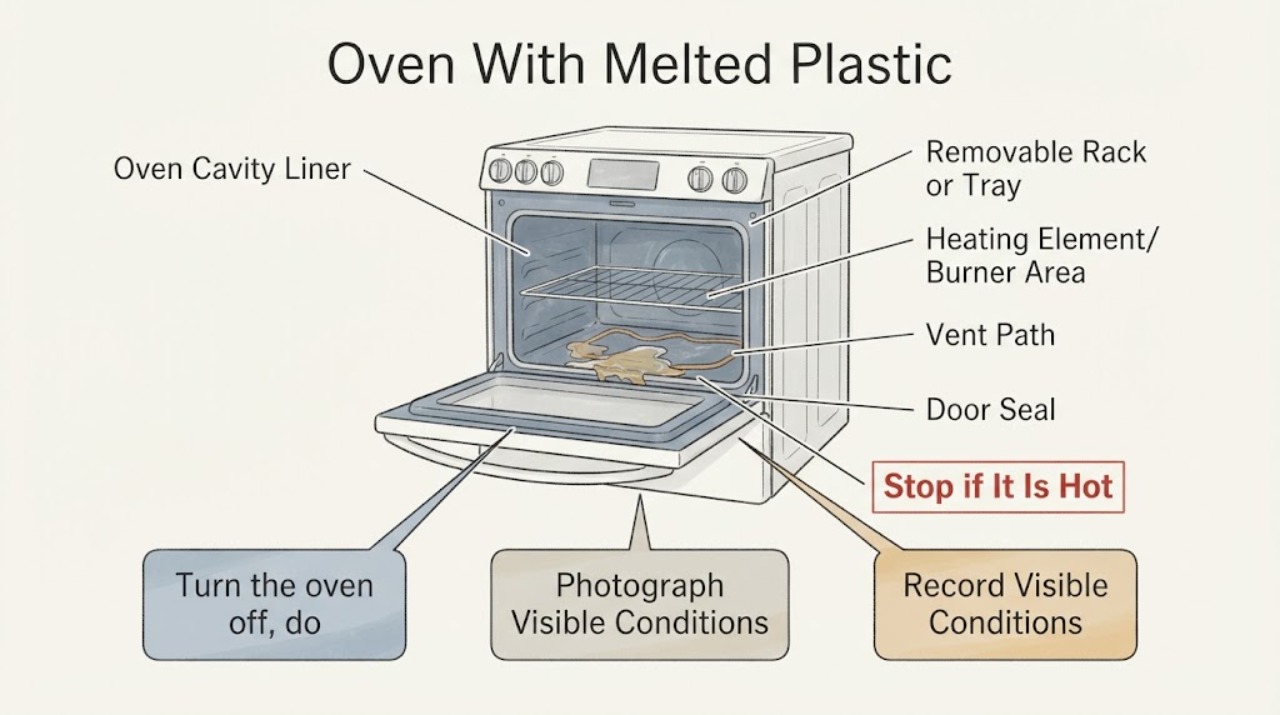
Do not turn the Kenmore oven back on or start self-clean while melted plastic remains or fumes/smoke are present. Let it cool completely, ventilate the room, remove only loose racks or accessories that the exact manual says are removable, and photograph where the plastic flowed. Kenmore's own cleaning guidance says self-cleaning uses extra-high heat and that the model owner's manual controls the procedure; it also says to collect loose debris before cleaning and to remove racks and other accessories. Plastic on a removable accessory may be a cleaning decision, but plastic bonded to the oven liner, trapped below the floor, or fallen through a burner/element opening is a service decision. The supplied Kenmore oven has no verified model, so do not scrape, heat, solvent-clean, or replace a liner/element from a different model. If there was fire, smoke, damaged wiring, a gas smell, or plastic in an inaccessible opening, keep the oven out of service and arrange qualified repair.
Work through in order
Diagnostic checks
Use only checks that match the exact appliance or system and its official guide.
-
Check 1
Turn the oven off, do not start bake, broil, steam-clean, or self-clean, and let the cavity cool completely. Ventilate the room without directing a fan into a gas flame or opening the appliance. If there is active smoke or fire, use the household emergency procedure and do not reach into the oven.
Expected result: Smoke, flames, a gas smell, continuing fumes, hot controls, or damaged cord/wiring are present, or the oven is cool with no active emission.
Next step: For fire, gas odor, smoke, damaged wiring, or strong fumes, leave the oven out of service and arrange appropriate emergency, gas, electrical, or appliance service. Otherwise continue only after the oven is fully cool.
Why this matters
Why: Active smoke, fire, gas odor, or heat/electrical damage is an immediate safety condition; a cool oven with no active emission permits only a visual identity and location check. Kenmore's cleaning guidance assumes a controlled cleaning process and does not authorize reheating unknown plastic.
-
Check 2
After cooling, remove only racks, pans, or other accessories that the exact Kenmore manual identifies as removable. Photograph the plastic and note whether it is on an accessory, the visible liner, the door/gasket, a vent, or an opening around the lower element or burner. Do not pry up the oven floor or reach through an opening.
Expected result: The plastic is limited to a removable accessory, is bonded to the visible liner, extends under or through the oven floor, touches the door seal, or cannot be seen completely.
Next step: Keep the oven off for liner, door-seal, vent, burner, element, or hidden plastic. Send the model label and photos to qualified service. Do not scrape toward an opening or use heat to make the plastic run again.
Why this matters
Why: A removable accessory can be handled according to its manual; plastic bonded to the liner or hidden below it is outside the ordinary loose-debris cleaning step. Plastic in a burner/element or vent path cannot be safely classified without the exact model and oven type.
-
Check 3
Read the complete Kenmore model number from the rating label or owner's documentation and record whether the unit is gas or electric, whether it has a hidden bake element, and whether it has self-clean or steam-clean. Do not infer these features from the exterior.
Expected result: The complete model and oven type are verified, or the model/feature identity remains unknown.
Next step: Use the exact manual to identify permitted rack/accessory removal and cleaning. If the identity is missing or the plastic is in an undocumented opening, request model-matched service rather than borrowing a procedure from another Kenmore oven.
Why this matters
Why: Kenmore says the model number is required to retrieve the correct manuals and resources. Cleaning, floor-panel access, burner/element layout, and self-clean instructions vary by model; the title alone cannot establish a safe repair route.
-
Check 4
Compare the cooled cavity with the model manual's cleaning boundary: inspect only accessible loose residue, keep heating elements, burner ports, vents, door gasket and wiring free from improvised tools or chemicals, and do not run a high-heat cleaning cycle while plastic remains unless the exact manual and service guidance explicitly permit it.
Expected result: All plastic is visibly loose and confined to a permitted removable surface, or residue is bonded/hidden/near a heat source, gasket, vent, burner or element.
Next step: For the permitted removable-surface case, follow only the exact manual and keep the part away from heat until clean. For bonded, hidden, or heat-source-adjacent plastic, stop DIY cleaning and schedule qualified inspection.
Why this matters
Why: Kenmore's public guidance covers removing loose debris and model-specific cleaning, but it does not establish that melted plastic inside an unknown cavity can be burned away. Bonded or hidden plastic can continue to smoke when heated and may involve an area the owner is not meant to access.
-
Check 5
Prepare a repair decision record with the full model, oven type, plastic source, location/depth, photos, whether the oven was gas or electric, any smoke/fire or odor after cooling, and visible damage to the liner, element, burner, vent, gasket or wiring. Do not order a replacement oven part from the symptom alone.
Expected result: The record shows a cleanable removable accessory, a damaged but identifiable model-specific component, or inaccessible/uncertain damage.
Next step: Use Kenmore's model-specific manual and repair service path. Keep the appliance out of service until a technician confirms that no plastic remains near heat, gas, electrical, vent or food-contact surfaces.
Why this matters
Why: A removable accessory may support a limited cleaning or replacement decision; inaccessible or heat-source damage requires inspection. Kenmore's customer-care page provides manuals and repair paths, but the opened generic pages do not establish part fit or whether the oven is economically repairable.
Use your observations
Decision map
Find the observation that best matches what you see, then follow the next safe action.
-
PATH 01Next step
What you see
There is fire, a gas smell, active smoke, damaged wiring, hot controls, or strong fumes after the plastic incident.
Do this next
Stop using the oven and follow the appropriate emergency, gas, electrical, and qualified-appliance-service path. Do not reopen the cavity or run another heating cycle.
Why this path and its safety boundary
Why it matters: This is a safety incident, not a routine oven-cleaning job.
-
PATH 02Next step
What you see
The plastic is fully confined to a removable rack, pan, or accessory and the exact manual permits that item to be removed and cleaned.
Do this next
Keep the accessory out of the oven while it cools and follow the exact manual's cleaning or replacement instructions. Do not heat the accessory to re-melt the plastic.
Why this path and its safety boundary
Why it matters: The oven cavity may not be damaged, but the accessory still must be clean and free of plastic before returning to heat.
-
PATH 03Next step
What you see
Plastic is bonded to the visible liner, lies under the floor, entered a lower-element or burner opening, touches the door gasket, or cannot be fully seen.
Do this next
Keep the oven out of service and arrange model-matched qualified inspection. Do not scrape toward openings, use a hair dryer/torch/solvent, remove panels, or invoke self-clean to burn it away.
Why this path and its safety boundary
Why it matters: The material is outside the safe scope of a generic cleaning tip; the exact model may have hidden heat, gas, insulation, or electrical parts below that surface.
-
PATH 04Next step
What you see
The cavity is cool, all plastic is visibly gone from permitted surfaces, there was no smoke/fire or gas/electrical symptom, and the exact manual confirms the cleaning method.
Do this next
Follow only that model's manual, ventilate as directed, and stop immediately if fumes, smoke, odor, or abnormal heating returns. If the manual does not address the incident, use qualified service before heating the oven again.
Why this path and its safety boundary
Why it matters: A limited cleanup may be reasonable, but the official Kenmore guidance still makes the model manual the controlling instruction for self-clean or manual cleaning.
Helpful context
Understand the symptom
The first decision is location, not the age of the oven
A plastic utensil or tray can leave a very different problem depending on whether it stayed on a removable rack, bonded to the visible liner, or flowed through an opening toward a burner or element. The exact Kenmore model and whether the oven is gas or electric were not supplied. Kenmore's manual page requires the complete model number for the correct owner's guide, so do not copy a floor-removal or burner-access procedure from another Kenmore range.
Why self-clean is not the first test
Kenmore describes self-clean as a high-heat process and says to follow the directions for the specific model. The newer Kenmore cleaning guide describes temperatures around 850–950°F and says to remove racks and accessories and wipe away loose debris first. Those instructions are for ordinary baked-on soil; they do not verify that an unknown amount of melted plastic can safely be heated again. Keep the oven off until the plastic is removed from accessible surfaces under the exact manual or a technician confirms that the appliance is safe.
Repair versus replacement depends on hidden damage
A repair decision needs the model, oven type, plastic location, and evidence of damage to the liner, element, burner, insulation, wiring, vent, or door seal. If only a removable accessory is affected and the manual permits cleaning or replacement, that is a different case from plastic under a sealed oven floor or inside a gas-burner path. Do not choose replacement based only on the smell or a photograph; give the full identity and photos to model-matched service.
When checks do not resolve it
Need a professional?
Arrange qualified repair before further heating if plastic is bonded to the liner, under the floor, in a burner/element or vent opening, near the door gasket or wiring, or if there was fire, smoke, gas odor, damaged controls, or persistent fumes. Keep the oven off and do not use self-clean as a test. A removable accessory is the only limited cleanup branch, and it still requires the exact Kenmore manual.
Common questions
FAQ
Can I run the self-clean cycle to burn the melted plastic away?
Do not do that while the plastic remains or its location is uncertain. Kenmore describes self-clean as an extra-high-heat process and says to follow the exact model's manual; the opened guidance does not authorize burning unknown plastic out of a liner, burner path, vent, or hidden cavity.
Is a Kenmore oven ruined if plastic melted on the bottom?
Not automatically. The decision depends on whether the plastic is limited to a removable accessory, bonded to the visible liner, or hidden near a heat source or gas/electrical opening. Confirm the complete model and have inaccessible or heat-source-adjacent residue assessed before deciding to repair or replace the appliance.
What should I tell the repair technician?
Provide the complete model number, gas or electric type, what melted, where it flowed, whether it entered an opening, photos, and any smoke, fire, fumes, gas odor, or visible damage. Kenmore's manual and customer-care pages route support by model, so do not rely on the short brand name alone.
Read the exact guide
Official sources
- Oven Cleaning Tips & TricksKenmore Livemore · Official Kenmore-owned Livemore page used for the high-heat/self-clean model-manual caveat, removable rack/accessory handling and collecting loose debris. It is not a model-specific melted-plastic procedure.
- Find Your Manual | Kenmore Appliance Manuals & GuidesKenmore · Official Kenmore manual portal used to establish that the complete model number is required for the correct oven manual and that oven manuals cover cleaning, parts and resources. It does not provide a melted-plastic repair procedure for this unidentified oven.
- Hot Oven Cleaning Tips and TricksKenmore Livemore · Official Kenmore-owned Livemore page used for the documented high-heat nature of self-clean, removing accessories, wiping loose debris and cooling/ventilation. It does not prove that melted plastic may be safely reheated or burned away.
- Customer Care & Support | Kenmore AppliancesKenmore · Official Kenmore customer-care page used for model-specific manuals and repair-service routing. It does not identify a failed part or authorize a generic oven-cavity repair.
Community feedback
Share a repair observation
Share a plain-text repair observation. Accepted observations are published automatically; this page may take a moment to update.