
On this page
Start here
Quick answer
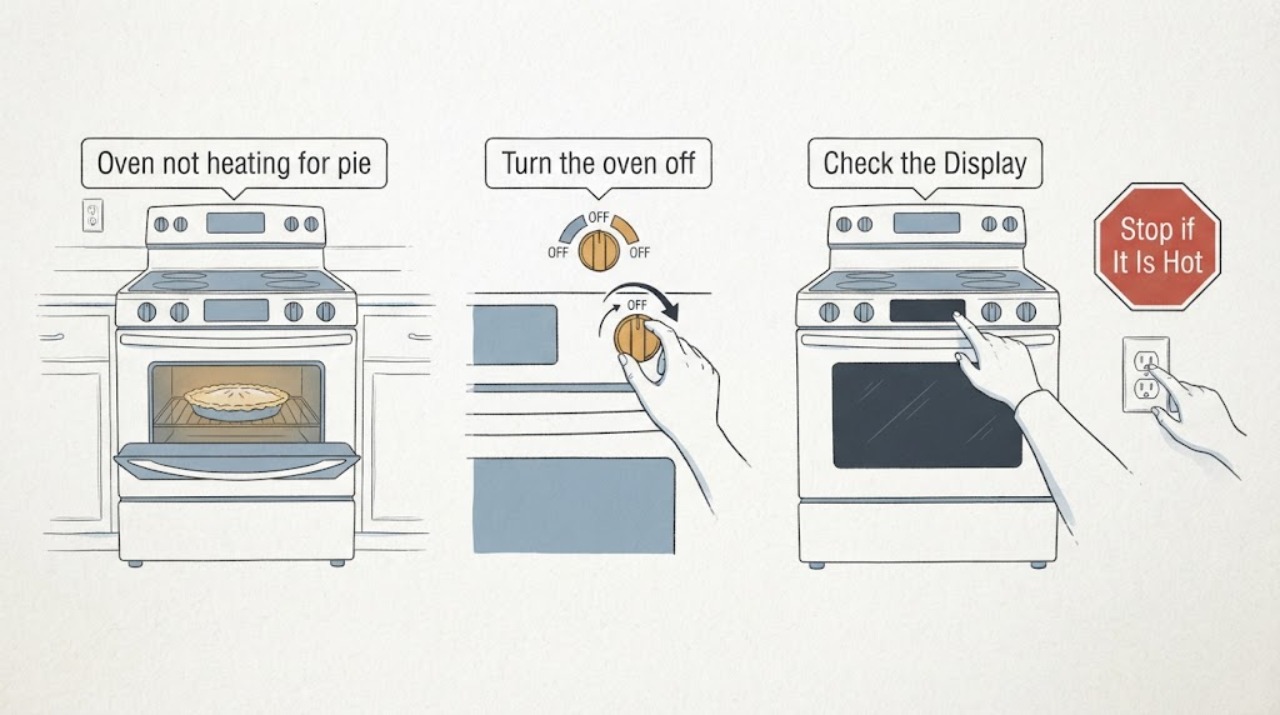
The assigned Kenmore 665.95142300 record is identified in appliance-service references as an electric range/oven, but verify the full model and serial plate before applying any 665-family instruction. For a pie crust that stays raw, first confirm that the oven is in Bake—not a cooktop, Broil, Delay Start, or self-clean function—set a temperature and press the model-specific Start/Enter control. With the oven cool, check only visible door closure, the external power/breaker condition, and whether the bake element shows obvious damage; do not remove panels or perform live tests. If the display is blank, the breaker trips, the cord or terminal area is hot or damaged, the element is visibly arced, or the oven still will not heat after the correct mode is confirmed, stop using it and arrange qualified range service. Do not order a bake element, sensor, or control from the symptom alone.
Work through in order
Diagnostic checks
Use only checks that match the exact appliance or system and its official guide.
-
Check 1
Turn the oven off and let it cool. Read the model and serial plate, usually behind or around the storage drawer on this style of range, and compare the complete string with 665.95142300. Confirm that the appliance is an electric range/oven rather than a different Kenmore 665 appliance.
Expected result: The plate either matches 665.95142300 and identifies the expected electric range, or it shows another model, an incomplete number, or a different appliance.
Next step: Use only the exact model entry in Kenmore's official manual portal. If the identity is incomplete or different, stop this procedure and obtain the correct manual or service help.
Stop if: Do not apply instructions from a 665 dishwasher, another 665 range suffix, or an unverified generic oven manual.
Why this matters
Why: A single missing digit can change the wiring, control layout, heating parts, and manual. If the plate does not match, the assigned topic cannot safely determine the oven procedure.
-
Check 2
With the door closed and the oven cool, select the exact model's Bake function, set a temperature appropriate to the recipe, and press the documented Start/Enter control. Check that the display shows an active bake/preheat state rather than Delay Start, Cook Time only, Broil, Self-Clean, or a locked/disabled control.
Expected result: The display either enters Bake/preheat normally, stays idle or delayed, shows a fault/lock, or accepts the setting but produces no heat.
Next step: Correct only a clearly documented user setting once. If Bake is active but no heat develops, turn the oven off and continue with external checks and service escalation.
Stop if: Do not start Self-Clean to test heating, repeatedly press keys, bypass a lock, or leave the oven unattended while trying an uncertain mode.
Why this matters
Why: A wrong mode or unstarted timed function can make the pie crust remain raw without proving a failed heater. An active Bake command with no heat shifts concern toward the power/heating/control path, which is not safely diagnosed by changing random settings.
-
Check 3
From outside the appliance, inspect the plug, cord, outlet, and household breaker/fuse area only when cool and dry. Note whether the display and interior light have power and whether the breaker has tripped; do not open the terminal block or disturb electrical connections.
Expected result: A powered display with an intact external supply differs from a blank display, a tripped breaker, a hot or scorched cord/outlet, repeated trips, or a burning smell.
Next step: If the supply is visibly normal, use only the exact manual's safe user reset once. For a trip that returns, damaged supply, smoke, odor, or arcing, leave the range off and call a qualified electrician or appliance technician.
Stop if: Do not reset a breaker repeatedly, use an adapter or extension cord, bypass grounding, remove the rear cover, or perform a live electrical test.
Why this matters
Why: An electric range needs a high-power supply, and an interruption can prevent both bake elements from heating. A repeat trip, heat, scorch, or odor is an electrical hazard rather than a pie-baking adjustment.
-
Check 4
After power is isolated only by a safe, external means and the oven is fully cool, inspect the visible bake element and door area without removing panels. Look for a clear hole, blister, broken section, loose visible damage, a door that cannot close, or a seal that is visibly displaced.
Expected result: The element and door appear intact, or there is obvious element damage, a misaligned/open door, scorching, or damage near wiring.
Next step: Close and align the door only if it is a simple external obstruction. If damage is visible or the oven still does not heat, arrange qualified range service rather than removing the element or control.
Stop if: Do not touch terminals, remove the element, defeat the door switch, scrape insulation, or energize the oven with exposed wiring.
Why this matters
Why: A visible heater failure or door problem can explain poor baking, but an intact element does not prove the element, sensor, relay, or control is good. A damaged or scorched area creates a stop-use condition.
-
Check 5
Prepare a service handoff with the exact 665.95142300 model and serial, the selected mode and displayed state, whether the display and light had power, breaker history, the pie-crust symptom, visible element/door findings, and any smoke, smell, scorch, or sparking.
Expected result: A correctly identified electric range that accepts Bake but never heats, a repeat power failure, or a component that would need internal testing is a persistent repair symptom.
Next step: Keep the oven off and arrange qualified Kenmore/range service. Ask the provider to verify the complete model, supply, heating circuit, control, sensor, and door interlock before naming a component.
Stop if: Do not order or install a bake element, sensor, relay, or control board from the symptom alone, and do not continue cooking in an oven that is arcing, overheating, or electrically unstable.
Why this matters
Why: The external checks narrow the problem but cannot distinguish a bake element, sensor, relay/control, wiring, or supply fault safely. Selecting a part from “not heating” alone risks a wrong fit and live electrical exposure.
Use your observations
Decision map
Find the observation that best matches what you see, then follow the next safe action.
-
PATH 01Next step
What you see
The plate matches 665.95142300, the exact manual confirms the electric range controls, Bake starts normally, and the oven heats after a corrected mode or start command.
Do this next
Use the exact manual and recipe timing, avoid repeated door opening, and monitor whether the no-heat symptom returns.
Why this path and its safety boundary
Why it matters: The pie-crust failure was more consistent with an unstarted or incorrect user setting than a proven component failure.
-
PATH 02Next step
What you see
Bake is active on the correctly identified electric range but there is no heat, the display is abnormal, or the symptom returns after one safe external power/mode check.
Do this next
Turn the oven off, protect against further failed cooking, and arrange qualified service with the model/serial and observed state.
Why this path and its safety boundary
Why it matters: A heating-circuit, sensor, control, wiring, or power problem remains possible, but the external symptom cannot identify the failed part.
-
PATH 03Next step
What you see
There is smoke, burning odor, arcing, scorching, a hot/damaged cord or outlet, repeated breaker trips, exposed wiring, or an oven door that cannot close safely.
Do this next
Stop using the range. If safe, isolate power externally without touching damaged parts; otherwise leave the area and obtain qualified emergency/electrical service.
Why this path and its safety boundary
Why it matters: This is an immediate electrical, fire, or heat-containment stop condition, not a calibration or pie-baking problem.
Helpful context
Understand the symptom
Why the 665 prefix is not enough by itself
The exact assigned string is Kenmore 665.95142300 (entered as 66595142300 in a manual lookup). Service references identify that number as an electric range/oven, which fits the pie-crust symptom, but Kenmore's public manual portal requires the full model entry and does not make every 665-family control sequence interchangeable. Confirm the rating plate and the appliance's electric range identity before using instructions. A pie that remains unbaked can result from a wrong mode, a control action that was not started, a power problem, an open door, or an internal heating/control fault; the visible symptom does not identify one part.
When checks do not resolve it
Need a professional?
Call when Bake is active but the oven remains cold, the model or manual cannot be confirmed, the display is abnormal, the breaker trips again, or internal testing would be needed. Stop immediately for smoke, burning odor, arcing, scorching, hot/damaged supply, exposed wiring, or a door that cannot contain heat.
Have this ready
- Provide the full 665.95142300 model and serial, country, exact mode/start state, display behavior, power/breaker observations, visible element and door findings, the pie-crust result, and any odor, smoke, scorch, or spark.
Common questions
FAQ
Is Kenmore 665.95142300 actually an oven?
Service references identify 665.95142300 as an electric range with an oven, but confirm the complete rating plate before using any instructions. Kenmore's official portal requires the full model number without punctuation and supports separate oven/range manuals; a different 665 number must not be treated as the same appliance.
What should I check first when the oven will not heat a pie crust?
Confirm the exact model, select the documented Bake function, set a temperature, press the documented Start/Enter control, and verify the display is not delayed, locked, or in another mode. Then make only safe external power and door/visible-element observations.
Can I replace the bake element based only on the no-heat symptom?
No. A no-heat symptom can involve mode selection, supply, wiring, the element, sensor, relay/control, or door interlock. Do not remove panels or test live circuits; have the exact model and heating circuit diagnosed before choosing a part.
Read the exact guide
Official sources
- Kenmore ManualsKenmore · Opened Kenmore's official manual portal. It requires entering the model without special characters, states that model numbers are at least 11 characters, and provides manuals for ovens and ranges. The assigned 665 95142300 record is identified in appliance-service research as an electric range/oven, but the full rating plate and exact portal result must remain the identity check before using model-specific instructions.
Community feedback
Share a repair observation
Share a plain-text repair observation. Accepted observations are published automatically; this page may take a moment to update.