
On this page
Start here
Quick answer
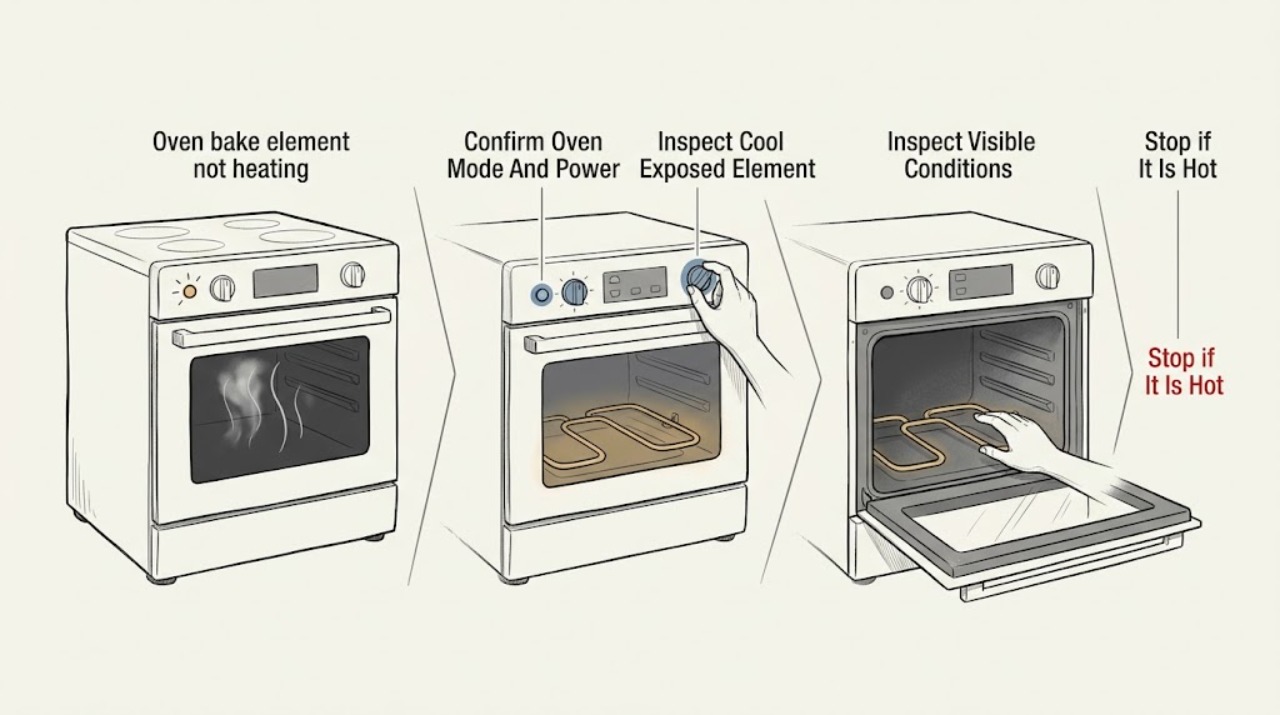
If an oven bake element is not heating, first confirm the Bake mode and temperature, check that the door closes, and observe from a safe position whether an exposed electric element ever activates during a normal bake request. After the oven is completely cool, look for a break, blister, hole, or severe damage without touching the element. A dark element at one instant may be a normal off-cycle; a lasting dark or damaged element can also reflect a control, wiring, sensor, power, or element fault. Gas ovens use a burner and igniter rather than the same exposed electric-element check. Do not remove panels, test live voltage, pull wiring, handle gas components, or touch a hot element. Stop using the appliance and arrange qualified service for a damaged or inactive element, an error that persists, smoke, sparks, arcing, burning odor, gas odor, abnormal flame, or a repeated breaker trip.
Before you begin
Safety first
- Owner checks are limited to ordinary controls, cool visual inspection, user-accessible rack and door observations, and safe external flame context where the model manual permits. A qualified technician must handle element removal, wiring, electrical measurements, sensors, controls, burners, igniters, gas, and cabinet access.
Work through in order
Diagnostic checks
Use only checks that match the exact appliance or system and its official guide.
-
Check 1
Read the control panel and confirm Bake, the intended temperature, timer or delayed-start state, and a fully closed door. Note whether the display, interior light, and other oven functions respond normally; do not open a control cover.
Expected result: Record a correct Bake request with an active display, a wrong mode or delayed start, a door that does not close, a blank display, an error code, or other functions that also fail.
Next step: Correct only an obvious user setting and observe one normal bake request. If the element remains inactive, the door is unsafe, an error persists, or the display or power behavior is abnormal, stop and arrange appliance service.
Stop if: Stop for smoke, sparks, arcing, burning odor, gas odor, an abnormal flame, exposed wiring, or a hot or buzzing control area.
Why this matters
Why: A setting, door, control, or power issue can look like a failed bake element. If the oven accepts Bake but the element never activates, the element, relay, sensor, wiring, or supply remains possible; the control symptom alone does not identify a part.
-
Check 2
After the oven has fully cooled, look at an exposed electric bake element from its normal visible position. Do not touch it, remove it, loosen mounting, pull wires, or use this check on a hidden element or gas burner without model-specific manual permission.
Expected result: Record an intact element, a visible break, blister, hole, severe discoloration, sagging, a hidden element, or an element that is inaccessible without tools.
Next step: Leave a damaged, hidden, or uncertain element for qualified appliance service. Do not attempt to remove or replace it based only on appearance.
Stop if: Do not touch the element, remove panels, disconnect terminals, or perform live voltage or resistance tests.
Why this matters
Why: A visible defect makes element damage more likely, but an intact element can still have an internal or circuit fault. A hidden or tool-access element requires service rather than a cabinet-access experiment.
-
Check 3
From a safe position during one ordinary Bake request, observe whether an exposed electric bake element activates according to the model manual and whether the oven indicates preheat. Do not repeatedly open the door or restart an appliance showing a hazard.
Expected result: Record normal activation and cycling, no activation, heating in only part of a damaged element, slow or absent preheat, an error display, or smoke, sparking, or unusual noise.
Next step: Stop using the oven and request service for an inactive or damaged element, persistent no-heat, an error, or abnormal heating. Do not reproduce a dangerous symptom.
Stop if: Stop immediately for smoke, sparks, arcing, burning odor, gas odor, an abnormal flame, or a loud electrical sound.
Why this matters
Why: Normal cycling makes a permanently failed element less likely, although it does not rule out weak output, a sensor, control, wiring, or power issue. No activation or abnormal heating makes the element or its circuit more likely, but it still requires de-energized professional testing.
-
Check 4
Identify whether the appliance is electric or gas from the model manual and ordinary controls before interpreting the heating observation. For a gas oven, limit the check to a safe visual observation of the normal burner behavior only if the manual allows it; never manually ignite or disturb the igniter or burner.
Expected result: Record an electric oven with an exposed or hidden element, a gas oven with normal ignition, no ignition, an abnormal flame, gas odor, or uncertainty about the fuel type.
Next step: For a gas ignition or flame problem, stop using the oven and arrange qualified appliance or gas service. For an electric oven, continue only with safe external observations and service handoff.
Stop if: Do not manually ignite gas, reach into the burner area, remove panels, or continue use with gas odor or an abnormal flame.
Why this matters
Why: A gas oven's no-heat path can involve the igniter, burner, safety valve, control, or gas supply, so an electric bake-element diagnosis does not transfer. Gas odor or abnormal flame is a safety issue, not a DIY test result.
-
Check 5
After cooling, check that the door closes and the visible gasket is not torn, displaced, or blocked. Confirm that foil or coverings are not blocking the oven floor or racks and that pans are not overcrowded; do not remove a fan or rear cover.
Expected result: Record a sound door and seal with clear airflow, a door gap, damaged gasket, blocked vent or covering, crowded pans, or a fan that is noisy or absent when the model says it should run.
Next step: Remove only an obvious user-added covering or obstruction after cooling. Request service for a damaged seal, unsafe door, abnormal fan, or persistent no-heat.
Stop if: Do not reach toward a fan, remove a cover, disassemble the door, or operate with loose parts, exposed insulation, smoke, or an unsafe door.
Why this matters
Why: Heat loss and restricted circulation can mimic a bake-element failure or make food appear underheated. A sound door and airflow with no element activation keeps element, control, sensor, and power paths more likely.
-
Check 6
Prepare an appliance service request with the model if safely visible, electric or gas configuration, mode and temperature, display or error, element appearance and activation, door and seal condition, fan or airflow observations, power events, and when the no-heat symptom began.
Expected result: Confirm that the record includes external observations only and that no element, panel, wiring, terminal, sensor, burner, igniter, or fan was disturbed.
Next step: Request qualified appliance diagnosis and let the technician test the element circuit, controls, sensor, power, door, and any gas components using model-specific procedures.
Stop if: Stop all user troubleshooting when the next step requires panel access, electrical measurements, element removal, gas work, burner or igniter access, or fan work.
Why this matters
Why: This record helps a technician separate a failed bake element from relay or control, wiring, sensor, power, door, fan, and gas-ignition causes without asking the owner to make a hazardous diagnosis.
Use your observations
Decision map
Find the observation that best matches what you see, then follow the next safe action.
-
PATH 01Next step
What you see
Bake is not selected, delayed start is active, the door does not close, or a visible seal or setup problem is present without smoke, gas odor, sparks, or exposed wiring.
Do this next
Correct only the documented user setting or obstruction after cooling. If the oven still does not heat, request appliance service rather than assuming the element is failed.
-
PATH 02Next step
What you see
A fully cool exposed electric bake element has a crack, blister, hole, severe discoloration, or never activates during the model's normal Bake behavior.
Do this next
Stop using the oven and arrange qualified appliance service for element and circuit diagnosis. Do not remove, wire, or live-test the element.
-
PATH 03Next step
What you see
The element appears intact and cycles or the element is hidden, but the oven remains cold or does not complete preheat.
Do this next
Request service to check element output, sensor, control or relay, wiring, power, and model-specific safety functions. A normal-looking element does not prove the circuit is healthy.
-
PATH 04Next step
What you see
The appliance is gas-fired and the burner does not ignite normally, the flame is abnormal, or gas odor is present.
Do this next
Stop using the oven, keep clear, and arrange qualified appliance or gas service. Do not manually ignite, disturb the burner or igniter, or transfer electric-element instructions to the gas appliance.
-
PATH 05Next step
What you see
There is smoke, sparks, arcing, burning odor, exposed wiring, a hot or buzzing control area, or a repeated breaker trip.
Do this next
Stop using the appliance and keep clear. Use appropriate emergency, electrical, or appliance help from a safe location; do not reset repeatedly or reopen the oven.
Helpful context
Understand the symptom
A bake element that is dark once is not automatically failed
Electric ovens cycle the bake element on and off to maintain temperature, and the broil element may also be energized periodically during Bake. Therefore, one glance at a dark element does not prove a fault. More useful evidence is a lasting dark element during a normal bake request, a visible break or blister after the oven is fully cool, no preheat, or an error that persists. Even then, the failed path could be the element, wiring, relay or control, sensor, or power supply rather than the coil alone.
Keep checks to cool visual observations and ordinary controls
Confirm the selected Bake mode, temperature, timer or delayed start, and a fully closed door using the model manual. After cooling, inspect an exposed electric element from its normal visible position for a break, blister, hole, or severe discoloration. Do not remove a cover or test voltage. A gas oven has a burner and igniter path, so an electric-element glow check does not apply; gas and flame concerns belong with qualified service.
The replacement part is conditional
A bake element should be replaced only after a technician confirms the element and exact model fit. A normal-looking or non-glowing element can still have an internal, wiring, control, sensor, or supply problem, while a visible defect supports but does not replace a complete diagnosis. Whirlpool directs users to licensed professional service for damaged or inactive elements and cautions that gas and electrical faults need appropriate expertise.
Safety boundary
Stop conditions
- Do not touch a hot bake element, remove an element or cabinet panel, pull wiring, test live voltage, or open the control area.
- For a gas oven, do not manually ignite or disturb the burner or igniter, and do not continue operation when gas odor or an abnormal flame is present.
- Stop using the oven for smoke, sparks, arcing, burning odor, exposed wiring, a repeated breaker trip, an unsafe door, or persistent abnormal heating.
Only after diagnosis
Potential parts
- oven bake element
Consider an element only when a qualified technician confirms element damage or circuit failure; no heat can also come from controls, wiring, sensor, power, door, or gas paths.
Confirm the exact oven model, element shape, terminals, mounting, voltage, wattage, and manufacturer-approved fit before sourcing a replacement. - oven control or relay component
Consider a control or relay only if service testing shows it is not sending the proper bake request after the element and sensor are evaluated.
Confirm model-specific control revision, connector, voltage, and manufacturer-approved fit through qualified service before replacement. - oven temperature sensor or gas igniter
Consider a sensor for an electric oven only after testing confirms temperature feedback failure; consider a gas igniter only for a confirmed gas ignition fault. Neither is established by a dark element alone.
Confirm whether the appliance is electric or gas, then match the exact model, connector, mounting, electrical specification, and manufacturer-approved fit; do not replace gas or electrical parts as a homeowner step.
When checks do not resolve it
Need a professional?
Call a qualified appliance technician when the bake element is damaged, inactive, hidden and inaccessible, the oven does not heat or preheat after safe setting checks, or the problem persists with a sound door and correct setup. Stop immediately and keep clear for smoke, sparks, arcing, burning odor, gas odor, abnormal flame, exposed wiring, unsafe door, or a repeated breaker trip; use appropriate emergency, gas, electrical, or appliance help.
Safety scope: Owner checks are limited to ordinary controls, cool visual inspection, user-accessible rack and door observations, and safe external flame context where the model manual permits. A qualified technician must handle element removal, wiring, electrical measurements, sensors, controls, burners, igniters, gas, and cabinet access.
Have this ready
- Give the technician the model if safely visible, electric or gas configuration, mode and temperature, display or error, element activation and appearance, door and seal condition, fan or airflow observations, power events, and symptom history.
Common questions
FAQ
Why is my oven bake element not heating?
Possible paths include a damaged element, control or relay, wiring, sensor, power supply, door issue, or a gas igniter and burner if the appliance is gas. A safe visual check can narrow the handoff, but it cannot identify the failed part.
Does a dark bake element mean it is broken?
Not always. Electric bake elements cycle on and off during normal bake operation. A lasting dark element, visible break or blister, or failure to activate during a normal Bake request needs qualified diagnosis.
Can I replace the bake element myself?
Do not remove panels, pull wiring, or test live voltage as a general homeowner step. Inspect only a fully cool exposed element from its normal visible position if the manual permits, then let a qualified technician confirm the element and exact fit.
What should I check before blaming the element?
Confirm Bake mode, temperature, timer or delayed start, a fully closed door, and the model's rack and airflow guidance. A blank display, persistent error, damaged seal, or blocked airflow can cause no-heat symptoms without an element failure.
Does this apply to a gas oven?
Only the general control and safety observations apply. Gas ovens use an igniter, burner, safety valve, and controls rather than the same exposed electric bake-element path. Do not manually ignite or disturb gas components.
When should I stop using the oven immediately?
Stop for smoke, sparks, arcing, burning odor, gas odor, an abnormal flame, exposed wiring, an unsafe door, a hot or buzzing control area, or a repeated breaker trip. Keep clear and use appropriate emergency, gas, electrical, or appliance help.
Read the exact guide
Official sources
- What to Do If Your Gas Oven Is Not HeatingWhirlpool · Whirlpool gas-oven guidance used to separate gas ignition from electric bake-element checks; model instructions govern.
- 9 reasons why your oven is not turning onWhirlpool · Whirlpool consumer oven guidance used for general no-heat checks; the exact model manual and qualified service procedures govern repairs.
- 6 Reasons Why Your Oven Is Not Baking ProperlyWhirlpool · Whirlpool consumer guidance used for setup and differential context around a no-heat report; exact model service procedures govern.
- Troubleshooting guide for Samsung built-in ovenSamsung · Samsung built-in oven guidance used for general no-heat and heat-retention context; exact model instructions take precedence.
- Electric Range Operation of the Elements During BakeGE Appliances · GE Appliances support guidance used only to explain normal electric element cycling; it is not a universal model-specific repair procedure.
Community feedback
Share a repair observation
Share a plain-text repair observation. Accepted observations are published automatically; this page may take a moment to update.