
On this page
Start here
Quick answer
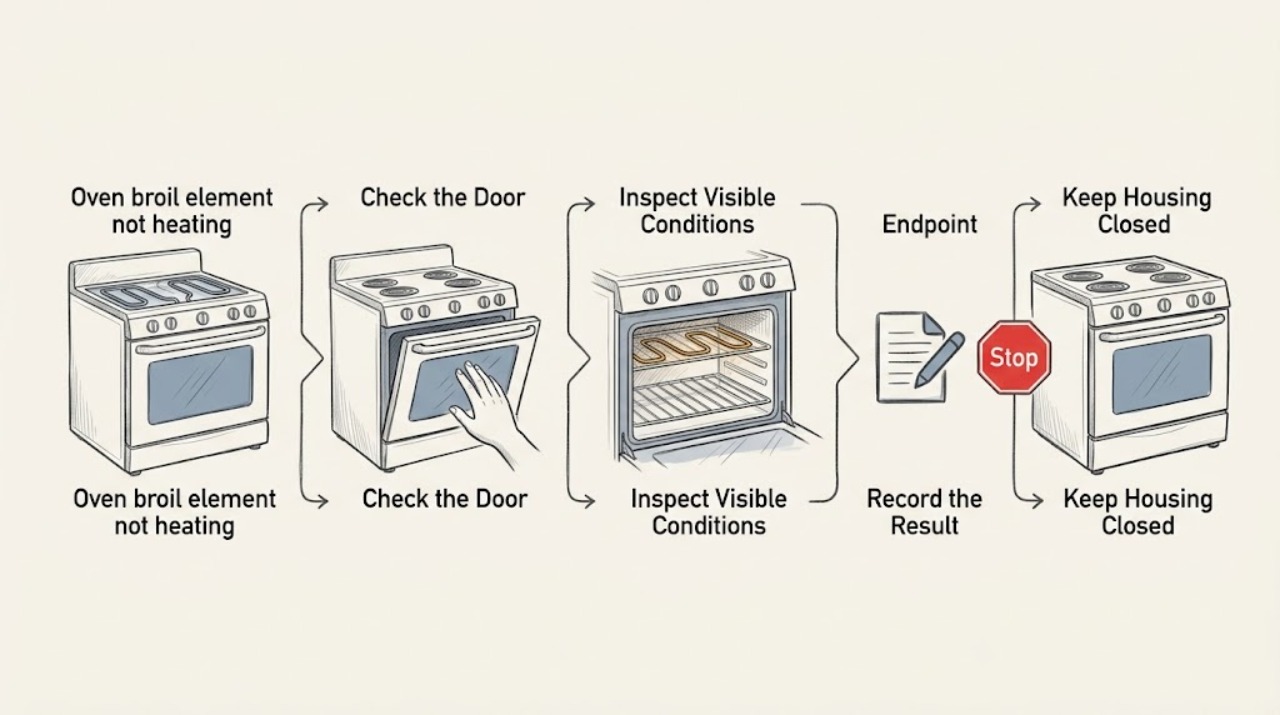
A broil element that appears not to heat may be operating in a cycle, may not glow even when it is producing heat, or may have a failed element, control, sensor, door-position, or power circuit. Select the exact broil mode and follow the model manual's door and start instructions; observe the upper element only after the oven is clear and without touching it. With the oven cool and power isolated only as the manual permits, look for a blister, crack, hole, sag, or separated section. Do not remove the element, measure live voltage, or run the oven with a damaged element. If the upper element never heats in the correct broil mode, the breaker trips, sparks appear, the element is damaged, or the oven has a burning smell, stop using the oven and arrange qualified appliance service.
Before you begin
Safety first
- Element replacement, live electrical testing, control diagnosis, wiring work, and door-interlock repair require a trained appliance technician. The user can verify the mode, inspect a cool exposed element, and record normal-versus-abnormal operation without opening the oven cabinet.
Work through in order
Diagnostic checks
Use only checks that match the exact appliance or system and its official guide.
-
Check 1
Use the oven's exact owner manual to select BROIL, confirm the required Start command, and follow the model's specified door position; do not infer broil behavior from Bake or another oven.
Expected result: The oven is in a confirmed broil cycle with the required door position, or it is in Bake, a different mode, or an unconfirmed control state.
Next step: Correct only the control or door-position setting described by the manual. If the confirmed broil cycle still produces no heat, continue with the cool visual check and arrange service if the issue persists.
Why this matters
Why: The upper element may not be commanded in another mode, and some models turn the element off when the door is opened or when the target temperature is reached. A correct mode is needed before judging the element.
-
Check 2
With the oven fully cool and the controls off, look at the exposed upper broil element without touching it; check for blisters, cracks, holes, sagging, or a separated section.
Expected result: Visible damage is present, or the element appears intact.
Next step: Do not use the oven if the element is damaged. Photograph the damage and arrange qualified appliance service; do not remove or bend the element or pull its wires.
Why this matters
Why: A damaged sheath or separated section makes an element failure more likely. An intact appearance does not prove that the element, wiring, relay, sensor, or power circuit is healthy.
-
Check 3
Run the model-approved broil cycle only long enough to observe the element from a safe position, without touching the cavity or using a hand to test temperature; note whether it heats, glows, cycles, or stays cold.
Expected result: The element heats and cycles, heats without a visible glow, never heats, or sparks or ruptures.
Next step: Stop the cycle for a cold, damaged, sparking, or ruptured element and arrange service. Do not repeat the test or use a multimeter on energized parts.
Why this matters
Why: Heating with intermittent or absent glow can be normal on some models. A cold element in a confirmed broil cycle keeps the element, wiring, control, sensor, door interlock, or supply circuit in consideration; sparking or rupture indicates a fault.
-
Check 4
Note whether the Bake function heats normally and whether the oven display, interior light, and other oven controls operate, using only the normal controls and the manual's instructions.
Expected result: Bake works while Broil does not, both Bake and Broil fail, or the oven has wider control or power symptoms.
Next step: Record the comparison and model information for a technician. Do not open the control panel or reset a repeatedly tripping breaker as a repair attempt.
Why this matters
Why: A broil-only failure makes the broil element or its dedicated control path more likely. Failure of multiple heating functions or controls raises concern about the supply, wiring, control, or interlock and cannot be narrowed safely from the cavity.
-
Check 5
Watch for sparks, smoke, a burning odor, a breaker trip, unusual heat at the controls, or a door that will not close or latch during or after the broil attempt; do not continue cooking to see whether the symptom clears.
Expected result: Any spark, smoke, burning smell, breaker trip, abnormal heat, or door/interlock problem occurs.
Next step: Turn the oven off, leave it out of service, and arrange qualified appliance service. If there is smoke, fire, active sparking, or an immediate electrical hazard, isolate power only if safe and use emergency assistance.
Why this matters
Why: The element or oven may have an electrical, thermal, or door-safety fault beyond a simple visible element check.
Use your observations
Decision map
Find the observation that best matches what you see, then follow the next safe action.
-
PATH 01Next step
What you see
The oven is not in the confirmed Broil mode or the model requires a door position or Start command that was not followed.
Do this next
Follow the exact manual's broil sequence once. If the element remains cold in the confirmed cycle, stop repeated testing and arrange service.
Why this path and its safety boundary
Why it matters: The apparent failure may be a mode or door-position condition rather than a failed broil element.
-
PATH 02Next step
What you see
The correct broil cycle is active, the element stays cold, Bake still works, and no spark or visible damage is present.
Do this next
Keep the oven out of service and arrange qualified appliance diagnosis. Do not remove the element or test voltage at its terminals.
Why this path and its safety boundary
Why it matters: A broil-element circuit problem is more likely, including the element, connection, control, sensor logic, or door interlock; the failed part cannot be identified from cold appearance alone.
-
PATH 03Next step
What you see
The element heats intermittently or without a red glow, the oven reaches its expected broil behavior, and no performance or safety symptom is present.
Do this next
Use the manual's expected cooking behavior as the reference. Arrange service if food does not brown, the cycle never produces heat, or the behavior is new or worsening.
Why this path and its safety boundary
Why it matters: Cycling or low visible emissive glow can be normal for some models, so glow alone does not prove a failed element.
-
PATH 04Next step
What you see
The upper element has a blister, crack, hole, sag, rupture, or visible sparking, or the oven trips its breaker during Broil.
Do this next
Stop using the oven and arrange qualified repair. Leave a repeatedly tripping breaker off and do not replace it with a larger device or keep resetting it.
Why this path and its safety boundary
Why it matters: An element failure or electrical fault is likely, and continued operation could worsen the damage.
-
PATH 05Next step
What you see
Bake and Broil both fail, the display or controls lose power, the door interlock behaves abnormally, or a burning odor, smoke, or active sparking occurs.
Do this next
Keep the oven off and arrange qualified appliance or electrical service. For smoke, fire, or active sparking, isolate power only if safe and use emergency assistance.
Why this path and its safety boundary
Why it matters: A broader supply, control, wiring, or safety problem is more likely than an isolated broil-element failure.
Helpful context
Understand the symptom
First verify what broil should look like on this oven
Broil behavior is model-specific. Some ovens cycle the element as temperature changes, and a powered element may not glow red throughout the cycle. Some models also require a particular door position or a confirmed Start command. Use the exact manual before deciding that a lack of visible glow means no heat.
Inspect only a cool, visibly accessible element
After the oven is fully cool and the controls are off, look for obvious damage on an exposed upper element. Blisters, cracks, holes, sagging, or a separated section make failure more likely. Do not bend the element, remove mounting screws, pull wires, or access live terminals.
Separate a broil-only fault from a wider oven power problem
If bake works but broil does not, the broil element, its wiring, relay, sensor logic, or control path remains in consideration. If multiple oven functions fail or the breaker trips, the power supply or control problem may be broader. These are diagnostic clues, not permission to test voltage or replace a component without model identification.
Do not keep using an element that shows a fault
A damaged element can rupture or arc, and GE recommends not using the oven when a bake or broil element fails. Stop if there are sparks, smoke, a burning odor, a tripped breaker, or visible damage. Surface burners may be a separate system on some ranges, but follow the appliance manual and keep the oven itself out of service until it is assessed.
Safety boundary
Stop conditions
- Do not remove the broil element, pull its wires, measure live voltage, open the control panel, bypass the door interlock, or continue operating with a damaged element.
- Keep the oven out of service and arrange qualified appliance repair when the broil element stays cold in the correct mode, the breaker trips, the element is damaged, or more than one heating function fails.
- If there is smoke, fire, active sparking, a burning odor, severe heat, or an immediate electrical hazard, isolate power only if safe, leave the area as appropriate, and use emergency assistance.
Only after diagnosis
Potential parts
- oven broil element
Consider this only if a qualified diagnosis or the exact model documentation confirms that the broil element itself is open, damaged, or not heating in the correct cycle.
Broil elements are model-specific; confirm the oven model and manufacturer's fit information before selecting a replacement.
When checks do not resolve it
Need a professional?
Safety scope: Element replacement, live electrical testing, control diagnosis, wiring work, and door-interlock repair require a trained appliance technician. The user can verify the mode, inspect a cool exposed element, and record normal-versus-abnormal operation without opening the oven cabinet.
Common questions
FAQ
Should the broil element always glow red?
No. GE notes that a broil element may be heating without a visible glow and may cycle off as the oven reaches its target. Use the exact model's expected broil behavior and actual heat or cooking result rather than glow alone.
Why does the bake element work but the broil element does not?
A broil-only failure can involve the broil element, its wiring, control path, sensor logic, or door interlock while the bake circuit remains functional. A cold upper element in the correct broil mode needs qualified diagnosis; do not test live terminals.
Can an open oven door stop broiling?
On some models, yes. Whirlpool says the broil element may not come on with the door open or may turn off when the door is opened during broiling. Follow the exact manual's door position before deciding that the element has failed.
What does a damaged broil element look like?
Visible breaks, blisters, holes, sagging, or a ruptured section are warning signs. Inspect only when the oven is fully cool and the controls are off; do not touch, bend, remove, or electrically test the element yourself.
Can I keep using the oven if only Broil has failed?
GE recommends not using the oven when a bake or broil element fails. Keep the oven out of service until qualified repair confirms the cause, especially if there was a spark, breaker trip, burning odor, visible damage, or more than one heating problem.
Read the exact guide
Official sources
- Range & Wall Oven - Oven Heating Element FailureGE Appliances · GE ranges and wall ovens with bake or broil element failures; model-specific service procedures apply
- Electric Range & Wall Oven - Bake and Broil Element OperationGE Appliances · GE electric ranges and wall ovens; exact element behavior varies by model and control design
- Broil Not Working - RangeWhirlpool Product Help · Whirlpool electric ranges covered by the product-help article; door behavior varies by model
- 6 reasons why your oven is not baking properlyWhirlpool · Whirlpool ovens with exposed bake or broil elements; exact inspection and repair depend on the model
Community feedback
Share a repair observation
Share a plain-text repair observation. Accepted observations are published automatically; this page may take a moment to update.