
On this page
Start here
Quick answer
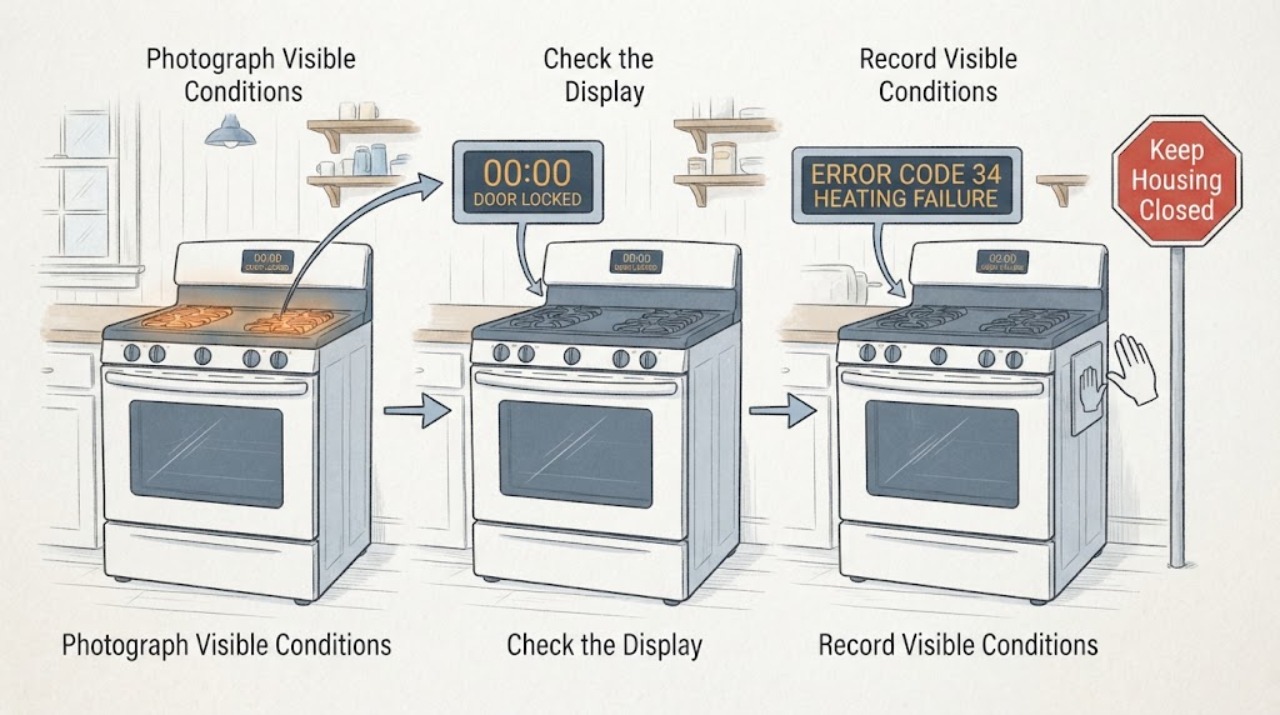
For a Kenmore C970-495526 range in a cottage, working surface elements with a cold oven is a localized oven-path symptom, not proof that the whole appliance has power or that one element is bad. First confirm the complete model from the rating plate and use Kenmore’s official model-number manual lookup; the opened Kenmore pages do not expose a C970-495526-specific fuel or manufacturer-platform record, so do not transfer a Frigidaire, gas, or electric procedure by the C970 prefix alone. With the controls and oven cool, record whether the clock is lit, which mode is selected, whether Bake and Broil differ, and whether the door or self-clean lock is released. Stop for gas odor, smoke, arcing, burning odor, repeated breaker trips, or a door that will not release. Do not remove an element, open the control area, or perform any live electrical test.
Before you begin
Safety first
- Do not remove oven elements, open the control or rear panel, perform live electrical testing, light a gas burner by hand, release gas, inspect or move the gas connection, force a self-clean latch, or move the range in the cottage. Stop for gas odor, smoke, arcing, burning odor, uncontrolled heat, a hot or damaged connection, repeated breaker trips, or a door that will not release normally.
Work through in order
Diagnostic checks
Use only checks that match the exact appliance or system and its official guide.
-
Check 1
With the range cool, photograph the rating plate and record the complete C970-495526 model, serial, country, fuel label, display state, and whether the surface controls are the same appliance. Enter the model in Kenmore’s official manual lookup without adding or removing characters.
Expected result: The exact model and a matching manual are found, or the plate is unreadable, the lookup returns a different model, or the fuel type is uncertain.
Next step: Use only the matching manual. If the identity cannot be matched safely, stop part selection and request Kenmore or qualified appliance support with the plate photo.
Why this matters
Why: The manual and fuel identity determine the permitted oven controls and safety path. Working surface elements do not establish that an electric or gas oven procedure from another platform applies.
-
Check 2
From outside the oven, record whether the clock and display are lit, whether buttons or knobs respond, whether a breaker or fuse has changed state, and whether the range has a hot cord, damaged outlet, burning odor, smoke, or arcing.
Expected result: The display is blank, controls respond but the oven stays cold, a breaker trips again, or there is a heat, smoke, odor, or arcing warning.
Next step: Stop use for smoke, arcing, burning odor, a hot or damaged connection, or repeated breaker trips and arrange qualified electrical or appliance service. Do not remove the rear cover or reset protection repeatedly.
Why this matters
Why: A blank or hazardous state is a supply or safety branch, while a responsive control with a cold oven leaves the mode, door, sensor, heating, and control paths open. Surface elements working do not clear the oven supply or internal wiring.
-
Check 3
With the door closed, select the exact manual’s normal Bake or equivalent oven mode and temperature, confirm the clock or Start requirement, and check whether Control Lock, Sabbath, Delay Start, or a self-clean lock is active. Do not open a hot oven repeatedly.
Expected result: The oven begins heating after the mode, clock, Start, or lock state is corrected, or the display remains active but the oven stays cold.
Next step: Keep only the documented setting correction. If the oven remains cold, continue with the conditional electric or gas observation in the matching manual; do not enter service diagnostics.
Why this matters
Why: A control state can make a healthy oven appear inactive. Persistent no-heat with a correct mode and responsive controls points toward the model-specific heating or control path rather than a surface-element issue.
-
Check 4
If the matched manual confirms an electric oven, look through the cool oven opening for an obvious break, blister, or burn mark on the accessible bake element without touching it. If the manual confirms gas, do not remove panels or keep trying a cycle when ignition is delayed or abnormal; observe only from the intended position.
Expected result: Bake is cold while another oven mode heats, neither oven mode heats, an element has visible damage, or a gas oven has no normal ignition, delayed ignition, or an abnormal flame.
Next step: Keep the oven off and arrange qualified service for a damaged element, persistent no-heat, or any gas ignition or flame concern. Do not remove an element, open the control area, light a burner by hand, or inspect the gas connection.
Why this matters
Why: A one-mode failure can localize the fault to that heating path, but a visible element mark does not prove the control or wiring is sound. Gas ignition or flame abnormalities are safety events, not ordinary user diagnosis.
-
Check 5
Check the cool oven door, hinge area, gasket, and self-clean latch from the outside for a visible obstruction or a door that will not close or release normally. Do not force the latch or move the range in the cottage to reach a connection.
Expected result: The door is not closing, the self-clean latch remains engaged, the door will not release normally, or the door and latch appear normal while the oven remains cold.
Next step: Use only the matching manual’s normal release or lock guidance. If the latch remains engaged or heating is still absent, stop use and request service rather than forcing the door or opening the panel.
Why this matters
Why: A door or lock state can prevent normal heating or make the oven appear unavailable. A normal visible latch does not clear a hidden switch, control, or heating fault.
-
Check 6
Record whether Bake, Broil, convection, or every oven mode is affected; whether the oven warms at all; and whether the surface elements remain normal. Make one documented retest only after a safe visible setting or supply correction and never perform a live electrical measurement.
Expected result: Only Bake fails, only another mode fails, no mode heats, or the oven briefly heats and then stops or overheats.
Next step: Give the exact model, fuel identity, mode results, display state, breaker history, and door observations to qualified service. Do not order an element, sensor, control, igniter, or regulator from the symptom alone.
Why this matters
Why: The affected mode helps a technician separate a local bake or broil path from a shared control, sensor, door, or supply issue, but it does not select a part by itself. Continued heating after Off or abnormal heat is an immediate stop condition.
Use your observations
Decision map
Find the observation that best matches what you see, then follow the next safe action.
-
PATH 01Next step
What you see
The rating plate cannot be read or the official Kenmore lookup does not return a matching C970-495526 manual, or the fuel type is uncertain.
Do this next
Stop code and part interpretation, photograph the plate, and request model-specific Kenmore or qualified appliance support.
Why this path and its safety boundary
Why it matters: The exact Canadian model and manufacturing platform are not established. A C970 prefix, a current Kenmore range page, or a Frigidaire procedure cannot safely fill that gap.
-
PATH 02Next step
What you see
The display is blank, a breaker or fuse trips again, or there is a hot or damaged connection, smoke, arcing, or burning odor while the surface elements may still work.
Do this next
Stop use, isolate power only if safe, and arrange qualified electrical or appliance diagnosis. Do not reset protection repeatedly or open the range.
Why this path and its safety boundary
Why it matters: The oven has crossed the external troubleshooting boundary and may have a supply or internal electrical hazard; working surface elements do not make continued oven use safe.
-
PATH 03Next step
What you see
The display is active, the exact mode and Start or clock state are correct, the door or self-clean lock is released, and the oven remains cold while surface elements work.
Do this next
Use the matched manual’s fuel-specific observation only from a safe external position, then arrange qualified service if no heat persists. Do not remove elements, open controls, or test wiring.
Why this path and its safety boundary
Why it matters: The symptom is localized to an oven heating, sensor, control, or fuel path rather than being explained by a simple selected mode. It still does not identify a component.
-
PATH 04Next step
What you see
Only one oven mode fails while another mode heats, or a cool electric oven has a clearly damaged accessible element without any electrical or heat hazard.
Do this next
Keep the oven off and provide the exact model, fuel identity, mode comparison, and photo to qualified service for element, sensor, wiring, and control assessment.
Why this path and its safety boundary
Why it matters: The failed mode gives the technician a useful heating-path clue, but a damaged element does not prove the element alone is the cause and does not authorize owner removal.
-
PATH 05Next step
What you see
A gas identity is confirmed and the oven has gas odor, delayed ignition, yellow or unstable flame, or no normal ignition, or any oven has smoke, uncontrolled heat, or a door that will not release.
Do this next
Stop immediately, leave the area for gas or smoke hazards, and contact the relevant gas or emergency assistance from a safe location; otherwise keep the range off and arrange qualified service. Do not move the range or inspect the gas connection.
Why this path and its safety boundary
Why it matters: This is a gas, fire, or mechanical safety event, not a routine not-heating branch. Surface burners working does not make abnormal oven ignition safe.
Helpful context
Understand the symptom
What the working stovetop tells you
Surface elements working while the oven stays cold narrows the observation to the oven function, but it does not prove a single element, sensor, control, door lock, or supply leg. Some ranges can show a clock or operate surface controls while an oven heating path remains unavailable. In a cottage, also record whether the range has been disconnected, moved, stored seasonally, or exposed to a supply interruption, but do not infer the electrical platform from the model prefix alone.
Why the Canadian C970 identity must be verified
The supplied identity is C970-495526, but the opened official Kenmore materials provide a model-number lookup rather than a readable page for this exact appliance. Confirm the serial plate, the complete punctuation-free model entered into the official lookup, the country or market, and whether the range is electric, gas, or dual fuel before applying any heating or lock procedure. A similar C970 manual, a current Kenmore range, or a Frigidaire manual is not a substitute for the matching document.
Only after diagnosis
Potential parts
- Kenmore C970-495526 oven bake or broil heating component
Consider an element or other oven heating component only after the exact Canadian model and fuel identity are confirmed and a technician verifies which oven mode fails and whether the control and wiring supply the path. A working stovetop does not prove an element is the only fault.
Confirm the complete C970-495526 literature and part record before ordering; do not transfer fit from another C970 or Frigidaire platform. - Kenmore C970-495526 oven control, sensor, door-lock, igniter, or regulator component
These remain conditional possibilities when the matched manual and service diagnosis show a shared oven-control, sensor, lock, ignition, or fuel-path problem. No component should be selected from surface elements working or from a generic not-heating symptom.
Internal electrical and gas diagnosis requires qualified service with the exact model and fuel identity; do not open the control or gas connection.
When checks do not resolve it
Need a professional?
Arrange Kenmore or qualified appliance service when the exact model or fuel platform cannot be matched, the oven remains cold after the documented mode, clock, door, and safe supply checks, only one mode fails, the oven heats abnormally, or a gas, electrical, lock, or supply hazard appears.
Safety scope: Do not remove oven elements, open the control or rear panel, perform live electrical testing, light a gas burner by hand, release gas, inspect or move the gas connection, force a self-clean latch, or move the range in the cottage. Stop for gas odor, smoke, arcing, burning odor, uncontrolled heat, a hot or damaged connection, repeated breaker trips, or a door that will not release normally.
Have this ready
- Provide the rating-plate photo, complete model C970-495526, serial and country, matched manual if found, fuel identity, display and clock state, surface-element behavior, Bake and Broil comparison, door or self-clean-lock state, breaker history, and any odor, smoke, arcing, gas, or heat observation.
Common questions
FAQ
If the stovetop works, does the Kenmore oven still have power?
Surface elements working shows only that some range functions respond. It does not prove that the oven heating path, controls, lock, fuel system, or all supply conditions are safe or intact. Record the display, mode, and breaker behavior.
Is C970-495526 definitely an electric or Frigidaire-built oven?
The opened official Kenmore pages do not expose an exact C970-495526 record or manufacturing-platform statement. Confirm the rating plate and matching Kenmore manual before using an electric, gas, or cross-brand procedure.
Can I replace the bake element because Bake does not heat?
Not from that symptom alone. A mode comparison can help service, but the element, sensor, control, wiring, door lock, and supply path may also be involved. Do not remove the element or perform live testing.
What should I do if the oven smells like gas or sparks?
Stop immediately, leave the area for gas, smoke, or sparking hazards, and contact the relevant gas or emergency assistance from a safe location. Do not light flames, operate switches, move the range, or inspect the connection.
Read the exact guide
Official sources
- Kenmore | Quality Appliances for Every HomeKenmore · Official Kenmore home page opened to confirm the brand’s product, manual, and customer-care navigation; it does not expose the assigned model’s manufacturing platform or oven fault.
- Customer Care & Support | Kenmore AppliancesKenmore · Official Kenmore customer-care page opened to support model-specific literature, parts, and repair escalation; it does not define a C970-495526 heating component or fuel platform.
- Ranges | Cooking | KenmoreKenmore · Official Kenmore range category opened only to confirm that Kenmore presents electric and gas range categories and current model-specific product information; it does not identify the assigned C970-495526 platform.
- Find Your Manual | Kenmore Appliance Manuals & GuidesKenmore · Official Kenmore manual portal opened for the assigned Canadian C970-495526 topic. The generic page requires the complete model and does not itself expose the exact appliance's fuel or manufacturer platform.
Community feedback
Share a repair observation
Share a plain-text repair observation. Accepted observations are published automatically; this page may take a moment to update.