
On this page
Start here
Quick answer
A lit clock only proves that some power reaches the Kenmore 790.4558-series range; it does not prove that the heating supply and installation are correct. Because the report is that the oven and the cooktop are both cold, confirm the complete model and fuel type first, then have the installer or a qualified electrician verify the range's supply and cord installation. Kenmore's manual portal says its model search needs the complete model number, and official electric-range guidance from GE describes the same useful symptom pattern: partial supply can leave the clock working while burners do not heat. Do not open a breaker panel or the appliance, pull out an installed range, make a live measurement, reset protection repeatedly, or order an element or control board from the abbreviated number. If there is a burning smell, smoke, arcing, a damaged cord or receptacle, a repeated trip, or any gas odor, leave the range off and arrange urgent qualified help.
Before you begin
Safety first
- No homeowner disassembly, live voltage measurement, breaker-panel opening, range movement, cord rewiring, control-board diagnosis, element removal, gas-connection inspection, or protection bypass is appropriate for this incomplete identity and whole-range no-heat symptom.
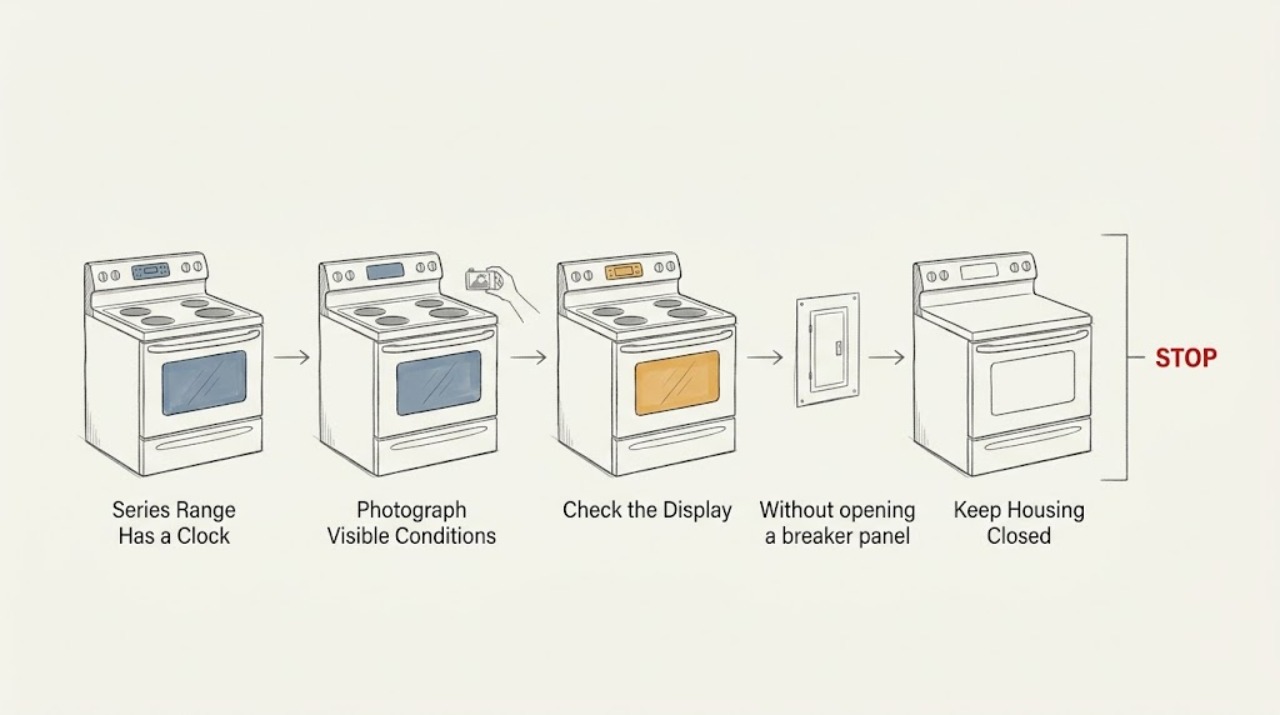
Work through in order
Diagnostic checks
Use only checks that match the exact appliance or system and its official guide.
-
Check 1
With the range cool and untouched, photograph the entire rating plate and record the full model number, serial information, market, and whether the plate identifies electric, gas, or dual-fuel operation. Note separately whether the clock is steady, whether the control responds, whether every surface heater is cold, and whether both Bake and Broil stay cold.
Expected result: The plate supplies a complete model and fuel type, or only 790.4558/790 4558 is visible; the clock may be stable while the controls, surface heaters, Bake, or Broil behave differently.
Next step: Use only the matching Kenmore manual once the full identity is available. If the suffix or fuel type cannot be confirmed, keep the advice at this safe symptom level and do not choose a part or diagnostic key sequence.
Why this matters
Why: A complete identity is needed for the correct manual and for distinguishing an electric supply path from a gas or dual-fuel path. The scope of the cold functions determines whether this is a whole-appliance supply symptom or a single heating branch.
-
Check 2
From a normal standing position, select the documented Bake or Broil function and temperature, verify the clock is set, and check only the visible control state for Lock, Delay Start, Sabbath, or a self-clean lock if the exact manual says the model has one. Do not reach behind the range or open it.
Expected result: The control accepts a mode and temperature and shows an active request, or the display remains unresponsive, locked, or returns to an idle state while the oven stays cold.
Next step: Correct only a clearly documented control-state issue. If the clock remains on but no heating function starts, continue with external observations and installer verification rather than repeatedly resetting or opening the appliance.
Why this matters
Why: A setting or lock can inhibit an otherwise powered oven, but a responsive display does not establish that the heating supply is complete. An unresponsive control is a separate control or supply symptom, not evidence for a particular board.
-
Check 3
Without opening a breaker panel, moving the range, removing a drawer, or touching a connection, look only at any already-visible plug, cord, receptacle, and appliance exterior for looseness, scorching, melted material, moisture, or impact damage. Have the installer or a qualified electrician verify the complete 240/208-volt range supply and installation; the homeowner should not make a live test.
Expected result: The visible exterior is normal and the installer confirms a complete supply, or there is a trip history, a damaged cord or receptacle, an uncertain self-installation, or no professional supply confirmation.
Next step: Keep the range off and arrange electrician or installer assessment when supply is uncertain, protection has tripped, or any damage is visible. Do not pull the range out, remove covers, open the terminal area, or repeatedly re-energize it.
Why this matters
Why: Official electric-range guidance says partial supply can leave the clock working while burners do not heat, and identifies voltage or cord problems as installation issues. A clock alone therefore cannot clear the supply. A visible burn or an uncertain installation raises an electrical hazard rather than identifying an oven component.
-
Check 4
After a qualified person has confirmed the installation and supply are safe, compare one surface-heating request with Bake and Broil using the exact manual, observing from outside for normal response. Do not touch an element, remove a panel, or continue a test if there is smoke, smell, arcing, uncontrolled heat, or a repeated trip.
Expected result: All surface heaters and both oven modes remain cold, one oven mode is cold while another heats, or a surface heater works but the oven does not.
Next step: Keep the appliance off and give the technician the exact model, supply verification, affected modes, and any display behavior. Do not order an element, sensor, or control board solely from 790.4558.
Why this matters
Why: If every heating function remains cold after supply is confirmed, the fault is inside the appliance or its controls but no specific part is proven. If only one function fails while others heat, the symptom is narrower and the complete model manual can guide a technician's model-specific diagnosis.
-
Check 5
If the rating plate identifies gas or dual-fuel operation, observe only the normal surface-burner and oven behavior from a safe distance and check for gas odor before any use. Do not attempt to light an oven, inspect a gas connection, or move the range while an odor or abnormal flame is present.
Expected result: Gas odor, delayed ignition, a yellow or unstable flame, or no oven heat with surface burners working is present, or the plate confirms an electric range instead.
Next step: For gas odor or an unsafe flame, leave the area and contact the gas supplier or emergency services from outside. Otherwise arrange qualified gas-appliance service and use the exact fuel-specific manual.
Why this matters
Why: Gas and dual-fuel appliances have a different hazard and ignition path; the electric 240/208-volt symptom cannot be transferred to them. Gas odor or abnormal flame is a safety event, not a reason to test an igniter or regulator.
Use your observations
Decision map
Find the observation that best matches what you see, then follow the next safe action.
-
PATH 01Next step
What you see
The clock is lit, every surface heater is cold, and both Bake and Broil are cold on a range that the rating plate identifies as electric, especially after a self-installation.
Do this next
Keep the range off and have the installer or a qualified electrician verify the complete supply and cord installation. Do not open the electrical panel or appliance and do not guess a control board or element.
Why this path and its safety boundary
Why it matters: This combined result makes incomplete, miswired, or interrupted range supply more important to rule out than an individual heating element. GE's official electric-range guidance documents the clock-on/heat-off pattern for partial supply, but it is not a Kenmore-specific model diagnosis.
-
PATH 02Next step
What you see
A breaker has tripped again, a cord or receptacle is scorched or loose, there is smoke, arcing, a burning smell, moisture, or the supply installation cannot be confirmed safely.
Do this next
Leave the range off, keep clear of the damaged area, and call a qualified electrician or emergency services for an active fire or immediate danger. Do not reset protection repeatedly or move the appliance.
Why this path and its safety boundary
Why it matters: The situation is an electrical or fire risk. A working clock does not make damaged wiring or an uncertain 240/208-volt installation safe.
-
PATH 03Next step
What you see
A qualified person confirms supply and installation, and one surface heater or one oven function works while another function remains cold.
Do this next
Provide the full rating-plate model and the exact working/non-working functions to a qualified appliance technician. Use only the matching manual and do not remove panels or perform live tests.
Why this path and its safety boundary
Why it matters: A whole-range supply failure becomes less likely, while a model-specific heating, sensing, control, or wiring path becomes more plausible. The pattern still does not identify a replacement part.
-
PATH 04Next step
What you see
The plate confirms gas or dual fuel, or there is gas odor, delayed ignition, or an abnormal flame.
Do this next
Do not light, switch, inspect, or move the appliance in the affected area. Leave and contact the gas supplier or emergency services from outside, or arrange qualified gas-appliance service when no emergency odor is present.
Why this path and its safety boundary
Why it matters: The electric-range supply branch does not apply, and the condition may involve gas release or unsafe combustion.
Helpful context
Understand the symptom
The clock and the heating circuits are not the same proof of operation. The exact Kenmore model suffix, fuel type, and installation arrangement are unknown here, and the 790.4558 label should not be used to select a part or button sequence. Kenmore's official manual page asks for a model number of at least 11 characters and provides manuals for ovens and ranges, so photograph the complete rating plate before looking up instructions.
The combined symptom is the important decision point: a clock that is on while every surface heater and the oven remain cold makes a supply or installation problem more important to rule out than a single bake element. The GE material used here is general electric-range electrical guidance, not proof of the Kenmore's internal design; it documents that partial supply can leave a clock working while burners do not heat. A qualified installer or electrician should verify the range supply and cord termination without the homeowner opening an electrical enclosure.
When checks do not resolve it
Need a professional?
Use an electrician or installer for supply, cord, receptacle, and self-installation verification; use qualified appliance service after safe supply is confirmed or whenever an internal fault, gas path, control, or heating component is suspected.
Safety scope: No homeowner disassembly, live voltage measurement, breaker-panel opening, range movement, cord rewiring, control-board diagnosis, element removal, gas-connection inspection, or protection bypass is appropriate for this incomplete identity and whole-range no-heat symptom.
Have this ready
- Provide the complete rating-plate model and serial information, fuel type, market, purchase and installation context, clock and display behavior, which surface heaters work, whether Bake or Broil works, any trip history, visible cord or receptacle condition, and any smell, smoke, or arc event.
Common questions
FAQ
Does a lit clock prove that a Kenmore range has full power?
No. The official electric-range guidance opened for this research says partial supply can leave the clock working while burners do not heat. With the oven and all surface heaters cold, have the installer or a qualified electrician verify the complete range supply; do not make a live test yourself.
Is Kenmore 790.4558 a complete model number for ordering a part?
It should be treated as an incomplete series-level identity. Kenmore's official manual page says its search needs a model number of at least 11 characters. Photograph the entire rating plate and use the matching manual before selecting a control, element, sensor, or fuel-specific procedure.
What should I do if the range was installed recently and the clock is on but nothing heats?
Leave it off and ask the installer or a qualified electrician to verify the supply and cord installation. Do not open the breaker panel, pull the range out, remove covers, repeatedly reset protection, or assume the control board or elements are defective.
Read the exact guide
Official sources
- Range, Cooktop & Wall Oven - Power Outage Tips and OperationGE Appliances · Cross-brand general fuel and power-safety guidance only; it is used to keep gas or dual-fuel observations separate from the electric-range branch.
- Kenmore ManualsKenmore · Directly supports the identity boundary and manual-routing step; it does not establish an exact 790.4558 suffix, fuel type, controls, or parts compatibility.
- Electric Range & Wall Oven - Oven Has Power But Does Not WorkGE Appliances · Cross-brand general control-state evidence only; it does not define Kenmore controls or a Kenmore-specific reset sequence.
- Electric Range - Check Power SupplyGE Appliances · Cross-brand general electrical-range evidence only; it supports supply and installation reasoning, not Kenmore 790.4558 internal design, controls, or parts.
- Frequently Asked Questions About GE Ranges and Wall OvensGE Appliances · Cross-brand general guidance only; used for the distinction between a clock that works with non-working burners, control-state checks, and the need for installer assistance.
- Range & Wall Oven - Oven Will Not Come OnGE Appliances · Cross-brand operational and safety guidance only; it does not identify Kenmore 790.4558 components or authorize work on this model.
Community feedback
Share a repair observation
Share a plain-text repair observation. Accepted observations are published automatically; this page may take a moment to update.